Ruidoso, New Mexico: The Village Named for a Noisy River
Ruidoso means 'noisy' in Spanish. The Village of Ruidoso says it took its name from the Rio Ruidoso, the 'Noisy River,' a small stream that weaves through town, and the WPA's New Mexico guide glossed the stream's name the same way. The settlement itself began as Dowlins Mill, around a sawmill Paul Dowlin built on the river in 1868.
Ruidoso, New Mexico, means “noisy” in Spanish, and the village says it took the name from the Rio Ruidoso, the small stream that weaves through it. If you’ve wondered what the word means, that’s the whole answer, and every source quoted here gives the same one. The more interesting part is how long it took the name to stick to the town.
The noisy river
The Village of Ruidoso puts it plainly in its 2022-23 strategic plan: “The Village received its name from the Rio Ruidoso (Spanish for ‘Noisy River’), a small stream that weaves through the Village.” Its parks department says the same thing in different words: “Ruidoso adopted its name from the Rio Ruidoso, which translates to the noisy river.”
The National Register nomination for the Old Dowlin Mill, written in 2013, traces the river itself. “The Rio Ruidoso (Noisy River) begins on the north-east flank of Sierra Blanca Peak,” it says, and flows eastward through the Mescalero Apache Reservation and the towns of Ruidoso, Ruidoso Downs and San Patricio, “until it joins the Bonito to form the Hondo River.”
The Writers’ Program guide to New Mexico, in its revised 1962 edition, translated both streams at the spot where they meet, at the village of Hondo: “Bonito (Sp., pretty) and Ruidoso (Sp., noisy), mountain streams which unite to form the Rio Hondo.” None of these sources says who first called the river noisy, or why, so we won’t guess.
Dowlins Mill
For its first decades, the settlement wasn’t called Ruidoso at all. “The Village of Ruidoso,” the National Register form says, “began as Dowlins Mill.”
Paul Dowlin, an army veteran with a subcontract to saw lumber for rebuilding Fort Stanton, claimed land on the Rio Ruidoso and built a water-powered sawmill there in 1868. His first mill washed out in a flood, and late that year he rebuilt a few hundred feet away on higher ground, the site where the mill still stands. In 1871 or 1872 he and his older brother Will added a gristmill. Paul died in 1877. Frank Lesnett, who had run the mill for the brothers since 1876, bought them out in 1882, and the 1880 census called the cluster of buildings Dowlins Mills.
The mill sat on a known overland route between Lincoln, Tularosa and the district court at Mesilla. In the mid-1880s, the form says, it housed the first post office on the Rio Ruidoso, with Lesnett as postmaster. Here’s the twist: “Even though mail was postmarked to Ruidoso, New Mexico Territory, the small settlement surrounding the mill was still known as Dowlins Mill on maps and among the local population.” The river’s name went out on the mail before the people at the mill used it. The post office stayed in the mill until 1904.
From mill to village
The town that grew into today’s Ruidoso took shape a little farther up the valley. The form says Ike Wingfield, born at the mill in 1887, set up the post office in 1921 at the junction of the Upper Canyon and the road to Alto, and the town grew around it as a cool summer refuge. The road from El Paso was paved in 1941.
The village government came last. Its strategic plan says the Village of Ruidoso was incorporated on November 15, 1945, by order of the Lincoln County commissioners, with the first municipal election set for December 11, 1945. The National Register form calls it the largest town and economic center of Lincoln County, a county of south-central New Mexico known, in the form’s words, “for its western heritage as well as modern tourist draws.”
Spanish adjectives for streams have named towns elsewhere, too. Chico, California, carries the word for “little” from Chico Creek, and Amarillo, Texas, took the word for “yellow” from a lake and a creek.
Ruidoso on the 1963 map
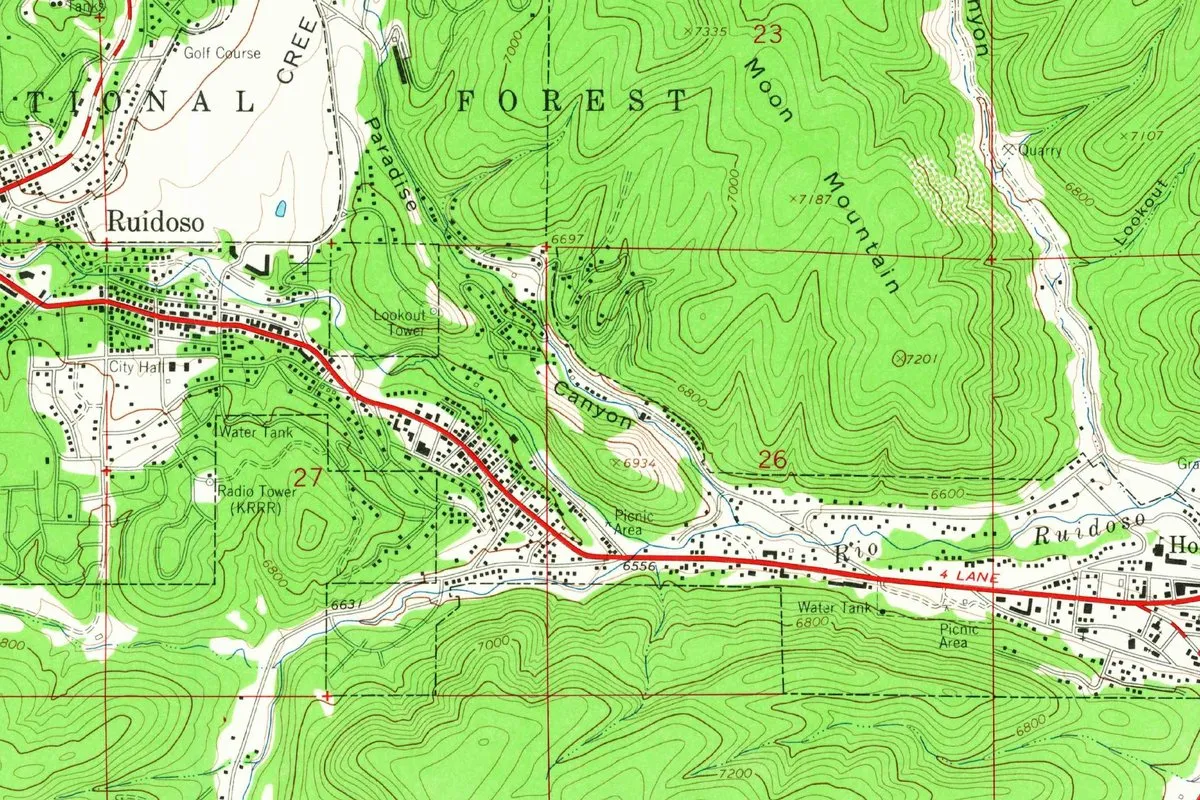
The map at the top comes from the Geological Survey’s Ruidoso quadrangle, at 1:24,000, mapped from aerial photographs taken in 1963 and field-checked the same year. The printer’s line in the margin, “WASHINGTON, D. C.—1967,” shows this copy was printed in 1967. Older sheets in the Survey’s collection cover the area only at 1:250,000; this 1963 quadrangle is the earliest close-up we found. On the full sheet, the village sits in the upper middle, with the Mescalero Apache Indian Reservation filling the southwest. In the crop you’ll see “Ruidoso” at the upper left, the words “Rio Ruidoso” along the valley floor, a red highway marked “4 LANE,” City Hall, a radio tower marked KRRR, a lookout tower, Paradise Canyon and Moon Mountain.
Quick answers
What does Ruidoso mean?
“Noisy.” The Village of Ruidoso says the town is named for the Rio Ruidoso, “Spanish for ‘Noisy River,’” and the 1962 WPA guide to New Mexico gives “Ruidoso (Sp., noisy).”
What was Ruidoso called before?
Dowlins Mill. The National Register form for the Old Dowlin Mill says the village “began as Dowlins Mill,” and the settlement was still called that on maps even after mail was postmarked Ruidoso.
Where does the Rio Ruidoso start?
On the northeast flank of Sierra Blanca Peak, according to the National Register form, which says the river flows east until it joins the Bonito to form the Hondo River.
When was Ruidoso incorporated?
On November 15, 1945, by order of the Lincoln County commissioners, according to the village’s strategic plan.
Key dates
- 1868Paul Dowlin builds a water-powered sawmill on the Rio Ruidoso, moving it to higher ground after a flood late that year.
- 1880The census calls the cluster of buildings around the mill Dowlins Mills.
- 1882Frank Lesnett, who had managed the mill since 1876, buys out the Dowlin brothers.
- 1904The post office leaves the mill, where it had been since the mid-1880s.
- 1921Ike Wingfield sets up the post office at the junction of the Upper Canyon and the road to Alto.
- 1945Lincoln County's commissioners incorporate the Village of Ruidoso on November 15.
- 1962The WPA's revised New Mexico guide glosses the stream's name: "Ruidoso (Sp., noisy)."
- 1963The Geological Survey maps the Ruidoso quadrangle from aerial photographs; the copy shown was printed in 1967.
Things to do in Ruidoso, New Mexico
Two Rivers Park
A village park of more than 27 acres (11 ha) where the Ruidoso River meets Carrizo Creek, behind the visitor center on Sudderth Drive, with picnic areas and the Ruidoso River Trail, a paved path of 1.25 miles (2 km) along the river.
Grindstone Lake Recreation Area
A stocked trout lake open to non-motorized boats, with a heavily wooded 27-hole disc golf course and a trail system of five trails totaling 18 miles (29 km) for hiking, mountain biking and horseback riding.
Wingfield Heritage House Museum
A house Ike and Lula Wingfield built in the 1920s, restored as a village museum with exhibits on the Wingfield family, ancient cultures and the town's growth from its first settlers.
Spencer Theater
A performing arts venue just north of Ruidoso with concerts, live performances and theater productions, known, the tourism office says, for its architecture and its acoustics.
Getting there
Open Ruidoso in Google Maps
Opens in a new tab. The pin is the center of Ruidoso in the USGS place-name record.
The closest airports, Amtrak stations and intercity bus stops, measured in a straight line from the center of Ruidoso.
Airports
- Roswell Air Center (ROW) 66 mi 106 km
- El Paso International (ELP) 113 mi 182 km
- Albuquerque International Sunport (ABQ) 130 mi 208 km
Intercity buses
- Greyhound Ruidoso Ruidoso Downs Shamrock 3 mi 5 km
Distances are as the crow flies, not by road. We don't list schedules or fares because they change; check with the airline, Amtrak or the bus company before you go. Official data (FAA commercial service airports (2025), FAA airport locations, Amtrak stations and Intercity Bus Atlas) from the FAA and the U.S. Bureau of Transportation Statistics, checked Nov 18, 2026.
Sponsored
Staying in Ruidoso?
Compare hotels in Ruidoso, New Mexico, on Expedia.
See hotels in RuidosoWe may earn a commission if you buy through this link. It never changes what we write. Read our affiliate disclosure
Historical Sources & References
- Village of Ruidoso, Strategic Plan 2022-23. The name from the Rio Ruidoso, “Spanish for ‘Noisy River,’” and the incorporation of November 15, 1945.
- Village of Ruidoso Parks & Recreation, “Find a Park”. “Ruidoso adopted its name from the Rio Ruidoso, which translates to the noisy river.”
- National Register of Historic Places form, Old Dowlin Mill (2013). The course of the Rio Ruidoso, the village that “began as Dowlins Mill,” Paul Dowlin’s mill of 1868, the gristmill, Frank Lesnett, the 1880 census, the post office from the mid-1880s to 1904, the postmark, Ike Wingfield’s post office of 1921 and the road of 1941.
- Writers’ Program, New Mexico: A Guide to the Colorful State (1962), p. 371. “Bonito (Sp., pretty) and Ruidoso (Sp., noisy).” Checked against the page image.
- Two Rivers Park; Grindstone Lake; Wingfield Heritage House Museum; Discover Ruidoso. The details in the things-to-do list.
- U.S. Geological Survey, GNIS feature 923668. The GNIS entry for the village, with Lincoln County and its coordinates.
- Ruidoso quadrangle, 1963, printed 1967. The sheet the map at the top was cropped from, mapped, edited and published by the Geological Survey.
Spot something wrong, or know more? Tell us here. You can also email us or use our contact page. Corrections are noted here with their date, never made silently.