Minot, North Dakota: Say MY-not, for Henry D. Minot
Minot is named for Henry Davis Minot, a young Massachusetts-born railroad investor, birdwatcher and college friend of Theodore Roosevelt who helped steer money into James J. Hill's railroad. According to Prairie Public's Dakota Datebook, Hill announced the name in September 1886, after an agent had suggested calling the new town Lincoln. It's pronounced MY-not.
A name you’re probably saying wrong
Minot, North Dakota, is pronounced MY-not, and it carries the name of Henry D. Minot, a young railroad man who’d been Theodore Roosevelt’s college friend. That’s not a guess: the state’s 1938 guidebook spelled it out, so now you can say it right.
That guide, written by the Federal Writers’ Project, opens its Minot chapter like this:
“Its name (pronounced MY-not) was given it to honor Henry D. Minot, young Eastern capitalist and college friend of Theodore Roosevelt.”
So there’s the answer in one line. The rest of the story is about who Henry Minot was, and why a Dakota railroad town ended up wearing the name of a Boston birdwatcher.
The bird book and the Harvard friend
Henry Davis Minot was born on August 18, 1859, in Roxbury, near Boston. A biographical notice in the 1895 edition of his own book says his family’s home grounds covered about thirty acres, where 75 to 100 bird nests went up every spring, and that he got into the habit of writing down what he saw every day. He finished the text of The Land-Birds and Game-Birds of New England “in his seventeenth year,” and his eldest brother got it published.
He entered Harvard in 1876. Prairie Public’s Dakota Datebook, in a 2008 episode by Christina Sunwall, picks up the story there. That fall, a freshman named Theodore Roosevelt was unpacking his things, including a catalog of birds he’d made, when Minot knocked on the door. The two became friends, and in 1877 they went birding in the Adirondacks and put out a little catalog together, The Summer Birds of the Adirondacks in Franklin County, NY, which the Datebook calls Roosevelt’s first published work.
Minot didn’t stay at Harvard. The 1895 notice says his health failed in his sophomore year and he turned to “the management and construction of railroads.” The Datebook says he left at his father’s insistence, went to work for a Boston investment house, Jackson and Curtis, and started studying railroads as investments.
How a Boston investor reached Dakota
According to the Datebook, Minot’s 1884 study of the Minneapolis, St. Paul and Manitoba Railway brought him to the attention of James J. Hill, and his work encouraged several Boston bankers to invest in Hill’s road. He was made a director and vice president of the company that would become the Great Northern.
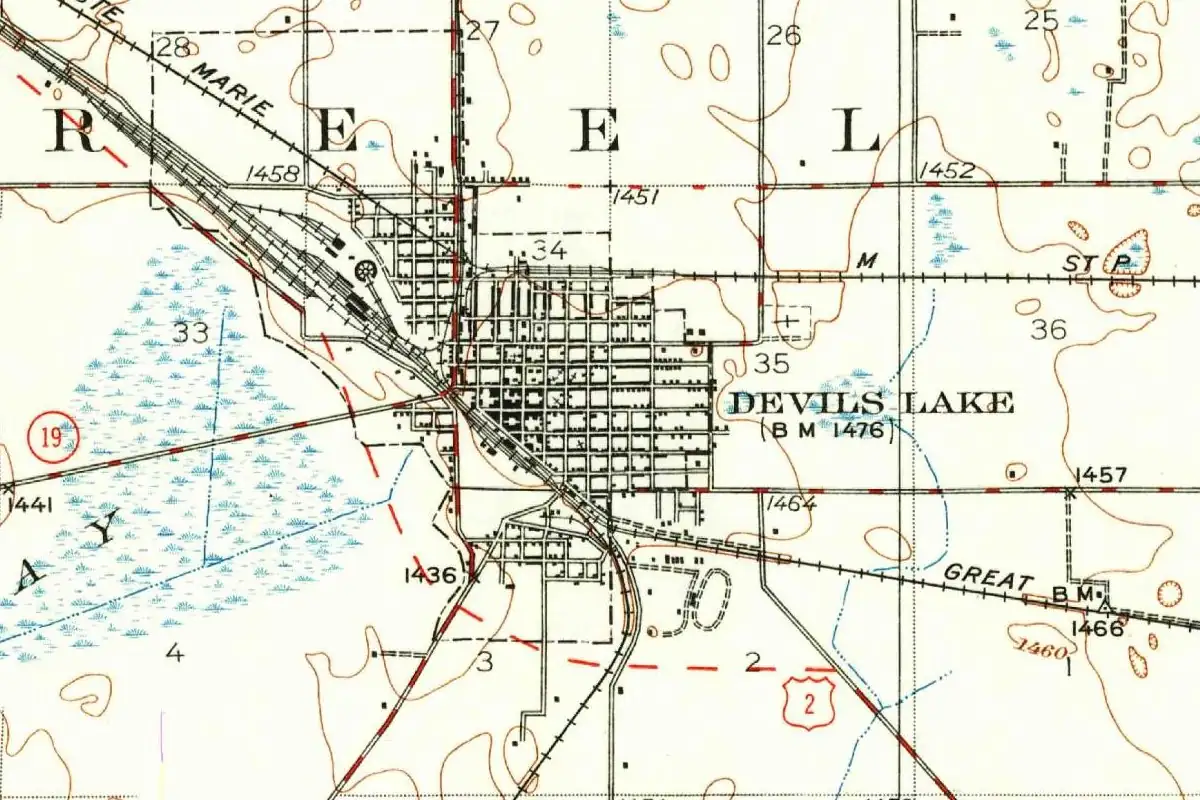
In the spring of 1886, as the line pushed west from Devils Lake, Minot was sent ahead on a 10-day scouting trip, and he reported back to Hill that it was “first rate country.” Engineers and right-of-way agents followed, and one of the new towns was platted on the farm of a Norwegian immigrant named Erik Ramstad, on the Mouse River.
The City of Minot tells the same opening in fewer words. In 1886, it says, Jim Hill’s Great Northern stopped its push across the state for the winter after trouble building a trestle across Gassman Coulee, and a tent town “sprung up over night, as if by magic.” That’s where the nickname Magic City comes from. The railroad put the town site on Ramstad’s homestead, and the city says plainly that “the town was named after Henry Davis Minot, a railroad investor and friend of Jim Hill.”
Minot, not Lincoln
The Datebook adds a detail about the name itself. It says that when Hill’s right-of-way agent, Solomon Comstock, was asked about a name for the new town, he suggested Lincoln. Hill had other plans. Minot’s friends and relatives in Boston were important investors in the railroad, and Minot was getting impatient with his slow rise in the company. So, the Datebook says, “to mollify him, in September of 1886 Hill announced that the new town would be named ‘Minot.’”
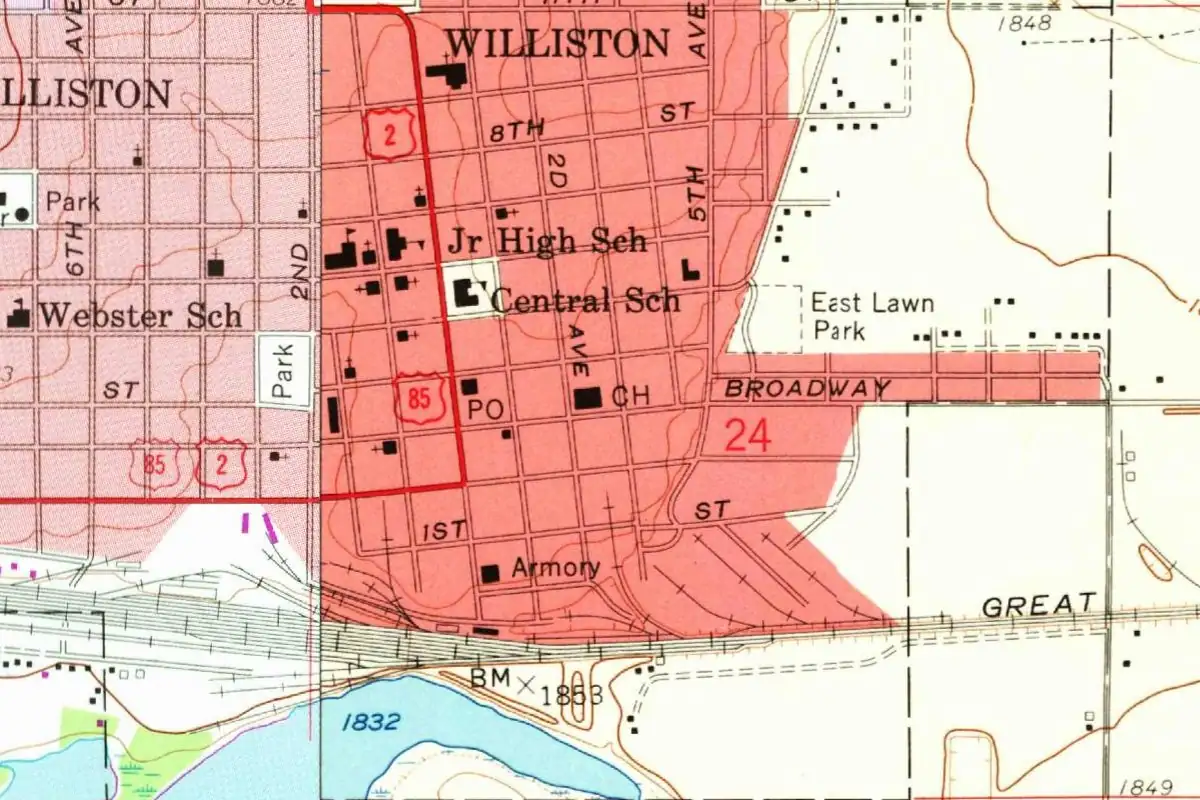
That account rests on later research, which the Datebook lists, including Henry DuGarm’s history of Minot’s founding and Steven Keillor’s book on Erik Ramstad and Hill. It isn’t a letter from Hill himself. Still, Minot wasn’t the only friend Hill put on the map: the 1938 guide says he named Williston for his friend S. Willis James of New York City, one of the railroad’s stockholders.
The dates don’t quite agree
If you go looking, you’ll find two different years for the start of Minot. The city says 1886. The 1938 guide says Hill’s railway was pushing west in 1887 when it stopped to build a bridge across a coulee, and it puts the city’s incorporation on July 16, 1887, while the city gives June 28, 1887. The guide also says Ramstad gave up 40 acres south of the river “late in the summer of 1886,” which lines up with the city’s date for the start of the town.
Either way, Minot grew fast. The guide says the population hit 5,000 in the first year, and it even preserves a joke from the early railroad days: a passenger conductor who called out the stop as “MINOT, this is M-I-N-O-T, end of the line. Prepare to meet your God!” The guide tells it as something pioneer residents remembered, so take it as a story, not a record.
A short life, a lasting name
Henry Minot didn’t get to watch the town grow up. According to the 1895 notice, he was put in charge of building the Eastern Railroad of Minnesota in 1888, from St. Paul to Superior, Wisconsin, and became its president, “the youngest railroad president in the United States.” Then, on November 14, 1890, he was killed in a railroad collision in Pennsylvania. He was 31.
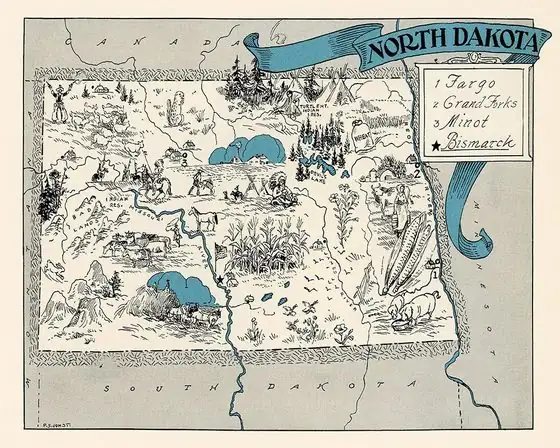
The Datebook’s Merry Helm noted the irony back in 2005: the man the town was named for died in a train wreck only four years after it was founded. Helm also found that the first non-Indian baby born in Minot, Ernest Tompkins, in 1886, got Minot as his middle name. So did a whole city on the Souris, and the North Dakota map still carries it.
Quick answers
How do you pronounce Minot, North Dakota?
MY-not. The state’s 1938 guide, written by the Federal Writers’ Project, gives that pronunciation right next to the name.
Who is Minot, North Dakota, named after?
Henry Davis Minot, a railroad investor and director of the line that became the Great Northern, and a college friend of Theodore Roosevelt. The City of Minot calls him a friend of Jim Hill.
Was Minot almost named Lincoln?
According to Prairie Public’s Dakota Datebook, yes. Right-of-way agent Solomon Comstock suggested Lincoln, but James J. Hill announced the name Minot in September 1886.
Why is Minot called the Magic City?
Because the tent town that sprang up when Hill’s railroad stopped there seemed to appear overnight, “as if by magic,” according to the City of Minot.
Key dates
- 1859Henry Davis Minot is born on August 18 in Roxbury, near Boston.
- 1886Hill's railroad halts for the winter near Gassman Coulee, and in September, according to the Dakota Datebook, Hill announces the new town will be called Minot.
- 1887Minot is incorporated, on June 28 by the city's count or July 16 by the 1938 state guide.
- 1890Henry D. Minot dies on November 14 in a railroad collision in Pennsylvania.
Things to do in Minot, North Dakota
Scandinavian Heritage Park
A 14-acre park with remembrances and replicas from Denmark, Finland, Iceland, Norway and Sweden, including a stabbur, a full-scale replica of the stave church from Gol, Norway, and a 25-foot (7.6 m) Swedish Dala horse.
Roosevelt Park Zoo
A zoo that started in 1914 with 24 squirrels in what was then Riverside Park. In 1922 the park board renamed the park for Theodore Roosevelt, and an equestrian statue of him followed in 1924.
Dakota Territory Air Museum
More than 50 aircraft and 12,000 aviation artifacts in several hangars, with many of the planes still airworthy, among them a World War II Supermarine Spitfire Mk IX.
Pioneer Village Museum
Fourteen historic buildings filled with settlers' artifacts, among them North Prairie School #1, a one-room schoolhouse built in 1903 that served rural students until 1947.
Getting there
Open Minot in Google Maps
Opens in a new tab. The pin is the center of Minot in the USGS place-name record.
The closest airports, Amtrak stations and intercity bus stops, measured in a straight line from the center of Minot.
Airports
- Minot International (MOT) 2 mi 3 km
- Bismarck Municipal (BIS) 104 mi 168 km
Amtrak trains
- Minot station (MOT) under 1 mi 0.4 km
- Stanley station (STN) 51 mi 81 km
Intercity buses
- Jefferson Lines Minot under 1 mi 0.2 km
Distances are as the crow flies, not by road. We don't list schedules or fares because they change; check with the airline, Amtrak or the bus company before you go. Official data (FAA commercial service airports (2025), FAA airport locations, Amtrak stations and Intercity Bus Atlas) from the FAA and the U.S. Bureau of Transportation Statistics, checked Nov 14, 2026.
Sponsored
Staying in Minot?
Compare hotels in Minot, North Dakota, on Expedia.
See hotels in MinotWe may earn a commission if you buy through this link. It never changes what we write. Read our affiliate disclosure
Historical Sources & References
- Federal Writers’ Project, North Dakota: A Guide to the Northern Prairie State (1938), section “Minot”. The quoted line with the pronunciation “MY-not” and Henry D. Minot as “young Eastern capitalist and college friend of Theodore Roosevelt”; the 1887 railroad stop and tent town; Erik Ramstad’s 40 acres in late summer 1886; incorporation on July 16, 1887; 5,000 people the first year; the conductor’s “Prepare to meet your God!”; Williston named by Hill for a friend (Tour 6).
- City of Minot, “History”. The 1886 halt at Gassman Coulee; the tent town “as if by magic” and the name Magic City; Ramstad’s homestead; “named after Henry Davis Minot, a railroad investor and friend of Jim Hill”; incorporation on June 28, 1887.
- Christina Sunwall, “Henry D. Minot,” Dakota Datebook, Prairie Public. Minot and Roosevelt at Harvard and the 1877 Adirondacks catalog; Jackson and Curtis; the 1884 study of the Manitoba road and Hill’s Boston investors; director and vice president; the 1886 scouting trip from Devils Lake; Comstock’s “Lincoln” and Hill’s September 1886 announcement. The episode cites DuGarm (1994), Keillor (2002), the New York Times of November 15, 1890, and the Massachusetts Historical Society’s Minot papers.
- Merry Helm, “Magic City Beginnings,” Dakota Datebook, Prairie Public. Named for Henry Davis Minot, a Great Northern director, who died in a train wreck four years later at 31; Ernest Tompkins, born in Minot in 1886, with Minot as his middle name.
- Henry D. Minot, The Land-Birds and Game-Birds of New England, 2nd ed. (1895), Biographical Notice, pp. vii-ix. Born August 18, 1859, in Roxbury; the book finished “in his seventeenth year”; Harvard in 1876; the switch to railroads; the Eastern Railroad of Minnesota in 1888 and “the youngest railroad president in the United States”; killed November 14, 1890, in a collision in Pennsylvania.
- GNIS feature 1030249 (U.S. Geological Survey). The government’s place-name database entry for Minot, in Ward County.
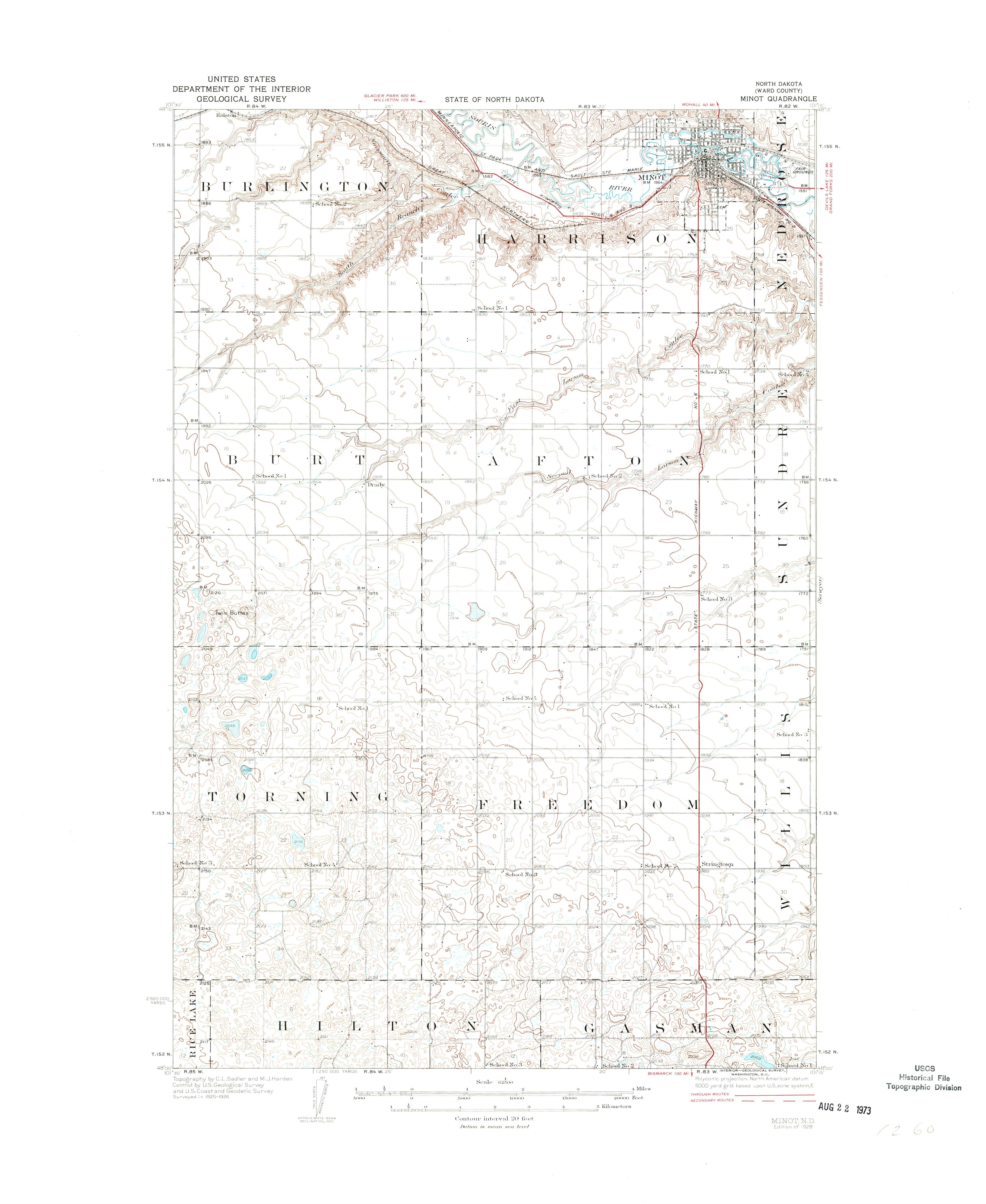
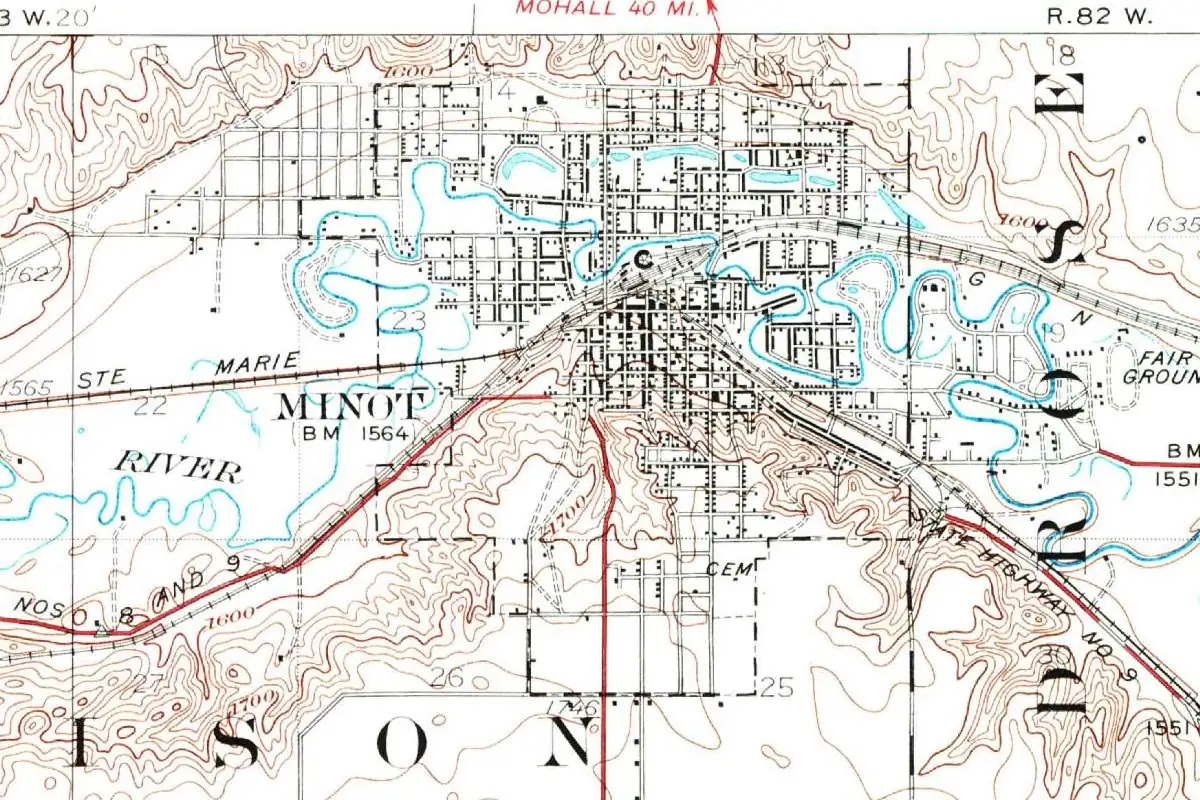
- U.S. Geological Survey, Minot sheet (1928). The 1:62,500 quadrangle the map at the top of this page was cropped from.
Sponsored
Put this 1928 map on your wall
The 1928 USGS Minot sheet is in the public domain. Download the full-size scan for free, then have it printed on canvas with CanvasOnTheCheap.
Print a map on canvasDownload the full-size mapWe may earn a commission if you buy through this link. It never changes what we write. Read our affiliate disclosure
Spot something wrong, or know more? Tell us here. You can also email us or use our contact page. Corrections are noted here with their date, never made silently.