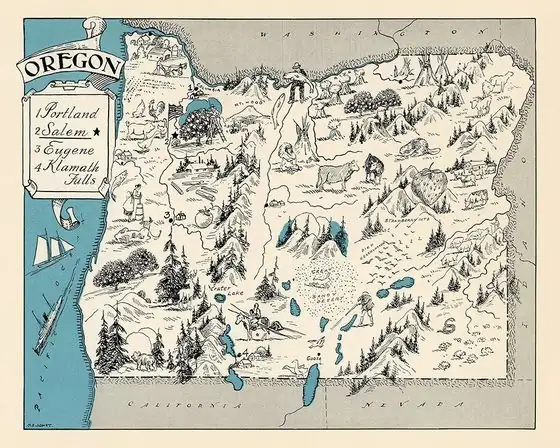
Why Is It Called Cannon Beach? A Shipwreck's Lost Cannon
Cannon Beach is named for a cannon from the U.S. Navy schooner Shark, lost at the Columbia River bar in 1846. A piece of its deck and a cannon washed up on the coast below Tillamook Head. A post office took the name in 1891, and in 1922 the town of Ecola took it over.
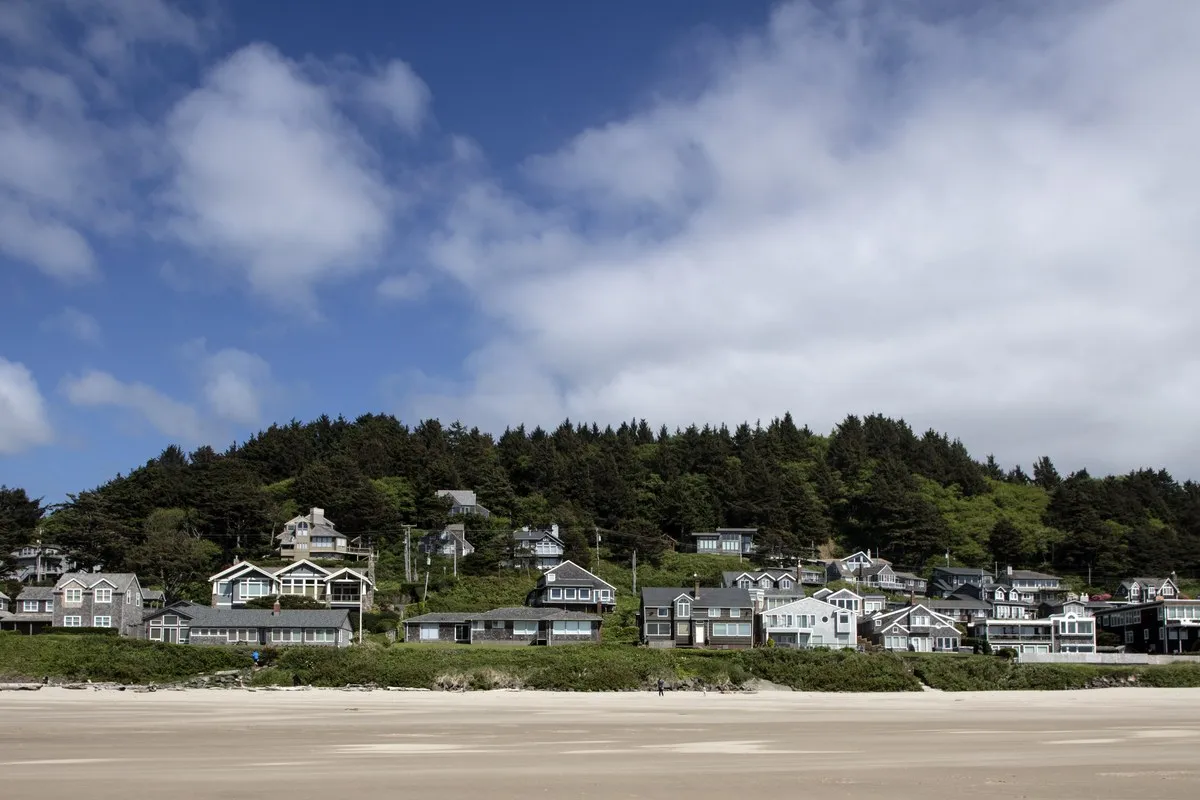
Cannon Beach, Oregon, is named for a cannon from the Navy schooner Shark, which wrecked in 1846 and left part of its deck on this stretch of sand. The name was on the beach and on a post office decades before the town adopted it, which was called Ecola until 1922.
Why is it called Cannon Beach?
Because of a gun that came ashore from a shipwreck. Lewis A. McArthur, in his Oregon Geographic Names, says the Shark was wrecked on September 10, 1846, while trying to leave the Columbia River, and “part of her deck and a small iron cannon drifted ashore south of Tillamook Head, thus giving the name to Cannon Beach.” In his entry, Cannon Beach is first of all the beach itself, “about eight miles long,” running from Chapman Point at the north to Arch Cape at the south.
The roadside marker that the Oregon Travel Information Council posted in 2024 is more specific about the gun. It calls it a carronade, “a short, smoothbore, cast iron naval cannon,” and says it “broke free of the USS Shark’s deck” in the wreck. Soon afterward, the marker says, one of the crew heard from Tillamook Indians that a piece of the deck had come ashore south of today’s town. Three cannons had been mounted on that section, and the sailors managed to pull one of them up into the creek that now runs through Arch Cape.
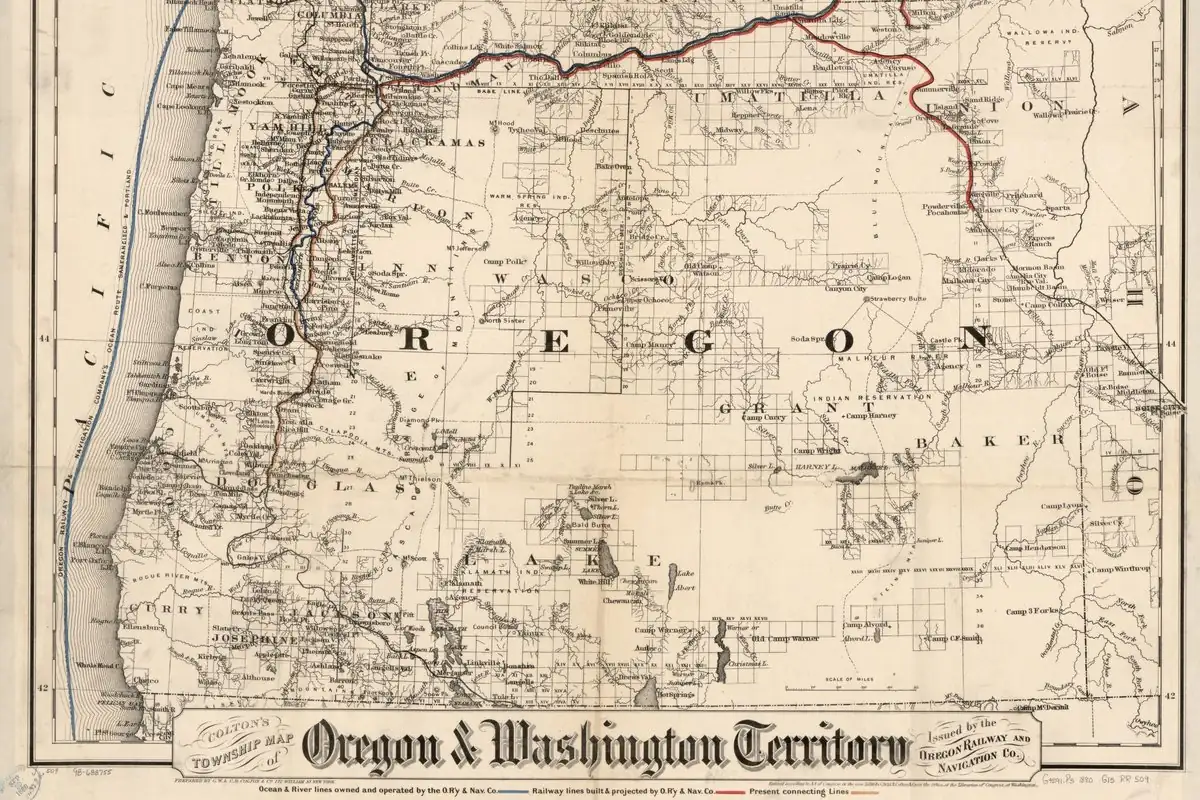
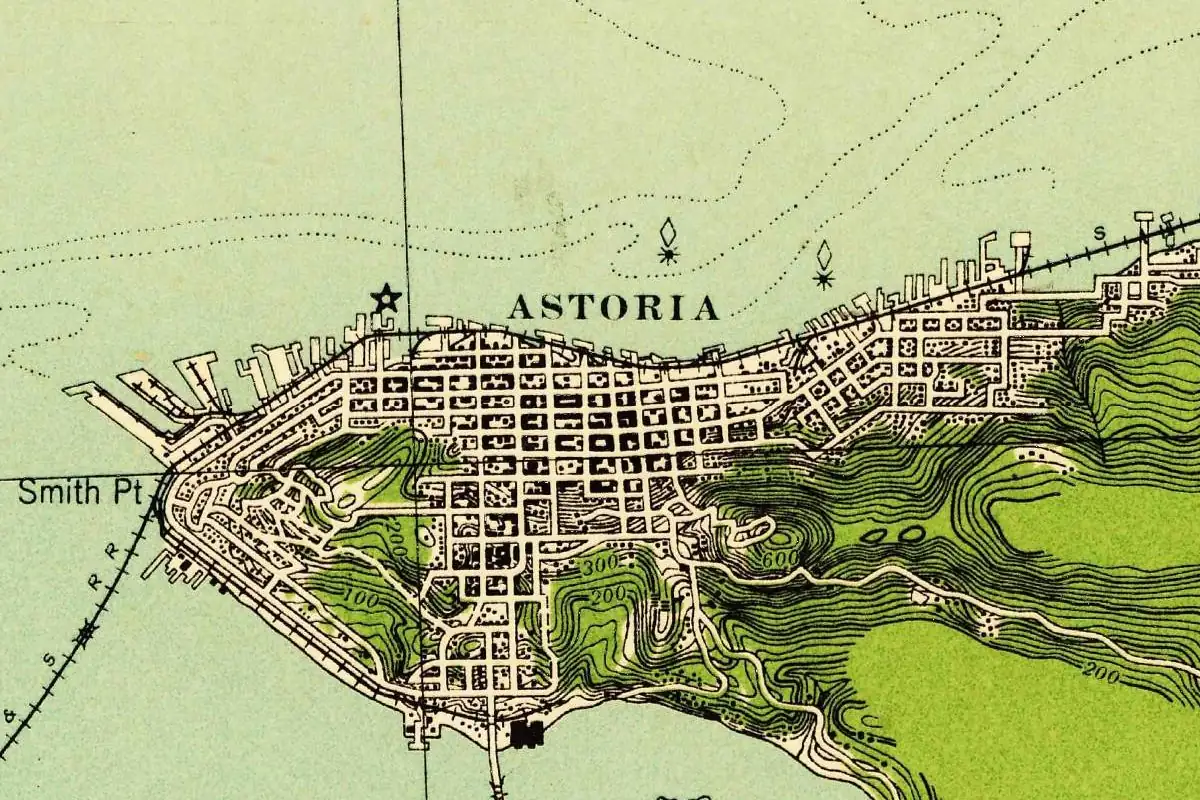
So the cannon never sat in downtown Cannon Beach, and the ship didn’t sink there. The wreck happened at the Columbia’s mouth, near Astoria, the trading post John Jacob Astor’s men had founded in 1811. The wreckage drifted down the coast.
Cannon Beach name origin: the USS Shark and its cannon
The Oregon Historical Society says the Shark dated from 1821, came out of an East Coast shipyard, and reached Oregon in August 1846, a few months after the treaty with Great Britain that set the border at the 49th parallel. Settlers heard rumors that it had come in case of trouble with the British, but it had really been sent to chart the harbor at the river’s entrance. McArthur has Lieutenant Neil M. Howison arriving in the schooner on July 1, 1846. When Howison tried to cross the bar in September, the marker says, the ship hit bottom, broke up and sank. Nobody died. The marker adds that British hands, from the Hudson’s Bay Company and the Royal Navy, rescued the whole crew.
The cannon then dropped out of sight in the sand. It came back in 1898. The marker says mail carrier John Luce saw it in Arch Cape Creek that June and brought it ashore with some help, and that for many years it was displayed outside the post office. The Cannon Beach History Center calls the carrier George Luce. In 2008 a teenager, Miranda Petrone, found a second cannon on the beach, and another beach visitor found the third close by. After five years of treatment at Texas A&M, those two went on display in 2014 at the maritime museum on the Columbia in Astoria. The gun from 1898 was handed over to the History Center in 2017.
Cannon Beach history: from Ecola to Cannon Beach
The name went onto a post office before anyone had found the gun again. McArthur lists a Cannon Beach post office from May 29, 1891; its postmaster was James P. Austin. Where it stood is the one point where the sources part ways. McArthur puts it “on or near the Kissling property at Hug Point,” a good distance down the coast from today’s town. The History Center says Austin opened it at Arch Cape and gave the place its name in hopes of finding the lost cannon, and the chamber of commerce’s timeline also puts Austin’s hotel and post office at today’s Arch Cape.
The Oregon Historical Society tells the same hope as local lore: Austin, a former Seaside postmaster, built a hostel at about the midpoint of the mail route between Astoria and Tillamook, and people said he picked the spot thinking the cannon might turn up on his land. In the society’s version, neighbors helped Austin haul the gun to the front of his house in 1898. The History Center, though, says Austin died in 1894 and that it was his widow who set the cannon up outside the post office.
That first office didn’t last. McArthur says it closed on November 2, 1901; the chamber’s timeline gives 1907.
Meanwhile a separate settlement grew up around Elk Creek, where the town is now. McArthur says it had been called Elk Creek and Ecola, and a post office named Ecola opened there on November 25, 1910. Ecola is older than the town: the chamber’s timeline says William Clark gave that name to the creek in 1806, and calls Ecola “the native term for whale.”
Two changes then moved the name north. In 1912, the marker says, the coastal settlement to the south “gave up the name Cannon Beach” and took the name of the headland next to it, Arch Cape. Ecola, meanwhile, had a mail problem: its letters kept ending up in Eola, another Oregon town, about 75 miles (121 km) off in Polk County. On May 25, 1922, McArthur says, the Post Office Department changed the Ecola office’s name to Cannon Beach, “to agree with the natural feature and to avoid confusion with Eola.” The marker puts it more cheerfully: Ecola “salvaged the Cannon Beach name for its own use, much to the delight of the local postmasters.”
Oregon had been down this road before. In 1889 the local paper in The Dalles explained why the post office there didn’t use the name Dalles City: Dallas, a Polk County town with a name too close for comfort, had caused “considerable annoyance.” Far away in Arizona, federal authorities wouldn’t let Mesa use its name at first because a post office called Mesaville already existed. And in Juneau, Alaska, a camp juggling three names settled on one at a town meeting, “owing to the resulting confusion in names.”
Cannon Beach became a city on March 5, 1957, according to the Oregon Blue Book. The chamber’s timeline says Elk Creek itself was renamed Ecola Creek in 1974, going back to Clark’s name.
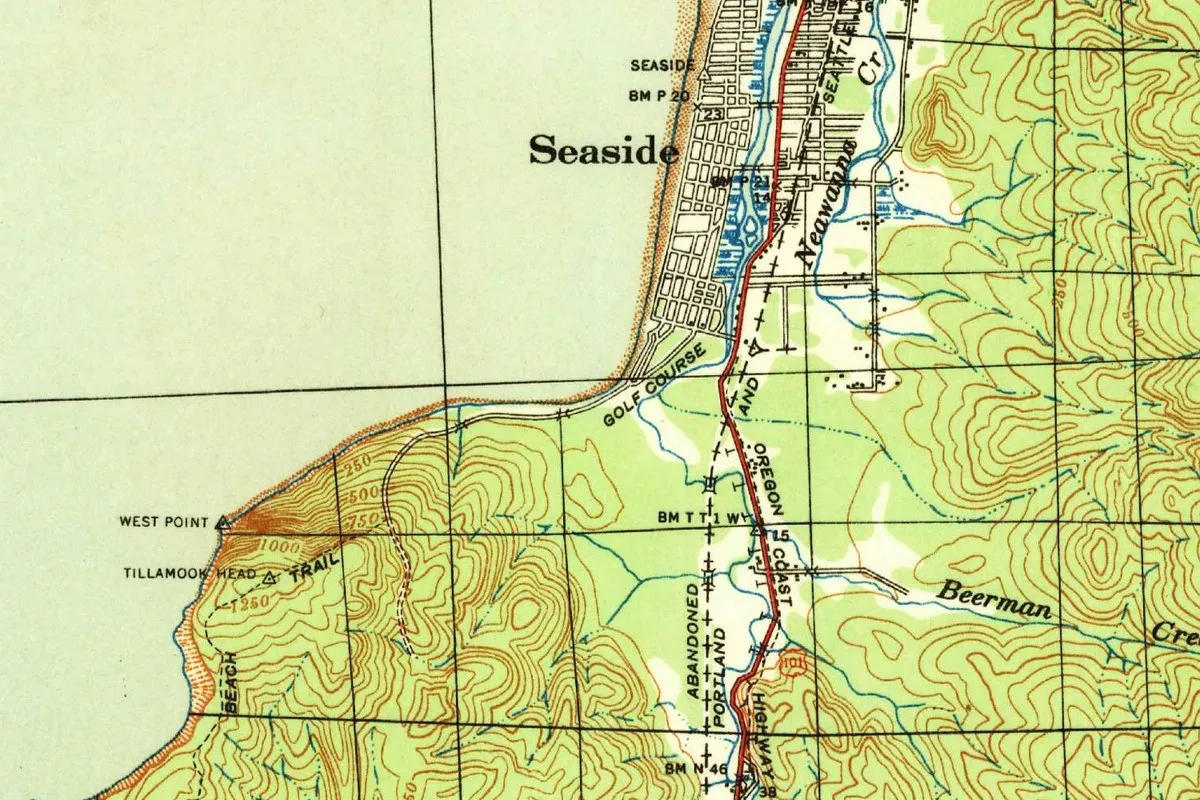
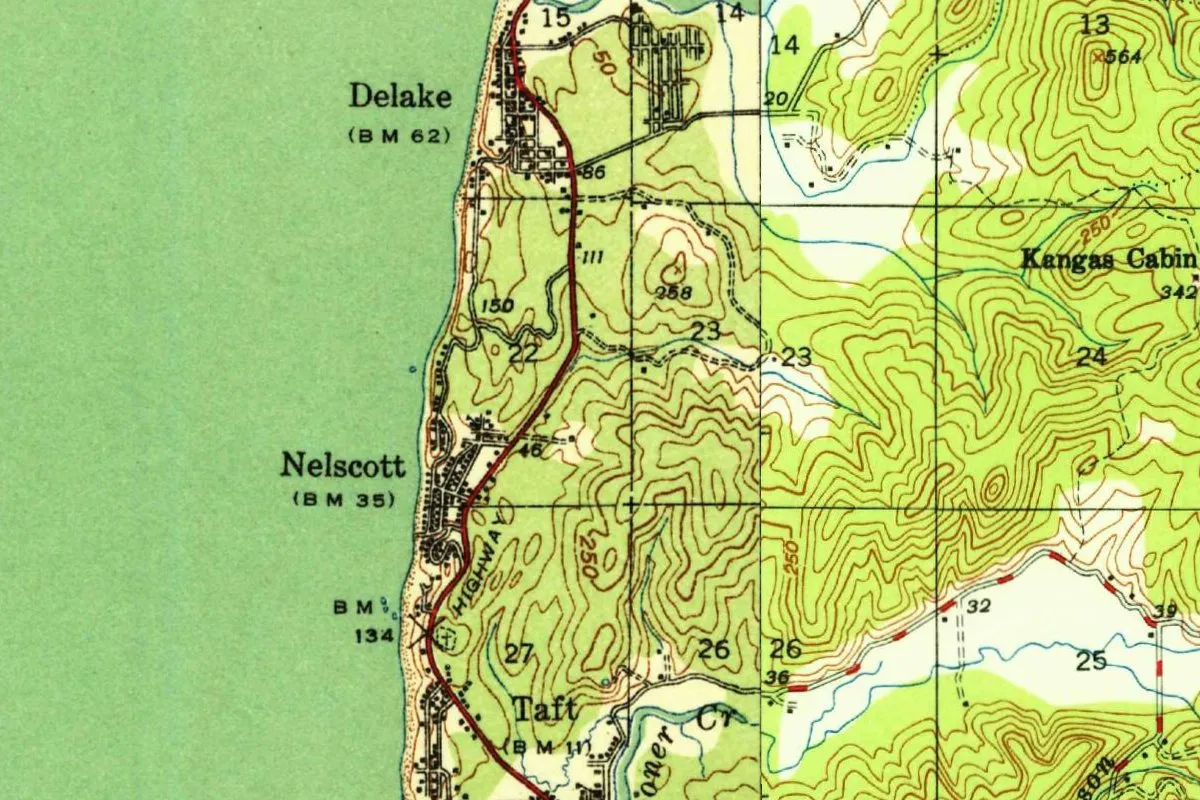
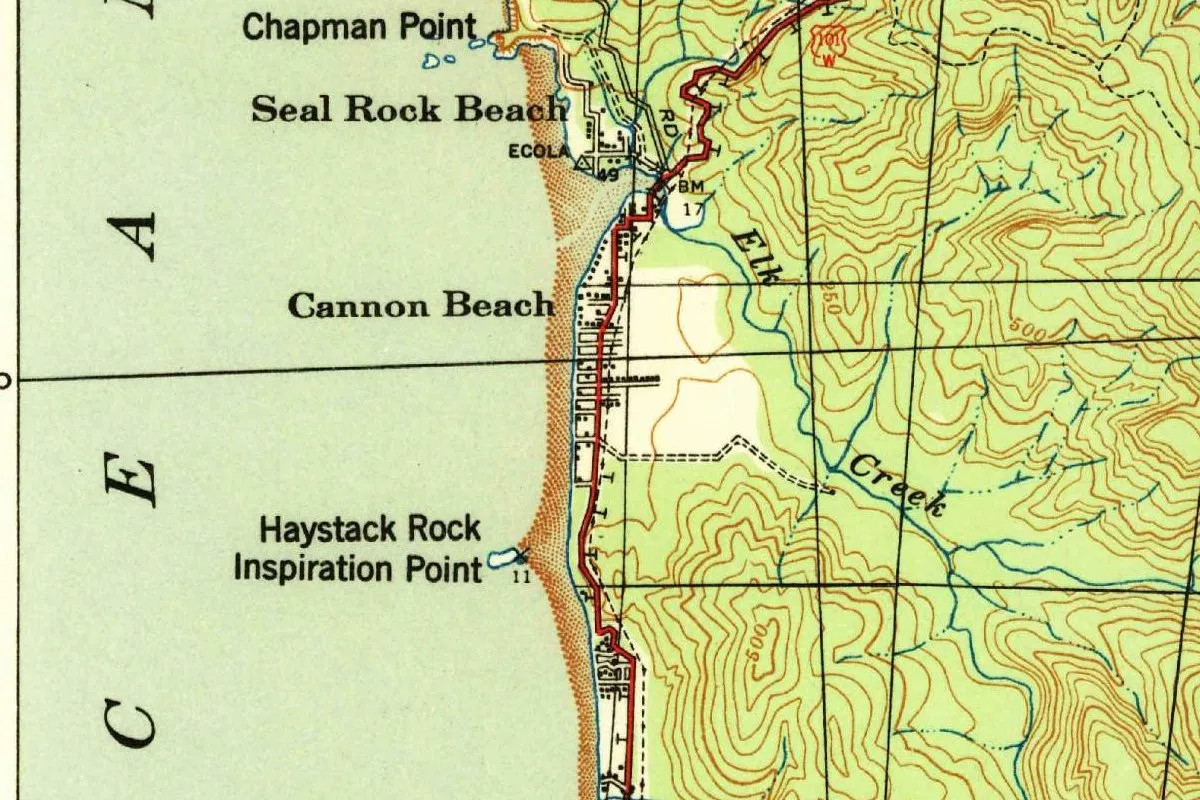
Cannon Beach on the 1940 map
The map that opens this article is cropped from the 1:62,500 Cape Falcon, Oreg. sheet. The U.S. Army Corps of Engineers prepared it, with topography by the 29th Engineers from aerial photographs flown in 1936, and the Engineer Reproduction Plant at the Army War College printed it in 1940. It’s the oldest sheet in the Geological Survey’s historical collection that covers the town.
Eighteen years after the 1922 rename, the map still calls the village by the creek ECOLA. The words Cannon Beach appear out on the water next to the sand, in the same lettering as Seal Rock Beach just to the north, as the name of the beach. Haystack Rock and Inspiration Point are offshore, and Highway 101 runs through in red.
Quick answers
Where did the cannon of Cannon Beach, Oregon, come from?
From the U.S. Navy schooner Shark, which broke up on the Columbia River bar on September 10, 1846. Part of its deck, with cannons on it, came ashore on the coast below Tillamook Head.
What was Cannon Beach, Oregon, called before?
The town was Ecola, after the creek, and McArthur says it was also known as Elk Creek. Its post office took the name Cannon Beach in May 1922. The earlier Cannon Beach post office, opened in 1891, was farther south.
Where is the cannon from Cannon Beach, Oregon, now?
The state marker says the gun found in 1898 has belonged to the town’s History Center since 2017. The two found in 2008 are shown at the Columbia River Maritime Museum in Astoria.
Key dates
- 1806William Clark crosses Tillamook Head looking for a beached whale; the chamber says he named the creek Ecola.
- 1846September 10: the Navy schooner Shark breaks up on the Columbia River bar.
- 1891May 29: a post office named Cannon Beach opens with James P. Austin as postmaster.
- 1898June, by the state marker: a mail carrier spots the cannon in the creek at Arch Cape.
- 1910November 25: the Ecola post office opens at Elk Creek, where the town is today.
- 1912The coastal settlement that had used the name Cannon Beach becomes Arch Cape.
- 1922May 25: the Ecola post office is renamed Cannon Beach, partly because mail kept going to Eola.
- 1957March 5: Cannon Beach incorporates as a city.
- 2008Two more of the Shark's cannons turn up on the beach.
Things to do in Cannon Beach, Oregon
Cannon Beach History Center & Museum
The town's history museum, on South Spruce Street at Sunset, keeps the story of Cannon Beach and Arch Cape. Since 2017 the center has kept the cannon found in 1898, now stabilized.
Haystack Rock
A basalt sea stack that rises 235 feet (72 m) at the edge of the beach. Its tide pools are one of Oregon's seven Marine Gardens, and the rock above the high tide line belongs to the Oregon Islands National Wildlife Refuge, with nesting tufted puffins.
Ecola State Park
A state park that wraps around Tillamook Head for 9 miles (14 km) of coast between Seaside and Cannon Beach, with viewpoints, Indian Beach and a trail over Tillamook Head that retraces part of the Corps of Discovery's route of 1806.
Hug Point State Recreation Site
A beach wayside 5 miles (8 km) south of Cannon Beach where, at low tide, you can walk the old stagecoach road around the point and see the wheel ruts cut into the rock, plus caves and a seasonal waterfall. Watch the tide.
Getting there
Open Cannon Beach in Google Maps
Opens in a new tab. The pin is the center of Cannon Beach in the USGS place-name record.
The closest airports, Amtrak stations and intercity bus stops, measured in a straight line from the center of Cannon Beach.
Airports
- Portland International (PDX) 69 mi 111 km
- McNary Field (SLE) Salem 82 mi 132 km
Amtrak trains
- Kelso-Longview station (KEL) 53 mi 86 km
- Vancouver, WA USA station (VAN) 64 mi 103 km
Intercity buses
- Oregon POINT Cannon Beach under 1 mi 0.3 km
- Pacific Crest Bus Lines Forest Grove 48 mi 78 km
Distances are as the crow flies, not by road. We don't list schedules or fares because they change; check with the airline, Amtrak or the bus company before you go. Official data (FAA commercial service airports (2025), FAA airport locations, Amtrak stations and Intercity Bus Atlas) from the FAA and the U.S. Bureau of Transportation Statistics, checked Nov 21, 2026.
Sponsored
Staying in Cannon Beach?
Compare hotels in Cannon Beach, Oregon, on Expedia.
See hotels in Cannon BeachWe may earn a commission if you buy through this link. It never changes what we write. Read our affiliate disclosure
Historical Sources & References
- Oregon Travel Information Council, “Cannons on the Beach”. The carronade, the wreck of September 10, 1846, the cannon in Arch Cape Creek, John Luce in 1898, the 2008 finds, Texas A&M, 2014 and 2017, Arch Cape in 1912 and the Ecola-Eola mix-up of 1922.
- McArthur, Oregon Geographic Names, 3rd ed. (1952), entry Cannon Beach, on Wikisource (continued). Howison’s arrival, the cannon “thus giving the name to Cannon Beach,” the 1891 post office near Hug Point and its closing in 1901, Ecola in 1910 and the change of May 25, 1922.
- Cannon Beach History Center & Museum, “The Cannon of Cannon Beach”. Austin’s post office at Arch Cape, his death in 1894, George Luce and the cannon in front of the post office.
- Oregon Historical Society, “Cannon Beach Cannon”. The Shark’s mission, the treaty of 1846 and Austin’s hostel on the mail route.
- Cannon Beach Chamber of Commerce, “Cannon Beach History Timeline”. Clark and the name Ecola, the 1907 closing of the first post office, and Ecola Creek in 1974.
- Oregon Blue Book, “Cannon Beach”. Incorporation on March 5, 1957.
- U.S. Geological Survey, GNIS feature 1136119. Cannon Beach in Clatsop County.
- Cape Falcon, Oreg. quadrangle, 1940. The sheet behind the cropped map.
Spot something wrong, or know more? Tell us here. You can also email us or use our contact page. Corrections are noted here with their date, never made silently.