Why Is It Called Seaside? An Oregon Town Named for a Hotel
Seaside takes its name from the Seaside House, a resort hotel Ben Holladay built in 1871 on land once held by the Lattie family. Its post office opened as Summer House in 1871, became Seaside House in 1873 and was cut to plain Seaside in 1882, according to Lewis A. McArthur's Oregon Geographic Names.
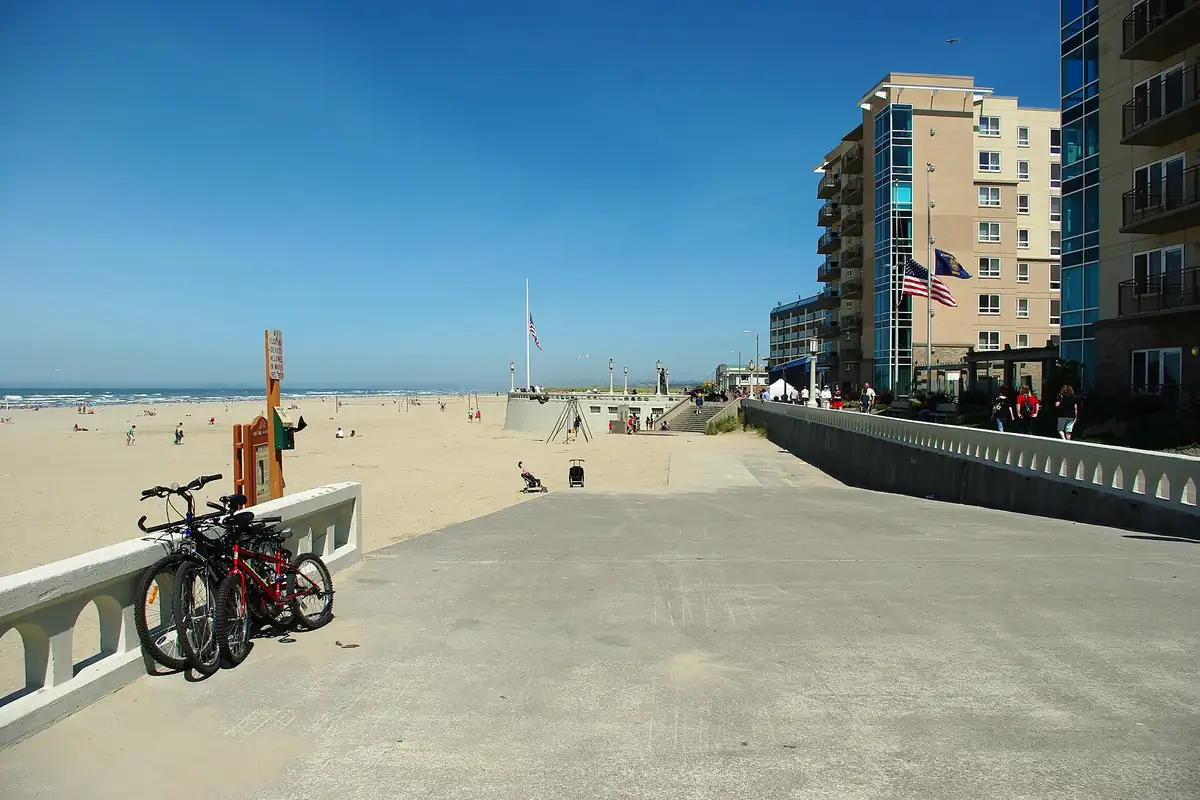
Seaside, Oregon, is named for the Seaside House, the summer hotel Ben Holladay opened in 1871, whose post office handed its name to the town. The beach was already there, of course, and one local account admits the setting alone could explain the name.
Why is it called Seaside, Oregon?
The short version is a hotel. In 1871 Ben Holladay bought a beach property and put up a resort he called the Seaside House, built in the style of an Italian villa. The Oregon Encyclopedia says plainly that the hotel lent its name to the settlement forming around it.
The Oregon History Project, which keeps a photograph of the hotel from about 1875, explains the mechanism. The resort had a post office on the premises, and so the hotel’s name and the community’s name became one and the same.
Lewis A. McArthur’s Oregon Geographic Names traces that post office step by step. It opened on December 1, 1871, under the name Summer House, with A. J. Clontire in charge. On July 23, 1873, it became Seaside House, with Charles H. Dexter as postmaster. On March 29, 1882, the word House was dropped. McArthur also places the old hotel a mile (1.6 km) or so south of the present business district.
The Seaside Visitors Bureau repeats the hotel story but hedges a little. It grants that a town this close to the surf hardly needed a reason to call itself Seaside, then says that tradition credits Holladay’s hotel. The encyclopedia and McArthur don’t hedge.
Who was Holladay? The Oregon History Project says he’d sold his stagecoach business to Wells Fargo in 1866 and moved to Portland two years later. Before that, his coaches had run a long way from here: according to an Idaho chronology, he named one of the stations on his Salt Lake City to Virginia City line Pocatello, a name that Pocatello, Idaho, carries today. The Visitors Bureau adds that Holladay first came to this beach in 1870, on a hunting trip.
Seaside, Oregon history
Long before the hotel, this was Clatsop country. The Oregon Encyclopedia lists four Clatsop villages inside today’s city, Niyakiwanki, Neacoxi, Necanicum and Nakutat, with the Nehalem band of the Tillamook living to the south. McArthur quotes the pioneer Silas B. Smith, who recorded the village at the town site as Ne-co-tat.
In the winter of 1805 to 1806, a detail from the Lewis and Clark expedition set up camp on this shore to make salt. The National Park Service says five of them left Fort Clatsop on December 28, 1805, and boiled seawater over fires near a Clatsop-Nehalem village. When they broke camp on February 20, 1806, they took 3½ bushels back with them. A rebuilt cairn now marks the spot.
The first non-Native landholders came in the middle of the century. The Oregon Encyclopedia says that in 1849 Mary Lattie, a Tillamook woman whose late husband, Alexander Lattie, had worked for the Hudson’s Bay Company, secured two claims with her children, 642 acres (260 ha) in all, and that much of downtown Seaside now stands on them. The Oregon History Project dates the family’s two donation land claims to 1852 and 1853 instead. Both say the Latties ran a boarding house, which the encyclopedia calls Summer House and places on ground now taken up by the Seaside Golf Course. That is the same name McArthur gives the first post office, though none of these sources links the two in so many words.
Holladay bought the Lattie place in 1871. His guests came by riverboat to Skipanon Landing, the encyclopedia says, then finished the trip on foot, on horseback or by mail stage. The Oregon History Project mentions a race track and stables, and advertising that called the Seaside House the oldest fashionable summer resort.
The trains changed the scale. The Oregon Encyclopedia says Hammond’s Oregon Pacific Railroad reached Seaside in 1894; the Oregon History Project has a line running by 1891. Summer cottages filled in around the hotel. One survivor, the Butterfield Cottage, was built in 1893 for a Portland jeweler, and the Seaside Museum calls it the last cottage left from Grimes Grove, the tract that is now the downtown core.
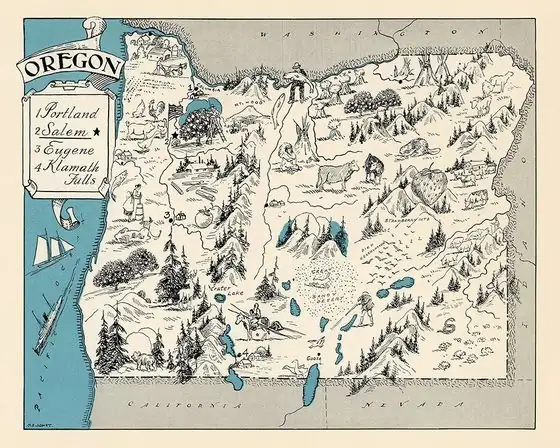
Seaside became a city on February 17, 1899. McArthur notes that two towns grew up on either side of the Necanicum, and the encyclopedia says Seaside and West Seaside merged in 1913. On August 11, 1921, the city dedicated a concrete Promenade and seawall, and boosters started calling the place the Atlantic City of the Northwest. That was a nod to Atlantic City, New Jersey, a resort named off a surveyor’s map in 1853. Seaside is in Oregon’s Clatsop County, on the north coast.
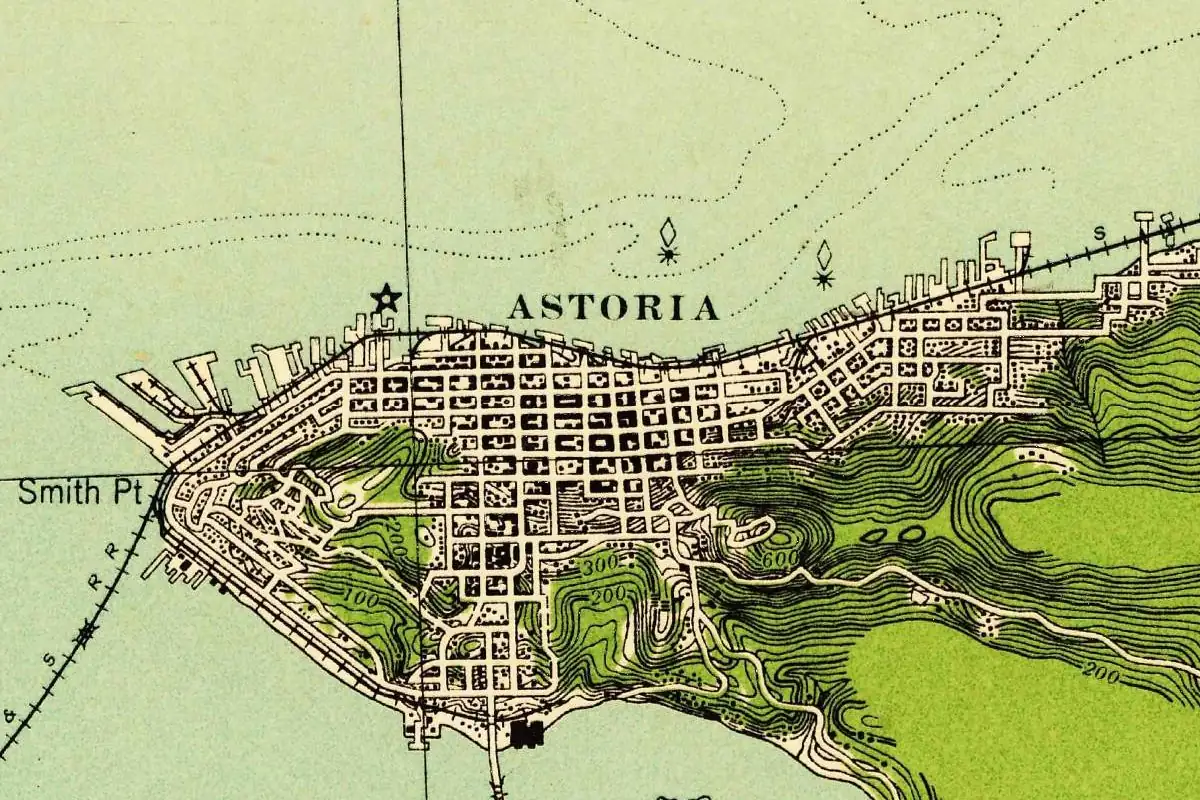
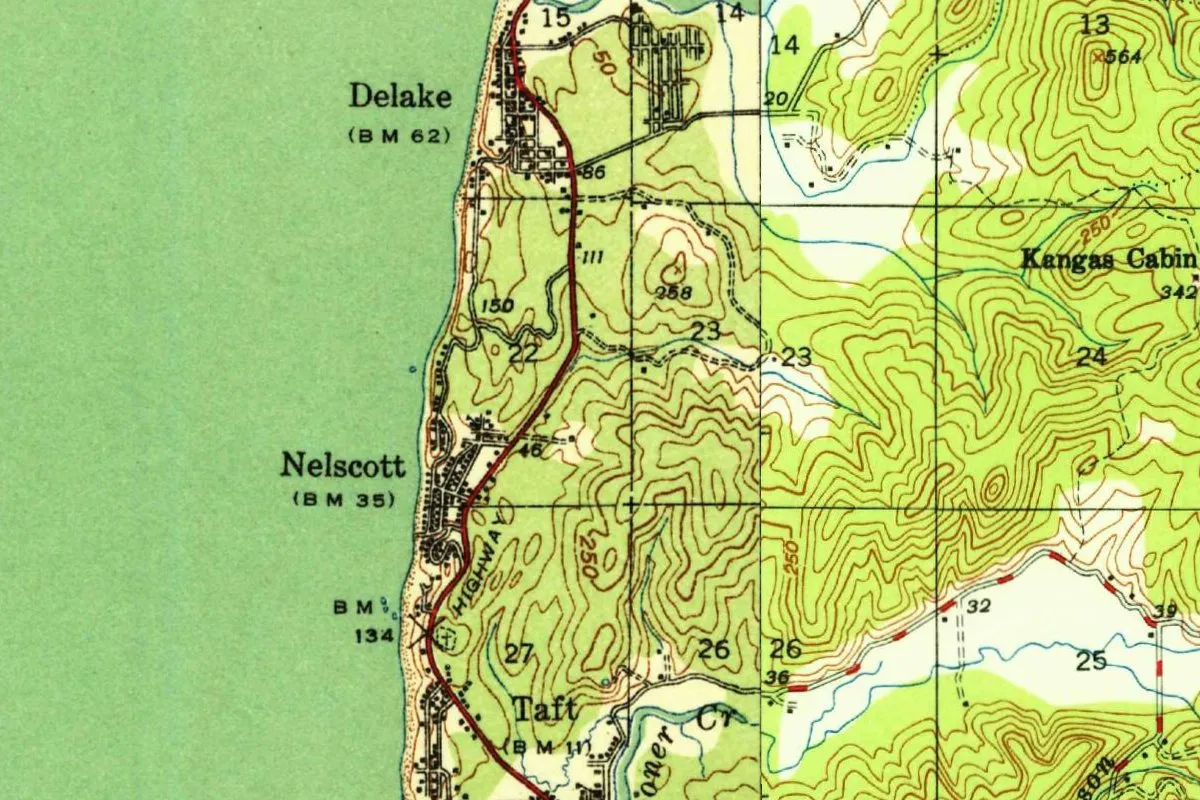
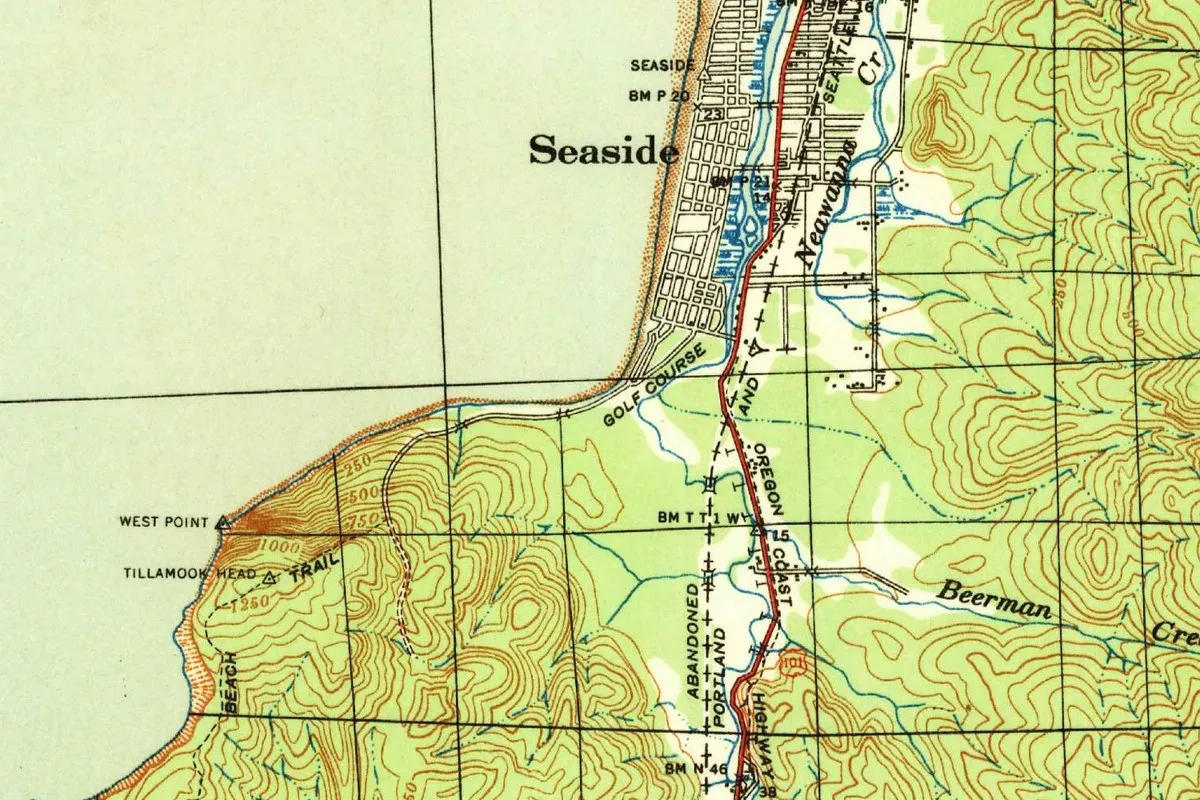
Seaside on the 1940 map
Our map is a crop of the Cape Falcon quadrangle, a 1:62,500 tactical map made by the Corps of Engineers, U.S. Army. The margin credits its preparation to the Chief of Engineers in 1936, with topography by the 29th Engineers from aerial photographs flown that year, road information from 1937, and a printing line from the Engineer Reproduction Plant at the Army War College dated 1940. It’s a military sheet, not a civilian Geological Survey one, though the scan comes from the Survey’s collection.
Seaside sits at the very top edge of the sheet. Look for the name in large type over the street grid, Neawanna Creek, a golf course, the red line of the coast highway with a 101 shield, and a label for the abandoned Portland and Oregon Coast Highway. To the south, the beach runs down past West Point to Tillamook Head.
Quick answers
What was Seaside, Oregon, called before?
The post office opened as Summer House in 1871 and became Seaside House in 1873, McArthur says. It took the name Seaside in 1882. Earlier, a Clatsop village stood at the site.
When did Seaside, Oregon, become a city?
On February 17, 1899, according to the Oregon Encyclopedia. It merged with West Seaside in 1913.
Did Lewis and Clark make salt in Seaside, Oregon?
Their men did. Five expedition members boiled seawater here from late December 1805 until February 20, 1806, the National Park Service says.
Key dates
- 1805Five men from the Lewis and Clark expedition leave Fort Clatsop on December 28 to boil seawater for salt on this beach.
- 1849Mary Lattie and her children secure two land claims here, the Oregon Encyclopedia says; the Oregon History Project dates the purchases to 1852 and 1853.
- 1871Ben Holladay buys the Lattie place and builds the Seaside House; a Summer House post office opens on December 1.
- 1873The post office becomes Seaside House on July 23.
- 1882The post office is renamed Seaside on March 29.
- 1894The Oregon Encyclopedia dates the railroad's arrival to this year; the Oregon History Project says a line ran by 1891.
- 1899Seaside incorporates as a city on February 17.
- 1913Seaside and West Seaside merge.
- 1921The Promenade and its seawall are dedicated on August 11.
- 1940The Army prints the Cape Falcon tactical map, from photographs flown in 1936, with Seaside on it.
Things to do in Seaside, Oregon
The Prom and the Turnaround
Seaside's 1.5-mile (2.4 km) oceanfront Promenade, which began as a wooden boardwalk, ends at the Turnaround, where a bronze statue shows Lewis and Clark with their dog, Seaman.
Salt Works
A reconstructed salt cairn just off the Prom on Lewis and Clark Way, part of Lewis and Clark National Historical Park, marking where expedition members boiled seawater for salt in the winter of 1805 to 1806.
Seaside Aquarium
An aquarium that has stood at the waterfront since 1937, in a 1924 building that started out as the Seaside Baths natatorium, where visitors can feed the seals.
Seaside Museum and Butterfield Cottage
The local history museum, with the Butterfield Cottage on its grounds: an 1893 beach cottage built for a Portland jeweler, moved here in the 1980s and returned to its 1912 appearance.
Getting there
Open Seaside in Google Maps
Opens in a new tab. The pin is the center of Seaside in the USGS place-name record.
The closest airports, Amtrak stations and intercity bus stops, measured in a straight line from the center of Seaside.
Airports
- Portland International (PDX) 70 mi 112 km
- McNary Field (SLE) Salem 87 mi 140 km
Amtrak trains
- Kelso-Longview station (KEL) 49 mi 80 km
- Vancouver, WA USA station (VAN) 65 mi 104 km
Intercity buses
- Oregon POINT Seaside, OR under 1 mi 0.8 km
- Pacific Crest Bus Lines Forest Grove 51 mi 82 km
Distances are as the crow flies, not by road. We don't list schedules or fares because they change; check with the airline, Amtrak or the bus company before you go. Official data (FAA commercial service airports (2025), FAA airport locations, Amtrak stations and Intercity Bus Atlas) from the FAA and the U.S. Bureau of Transportation Statistics, checked Nov 21, 2026.
Sponsored
Staying in Seaside?
Compare hotels in Seaside, Oregon, on Expedia.
See hotels in SeasideWe may earn a commission if you buy through this link. It never changes what we write. Read our affiliate disclosure
Historical Sources & References
- Oregon Encyclopedia, “Seaside”. The Clatsop villages, Mary Lattie and the 1849 claims, Summer House, the Seaside House and its role in naming the town, the railroad in 1894, incorporation in 1899, the 1913 merger and the 1921 Promenade.
- Sara Paulson, “Seaside House,” Oregon History Project (2007). Holladay’s sale to Wells Fargo and move to Portland, the 1852 and 1853 claims, the resort’s post office and its name passing to the town, and the railroad by 1891.
- Lewis A. McArthur, Oregon Geographic Names, 3rd ed. (1952), p. 540. The hotel as the source of the name, the post office dates of 1871, 1873 and 1882, Ne-co-tat and the two towns on the Necanicum. Checked against the page image.
- Seaside Visitors Bureau, “Ben Holladay’s Seaside House”. Holladay’s 1870 hunting trip and the naming story told as tradition.
- National Park Service, Salt Works and “Visit the Salt Works”. The salt camp of 1805 and 1806 and its reconstructed cairn.
- Seaside Museum & Historical Society, The Butterfield Cottage; Seaside Aquarium; Seaside Visitors Bureau, Attractions. The cottage and Grimes Grove, and the details in the things-to-do list.
- U.S. Geological Survey, GNIS feature 1136735. Seaside’s federal record.
- Corps of Engineers, U.S. Army, Cape Falcon quadrangle, tactical map, printed 1940. The sheet the map at the top was cropped from.
Spot something wrong, or know more? Tell us here. You can also email us or use our contact page. Corrections are noted here with their date, never made silently.