Milford, Utah: A Mill Ford on the Beaver River
Milford, Utah, became a railroad division point, but its name came from wagons, not trains: ore haulers forded the Beaver River below a stamp mill. People called that crossing the mill ford, and the town took the name.
Ore wagons and a stamp mill
The rush started with silver. The Horn Silver Mine was found in 1875 in the San Francisco Mountains, in western Beaver County, and the mining camps of the San Francisco district grew to some 6,000 people, according to the City of Milford’s history page. The ore had to get to the mills, and that meant crossing the Beaver River.
The Federal Writers’ Project’s Utah volume of 1941 tells it in two sentences:
“Ore seekers traveling to and from the ‘diggings’ in 1880 forded the Beaver River below a stamp mill. The crossing, known as the ‘mill ford,’ suggested a name for the town.”
So the name is about as literal as it gets, a mill and a ford run together. You don’t need a founder’s surname or a hometown back east to explain this one.
Who said “Milford” first
The city’s own history adds a person. It says a stamp mill was built in 1873 on a hillside of Arvin Stoddard’s land, and that someone sitting by the mill one day watched the ore wagons rumble down from the Cave Mine and ford the Beaver River about a third of a mile (0.5 km) southeast of town. “Daniel decided to name the town Milford,” the page goes on, crediting a Daniel Williams and adding that “early court records often show it written as Mill-ford.”
That page is a modern local account, and it gets a little tangled: in the same passage it introduces John D. Williams, a Welsh smelterman, and then calls the mill worker “Daniel Williams son John,” so it’s hard to tell who was sitting by the mill. The mill ford itself isn’t in question; who first said the word out loud is a city tradition, not something the WPA book confirms.
Then the railroad came
You might expect a town like this to be named for a railroad man, since the railroad is what made it. The guide notes that by 1880 the Utah Southern tracks “were laid as far south as Milford,” and the city page puts the first passenger train there on Saturday, May 15, 1880. Martha Sonntag Bradley’s entry in the Utah History Encyclopedia says Milford became the railroad terminal for the line in the 1880s, a loading place for southern Utah’s cattle and a shipping point for the mines. After the line was pushed on to Caliente, Nevada, by 1901, Milford was “a valuable division terminal because of its excellent location and water facilities.”
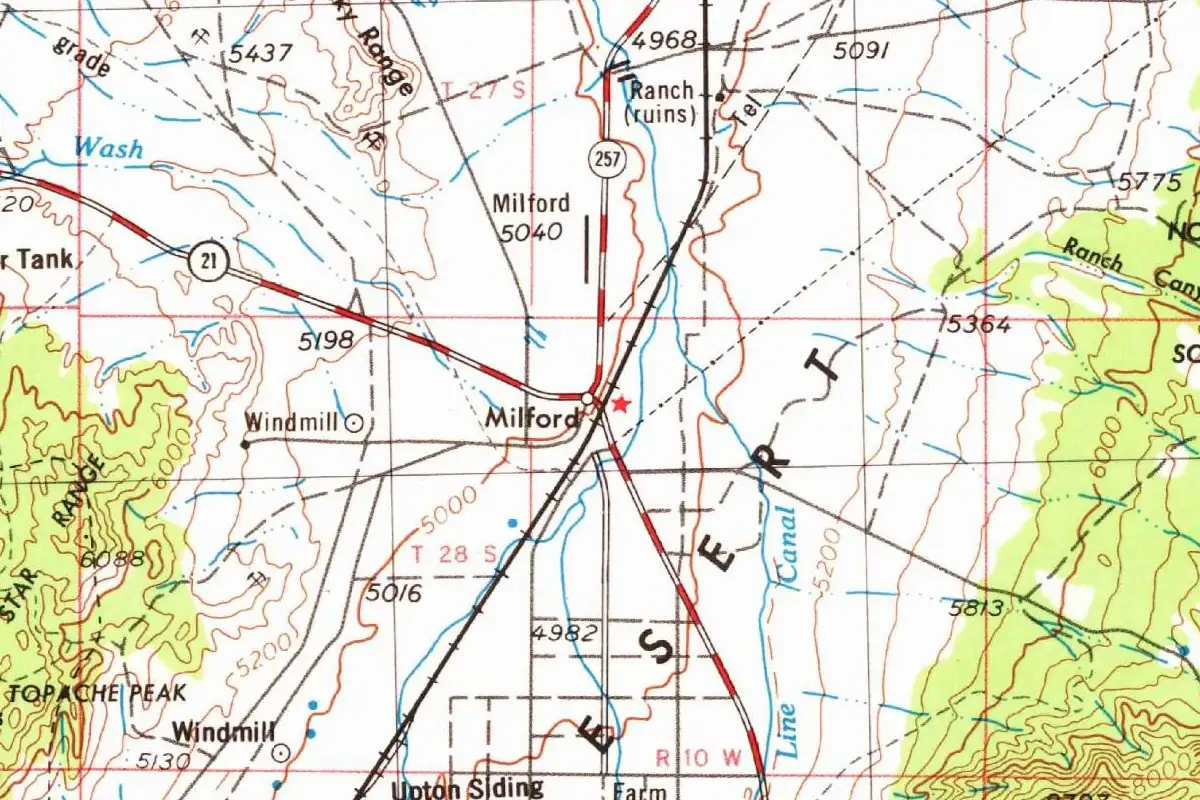
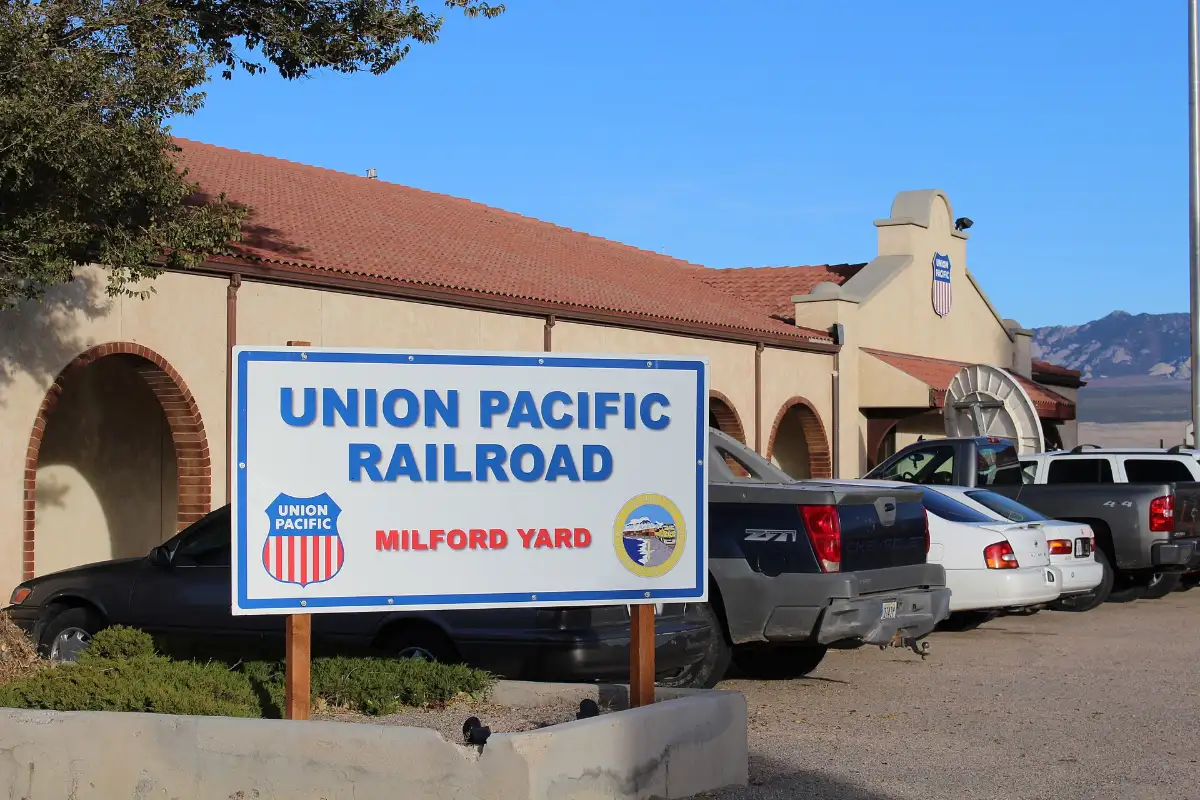
By 1941 the guide described a two-block main street “with business houses and cafes on one side, and the Union Pacific depot on the other.” The Richfield sheet of 1953 shows the same layout from above: the railroad and the highways meet at Milford, with the river channel just to the east.
Quick answers
How did Milford, Utah, get its name?
From a “mill ford,” a crossing of the Beaver River below a stamp mill that ore haulers used. Utah’s WPA guide, published in 1941, says the crossing “suggested a name for the town.”
Who named Milford, Utah?
The City of Milford’s history credits Daniel Williams with the name, in a story set beside the stamp mill. The WPA guide doesn’t name anyone.
Is Milford, Utah, a railroad town?
Yes, though the name isn’t from the railroad. The Utah Southern reached Milford in 1880, the town became a division terminal, and by 1941 it was a Union Pacific division point.
Key dates
- 1875The Horn Silver Mine is discovered in the San Francisco Mountains west of Milford.
- 1880The first passenger train reaches Milford on May 15, by the city's account; ore haulers are fording the Beaver River below a stamp mill.
Getting there
Open Milford in Google Maps
Opens in a new tab. The pin is the center of Milford in the USGS place-name record.
The closest airports, Amtrak stations and intercity bus stops, measured in a straight line from the center of Milford.
Airports
- Cedar City Regional (CDC) 48 mi 78 km
- St George Regional (SGU) St. George 98 mi 158 km
Intercity buses
- Salt Lake Express Beaver (Exit 112) 21 mi 33 km
- Greyhound Parowan Travel Centers Of America 38 mi 62 km
Distances are as the crow flies, not by road. We don't list schedules or fares because they change; check with the airline, Amtrak or the bus company before you go. Official data (FAA commercial service airports (2025), FAA airport locations, Amtrak stations and Intercity Bus Atlas) from the FAA and the U.S. Bureau of Transportation Statistics, checked Nov 6, 2026.
Sponsored
Staying in Milford?
Compare hotels in Milford, Utah, on Expedia.
See hotels in MilfordWe may earn a commission if you buy through this link. It never changes what we write. Read our affiliate disclosure
Historical Sources & References
- Federal Writers’ Project, Utah: A Guide to the State (1941), pp. 85 and 323. By 1880 the Utah Southern’s tracks “were laid as far south as Milford” (p. 85); Milford as a Union Pacific division point, the main street and depot, settlement in 1870, and the “mill ford” that “suggested a name for the town” (p. 323).
- City of Milford, “History of Milford”. The Horn Silver Mine (1875), Stoddard’s land, the 1873 stamp mill, Daniel Williams and the name, “Mill-ford” in early court records, and the first passenger train on May 15, 1880.
- Martha Sonntag Bradley, “Milford,” Utah History Encyclopedia. Milford as the railroad’s terminal in the 1880s, the line to Caliente by 1901, the “valuable division terminal,” and the 1903 petition for incorporation.
- GNIS feature 1430317 (U.S. Geological Survey). Milford’s entry in the federal gazetteer, Beaver County.
Spot something wrong, or know more? Tell us here. You can also email us or use our contact page. Corrections are noted here with their date, never made silently.