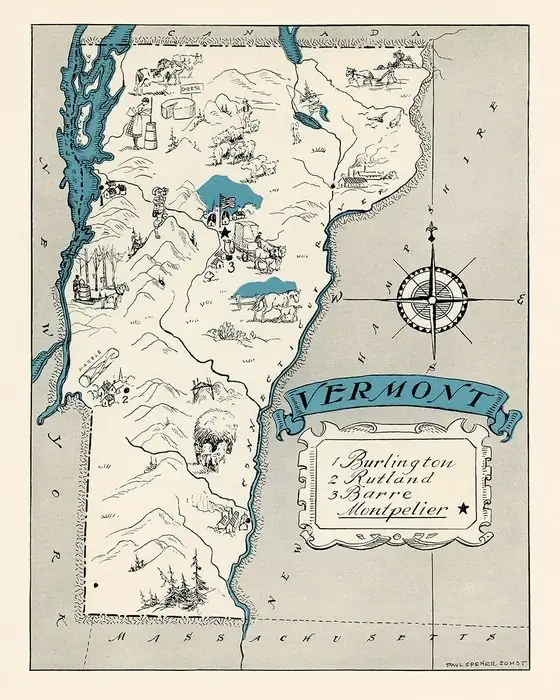
Island Pond, Vermont: The Pond That Was Knowlton Lake
Island Pond, Vermont, is named for a pond with an island in it, and that pond had a different name first: early surveyors knew it as Knowlton Lake. The village on its north shore took the newer name, and then a railroad made the village a lot bigger than the pond’s old namers could have guessed.
Knowlton Lake gets a plainer name
Hamilton Child’s 1887 gazetteer of Caledonia and Essex counties tells the story inside its chapter on the town of Brighton:
“the largest, formerly called Knowlton lake, a name given it by Mr Knowlton, one of the first surveyors, but latterly called Island Pond, from having near its center an island containing an area of twenty two acres”
The same island, he adds, “also gives the name to the postoffice at the outlet.” Child describes the pond as about 2 miles (3 km) long and a mile and a half (2.4 km) wide, sitting about 1,250 feet (380 m) above the sea, right on the height of land between Lake Memphremagog and the Connecticut River.
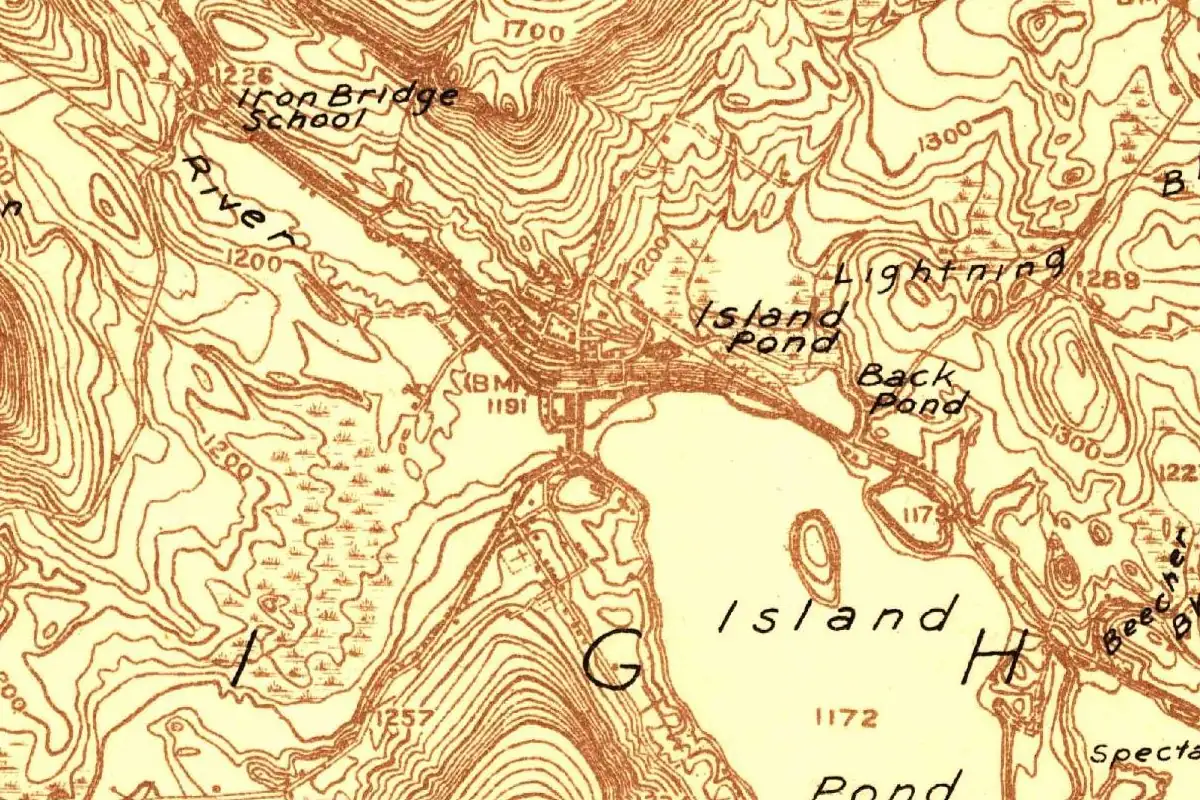
So the surveyor’s name lost out to a description anybody could check from the shore. The island hasn’t gone anywhere: on the 1924 map you’ll find it as the small oval near the middle of the water.
A village inside a town called Random
Island Pond isn’t a town of its own. It’s a village in Brighton, and Brighton has a naming story too. Child says the township was chartered in 1781 and first named Random, because it was a “random” purchase. On November 3, 1833, the name was changed to Brighton, “this name being preferred by its inhabitants.”
The village, Child writes, sits “on the northern shores of Island pond, from which the village derives its name.” Henry Gannett’s 1905 list of American place names agrees in one line: “so named because of an island in the center of a little lake between the spurs of the mountains.” Even the stream that drains the pond has a borrowed name. A surveyor named Whitlaw called it the Clyde, out of fondness for the Scottish river.
Halfway between Portland and Montreal
The railroad came through in 1853. That was the Grand Trunk, chartered in 1848, and Child says the village stood at “the half-way place” between Portland, Maine, and Montreal. The road wasn’t supposed to come this way at all. It was first surveyed up the Connecticut valley to Canaan, but the Canadians, who then owned only their end, offered to build to Island Pond and put the custom house there instead of on the border line. The route was changed.
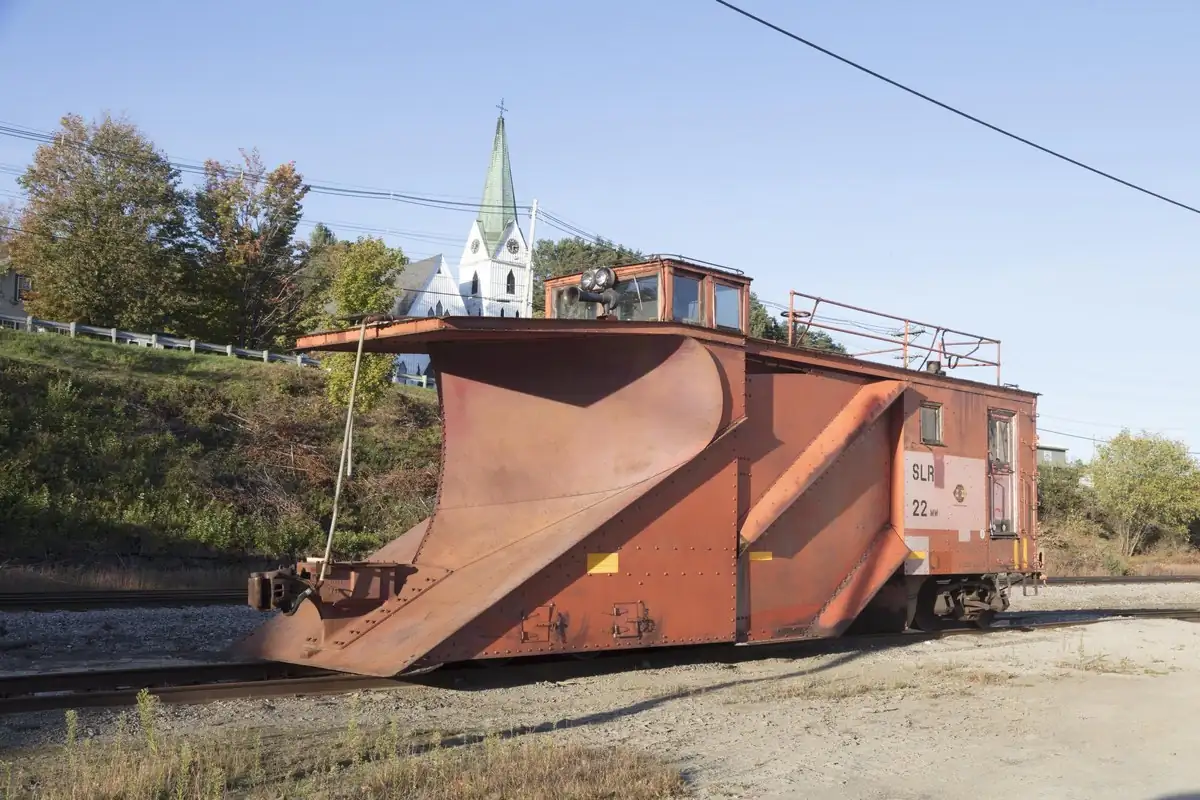
That’s how a village named for a 22-acre island ended up with the principal station, the end of the Portland division, and both the United States and Canadian custom houses. If you’re wondering what’s left, Carol Highsmith’s 2017 photo below shows the rail yard still there, with a white church steeple on the hill behind it.
Quick answers
Why is it called Island Pond?
Because of the island in the pond. Child (1887) says the pond took the name “from having near its center an island” of about 22 acres, and the village on its north shore took the name from the pond.
Who was the Knowlton in Knowlton Lake?
Child (1887) says only that he was “Mr Knowlton, one of the first surveyors,” who gave the pond his name before it came to be called Island Pond. He doesn’t give a first name.
Which town is Island Pond in?
Brighton. Island Pond is a village in that town, which was chartered in 1781 as Random and renamed Brighton in 1833.
Why did the Grand Trunk come through Island Pond?
Child (1887) says it was “the half-way place” between Portland and Montreal, and that the Canadians offered to build to Island Pond and put the custom house there. The line came through in 1853.
Key dates
- 1781The township is chartered under the name Random.
- 1833Random becomes Brighton, the town that holds the village of Island Pond.
- 1853The Grand Trunk railroad is built through, with its station and custom houses at Island Pond.
Getting there
Open Island Pond in Google Maps
Opens in a new tab. The pin is the center of Island Pond in the USGS place-name record.
The closest airports, Amtrak stations and intercity bus stops, measured in a straight line from the center of Island Pond.
Airports
- Patrick Leahy Burlington International (BTV) 67 mi 108 km
- Plattsburgh International (PBG) 79 mi 127 km
Amtrak trains
- Montpelier-Berlin station (MPR) 53 mi 85 km
- Waterbury-Stowe station (WAB) 54 mi 87 km
Intercity buses
- Concord Coach Lines Littleton 36 mi 58 km
- FlixBus Montpelier Transit Center 52 mi 83 km
- Greyhound St. Albans Bus Stop 59 mi 95 km
Distances are as the crow flies, not by road. We don't list schedules or fares because they change; check with the airline, Amtrak or the bus company before you go. Official data (FAA commercial service airports (2025), FAA airport locations, Amtrak stations and Intercity Bus Atlas) from the FAA and the U.S. Bureau of Transportation Statistics, checked Nov 6, 2026.
Sponsored
Staying in Island Pond?
Compare hotels in Island Pond, Vermont, on Expedia.
See hotels in Island PondWe may earn a commission if you buy through this link. It never changes what we write. Read our affiliate disclosure
Historical Sources & References
- Hamilton Child, Gazetteer of Caledonia and Essex Counties, Vt., 1764-1887 (1887), part first, pp. 93 and 397-398. Knowlton Lake and the 22-acre island; the village “from which the village derives its name”; Random and the 1833 change to Brighton; the Clyde; the Grand Trunk of 1853, the change of route and the custom houses.
- Henry Gannett, The Origin of Certain Place Names in the United States, 2nd ed. (USGS Bulletin 258, 1905), p. 166. Island Pond, “so named because of an island in the center of a little lake between the spurs of the mountains.”
- GNIS feature 1457977 (U.S. Geological Survey). The USGS place-name page for the village of Island Pond, in Essex County, with its coordinates.
Spot something wrong, or know more? Tell us here. You can also email us or use our contact page. Corrections are noted here with their date, never made silently.