Mineral Point, Wisconsin: The Lead Is Clear, the Point Isn't
Mineral Point is named for the lead ore that drew miners to its hills in the late 1820s. The Wisconsin Historical Society says the city 'was named after its lead mines,' and an 1881 county history says the name came from the area's mineral resources. Why 'Point' was added, and who chose the name, no source found here says.
Mineral Point, Wisconsin, owes the “Mineral” in its name to the lead ore in its hills, but none of the sources we found explains the “Point.” And in 1836, by one visitor’s account, people more often called the place Shake-Rag anyway.
Named after the lead mines
The ore of Wisconsin’s lead region, the 1881 county history says in its chapter on the state, was “of one kind only, the sulphide known as galena,” the lead mineral that also named Galena, Illinois, about 35 miles (56 km) to the south. The Wisconsin Historical Society puts it plainly in a caption for a 1925 aerial photo of the town: “The city was named after its lead mines.” Elsewhere it says names like Mineral Point and New Diggings “evoke an earlier time when local mines produced much of the nation’s lead.”
The 1881 History of Iowa County opens its chapter on the city the same way. Mineral Point, it says, holds a place in Wisconsin’s annals partly because of “the various mineral resources of this locality, from which the name was derived.” In 1905, Henry Gannett paired it with a village of the same name in Missouri and gave both one reason: “So named because of the abundance of ore in those regions.”
So the first word is settled. The trouble is the second one.
What was the “Point”?
You’d think a county history written while early settlers were still alive would say. It doesn’t. The 1881 book uses “the Point” as a nickname for the place, with the quotation marks, over and over. Miners staked claims “scattered here and there about the ‘Point,’” and in 1835 Charles Bracken surveyed them. Stephen Taylor, who arrived that year, described the first cabins standing near what became Commerce and High streets, “in view from the diggings on the ‘Point.’”
That last phrase hints that the Point was a spot on the hill where the digging went on. But the book never says so, and it never says who first called the place Mineral Point. It even admits it can’t settle who found ore there first. “As early as 1827, certainly,” it says, “it was known among the miners of Galena that there was lead ore to be found in abundance in Iowa County; but that they then discovered mineral at the ‘Point’ does not seem so certain.”
The miners weren’t the first to work that lead, either. The 1881 history says Indians had been smelting lead nearby, “no one knows for how long a time before the discoveries by white men in 1827.” The Wisconsin Historical Society’s Pendarvis site says the Ho-Chunk, Meskwaki, Sauk and other tribes had mined lead for hundreds of years before French fur traders arrived in the 1600s, and that the miners who poured into the region in 1827 did so illegally, “violating the treaty rights of native nations settled there.” Across the Mississippi, the French-Canadian trader who gave his name to Dubuque, Iowa had worked lead with the Meskwaki decades earlier.
Shake-Rag, two ways
Whatever “Point” meant, the name competed with a nickname. S. M. Palmer, who visited in 1836, wrote a description the county history reprinted on page 661:
“Mineral Point, or, as it was more generally called, ‘Shake-Rag,’ at the time of which I write, was indeed a most humble and unpretending village in appearance…”
The 1881 book explains the nickname this way: women were scarce, so bachelor miners did their own cooking, and a rag hung on an upright pole told the men “at work on the hill” that a meal was ready. It credits the name to “Uncle Ab” Nichols, a tavern keeper who loved a good joke.
By the town’s centennial in 1927, the story had changed. The centennial memory book calls it “a familiar one”: “resourceful housewives summoning their men home from the mines to the steaming pasties by energetically waving dishcloths.” Same rag, different hands. Of the two versions, the pasty one is the later in the sources here.
Badger holes and Cornish stone
The rush came fast. By 1829, the Historical Society says, more than 4,000 miners worked in the southwest corner of the state. Some didn’t bother with houses and “simply burrowed holes into hillsides, earning them the nickname ‘badgers.’” Mineral Point’s Chamber of Commerce goes a step further and calls those holes the source of Wisconsin’s nickname, the Badger State.
Miners from Cornwall, already seasoned at the trade, came next in the 1830s. The Historical Society says they “settled primarily in Mineral Point,” building small limestone houses like the ones they’d left behind. The town mattered politically, too. It became the county seat of the new Iowa County in 1829, and on July 4, 1836, Henry Dodge was inaugurated there as the first governor of Wisconsin Territory, the Chamber says. It was also one of the towns that wanted to be the territory’s capital, a contest you can read about in the story of Madison.
The boom didn’t last. The Historical Society says that in 1844 “a third of the region’s residents left for copper and iron mines elsewhere,” and the California gold rush pulled more away in 1849. Some who stayed turned to zinc, and for a few years late in the 1800s, the Historical Society says, Mineral Point had “the largest zinc smelting facility in the world.”
Then, in 1935, two partners named Robert Neal and Edgar Hellum bought a stone cottage for $10 and started restoring it. They called it Pendarvis, after an estate in Cornwall, and served Cornish pasties to pay for the work. The Wisconsin Historical Society took the site over in 1971.
Mineral Point on the 1902 map
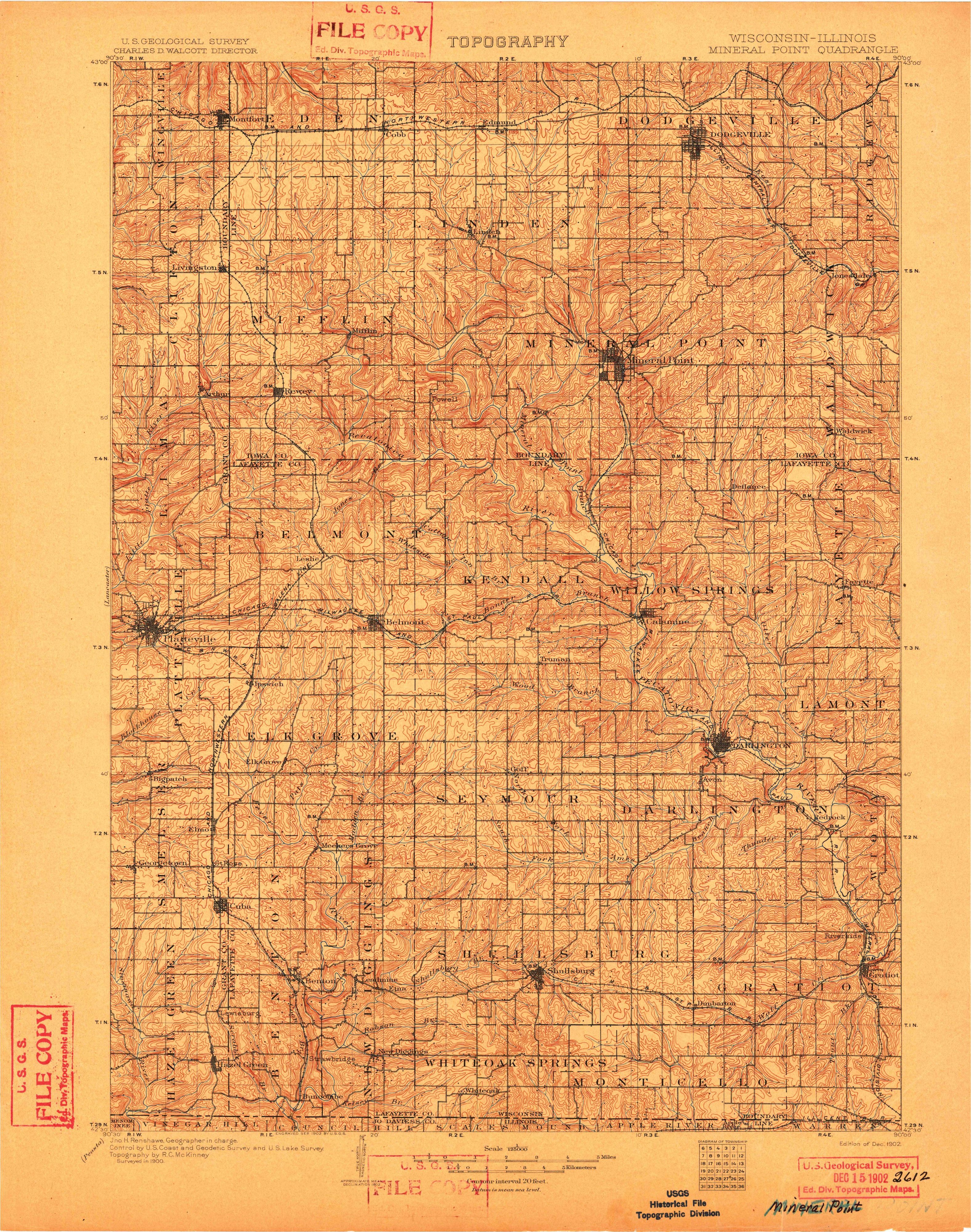
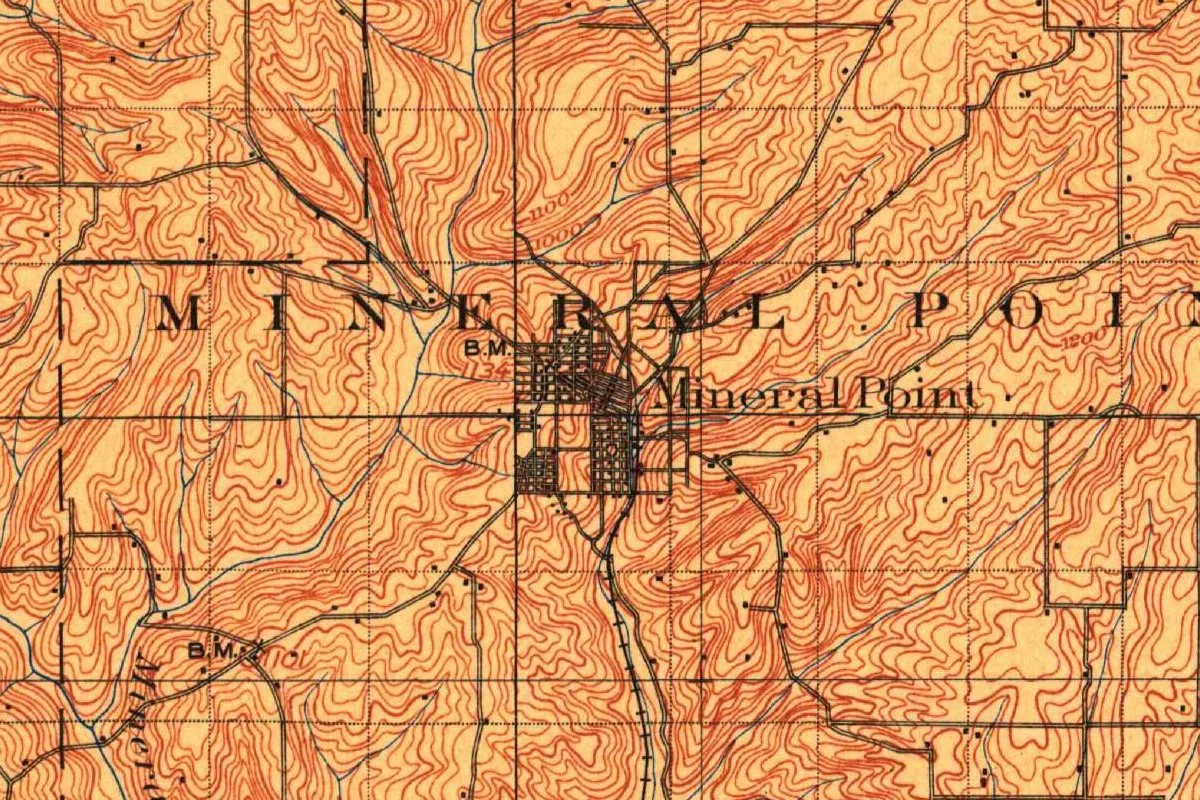
The Geological Survey’s Mineral Point sheet, surveyed in 1900 and published in December 1902, puts the town in its setting. The streets squeeze in where several valleys meet, surrounded by tightly packed contour lines, and a railroad runs south out of town. Across the sheet, the name of the surrounding town of Mineral Point is spelled out in big spaced capitals, the way the map labels each township. The 1881 history says the first squatters built their cabins and dug “hap-hazard,” and the streets later laid out around them were cut “into all sorts of shapes.” On the map, you can see it. Other mining towns, from Galena to Leadville, Colorado, took their names from their ore, too. Mineral Point kept a mystery on the end of its own.
Quick answers
Why is Mineral Point, Wisconsin, called Mineral Point?
Because of its lead. The Wisconsin Historical Society says the city “was named after its lead mines,” and the 1881 county history says the name came from the area’s mineral resources.
What does the “Point” in Mineral Point mean?
No source found for this page explains it. The 1881 county history calls the place “the Point” and mentions “the diggings on the ‘Point,’” but it doesn’t say what the word first referred to or who chose it.
Why was Mineral Point called Shake-Rag?
There are two stories. The 1881 county history says bachelor miners hung a rag on a pole to signal mealtime; the town’s 1927 centennial book says housewives waved dishcloths to call the men home to pasties.
Key dates
- 1827Miners at Galena know there's lead ore in abundance in Iowa County, says the 1881 county history.
- 1829Mineral Point becomes the county seat of the new Iowa County, according to the Chamber of Commerce.
- 1835Charles Bracken surveys the miners' claims about the "Point" for the settlers.
- 1836July 4: Henry Dodge is inaugurated in Mineral Point as the first governor of Wisconsin Territory.
- 1902The Geological Survey's Mineral Point sheet is published, from a survey of 1900.
- 1935Robert Neal and Edgar Hellum begin restoring Cornish stone cottages, the start of Pendarvis.
- 1971The Wisconsin Historical Society acquires Pendarvis and runs it as a historic site.
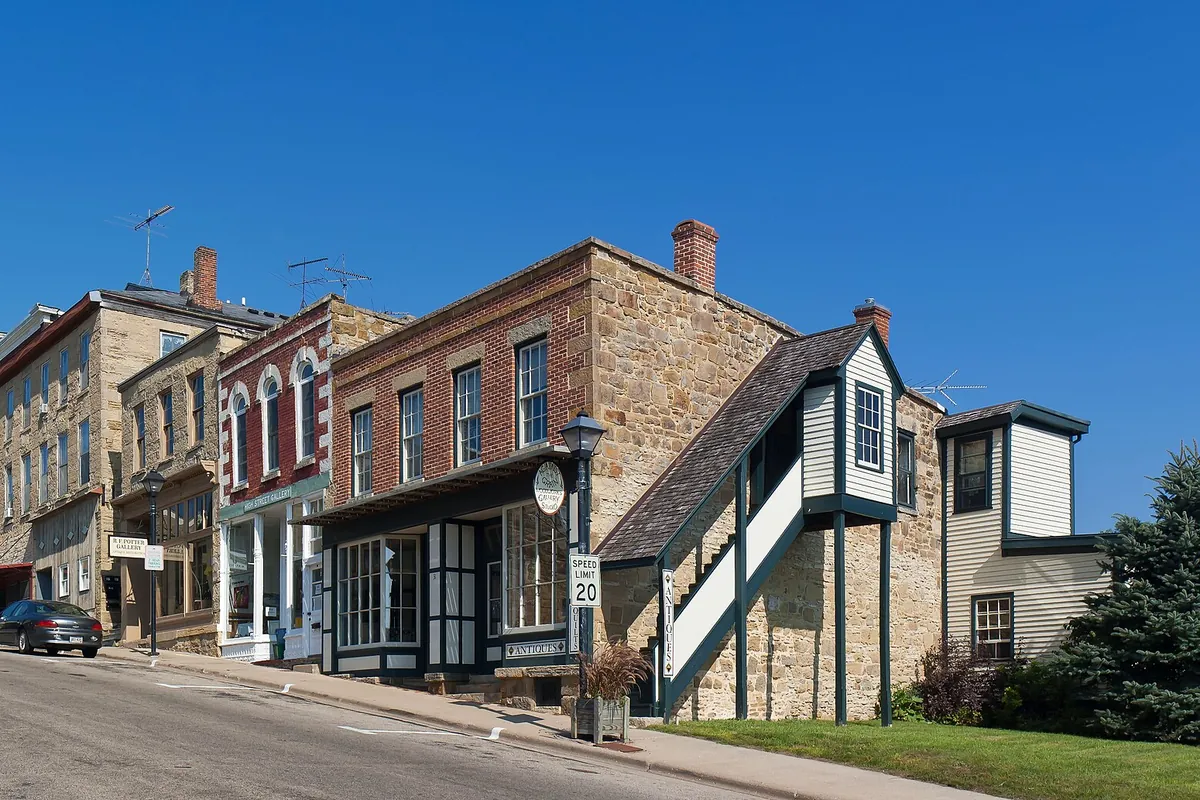
Things to do in Mineral Point, Wisconsin
Pendarvis
A Wisconsin Historical Society site of buildings from the early to middle 1800s, saved from 1935 on by Robert Neal and Edgar Hellum, which tells the story of Cornish immigration and the lead-mining years.
Merry Christmas Mine Hill
Trails across 43 acres at Pendarvis where, the Wisconsin Historical Society says, you can learn about the natural and historic landscape shaped by mining. The prairie restoration there began in 1988.
Mineral Point Railroad Museum
A museum in the restored former Milwaukee Road depot, run by the Mineral Point Railroad Society, with railroad artifacts, uniforms and a model of the valley around the depot as it looked around 1920.
Orchard Lawn
The 19th-century Italianate mansion and grounds that serve as headquarters of the Mineral Point Historical Society, a private nonprofit that offers tours of the estate.
Getting there
Open Mineral Point in Google Maps
Opens in a new tab. The pin is the center of Mineral Point in the USGS place-name record.
The closest airports, Amtrak stations and intercity bus stops, measured in a straight line from the center of Mineral Point.
Airports
- Dane County Regional/Truax Field (MSN) Madison 47 mi 75 km
- Chicago/Rockford International (RFD) 72 mi 115 km
- General Mitchell International (MKE) Milwaukee 116 mi 186 km
Amtrak trains
- Wisconsin Dells station (WDL) 57 mi 91 km
- Portage station (POG) 60 mi 96 km
Intercity buses
- Jefferson Lines Dubuque 35 mi 56 km
- FlixBus Madison WI - Univ. of Wisc. Wisconsin Hist. Soc. (MSN) 42 mi 68 km
- Van Galder (Coach USA) 250 N. Lake St - Madison UW Campus 42 mi 68 km
Distances are as the crow flies, not by road. We don't list schedules or fares because they change; check with the airline, Amtrak or the bus company before you go. Official data (FAA commercial service airports (2025), FAA airport locations, Amtrak stations and Intercity Bus Atlas) from the FAA and the U.S. Bureau of Transportation Statistics, checked Nov 17, 2026.
Sponsored
Staying in Mineral Point?
Compare hotels in Mineral Point, Wisconsin, on Expedia.
See hotels in Mineral PointWe may earn a commission if you buy through this link. It never changes what we write. Read our affiliate disclosure
Historical Sources & References
- Wisconsin Historical Society, “Lead Mining in Southwestern Wisconsin”. “The city was named after its lead mines,” the place names that “evoke an earlier time,” the 4,000 miners of 1829, the “badgers,” the Cornish, the departures of 1844 and 1849, and the zinc works.
- History of Iowa County, Wisconsin (1881), p. 651. “From which the name was derived,” the 35 miles (56 km) to Galena, and the streets cut “into all sorts of shapes.” Checked against the page image.
- History of Iowa County, Wisconsin (1881), p. 163. The lead region’s ore, “of one kind only, the sulphide known as galena,” in the chapter on the state’s history. Checked against the page image.
- History of Iowa County, Wisconsin (1881), pp. 652, 655, 660-661. The claims “about the ‘Point,’” Bracken’s survey of 1835 (p. 652); the 1827 passage and Indian smelting (p. 655); Stephen Taylor’s “diggings on the ‘Point,’” the rag on the pole, “Uncle Ab” Nichols and Palmer’s “Shake-Rag” (pp. 660-661). Checked against the page images.
- Henry Gannett, The Origin of Certain Place Names in the United States (1905), p. 209. “So named because of the abundance of ore in those regions.”
- Centennial Memory Book, Mineral Point (1927). The housewives, the dishcloths and the pasties.
- Wisconsin Historical Society, “History of Pendarvis”. Native lead mining before the 1600s, the miners of 1827 and treaty rights, the Cornish, Neal and Hellum, the $10 cottage, the pasties and the 1971 transfer.
- Mineral Point Chamber of Commerce, “History of Our Town”. The county seat in 1829, Henry Dodge’s inauguration on July 4, 1836, and the badger holes as the source of the state nickname.
- Pendarvis, Plan Your Visit; Mineral Point Railroad Museum; Mineral Point Historical Society. The details in the things-to-do list.
- GNIS feature 1569549 (U.S. Geological Survey). Mineral Point’s listing as a populated place in Iowa County and its coordinates.
- Mineral Point quadrangle, edition of December 1902. The sheet the map at the top was cropped from, surveyed in 1900, with a benchmark of 1134 feet (346 m).
Sponsored
Put this 1902 map on your wall
The Geological Survey's 1902 Mineral Point quadrangle, surveyed in 1900, is in the public domain. Download the full-size scan for free, then have it printed on canvas with CanvasOnTheCheap.
Print a map on canvasDownload the full-size mapWe may earn a commission if you buy through this link. It never changes what we write. Read our affiliate disclosure
Spot something wrong, or know more? Tell us here. You can also email us or use our contact page. Corrections are noted here with their date, never made silently.