Wisconsin Dells: Why Kilbourn City Changed Its Name
Wisconsin Dells began as Kilbourn City, platted in 1856 and named for Byron Kilbourn, president of the La Crosse & Milwaukee Railroad. In 1931 it officially became Wisconsin Dells, the name locals and visitors used for the area anyway. A 1912 study traced 'Dells' to the French dalles, meaning the narrows of a river.
Wisconsin Dells was platted in 1856 as Kilbourn City, for a railroad president, and in 1931 it switched to the name of the river’s rocky narrows. The Dells had been the draw from the start, and the town’s own first newspaper said so within months of the first house going up.
Why is it called Wisconsin Dells?
Because of the river. The Dells are the stretch of the Wisconsin River where it runs between sandstone cliffs, and the Wisconsin Dells Visitor & Convention Bureau says that when the town changed its name in 1931, it took “the name the locals and tourists had always used.” The local tourism site dells.com tells it the same way: locals and visitors “never stopped referring to the area as the ‘Dells’.”
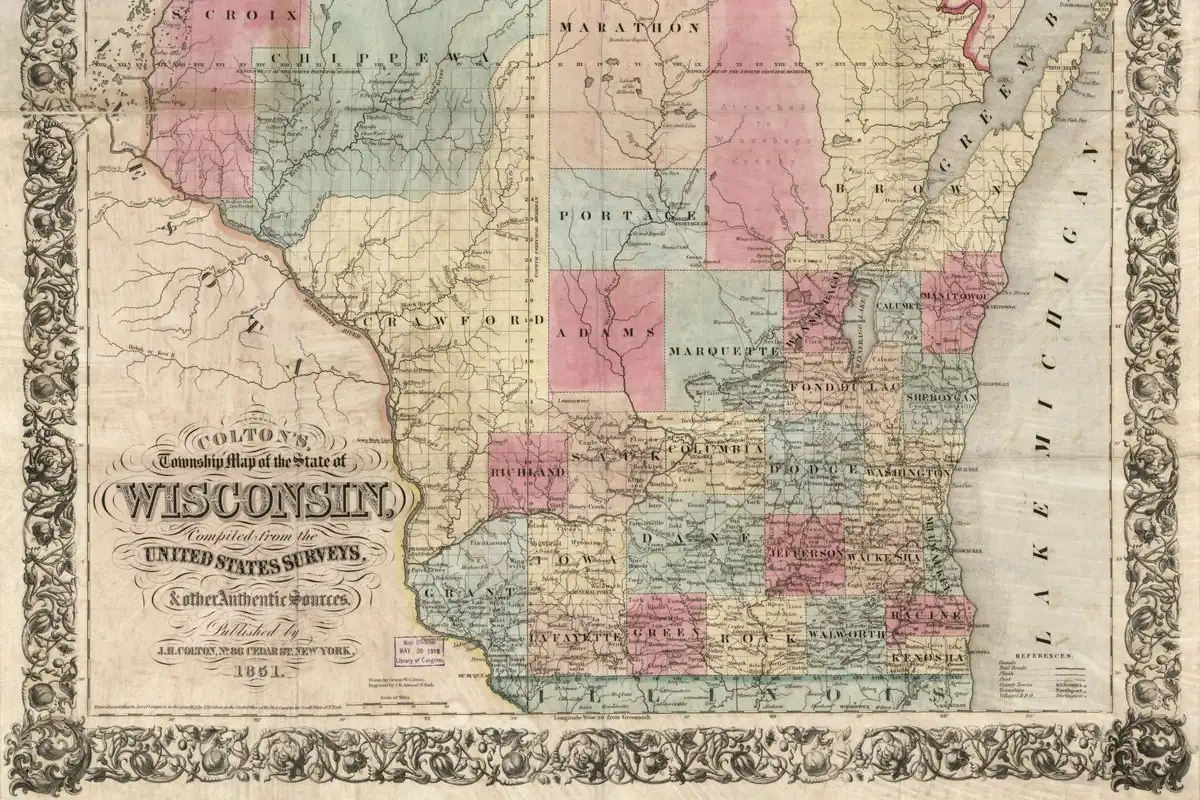
The river gave its name to the state as well, through a word whose meaning, Henry Legler wrote in 1898, is in dispute; you’ll find that story at Wisconsin. The town’s first name, though, came from the railroad.
Kilbourn City and the railroad president
The most detailed early account appears in The History of Columbia County, Wisconsin, edited by C. W. Butterfield and published by the Western Historical Company in 1880. It says the Wisconsin River Hydraulic Company bought the land in the summer of 1855. Alanson Holly arrived that November to start a newspaper, the Wisconsin Mirror, and printed the first issue on January 1, 1856, with hardly another house within half a mile (0.8 km). The village was laid out in June 1856, and the plat was put on record on June 10.
“The new village in the woods was now christened Kilbourn City,” the history says, “so named in honor of Byron Kilbourn, President of the La Crosse & Milwaukee Railroad.” Holly’s Mirror defended the choice on June 17, 1856, and you can hear the town’s hopes in it: “Under ordinary circumstances we should be opposed to naming a town after a person,” it began, but Kilbourn “is the body and soul of the La Crosse Railroad,” and the town sat about midway along the line, where it crossed the state’s largest river. The paper liked the sound, too: “It has but two syllables and is euphonious.” And it ended on this line: “as the place is honored by the name, it is expected that the name will be honored by the place.” J. E. Jones’s 1914 county history repeats, more briefly, the plat date and the Mirror’s approval a week later.
Kilbourn’s name was already known in Milwaukee, where, in a long quarrel over how to spell the city’s last syllable, he held out for “kie”; that story is at Milwaukee. By 1905, when Henry Gannett got to Kilbourn City in his guide to the roots of American place names for the Geological Survey, the railroad man had become simply “Byron Kilbourn, a pioneer.”
A modern telling skips the newspaper. Dave Rambow, who manages the H. H. Bennett Studio historic site, told Wisconsin Public Radio in 2022 that Kilbourn “was not a modest man, so he founded this city in 1857 and named it after himself.” The 1880 history puts the name on the plat in 1856 and doesn’t say Kilbourn picked it. Dells.com says the railroad itself arrived in 1857.
Kilbourn City had a rival. Butterfield’s history describes Newport, a village that in 1857 promised to keep up a ferry and agreed to build a station house to get a railroad depot, then lost half its people within a year; its last firm left in October 1860.
Railroad presidents put their names on towns in other states too. In 1879 the Milwaukee Road laid out Mitchell, South Dakota, and named it for its president, Alexander Mitchell. And Billings, Montana, carries the name of Northern Pacific president Frederick Billings, even though a 1905 list credited his son Parmly.
What does Dells mean?
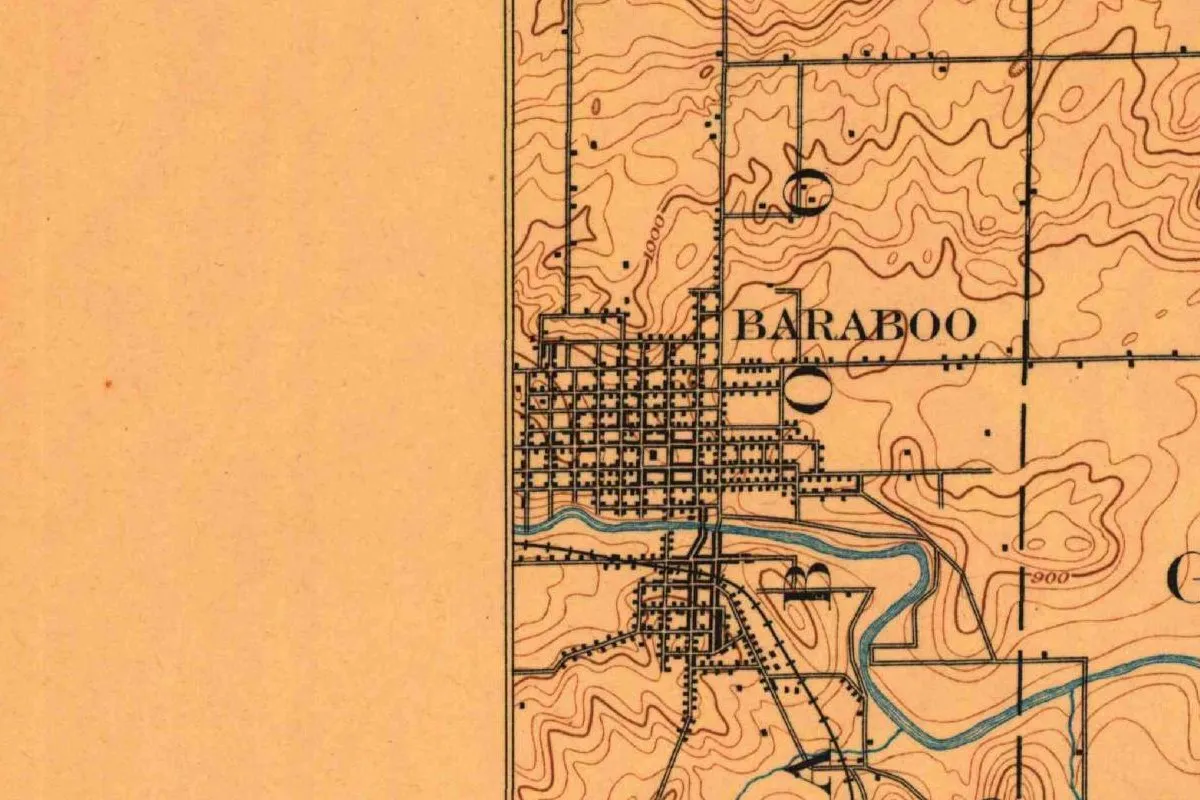
The earliest explanation we found comes from H. E. Cole’s 1912 study of place names in neighboring Sauk County, the same one used for Baraboo. He wrote that “Dells,” as used for the region along the river above and below Kilbourn, “comes from the French, Dalles, meaning the narrows of a river or between the cliffs.” He had “no doubt” that early Frenchmen gave the place the name, and added that it “appears as early as 1845 as shown by the government plats of the surveys.”
Dells.com says the “Dalles” of the Wisconsin was a landmark for French explorers in the 1700s. The visitors bureau offers its own definitions, “layers of flat rock” for dalles and “dark rushing waters” for Wisconsin. Those are the bureau’s readings; Cole’s book is the older source.
From Kilbourn to Wisconsin Dells
The Mirror saw the tourist business coming early. Dells.com quotes Holly writing on March 25, 1856, that “the wild, romantic scenery of the Dells will always make them a place of resort for seekers of pleasure.” Rambow told WPR that Leroy Gates, a logger and river pilot, began rowing tourists through the Dells in 1857. The visitors bureau says H. H. Bennett opened his photography studio in 1875. It calls him “the man who made Wisconsin Dells famous,” and his best-known picture, “Leaping the Chasm,” caught his son Ashley in midair between two rock ledges.
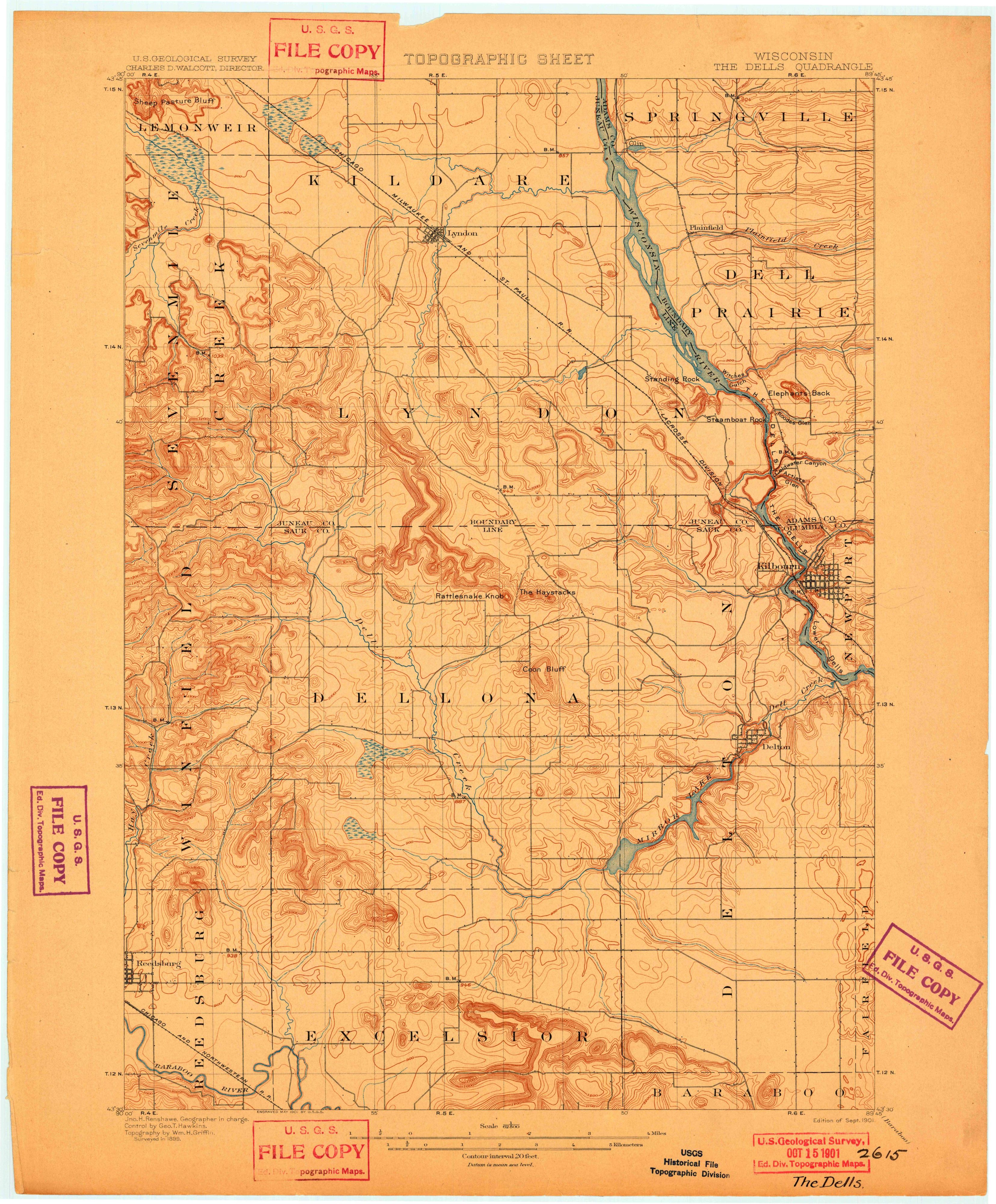
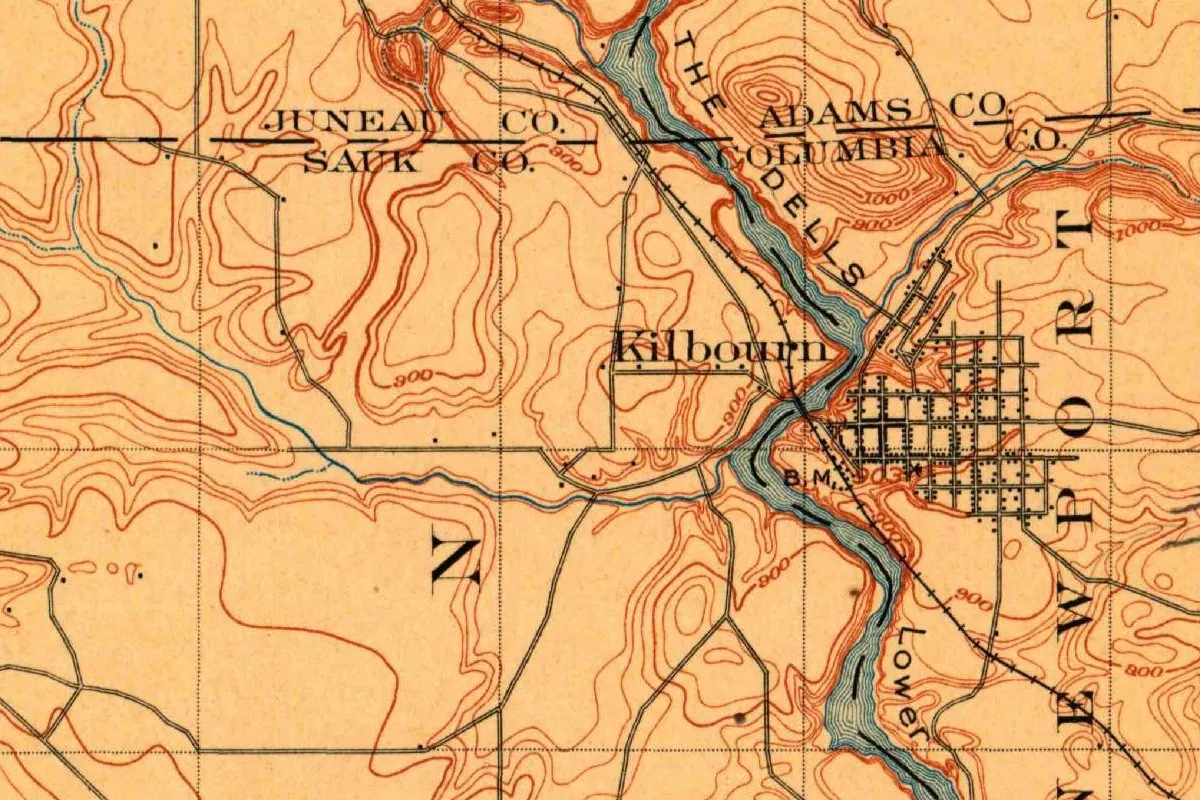
The 1901 survey map calls the town just Kilbourn, and so does dells.com when it describes the change: in 1931 “the city of Kilbourn officially changed its name to Wisconsin Dells.” Rambow gave WPR the reason: to make it easier for the tourists already coming to find the place. In 1946, the visitors bureau says, Mel Flath brought the first Ducks, World War II land-and-water vehicles, and started a tour company.
Wisconsin Dells on the 1901 map
Above the article is a crop of The Dells quadrangle, Wisconsin, at 1:62,500, from the years when Charles D. Walcott directed the Geological Survey. The margin credits Jno. H. Renshawe as geographer in charge, control by Geo. T. Hawkins and topography by Wm. H. Griffin, “Surveyed in 1899.” It was engraved in May 1901, and this copy is the “Edition of Sept. 1901,” stamped by the Survey on October 15, 1901.
In the crop, Kilbourn is lettered on one bank of the river, and the street grid lies on the other. THE DELLS is printed along the river to the north of town on the map and Lower to the south, the railroad crosses the river at town, and NEWPORT, the town (township) Kilbourn City stood in, runs in large letters down the right side. The county lines of Juneau, Sauk, Adams and Columbia meet nearby.
Quick answers
What was Wisconsin Dells called before?
Kilbourn City, from its 1856 plat, later shortened to Kilbourn. It became Wisconsin Dells in 1931.
Who was Kilbourn City named after?
Byron Kilbourn, who headed the La Crosse & Milwaukee Railroad, says the 1880 county history.
What does the word Dells mean?
In H. E. Cole’s 1912 explanation, it’s from the French dalles, “the narrows of a river or between the cliffs.”
Why did Kilbourn change its name?
The visitors bureau says Wisconsin Dells was the name people already used, and a local historian told WPR the change was meant to help tourists find the town.
Key dates
- 1845The word Dells appears on government survey plats, according to H. E. Cole.
- 1855The Wisconsin River Hydraulic Company buys the land; Alanson Holly arrives in November.
- 1856The Wisconsin Mirror first appears on January 1; the plat of Kilbourn City is recorded on June 10.
- 1857The railroad reaches the river crossing, and Leroy Gates starts rowboat tours of the Dells.
- 1860The last firm leaves the rival village of Newport, Butterfield says.
- 1875H. H. Bennett opens his photography studio in town.
- 1901The Dells quadrangle, surveyed in 1899, labels the town Kilbourn.
- 1931Kilbourn officially changes its name to Wisconsin Dells.
- 1946Mel Flath brings the first amphibious Ducks to the Dells.
Things to do in Wisconsin Dells, Wisconsin
Dells of the Wisconsin River State Natural Area
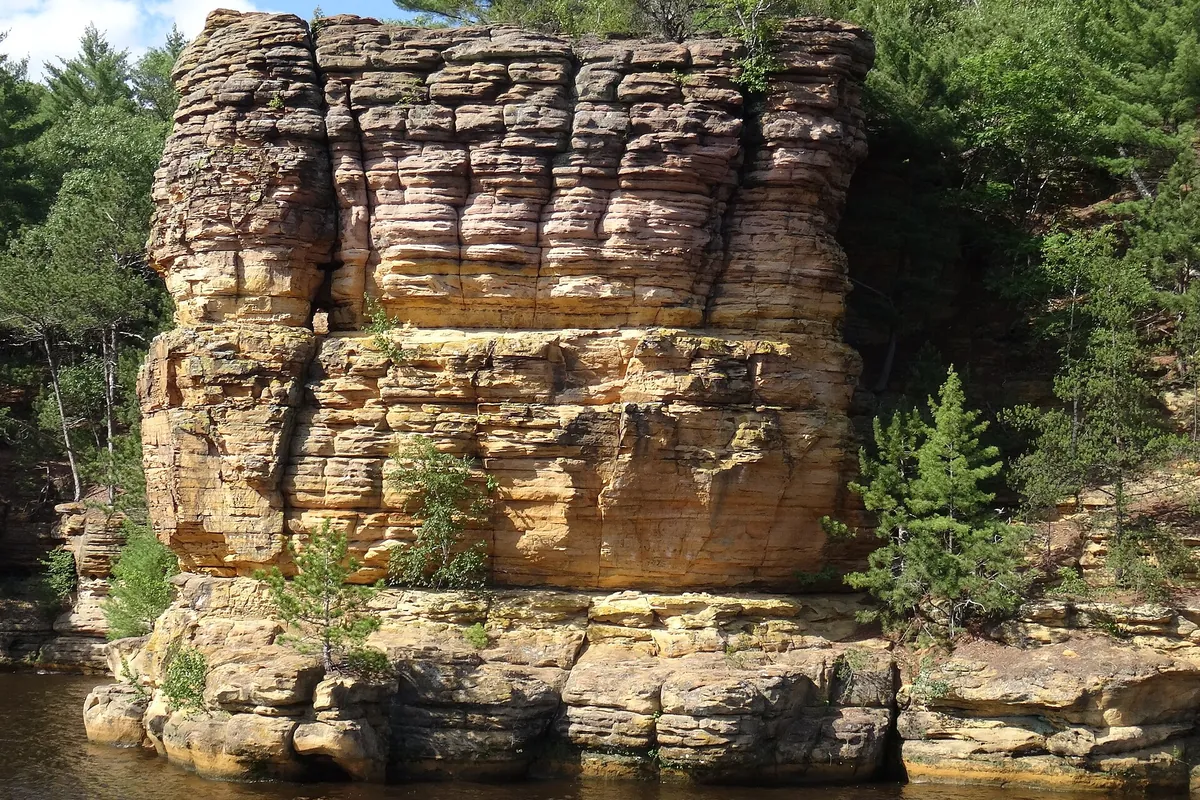
More than five miles (8 km) of river gorge where cliffs of Cambrian sandstone, formed 510 to 520 million years ago, rise over 100 feet (30 m). The Cambrian Overlook on the west bluff looks out over the Upper Dells and the cliffs called the Palisades.
Mirror Lake State Park
A 2,200-acre (890 ha) state park named for its lake, often still enough to reflect the woods and sandstone cliffs, up to 50 feet (15 m) high, along its shore.
Upper Dells boat tour
A cruise above the dam, past sandstone formations and through the Narrows, with stops ashore at Witches Gulch and at Stand Rock, a tall sandstone pillar known for its dog leap.
Lower Dells boat tour
A cruise below the dam along high sandstone cliffs to formations such as Hawk's Bill and the Rocky Islands, with stories of the river's lumber and Native American past.
Getting there
Open Wisconsin Dells in Google Maps
Opens in a new tab. The pin is the center of Wisconsin Dells in the USGS place-name record.
The closest airports, Amtrak stations and intercity bus stops, measured in a straight line from the center of Wisconsin Dells.
Airports
- Dane County Regional/Truax Field (MSN) Madison 40 mi 65 km
- Appleton International (ATW) 76 mi 122 km
- General Mitchell International (MKE) Milwaukee 105 mi 170 km
Amtrak trains
- Wisconsin Dells station (WDL) under 1 mi 0.5 km
- Portage station (POG) 16 mi 26 km
Intercity buses
- FlixBus Wisconsin Dells Commerce Street 3 mi 6 km
- Jefferson Lines Wisconsin Dells 4 mi 6 km
- Van Galder (Coach USA) 250 N. Lake St - Madison UW Campus 43 mi 69 km
Distances are as the crow flies, not by road. We don't list schedules or fares because they change; check with the airline, Amtrak or the bus company before you go. Official data (FAA commercial service airports (2025), FAA airport locations, Amtrak stations and Intercity Bus Atlas) from the FAA and the U.S. Bureau of Transportation Statistics, checked Nov 18, 2026.
Sponsored
Staying in Wisconsin Dells?
Compare hotels in Wisconsin Dells, Wisconsin, on Expedia.
See hotels in Wisconsin DellsWe may earn a commission if you buy through this link. It never changes what we write. Read our affiliate disclosure
Historical Sources & References
- The History of Columbia County, Wisconsin (1880), pp. 807-809. The hydraulic company, Holly and the Mirror, the plat of June 10, 1856, the name Kilbourn City and the Mirror of June 17, 1856, and the end of Newport. Checked against the page image for p. 809.
- J. E. Jones, A History of Columbia County (1914), pp. 251-252. A shorter retelling of the plat date and the Mirror’s approval; it doesn’t add an independent account.
- Henry Gannett, The Origin of Certain Place Names in the United States (1905), p. 175. Kilbourn City “named for Byron Kilbourn, a pioneer.” Checked against the page image.
- H. E. Cole, Baraboo and Other Place Names in Sauk County (1912), pp. 24-25. Dells from the French Dalles, and the name on survey plats by 1845. Checked against the page images.
- Wisconsin Dells Visitor & Convention Bureau, “History”. The name change of 1931, the bureau’s definitions, Bennett’s studio of 1875 and the Ducks of 1946.
- Dells.com, “History”. The French “Dalles,” the railroad of 1857, Holly’s line of March 25, 1856, and the change of 1931.
- Rachael Vasquez, WPR (2022). Dave Rambow on Kilbourn, Leroy Gates and the reason for the 1931 change.
- Wisconsin DNR pages on the Dells of the Wisconsin River and Mirror Lake; Dells Boat Tours. The details in the things-to-do list.
- U.S. Geological Survey, GNIS feature 1576900. Wisconsin Dells in Columbia County.
- The Dells quadrangle, surveyed 1899, edition of September 1901. The sheet the map at the top was cropped from.
Sponsored
Put this 1901 map on your wall
The Geological Survey's 1901 sheet for The Dells, surveyed in 1899, still labels the town Kilbourn and is in the public domain. Download the full-size scan for free, then have it printed on canvas with CanvasOnTheCheap.
Print a map on canvasDownload the full-size mapWe may earn a commission if you buy through this link. It never changes what we write. Read our affiliate disclosure
Spot something wrong, or know more? Tell us here. You can also email us or use our contact page. Corrections are noted here with their date, never made silently.