What Does Yuma Mean? Smoke, a Chief's Son or the River
Yuma is named for the Yuma people, today's Quechan, and Arizona's territorial legislature gave the name to Arizona City on February 3, 1873. The word's meaning is disputed: the National Park Service traces it to humo, Spanish for smoke; Hodge's 1910 handbook gives Yahmáyo, 'son of the captain'; and Gannett wrote 'sons of the river.'
Yuma, Arizona, took its name in 1873 from the Yuma people, and what that name means depends on whether you ask the Park Service, Hodge or Gannett. The people themselves, today’s Quechan, have their own name, and it isn’t Yuma.
Three meanings for one word
Henry Gannett says the city, like the county, is named for an Indian tribe. What the tribe’s name means is another matter.
Smoke. The National Park Service, in its article on the Yuma Crossing National Heritage Area, gives the word a Spanish origin. Hernando de Alarcón and Melchior Díaz reached the crossing in 1540, it says, and “these Spanish explorers coined the name Yuma.” The explorers saw smoke from the Native people’s cooking fires hanging over the valley, so they called them the Yumas, “stemming from the Spanish word for smoke, humo.”
A chief’s son. Frederick Webb Hodge’s Handbook of American Indians North of Mexico, published by the Bureau of American Ethnology in 1910, has a different story, credited to a writer named Hardy. Its entry reads:
“Yuma (Yahmáyo, ‘son of the captain,’ seemingly the title of the son of the hereditary chief, contracted and applied to the tribe through misunderstanding by the early Spanish missionaries.—Hardy. They call themselves Kwichána).” (Hodge, p. 1010)
So in this version the word is the people’s own, a title that the missionaries mistook for the name of the whole tribe.
Sons of the river. Henry Gannett’s Origin of Certain Place Names in the United States, from 1905, gives a third reading. His entry covers Yuma County and the city in Arizona and the county and town in Colorado, all “named for an Indian tribe, the name meaning ‘sons of the river.’” He doesn’t say where he got that.
Note the word “seemingly” in Hodge’s entry. And Gannett gives no source for his reading, so you’re left with three answers and no tiebreaker.
The Quechan at the crossing
Whatever the word means, the people it named were the ones who held the river. Hodge says they call themselves Kwichána, and he describes the Yuma as “one of the chief divisions, or tribes, of the Yuman family,” on either bank of the Colorado, upstream from the Cocopa and downstream from where the Gila comes in. Fort Yuma, he notes, sat about the center of their old territory. When Oñate came through in 1604 and 1605, he found them as the “Coahuanas,” which Hodge glosses as Cuchan.
The Park Service picks up the story at the crossing, where granite outcrops narrow and calm the Colorado. Juan Bautista de Anza arrived in January 1774 looking for an overland route to California and got on friendly terms with “the Quechans, who controlled the crossing.” Anza’s records also turn up in the story of Tucson, where they hold early spellings of that city’s name. Spanish attempts to control the crossing strained relations, the Park Service says, and led to a rebellion in 1781.
The Yuma weren’t the only people of that family on the river. When A. L. Kroeber traced the name of Mojave, California, in 1916, he described the Mohave as a tribe “of Yuman lineage” in the bottom lands of the Colorado.
Colorado City, Arizona City, Yuma
The town went through three names. The Park Service says the Gold Rush brought crowds through what was then called Colorado City, and in one year more than 60,000 travelers crossed the river there on a rope ferry. In 1852 the Army put Fort Yuma on Indian Hill, looking down on the crossing. In 1854 the Gadsden Purchase made the land south of the Gila, Yuma included, part of the United States. That’s the same James Gadsden whose name went on Gadsden, Alabama, in 1845, before the purchase. Fort Yuma also turns up in the story of Oatman, Arizona: it’s where Olive Oatman rejoined her brother after her release by the Mohaves.
A flood in 1862 wiped out Colorado City, the Park Service says, and the town came back as Arizona City. It was incorporated under that name in 1871. Then the territorial legislature stepped in. Its session laws for 1873 include “An Act to change the name of Arizona City,” and the wording is short:
“That the name of Arizona City, the county seat of Yuma county, be, and is hereby changed to ‘Yuma,’ and shall be known as such from and after the passage of this act.” (Acts of the Seventh Legislative Assembly, p. 39)
It was approved on February 3, 1873. As the act’s own wording shows, Yuma County already had the name. The national names database now lists the city in Yuma County, Arizona.
The prison came next. Arizona State Parks says construction started on April 28, 1876, prisoners helped build their own cells, and the first seven moved in on July 1. The railroad arrived in 1877, the Park Service says, and the prison stayed open until overcrowding closed it in 1909.
Yuma on the 1903 map
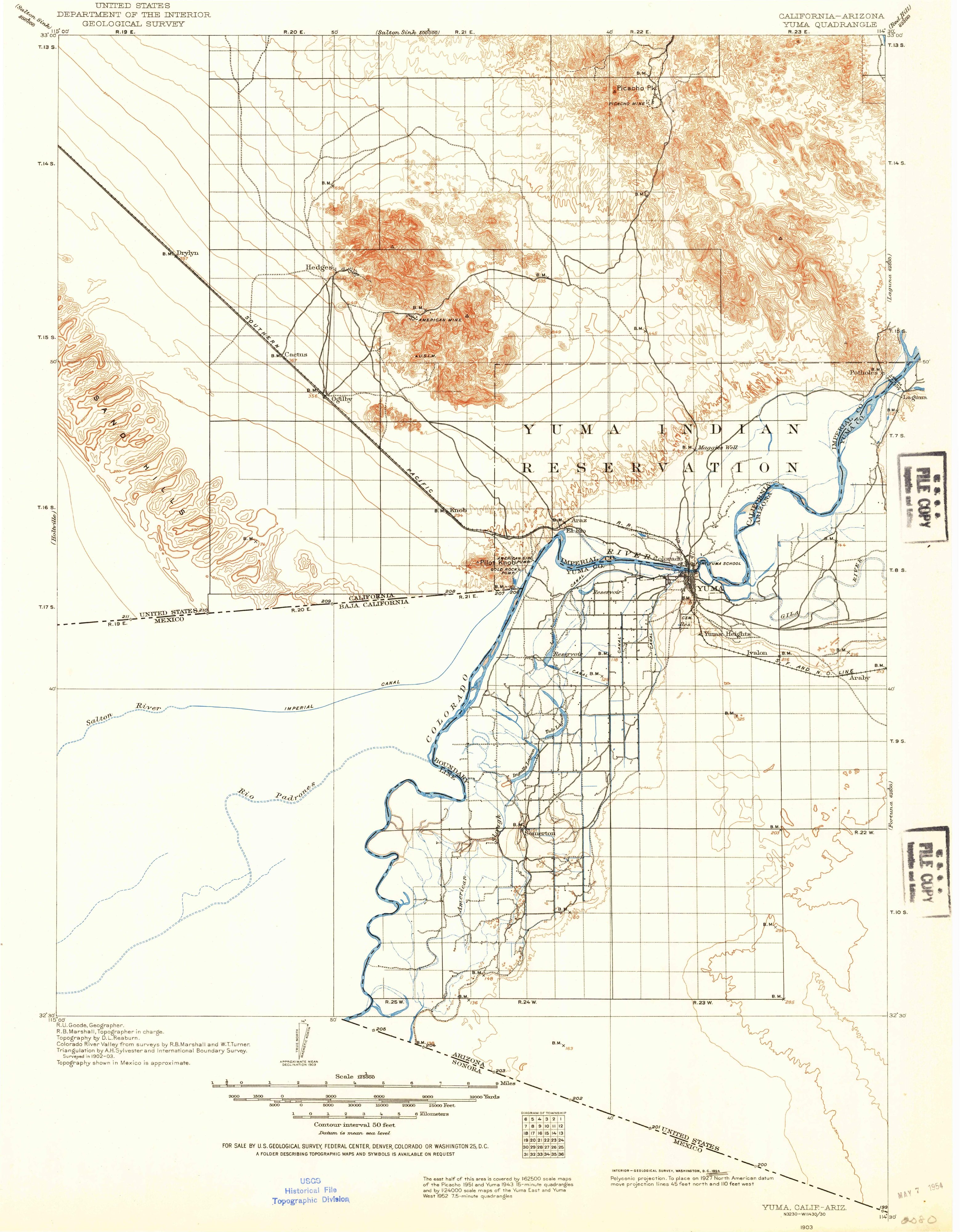
The map at the top comes from the Geological Survey’s Yuma quadrangle, a sheet covering parts of California and Arizona at 1:125,000. R. U. Goode is named as geographer and R. B. Marshall as topographer in charge, with topography by D. L. Reaburn. The Colorado River valley came from surveys by Marshall and W. T. Turner, and the triangulation from A. H. Sylvester and the International Boundary Survey. It says “Surveyed in 1902-03” and carries the date 1903. The printer’s line at the bottom reads 1954, though, and so does a stamp, so this copy is a 1954 printing of the 1903 edition.
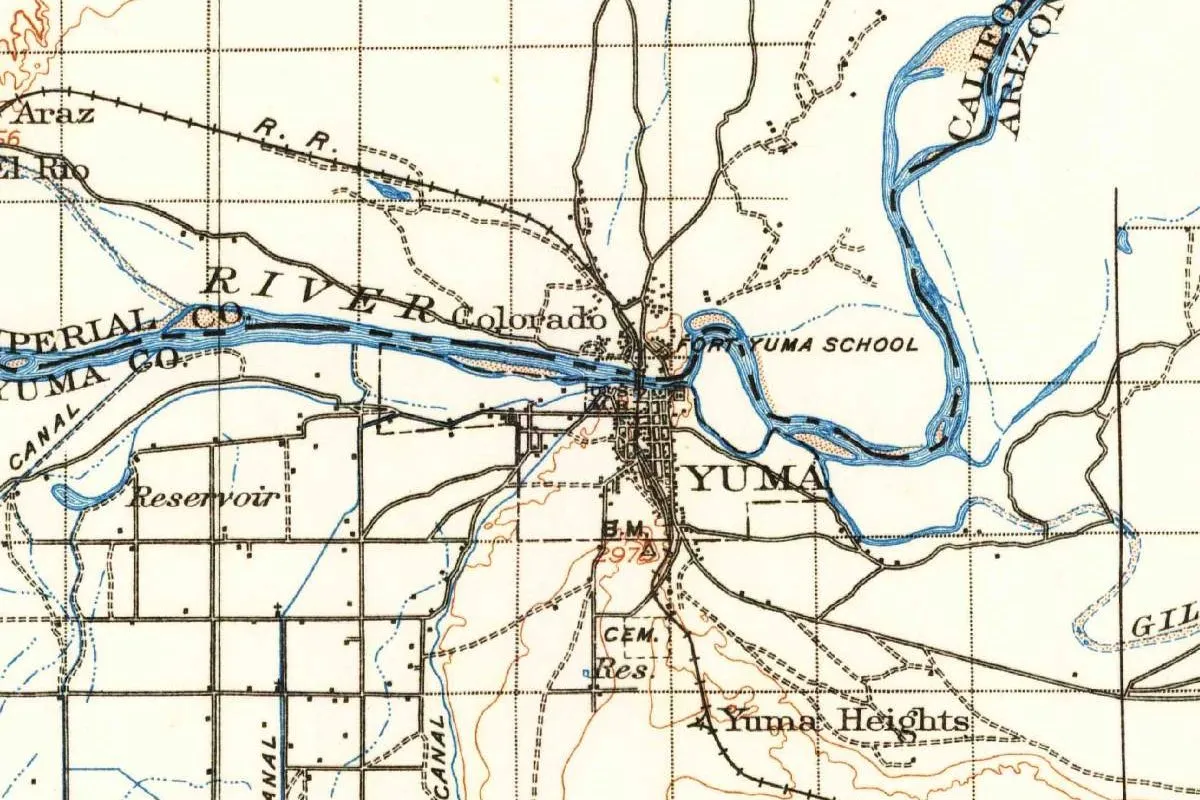
In the crop, YUMA sits on the south bank, with Yuma Heights, a cemetery and a reservoir nearby. Across the Colorado, on the California side, the sheet marks FORT YUMA SCHOOL. You can also find a canal, the railroad marked R.R., the names Araz and El Rio, and the county labels IMPERIAL CO. and YUMA CO.
Quick answers
What does Yuma mean?
It’s disputed. The National Park Service traces it to humo, Spanish for smoke; Hodge’s handbook gives Yahmáyo, “son of the captain”; Gannett gives “sons of the river.”
Who named Yuma, Arizona?
The territorial legislature, which renamed Arizona City by an act approved February 3, 1873. The town took the name of the people and of the county it was already the seat of.
What was Yuma called before?
Colorado City, then Arizona City after the flood of 1862, by the Park Service’s account.
What do the Yuma people call themselves?
Kwichána, according to Hodge in 1910. Today they’re the Quechan, the name the Park Service and the Heritage Area use.
Key dates
- 1540Spanish expeditions under Alarcón and Díaz reach the crossing; the Park Service says they coined the name Yuma.
- 1774Juan Bautista de Anza crosses in January and gets on friendly terms with the Quechans, who control the crossing.
- 1781Strained relations with the Spanish lead to a Quechan rebellion.
- 1852The Army sets up Fort Yuma on Indian Hill, above the crossing.
- 1854The Gadsden Purchase makes the land south of the Gila, Yuma included, part of the United States.
- 1862A flood destroys Colorado City; the town is renamed Arizona City, by the Park Service's account.
- 1871Arizona City is incorporated.
- 1873On February 3 the territorial legislature changes the name of Arizona City to Yuma.
- 1876Work on the territorial prison starts April 28; the first seven inmates arrive July 1.
- 1877The first railroad train enters Arizona at Yuma.
- 1903The Geological Survey issues its Yuma quadrangle, surveyed in 1902 and 1903; the copy shown here was printed in 1954.
Things to do in Yuma, Arizona
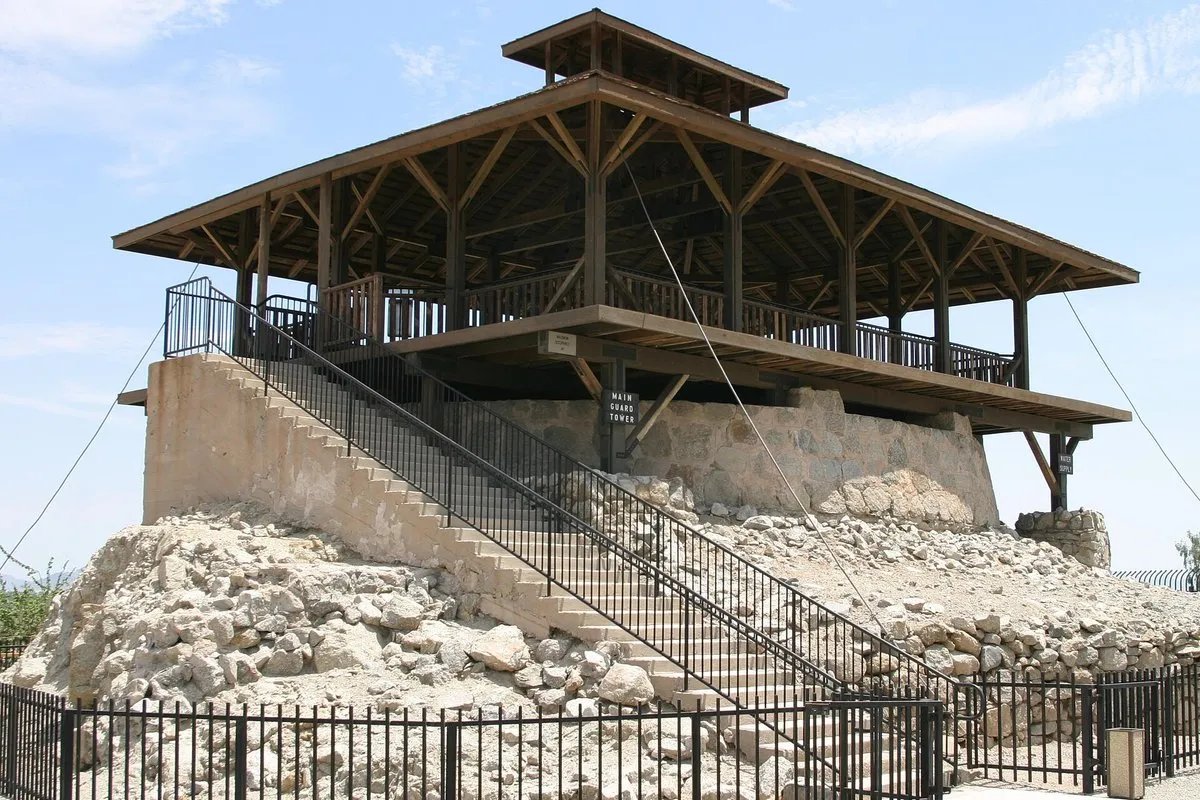
Yuma Territorial Prison State Historic Park
The ruins of Arizona Territory's first prison, on a bluff above the Colorado, where you can walk through the strap-iron cells and the solitary chamber. It held prisoners for 33 years, among them the stagecoach robber Pearl Hart.
Colorado River State Historic Park
Part of the grounds of the Army's Yuma Quartermaster Depot of 1864, which supplied forts across the Southwest. The 10-acre (4 ha) park keeps five buildings from the depot's earliest days.
Pivot Point
An outdoor exhibit on the spot where the first train entered Arizona in 1877, with a 1907 Baldwin steam engine, restored, and the concrete pivot the old rail bridge turned on to let steamboats by.
Yuma East Wetlands
Nearly 400 acres (162 ha) of river bottom turned from a dump into marsh, mesquite, cottonwood and willow since 2004, in a partnership that includes the Heritage Area, the Quechan Indian Tribe and the City of Yuma.
Getting there
Open Yuma in Google Maps
Opens in a new tab. The pin is the center of Yuma in the USGS place-name record.
The closest airports, Amtrak stations and intercity bus stops, measured in a straight line from the center of Yuma.
Airports
- Yuma MCAS/Yuma International (NYL) 5 mi 8 km
- Palm Springs International (PSP) 133 mi 214 km
- San Diego International (SAN) 149 mi 240 km
Amtrak trains
- Yuma station (YUM) under 1 mi 0.9 km
Intercity buses
- FlixBus Yuma County Area Transit 2 mi 3 km
Distances are as the crow flies, not by road. We don't list schedules or fares because they change; check with the airline, Amtrak or the bus company before you go. Official data (FAA commercial service airports (2025), FAA airport locations, Amtrak stations and Intercity Bus Atlas) from the FAA and the U.S. Bureau of Transportation Statistics, checked Nov 18, 2026.
Sponsored
Staying in Yuma?
Compare hotels in Yuma, Arizona, on Expedia.
See hotels in YumaWe may earn a commission if you buy through this link. It never changes what we write. Read our affiliate disclosure
Historical Sources & References
- National Park Service, “Arizona: Yuma Crossing National Heritage Area”. Alarcón and Díaz in 1540, humo, Anza in 1774, the rebellion of 1781, Colorado City and the rope ferry, Fort Yuma in 1852, the Gadsden Purchase, Arizona City, incorporation in 1871, the rename of 1873, the prison and the railroad.
- Frederick Webb Hodge, ed., Handbook of American Indians North of Mexico, part 2 (1910), p. 1010. Yahmáyo, “son of the captain,” after Hardy; Kwichána; the Yuman family; Fort Yuma; Oñate and the “Coahuanas.” Checked against the page image.
- Henry Gannett, The Origin of Certain Place Names in the United States (1905), p. 333. Yuma in Arizona and Colorado “named for an Indian tribe, the name meaning ‘sons of the river.’” Checked against the page image.
- Acts, Resolutions and Memorials of the Seventh Legislative Assembly of Arizona Territory (1873), p. 39. The act changing Arizona City to Yuma, approved February 3, 1873. Checked against the page image.
- Arizona State Parks, Yuma Territorial Prison and Colorado River State Historic Park; Yuma Crossing National Heritage Area, Pivot Point and East Wetlands. The prison’s opening and the details in the things-to-do list.
- U.S. Geological Survey, GNIS feature 14111. Yuma in Yuma County.
- Yuma quadrangle, surveyed 1902-03, 1903 edition, 1954 printing. The sheet the map at the top was cropped from.
Sponsored
Put this 1903 map on your wall
The Geological Survey's 1903 Yuma sheet, surveyed in 1902-03 and shown here in a 1954 printing, with the town on the Colorado River, is in the public domain. Download the full-size scan for free, then have it printed on canvas with CanvasOnTheCheap.
Print a map on canvasDownload the full-size mapWe may earn a commission if you buy through this link. It never changes what we write. Read our affiliate disclosure
Spot something wrong, or know more? Tell us here. You can also email us or use our contact page. Corrections are noted here with their date, never made silently.