Central Park: Name, History and Visiting
Central Park got its name in an 1850s fight over where New York’s big park should go: a central tract in Manhattan, or Jones’ Wood on the East River. The central site won, and the name came with it, years before Frederick Law Olmsted and Calvert Vaux drew a single path.
Why Is Central Park Called Central Park?
Because “central” was the argument. New York City’s Landmarks Preservation Commission laid out the debate in its 1974 report on the park. The journalist William Cullen Bryant had been pushing for a park in his New York Evening Post since July 3, 1844, and he wanted it at Jones’ Wood, a stretch of woodland on the East River, from 68th to 77th Street.
The landscape architect Andrew Jackson Downing thought bigger. In the August 1851 issue of The Horticulturist, he called for a “central” park, 500 acres (about 200 hectares) or more, wrapped around the Croton Water Works’ receiving reservoir near 80th Street. That’s the word, in quotation marks, in the commission’s report.
Mayor Ambrose C. Kingsland asked the Common Council for parkland on April 5, 1851, and a bill to take Jones’ Wood followed three months later. Then the Board of Aldermen went another way and chose what the commission calls “a more central tract,” running from 59th to 106th Street between Fifth and Eighth avenues.
The city’s Municipal Archives puts a date on the name. In 1852, a special parks committee of the aldermen put forward “The Central Park” for exactly that rectangle. So the name described a location, and it was settled before anyone knew what the park would look like.
Central Park History: From the 1853 Act to Greensward
The chosen land was rough. The Municipal Archives describes a plot two miles (3.2 km) long and half a mile (0.8 km) wide, 778 acres (315 hectares) of schist outcrops and bogs where almost 1,600 people lived. State lawmakers acted on June 21, 1853, letting the mayor issue stock, called the Central Park Fund, to pay the 561 owners of more than 7,000 lots. The old Jones’ Wood law stayed on the books until it was repealed in 1854.
Some of those homes belonged to Seneca Village. The Central Park Conservancy says free Black New Yorkers began buying land there in 1825, along what’s now the park’s edge from West 82nd to 89th Street. By 1855 the village had 225 residents, roughly two in three of them Black and one in three Irish, with three churches and a school. When the city took the land in 1857, those families were pushed out, and historians didn’t rediscover the village until the 1990s.
A state-appointed board announced a design contest in October 1857. Its list of must-haves included at least four roads crossing the park, a parade ground, a fountain and a skating area. Vaux and Olmsted worked nights and weekends on their entry and, according to the Municipal Archives, had to wake a caretaker at the Arsenal late on March 31, 1858, to hand it in. It was logged as entry No. 33 under the name “Greensward,” a word for ground covered in green grass.
The commissioners picked it on April 28, 1858, and paid out the $2,000 top prize. The park later grew north to 110th Street: the board asked the legislature for the extra land in April 1859, and the fights over what that land was worth weren’t settled until 1863.
The park became a National Historic Landmark in 1963, and New York City made it a Scenic Landmark in 1974, according to the New York Preservation Archive Project.
What Was Central Park Called Before?
Nothing else, as far as the record shows. Jones’ Wood wasn’t an old name for Central Park; it was the rival site on the East River that lost. Greensward wasn’t a former name either. It was the title of Olmsted and Vaux’s winning plan, and the Municipal Archives points out how much of the park they set aside for open, grassy meadows.
If you see “Greensward” on an old drawing, you’re looking at a design. The park it was drawn for had already been called the Central Park since at least 1852.
Visiting Central Park
The Conservancy, which has cared for the park in partnership with the city since 1980, says the park opens at 6 a.m. and closes at 1 a.m. every day of the year. It covers 843 acres (341 hectares), so pick a corner instead of trying to see it all.
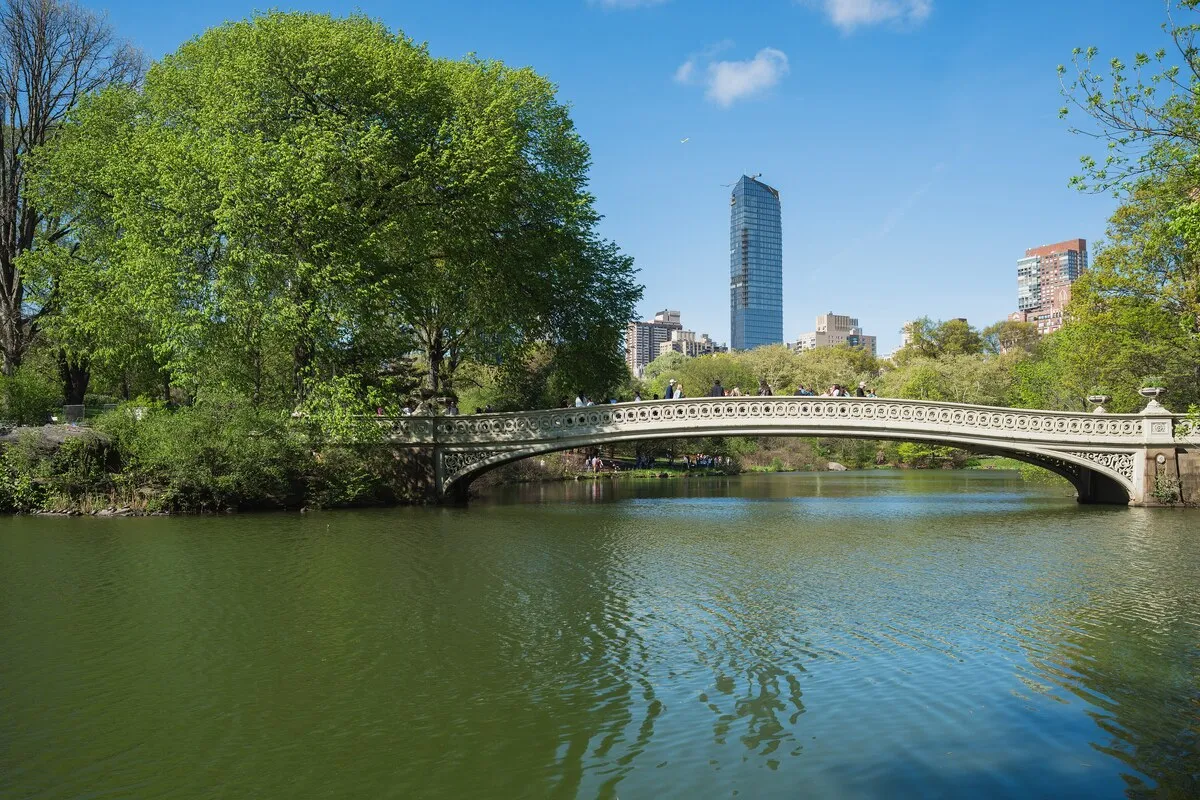
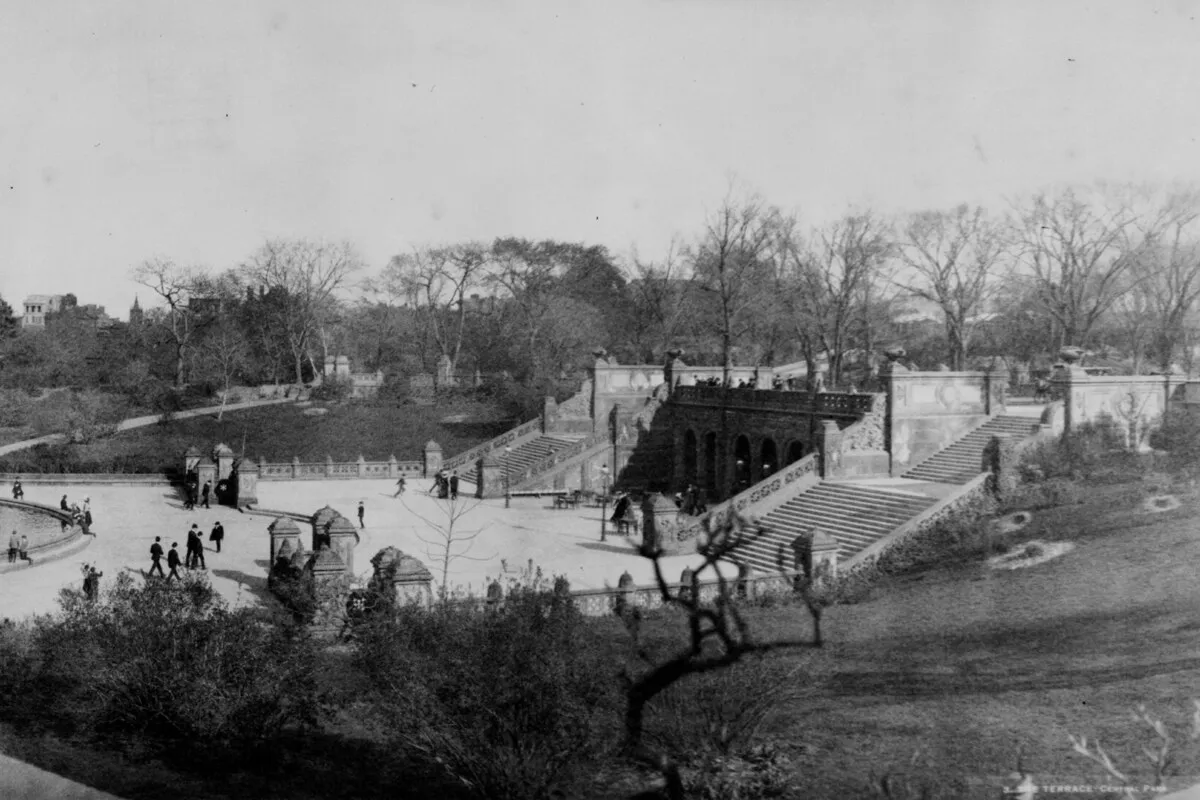
The Mall and the Terrace, from about 65th to 73rd Street, are the one formal piece of the plan, according to the 1974 landmark report. Bow Bridge, a cast-iron span, crosses the Lake. Farther north, the Great Lawn sits where the old Croton receiving reservoir was, the same reservoir Downing wanted his “central” park built around. On the west side between 82nd and 89th streets, a temporary Conservancy exhibit of outdoor signs marks where Seneca Village’s churches and homes stood.
The gates have a naming story of their own. The park commissioners named the 20 gates in the park’s wall in 1862 for the people of the city: Artisans, Artists, Merchants, Scholars, Mariners, Engineers, Women, Children and more. Clarence Cook wrote in 1869 that the names were meant to make “every working member of the community, whether he worked with his head or his hands, feel his personal ownership of the Park.” Three were later changed: Cultivators became Farmers, Explorers became Pioneers, and Foreigners became Strangers.
Central Park wasn’t New York’s only park with a place name built in. Madison Square Garden borrowed its name from Madison Square, and Madison Square Park opened to the public in 1847, while Bryant was still campaigning for something much bigger. And the island the park sits on has a name that’s still argued over: our New York City name guide explains why the meaning of Manhattan is still disputed.
Quick answers
Why Is Central Park Called Central Park?
For its location. In the early 1850s, New York’s aldermen picked “a more central tract” in Manhattan over Jones’ Wood on the East River, and a committee proposed “The Central Park” there in 1852, the Municipal Archives says.
What Was Central Park Called Before?
It wasn’t called anything else, in the sources we checked. Jones’ Wood was a competing site, and Greensward was the name of Olmsted and Vaux’s 1858 design.
Did Olmsted and Vaux Name Central Park?
No. The name was in use by 1852, and their plan didn’t win the design contest until April 28, 1858. They named their plan, Greensward, not the park.
Is Central Park Open All Night?
No. The Central Park Conservancy lists the hours as 6 a.m. to 1 a.m., every day of the year.
Key dates
- 1844William Cullen Bryant starts writing editorials for a park in the New York Evening Post.
- 1851Andrew Jackson Downing calls for a "central" park of at least 500 acres around the Croton reservoir.
- 1852A Board of Aldermen committee proposes "The Central Park" between Fifth and Eighth avenues, 59th to 106th streets.
- 1853On June 21, the state legislature authorizes the Central Park Fund to pay the landowners.
- 1857The city acquires the land; Seneca Village's residents are displaced. A design competition is announced.
- 1858Olmsted and Vaux's "Greensward" plan wins the competition on April 28.
- 1862The park commissioners name the gates in the park wall.
- 1863Disputes over the land for the extension to 110th Street are settled.
- 1974New York City designates Central Park a Scenic Landmark.
Getting there
Open Central Park in Google Maps
Opens in a new tab. The pin is an approximate point for Central Park.
The closest airports, Amtrak stations and intercity bus stops, measured in a straight line from the center of Central Park.
Airports
- Laguardia (LGA) New York 5 mi 8 km
- Newark Liberty International (EWR) 12 mi 20 km
Amtrak trains
- New York station (NYP) 3 mi 4 km
- Newark station (NWK) 11 mi 18 km
Intercity buses
- OurBus New York, NY (Upper West Side, Columbus Ave between W. 80th and W. 81st Streets) under 1 mi 0.7 km
- ShortLine Hudson Lexington Ave & E 86th St under 1 mi 0.9 km
- Monsey Trails 5th Ave & 47th St 2 mi 3 km
Distances are as the crow flies, not by road. We don't list schedules or fares because they change; check with the airline, Amtrak or the bus company before you go. Official data (FAA commercial service airports (2025), FAA airport locations, Amtrak stations and Intercity Bus Atlas) from the FAA and the U.S. Bureau of Transportation Statistics, checked Nov 20, 2026.
Sponsored
Planning a visit?
Compare hotels near Central Park on Expedia.
See hotels nearbyWe may earn a commission if you buy through this link. It never changes what we write. Read our affiliate disclosure
Historical Sources & References
- Landmarks Preservation Commission, Central Park designation report LP-0851 (1974). Bryant and Jones’ Wood, Downing’s “central” park (1851), Kingsland’s 1851 letter, the aldermen’s “more central tract,” the 1854 repeal, the gates named in 1862, the Mall, Terrace, Bow Bridge and Great Lawn.
- Sylvia Kollar, “The Greensward,” NYC Municipal Archives (2022). The 1852 committee proposal for “The Central Park,” the 1853 Central Park Fund, the size of the site and its residents, the 1857–1858 competition, the meaning of “Greensward,” and the extension to 110th Street.
- New York Preservation Archive Project, “Central Park”. National Historic Landmark (1963) and New York City Scenic Landmark (1974).
- National Park Service, “Central Park”. The 33 competition entries and the Greensward plan.
- Central Park Conservancy, “Seneca Village History”. The village from 1825, its 225 residents in 1855, and their displacement in 1857.
- Central Park Conservancy, “Central Park History”. The Conservancy’s founding in 1980 and the park’s 843 acres.
- Central Park Conservancy, “Visit”. Opening hours.
- Library of Congress, “The Terrace, Central Park” (1902), via Wikimedia Commons. The historic photograph on this page.
- U.S. Geological Survey, Geographic Names Information System, “Central Park”. Official federal record of the park’s name and location.
Spot something wrong, or know more? Tell us here. You can also email us or use our contact page. Corrections are noted here with their date, never made silently.