Navy Pier: Why Chicago Renamed Its Municipal Pier
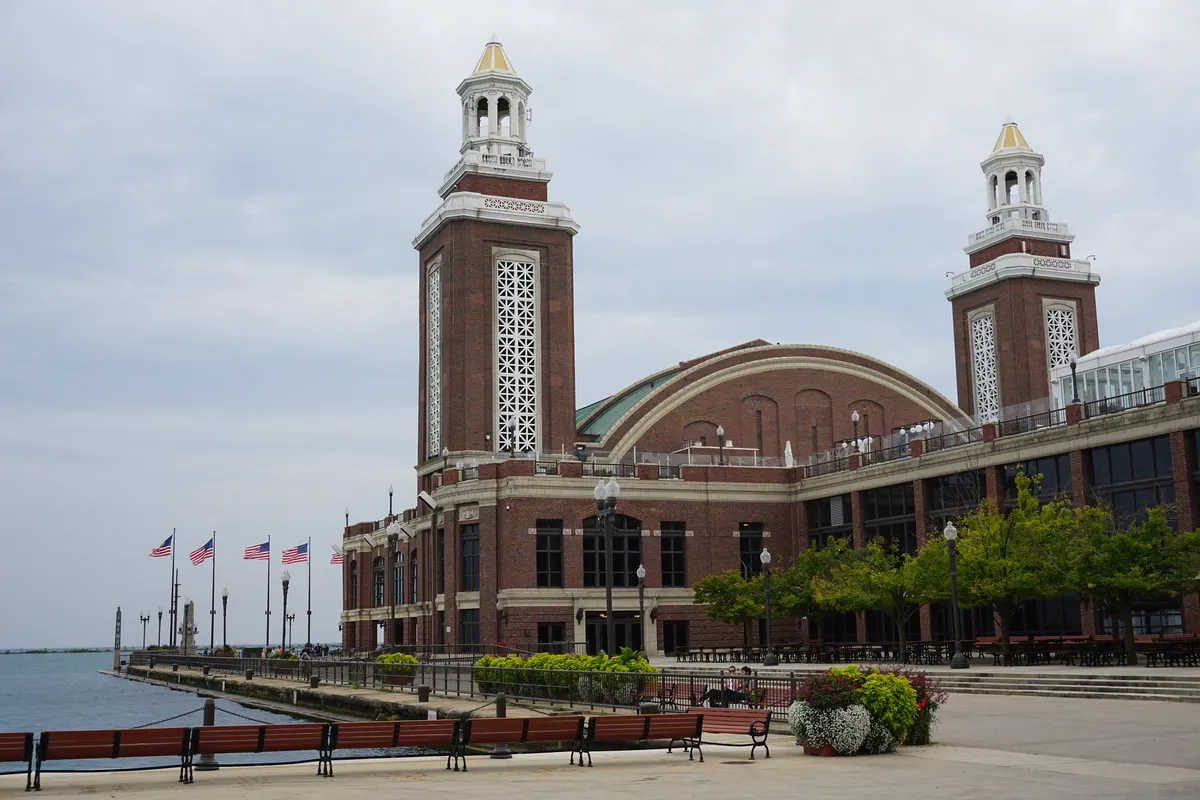
Navy Pier opened in Chicago in 1916 as Municipal Pier and took its Navy name in 1927, for the sailors who had lived and trained there in World War I. There’s more to it, though: a pier numbered “No. 2” with no No. 1 beside it, and three sources that don’t quite agree on whom the new name was honoring.
Navy Pier History: From Municipal Pier No. 2
The idea came from Daniel Burnham’s 1909 Plan of Chicago. The city’s landmark listing says the plan proposed a pair of big piers reaching out into Lake Michigan, and that this one was built for shipping, at a time when the city was a major inland port. The Chicago Architecture Center adds where Burnham wanted them, one at Chicago Avenue and one at Cermak Road, and says city planners liked the idea so much they proposed five.
Only one was built. Charles Sumner Frost designed it, and it opened in 1916 with two-story sheds for freight and passengers between a head house at the shore end and a ballroom at the far end, all resting on 20,000 wooden piles sunk into the lake bottom, the architecture center says. It was supposed to be a working dock and a place to relax at the same time, with picnic spots, a playground and streetcar service.
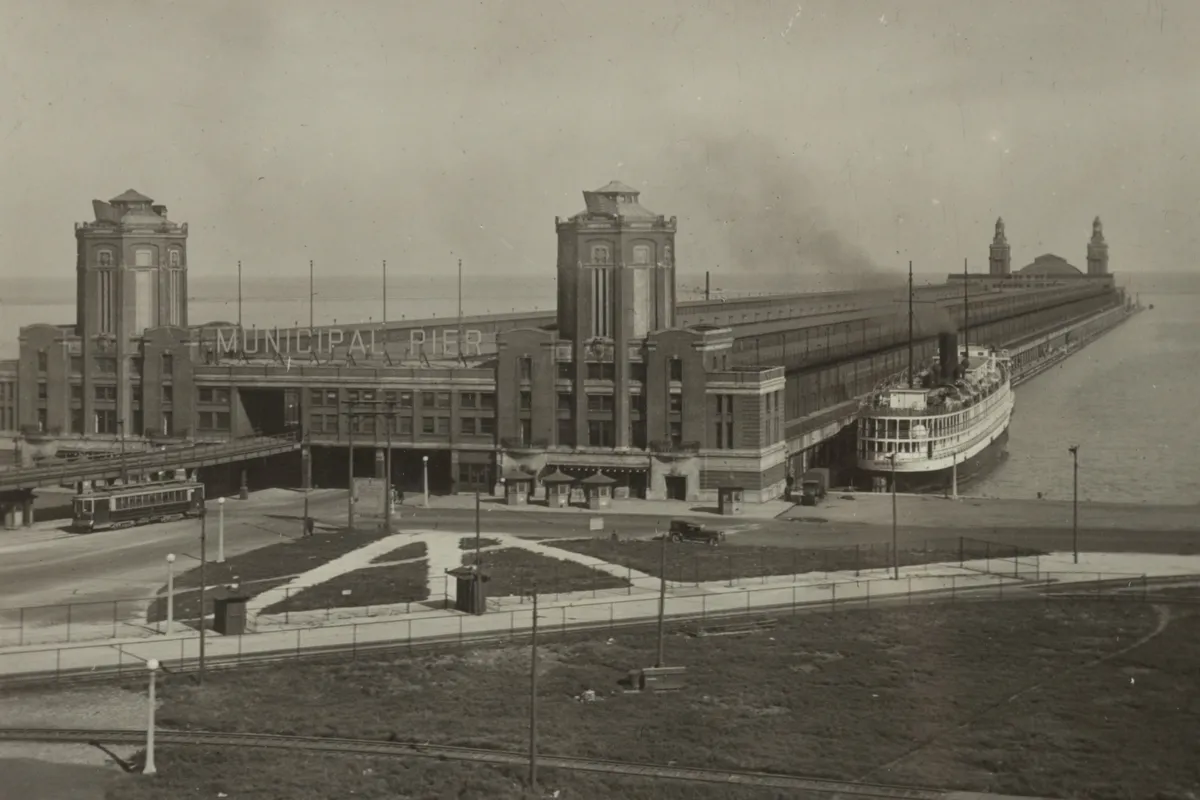
Its name is where the sources start to differ. The city’s landmark page puts “Municipal Pier No. 2” in quotation marks and explains, in parentheses, that “the other pier was never built.” The architecture center says Frost was hired to design “the first pier” and still says it was named Municipal Pier No. 2. Navy Pier’s own history and the Chicago Navy Memorial Foundation just say it was originally Municipal Pier, or Chicago Municipal Pier. And the old photo at the bottom of this page, a stereograph the Library of Congress dates to about 1926, shows two words lettered across the front building: MUNICIPAL PIER. None of these sources explains where the “No. 2” came from.
Why Is Navy Pier Called Navy Pier?
Because of what it did in World War I. The Chicago Navy Memorial Foundation says the pier went to war fast. In 1917, less than a month after the United States declared war, it had a recruiting center and barracks for soldiers and sailors alike, plus a jail for draft dodgers. There was a Navy school for deck officers, too. By war’s end, the foundation says, that program had trained nearly 4,000 officers for the Navy and the merchant marine.
When the war ended, the pier went back to its old work. Then, in 1927, the city renamed it.
Each source puts the reason a little differently. Navy Pier’s own history calls the new name “a tribute to the Navy personnel who were housed at the Pier during World War I.” The memorial foundation says it was “in honor of the personnel who lived and trained there.” The city’s landmark listing is broader: the name was changed “to honor those who served in the U.S. Navy during World War I,” which takes in more than the people who stayed at the pier. You’ll notice the Army doesn’t get a mention, even though soldiers had bunked there too.
The pier went back to war in the 1940s. In 1941, the architecture center says, the Navy made it a training center again, and over 60,000 service members went through it. So the name you see today was chosen 14 years before the Navy came back in 1941, not because of that later service.
After World War II, veterans going to college on the GI Bill filled a University of Illinois campus on the pier from 1946 to 1965, with an estimated 100,000 students over those years. The city made the headhouse and the buildings at the east end a Chicago landmark on November 14, 1977. In 1992, the long sheds in between were torn down, and the masonry buildings at each end were kept.
Navy Pier Ferris Wheel: The Centennial Wheel
The wheel is much newer than the name. The architecture center says the 1995 rebuilding of the pier added a Ferris wheel, and Navy Pier says the rebuilt pier reopened to the public that July. For the pier’s 100th anniversary in 2016, it unveiled the Centennial Wheel, which the architecture center describes as 200 feet (61 m) tall, at the top of a new grand staircase. The “Centennial” in its name points back to 1916, when this was still Municipal Pier.
Visiting Navy Pier
You don’t have to pay to walk out onto the pier. Navy Pier’s admission page says there’s no fee to enter, though attractions on the pier may charge their own prices. It also says the Centennial Wheel runs every day, while the other rides in Pier Park don’t run in winter.
The pier is 3,300 feet (1,006 m) long, so give yourself time. If you’re there for the name, look at the two ends. The headhouse by the shore and the buildings at the far east end are the ones the city kept in 1992 and protects as a landmark, the same buildings you can see in the 1926 photo below.
The city around it has an even older naming story. Chicago is named for its river, and the earliest written sources link the Native word behind it to wild garlic. You can follow the state’s own name on the Illinois page.
Quick answers
Why Is It Called Navy Pier?
Chicago renamed Municipal Pier in 1927 to honor Navy service in World War I. Navy Pier and the Chicago Navy Memorial Foundation say it honored the personnel who were housed and trained there, and the city’s landmark listing says it honored “those who served in the U.S. Navy during World War I.”
What Was Navy Pier Called Before?
Municipal Pier. The city’s landmark listing and the Chicago Architecture Center call it Municipal Pier No. 2, and the city says the other pier in the 1909 plan was never built.
Is Navy Pier’s Ferris Wheel the Original?
No. The first Ferris wheel came with the pier’s 1995 rebuilding, and the Centennial Wheel, a new 200-foot wheel, was unveiled for the pier’s 100th anniversary in 2016.
Is Navy Pier Free to Enter?
Yes. Navy Pier says there’s no admission fee to enter, though attractions on the pier, like the Centennial Wheel, may charge their own prices.
Key dates
- 1909The Plan of Chicago proposes a pair of big piers reaching out into Lake Michigan.
- 1916The pier designed by Charles Sumner Frost opens as Municipal Pier.
- 1917Less than a month after the U.S. enters World War I, the pier has a recruiting center and barracks for the Army and Navy.
- 1927Municipal Pier is officially renamed Navy Pier.
- 1941The U.S. Navy turns the pier into a training center again.
- 1946The University of Illinois opens a campus on the pier, which it uses until 1965.
- 1977November 14: Chicago designates the headhouse and east end buildings a city landmark.
- 1995The rebuilt pier reopens in July with a Ferris wheel.
- 2016The pier marks its 100th anniversary with the Centennial Wheel.
Getting there
Open Navy Pier in Google Maps
Opens in a new tab. The pin is an approximate point for Navy Pier.
The closest airports, Amtrak stations and intercity bus stops, measured in a straight line from the center of Navy Pier.
Airports
- Chicago Midway International (MDW) 11 mi 17 km
- Chicago O'Hare International (ORD) 17 mi 27 km
Amtrak trains
- Chicago station (CHI) 2 mi 4 km
- Summit station (SMT) 13 mi 20 km
Intercity buses
- Amtrak Chartered Vehicle Amtrak Connecting Service · Chicago Union Station 2 mi 4 km
- Van Galder (Coach USA) W Jackson Blvd, after S Clinton St (across from Union Station) 2 mi 4 km
- Greyhound Chicago Train Station 2 mi 4 km
Distances are as the crow flies, not by road. We don't list schedules or fares because they change; check with the airline, Amtrak or the bus company before you go. Official data (FAA commercial service airports (2025), FAA airport locations, Amtrak stations and Intercity Bus Atlas) from the FAA and the U.S. Bureau of Transportation Statistics, checked Nov 20, 2026.
Sponsored
Planning a visit?
Compare hotels near Navy Pier on Expedia.
See hotels nearbyWe may earn a commission if you buy through this link. It never changes what we write. Read our affiliate disclosure
Historical Sources & References
- City of Chicago, Chicago Landmarks, “Navy Pier Headhouse and Auditorium”: the 1909 Plan’s two piers; “Municipal Pier No. 2” (“the other pier was never built”); Charles S. Frost, 1916; the name changed in 1927 “to honor those who served in the U.S. Navy during World War I”; the University of Illinois campus, 1946-1965; the sheds torn down in 1992; landmark designation on November 14, 1977.
- Chicago Navy Memorial Foundation, “Navy Pier’s historical role in WWI”: Chicago Municipal Pier; the recruiting center, barracks and jail of 1917; the deck officer school and its nearly 4,000 officers; the 1927 renaming “in honor of the personnel who lived and trained there.”
- Navy Pier, “Navy Pier Through the Years”: opened in 1916 as “Municipal Pier”; renamed in 1927 as “a tribute to the Navy personnel who were housed at the Pier during World War I”; reopened in July 1995; the Centennial Wheel for the 100th anniversary.
- Chicago Architecture Center, “Navy Pier”: Burnham’s piers, one at Chicago Avenue, one at Cermak Road and the five proposed; Frost’s “first pier,” named Municipal Pier No. 2; 20,000 piles; the Navy training center of 1941 and its 60,000 service members; the university campus; the 3,300-foot pier; the 1995 Ferris wheel and the 200-foot Centennial Wheel of 2016.
- Keystone View Company, “Municipal Pier, Chicago, Ill.” (about 1926), Library of Congress: the stereograph at the bottom of this page, with MUNICIPAL PIER lettered on the building.
- Navy Pier, “Hours & Admission”: “There is no admission fee to enter Navy Pier”; the Centennial Wheel open daily and other Pier Park rides not running in winter.
- Navy Pier, “Pier Park”: the Centennial Wheel and the other rides in Pier Park.
Spot something wrong, or know more? Tell us here. You can also email us or use our contact page. Corrections are noted here with their date, never made silently.