South Bend, Indiana: The River Bend That Replaced Southold
South Bend is named for its spot on the south bend of the St. Joseph River. Its first post office, opened in 1829, was called Southold, a name historian Timothy Howard said no one had satisfactorily explained. On October 18, 1830, U.S. authorities directed the change to South Bend.
South Bend, Indiana, got its first post office in 1829 under a name no one could satisfactorily explain, Southold, then was renamed for a river bend. The bend won out, and the town has been named for that curve of water ever since.
The Bend, St. Joseph’s, Southold
Timothy Edward Howard’s 1907 History of St. Joseph County, Indiana sums up the town’s early names in a single sentence. The town, he wrote, was “called at first ‘The Bend,’ then the ‘Big St. Joseph’s Station,’ then ‘St. Joseph’s,’ then ‘Southold,’ and finally ‘South Bend,’” before it was platted on March 28, 1831, and made the permanent county seat that May 12.
Each of those names has a story in Howard’s book. Alexis Coquillard, an agent of the American Fur Company, set up a trading post at the spot in 1823. It was called the Big St. Joseph’s Station, Howard explains, to tell it apart from another fur company post at Fort Wayne, on the little St. Joseph River, run by Coquillard’s father-in-law, Francis Comparet. That smaller St. Joseph is the river that runs down into Fort Wayne from the north.
In 1827 Lathrop M. Taylor opened a second trading post there for Samuel Hanna & Co. of Fort Wayne. His account books, Howard says, open with an entry dated at “St. Joseph’s, Indiana,” October 29, 1827, and keep that name all the way through.
The Southold mystery
Then the federal government stepped in with a name of its own. A post office was established in 1829, and on June 6 of that year Taylor was commissioned as its first postmaster. His commission named him postmaster at “Southold, Allen county, Indiana.”
If you’re wondering where that came from, Howard couldn’t tell you either. He wrote that “no one has ever given a satisfactory explanation of Southold as the name of the town.” He did pass along the guess people fell back on “for want of a better explanation.” There’s a Southold in Suffolk County, New York, on Long Island Sound, so the idea was that someone at the Post Office Department who knew that town had suggested the name, “designedly or by mistake.” Howard didn’t oversell it. “This, however, is mere conjecture,” he wrote, “and the origin of Southold as a former name of our city is yet to be discovered.”
It didn’t last. On October 18, 1830, Howard says, “the United States authorities directed the name of the post office to be changed to South Bend, which has since been retained.” The federal Advisory Council on Historic Preservation spells the old name “Southhold” and says the town was known by it only briefly.
The bend in the river
So where does South Bend come from? Howard was blunt about it. “It has been said that the origin of this name is due to Alexis Coquillard,” he wrote, “but it is plain that the name came naturally from the location of the town upon the river.”
He calls the great south bend of the Big St. Joseph’s “the most remarkable natural phenomenon of the region south of the great lakes,” and says that for a while it wasn’t clear whether the town would grow up at the old portage or at the bend two miles (3 km) up the river. Locals called the place “The Bend” before it was formally named that. Then, as Howard put it, “Some dignity was added to the woodsman’s simple designation by prefixing to it the word ‘South,’ suggested by the location of the bend, strengthened also, perhaps, by the accidental name of Southold first given to the post office.”
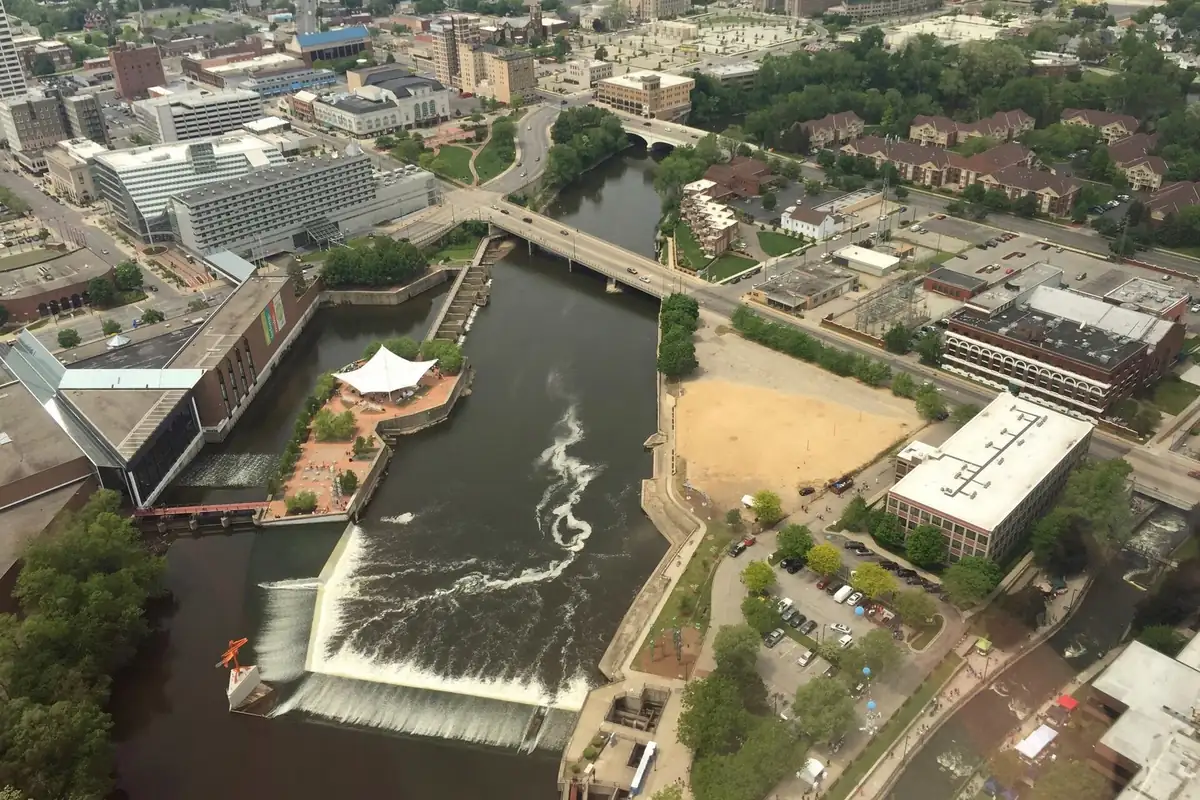
That “perhaps” is Howard’s own idea about how the two names met, and he offers it as no more than that. His book even prints a photograph of the river with the caption “The South Bend of the St. Joseph River from Which the City Derives Its Name.” The ACHP agrees, saying the name was adopted “due to the city’s location on the ‘south bend’ of the St. Joseph River.”
“Plebeian and meaningless”
Not everyone loved the result. Howard writes that years later, when the trading posts had grown into a town, ambitious citizens found the name South Bend “plebeian and meaningless.” They held public meetings to consider other names, and one suggestion was to bring back the old St. Joseph’s. Serious efforts were made, he says, even long afterward.
He also notes that “Up to a recent time” people still called the city just “The Bend,” a habit he called “this irreverent appellation.” Howard himself was firmly on the side of the name as it stood: “South Bend it is, and South Bend it will be,” he wrote, “for the people have become attached to the simple and expressive, even if homely, title.”
A beautiful site for a town
The town plat came in 1831. Howard opens his chapter on the city with a line he says was entered in 1828 in the field notes of the second survey of the Michigan Road, at the point where the road reached the south bend of the St. Joseph:
“At this point is a beautiful site for a town.”
Howard calls the man who wrote it “the prophetic surveyor.” The History Museum in South Bend reprints the court record of March 28, 1831, in which Alexis Coquillard and Lathrop M. Taylor acknowledged “the foregoing instrument and town plat of the town of South Bend.”
What the 1983 map shows
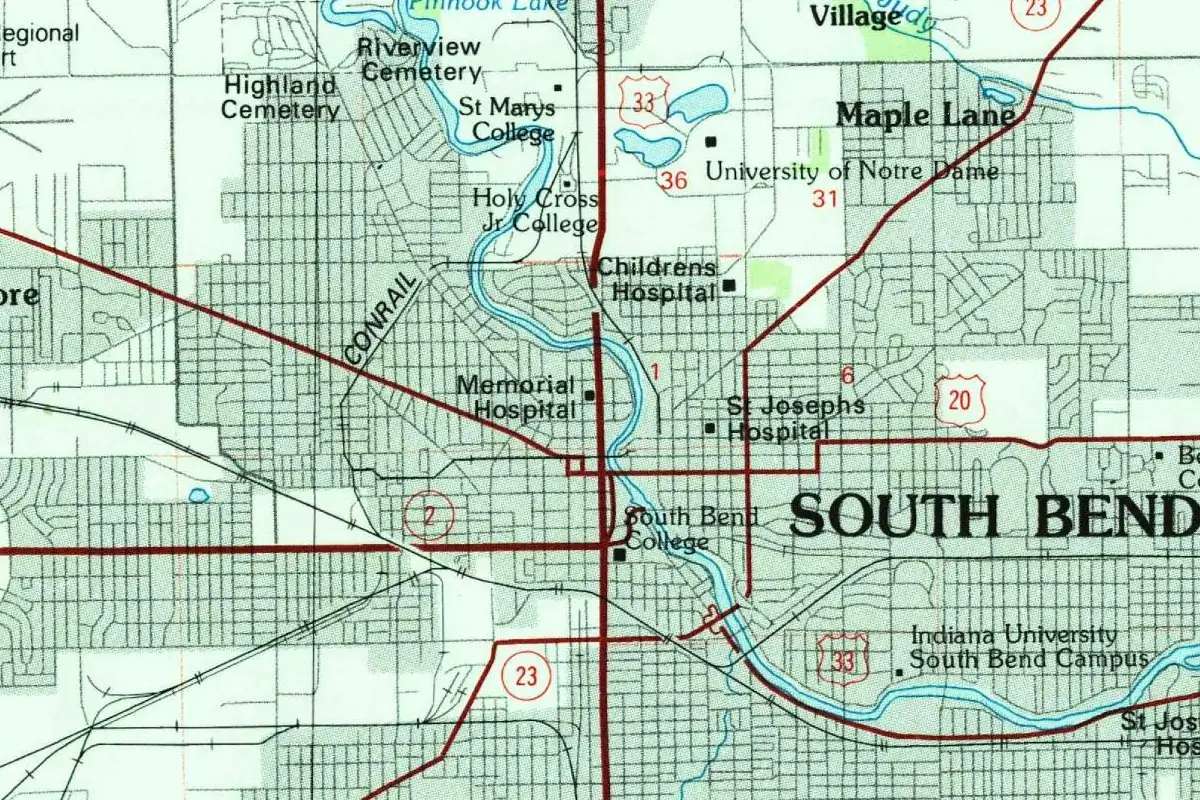
The USGS index of historical maps has only modern sheets for South Bend, so the map at the top of this page is from 1983. You can see the river doing exactly what gave the city its name, swinging south and then curving back to the east through the middle of the city.
One more name connection: the History Museum says the neighboring town of Lowell, Indiana, platted in 1846 and annexed by South Bend in 1867, was founded by people who hoped to capture the industrial success of its namesake, Lowell, Massachusetts. For more of the state’s names, head to our Indiana page.
Quick answers
Why is it called South Bend, Indiana?
Because the town grew up at the south bend of the St. Joseph River. Historian Timothy Howard wrote in 1907 that “the name came naturally from the location of the town upon the river.”
What was South Bend called before?
Howard lists “The Bend,” the “Big St. Joseph’s Station,” “St. Joseph’s” and “Southold.” Southold was the name of the first post office, from 1829 until October 18, 1830.
Why was South Bend called Southold?
No one knows for sure. Howard wrote that no one had given “a satisfactory explanation.” One guess was that a postal official borrowed the name of Southold on Long Island, but Howard called that “mere conjecture.”
Did Alexis Coquillard name South Bend?
Not according to Howard. He wrote that “it has been said” the name was due to Coquillard, but that it plainly came from the town’s place on the river.
Key dates
- 1823Alexis Coquillard opens a trading post at the bend, known as the Big St. Joseph's Station.
- 1827Lathrop M. Taylor's account books are dated at "St. Joseph's, Indiana."
- 1828A Michigan Road surveyor notes a "beautiful site for a town" at the bend.
- 1829A post office opens; Taylor is commissioned postmaster at "Southold" on June 6.
- 1830On October 18, federal authorities order the post office renamed South Bend.
- 1831Coquillard and Taylor's plat of South Bend is dated March 28, and the town becomes the county seat on May 12.
Things to do in South Bend, Indiana
Studebaker National Museum
A museum of South Bend's automotive and industrial history built around Studebaker vehicles. Its collection includes the carriage Abraham Lincoln rode to Ford's Theatre and a carriage the Marquis de Lafayette used on his 1824 farewell tour.
Oliver Mansion (Copshaholm)
A 38-room Queen Anne Romanesque house completed in 1897 for J.D. Oliver, president of the Oliver Chilled Plow Works, and his family, who named it after the Scottish village where his father was born. The furnishings on all three floors are original.
Navarre Cabin
The log cabin of fur trader Pierre Navarre, who traded on the St. Joseph River at South Bend in 1820 and married Keshewaquay, a Potawatomi chief's daughter. He sited it for easy access to the St. Joseph and Kankakee rivers and the portage between them.
Leeper Park
A city park on the St. Joseph River with the Studebaker Fountain, donated by John Studebaker and restored after decades of disrepair, a rose garden kept up by volunteers, and an overlook into the river.
Getting there
Open South Bend in Google Maps
Opens in a new tab. The pin is the center of South Bend in the USGS place-name record.
The closest airports, Amtrak stations and intercity bus stops, measured in a straight line from the center of South Bend.
Airports
- South Bend International (SBN) 4 mi 6 km
- Kalamazoo/Battle Creek International (AZO) 52 mi 84 km
- Chicago Midway International (MDW) 78 mi 125 km
Amtrak trains
- South Bend station (SOB) 2 mi 3 km
- Niles station (NLS) 11 mi 17 km
Intercity buses
- FlixBus South Bend Transpo S St Station 1 mi 2 km
- Miller Transportation South Bend 1 mi 2 km
- Barons Bus Lines South Bend 1 mi 2 km
Distances are as the crow flies, not by road. We don't list schedules or fares because they change; check with the airline, Amtrak or the bus company before you go. Official data (FAA commercial service airports (2025), FAA airport locations, Amtrak stations and Intercity Bus Atlas) from the FAA and the U.S. Bureau of Transportation Statistics, checked Nov 14, 2026.
Sponsored
Staying in South Bend?
Compare hotels in South Bend, Indiana, on Expedia.
See hotels in South BendWe may earn a commission if you buy through this link. It never changes what we write. Read our affiliate disclosure
Historical Sources & References
- Timothy Edward Howard, A History of St. Joseph County, Indiana, vol. 1 (1907), p. 351. The 1828 Michigan Road field note, Coquillard’s Big St. Joseph’s Station, Taylor’s “St. Joseph’s” account books, the citizens who found the name “plebeian and meaningless,” and Taylor’s 1829 commission as postmaster at “Southold.” Checked against the page image.
- Howard, vol. 1 (1907), p. 352. The Southold mystery and the Long Island “conjecture,” the October 18, 1830, change to South Bend, the name coming “naturally from the location of the town upon the river,” “The Bend,” and the word “South.” Checked against the page image.
- Howard, vol. 1 (1907), plate facing p. 352. The photograph captioned “The South Bend of the St. Joseph River from Which the City Derives Its Name.”
- Howard, vol. 1 (1907), p. 356. The quoted list of names, the plat of March 28, 1831, and the county seat on May 12, 1831. Checked against the page image.
- Advisory Council on Historic Preservation, “South Bend, Indiana”. The Pokagon Band of Potawatomi, Coquillard in 1823, “Southhold,” and the name taken from the “south bend” of the St. Joseph.
- The History Museum, “Early South Bend”. The 1831 court record of the plat and the town of Lowell, Indiana.
- GNIS feature 452796 (U.S. Geological Survey). The official GNIS record for South Bend, St. Joseph County, with its coordinates.
- U.S. Geological Survey, South Bend sheet (1983). The 1:100,000 map the image at the top of this page was cropped from.
Spot something wrong, or know more? Tell us here. You can also email us or use our contact page. Corrections are noted here with their date, never made silently.