Bagdad, California: A Desert Stop Named for Baghdad
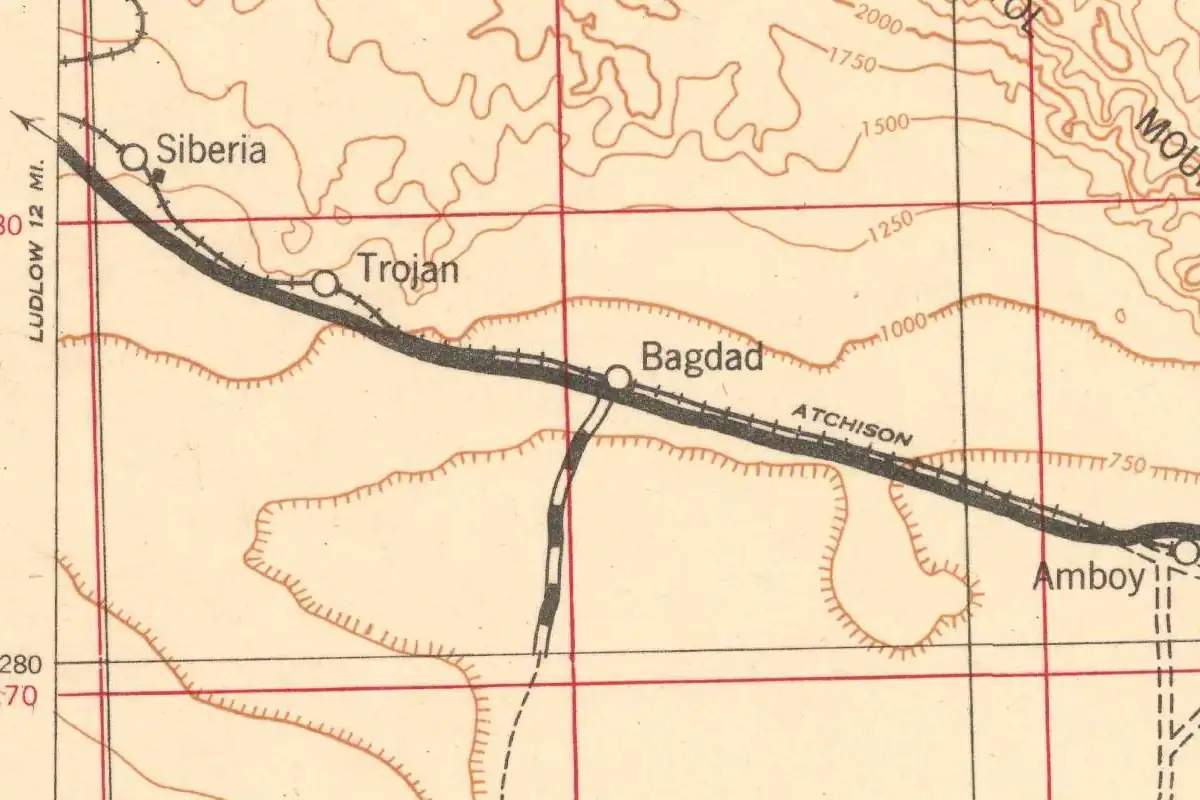
Bagdad, California, a lost railroad stop on Route 66, was named in 1883 for Baghdad, presumably because it, too, stood in the desert. That “presumably” comes from Erwin G. Gudde’s California Place Names, and it’s worth keeping: we couldn’t find a railroad record of who picked the name or why.
A city in Asiatic Turkey
The oldest explanation we found is also the shortest. In 1905, Henry Gannett of the U.S. Geological Survey published the second edition of his book on American place names, and it included a line the 1902 edition didn’t have:
“Bagdad; town in San Bernardino County, California, named from the city in Asiatic Turkey.”
That’s the whole entry. It doesn’t say who chose the name or why.
Gudde fills in a little more. His entry says the Southern Pacific named Bagdad in 1883, when the original line, now the Santa Fe, was built, and that it “was presumably named after Baghdad, Iraq, because it is in the desert.” Phil Townsend Hanna’s 1946 dictionary of California names sounds more sure of itself. It says the stop was “obviously named for Bagdad in the hot and arid province” of Mesopotamia. A few lines later, though, the same entry says Bagdad “took its name directly from the Bagdad Mining and Milling Co.,” whose mill Hanna describes at work in 1903. The station’s name is older than that: Bagdad is already on an 1890 list of the railroad’s stations.
San Bernardino County tells it with no hedging at all. A 2025 county history feature says that “due to its similar desert climate, railroad officials named the town after the Iraqi capital.” It credits the Atchison, Topeka & Santa Fe, while Gudde names the Southern Pacific. Either way, it’s the same track. If you want to know which railroad man looked at this valley and thought of the Tigris, though, none of these sources can tell you.
Bagdad without the h
You’ll often read that the railroad dropped the h. The county says the name came “omitting the h,” and the Los Angeles Times called it “a divergent spelling for the city on the Tigris.”
But Bagdad was an older English spelling of the city’s name, and California’s own reference books used it. Hanna’s 1946 dictionary writes “Bagdad in the hot and arid province.” Gudde’s 1969 edition still says “Bagdad, Iraq.” Only the 1998 revision of his book switched to “Baghdad.” The California stop simply kept the old spelling.
Siberia, Klondike and the alphabet
Bagdad had company. The 1991 Times story said the same railroad officials named two nearby settlements Siberia and Klondike, though Gudde dates Klondike to 1897. The 1939 WPA guide to California noticed it too, on its tour of US 66:
“The railroad tracks are dotted with lonely stops without accommodations, which bear such curiously incongruous names as Siberia and Klondike.”
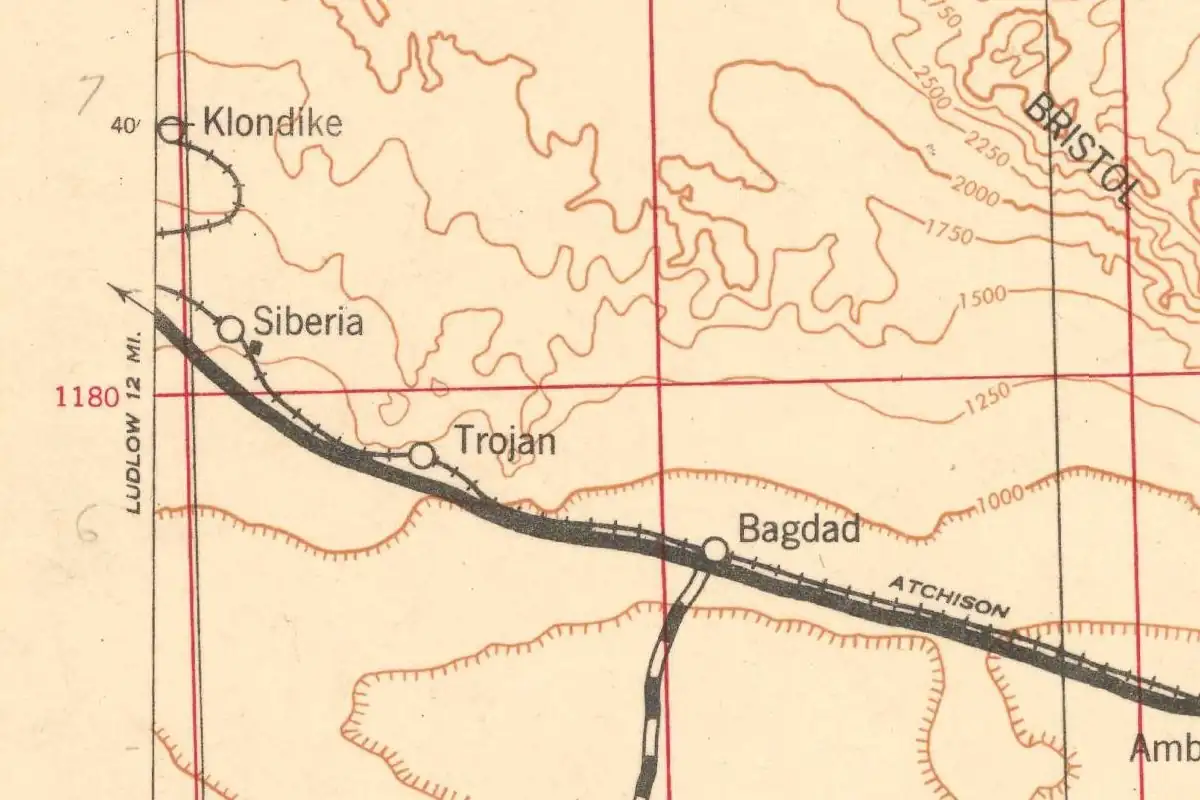
East of here, the station names follow a pattern. An 1890 railway guide lists the stations heading west from the Colorado River as Java, Ibex, Homer, Goff’s, Fenner, Edson, Danby, Cadiz, Bristol, Amboy, Bagdad, Siberia, Ash Hill and Ludlow. Read it backward from Amboy and you get the alphabet, from A to J. Bagdad sits just west of Amboy, outside that run. The B east of Amboy was Bristol.
Water, gold and a very long dry spell
Bagdad wasn’t just a name on a timetable. It was a watering stop for steam engines and a center for nearby gold, silver, copper and lava mining camps, the Times reported, with mines like the Orange Blossom and the War Eagle. There were homes, hotels, saloons and stores, a school, a Harvey House restaurant and a post office from 1889 to 1923. The county says the Bagdad-Chase and Roosevelt mines produced half of San Bernardino County’s recorded gold.
Water was the problem. The WPA guide noted that water trains came from Newberry, to the west, hauling tank cars “as far as Bagdad for use in locomotive boilers.” And Bagdad got very little rain. The Times and the county both say it went 767 days without rain in the early 1910s, ending in November 1914, the longest dry spell on record in the United States. They don’t agree on when it started: the Times says July 1912, the county October 1912.
By 1939, the WPA guide described a town that had already seen better days:
“BAGDAD (accommodations), 95.5 m. (787 alt., 20 pop.), is merely a shell of the rip roaring camp that thrived here when the War Eagle and Orange Blossom gold mines to the north were active.”
Only a few old buildings had escaped a fire in 1918, the guide said, and the desert wind was working on those.
The other Bagdad Cafe
Route 66 kept a little of Bagdad going. In the 1940s, the Times reported, what was left included the depot, a few homes, a gas station, cabins for travelers and the Bagdad Cafe, run by a woman named Alice Lawrence. Paul Limon, who pumped gas there in the 1940s, told the paper it was “the only place for miles around with a dance floor and juke box,” and that overheated cars from every state stopped for water.
The Times says the town was the original inspiration for the 1988 movie Bagdad Cafe, but the movie wasn’t shot here. It was filmed at the Sidewinder Cafe in Newberry Springs, about 40 miles (64 km) to the northwest. The filmmaker, Percy Adlon, said he and his wife saw Bagdad on a map in 1985 and went looking for it. They never found it. So if you’ve seen the movie, you’ve seen a cafe 40 miles from the real Bagdad.
What’s left of Bagdad
Interstate 40 opened in 1972, about 20 miles (32 km) to the north, and the old road through Bagdad went quiet. But the Times said the town had died years before that. When reporter Charles Hillinger wrote about it in January 1991, the cafe and depot were gone, wrecked by vandals. He found dirt streets, two 15 mph speed-limit signs, concrete foundations, a small cemetery and a “Bagdad” sign along the tracks. The county’s history says the remaining buildings were demolished in 1991.
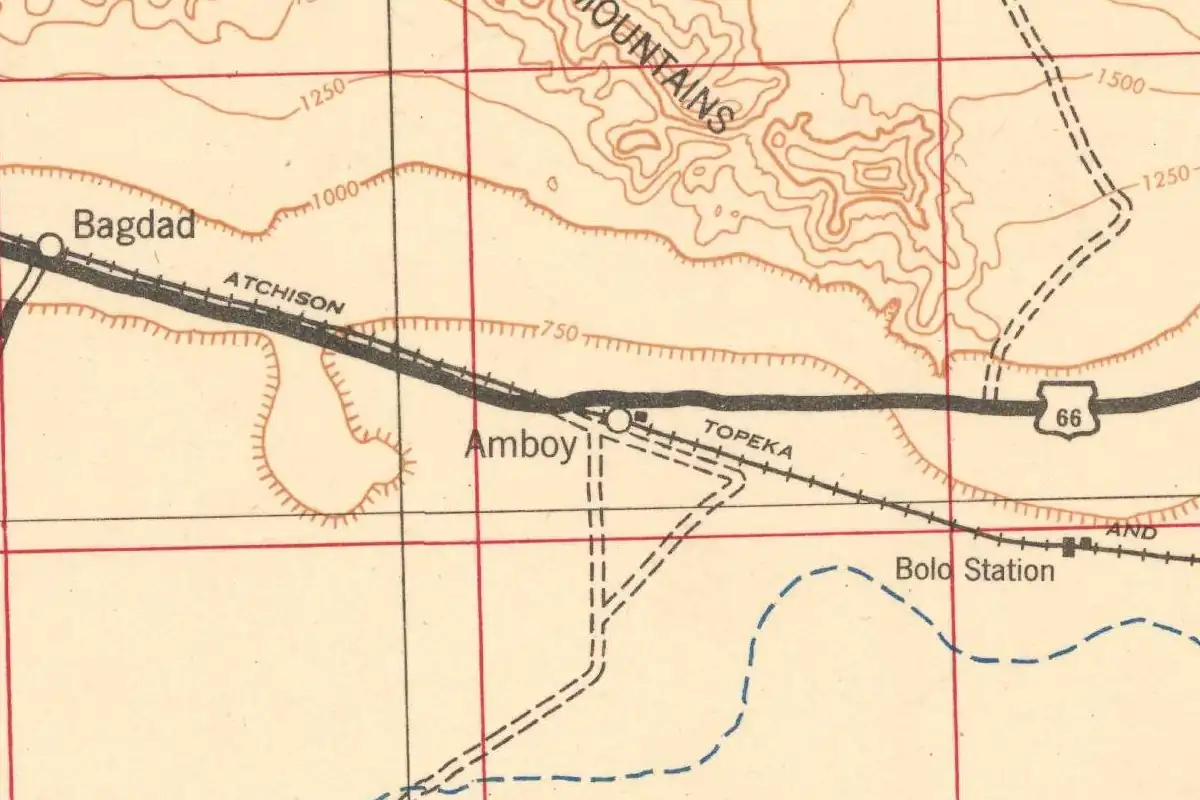
Bagdad is about 8 miles (13 km) west of Amboy and roughly 75 miles (121 km) southeast of Barstow, in California’s Mojave Desert. In 1991, after Iraq invaded Kuwait, drivers kept stopping in Amboy to ask where Bagdad was. Limon had his own answer: “When I hear or read about the war in the Persian Gulf and Baghdad is mentioned, I think about Bagdad, Calif., and all the good times I had in this town.” You’ll find more of the old road’s stops in our Route 66 towns collection.
Quick answers
Why is Bagdad, California, called Bagdad?
It’s named for Baghdad, the city on the Tigris. Gudde’s California Place Names says the railroad named it in 1883, “presumably” because it, too, is in the desert. San Bernardino County says railroad officials picked it for the similar desert climate.
Why is there no h in Bagdad, California?
Bagdad is an older English spelling of the city’s name. A 1946 California dictionary and Gudde’s 1969 edition both spell it that way. The county and the Los Angeles Times describe it as leaving out the h.
Was the movie Bagdad Cafe filmed in Bagdad?
No. The town inspired the 1988 movie, but it was filmed at the Sidewinder Cafe in Newberry Springs, about 40 miles (64 km) to the northwest.
Is anything left of Bagdad, California?
Very little. In 1991 a reporter found foundations, dirt streets, a small cemetery and a railroad sign. San Bernardino County says the last buildings were demolished that year.
Key dates
- 1883The railroad is built across the Mojave, and the stop is named Bagdad, Gudde and the county say.
- 1889A Bagdad post office opens. It lasts until 1923, the Los Angeles Times reported.
- 1905Henry Gannett's federal place-name book adds Bagdad, "named from the city in Asiatic Turkey."
- 1912A dry spell begins that lasts 767 days, into November 1914. Sources disagree on the starting month.
- 1918A fire hits Bagdad. Only a few old buildings escape it, the 1939 WPA guide says.
- 1972Interstate 40 opens about 20 miles to the north, and the Route 66 stretch through Bagdad goes quiet.
- 1988The movie Bagdad Cafe comes out. It was inspired by the town but filmed in Newberry Springs.
- 1991In January a reporter finds only ruins. The county says the remaining buildings were demolished that year.
Getting there
Open Bagdad in Google Maps
Opens in a new tab. The pin is the center of Bagdad in the USGS place-name record.
The closest airports, Amtrak stations and intercity bus stops, measured in a straight line from the center of Bagdad.
Airports
- Palm Springs International (PSP) 63 mi 102 km
- Laughlin/Bullhead International (IFP) Bullhead City 84 mi 136 km
- Ontario International (ONT) 105 mi 169 km
Amtrak trains
- Palm Springs station (PSN) 61 mi 98 km
- Barstow station (BAR) 69 mi 111 km
Distances are as the crow flies, not by road. We don't list schedules or fares because they change; check with the airline, Amtrak or the bus company before you go. Official data (FAA commercial service airports (2025), FAA airport locations, Amtrak stations and Intercity Bus Atlas) from the FAA and the U.S. Bureau of Transportation Statistics, checked Nov 10, 2026.
Sponsored
Staying in Bagdad?
Compare hotels in Bagdad, California, on Expedia.
See hotels in BagdadWe may earn a commission if you buy through this link. It never changes what we write. Read our affiliate disclosure
Historical Sources & References
- Henry Gannett, The Origin of Certain Place Names in the United States, 2nd ed. (1905). p. 34: “Bagdad; town in San Bernardino County, California, named from the city in Asiatic Turkey.” Also online: the 1902 first edition, which has no Bagdad entry (it goes from Babylon, p. 32, to Baggers, p. 33).
- Erwin G. Gudde, California Place Names, 3rd ed. (1969). Entry “Bagdad”: named in 1883 by the Southern Pacific when the original line (now Santa Fe) was built; “presumably” named for “Bagdad, Iraq, because it is in the desert.” Entry “Klondike”: named “by the Santa Fe in 1897.” Also online: the 4th edition, revised by William Bright (1998), with the same entry spelled “Baghdad, Iraq.”
- Phil Townsend Hanna, The Dictionary of California Land Names (1946). Entry “Bagdad”: “Obviously named for Bagdad in the hot and arid province” of Mesopotamia (spelled “Mesopatamia” in the book). The same entry also says Bagdad “took its name directly from the Bagdad Mining and Milling Co.,” with the company’s mill at work in 1903.
- James Macfarlane, An American Geological Railway Guide, 2nd ed. (1890). p. 324: the Atlantic & Pacific Railroad’s station list from The Needles west to Ludlow, with Bagdad between Amboy and Siberia.
- Federal Writers’ Project, California: A Guide to the Golden State (1939). Tour 12 (US 66), p. 611: Bagdad “merely a shell of the rip roaring camp,” the War Eagle and Orange Blossom mines, the 1918 fire, the rainfall, and Siberia and Klondike; p. 612: water trains from Newberry to Bagdad.
- Charles Hillinger, “Bagdad Fades Into the Desert–in California,” Los Angeles Times (January 31, 1991). The 1883 naming by the railroad officials who named Siberia and Klondike, the “divergent spelling,” the 767-day dry spell (July 1912 to November 1914), the mines, the post office from 1889 to 1923, the Harvey House, Alice Lawrence’s Bagdad Cafe, Paul Limon’s memories, the movie and the Sidewinder Cafe, Interstate 40 in 1972, the ruins in 1991 and the distances to Amboy, Barstow and Newberry Springs.
- San Bernardino County, “San Bernardino County history: Bagdad” (August 14, 2025). Founded in 1883 with the railroad; named for Baghdad “due to its similar desert climate,” “omitting the h”; the dry spell from October 1912 to November 1914; the Bagdad-Chase and Roosevelt mines; the remaining buildings demolished in 1991.
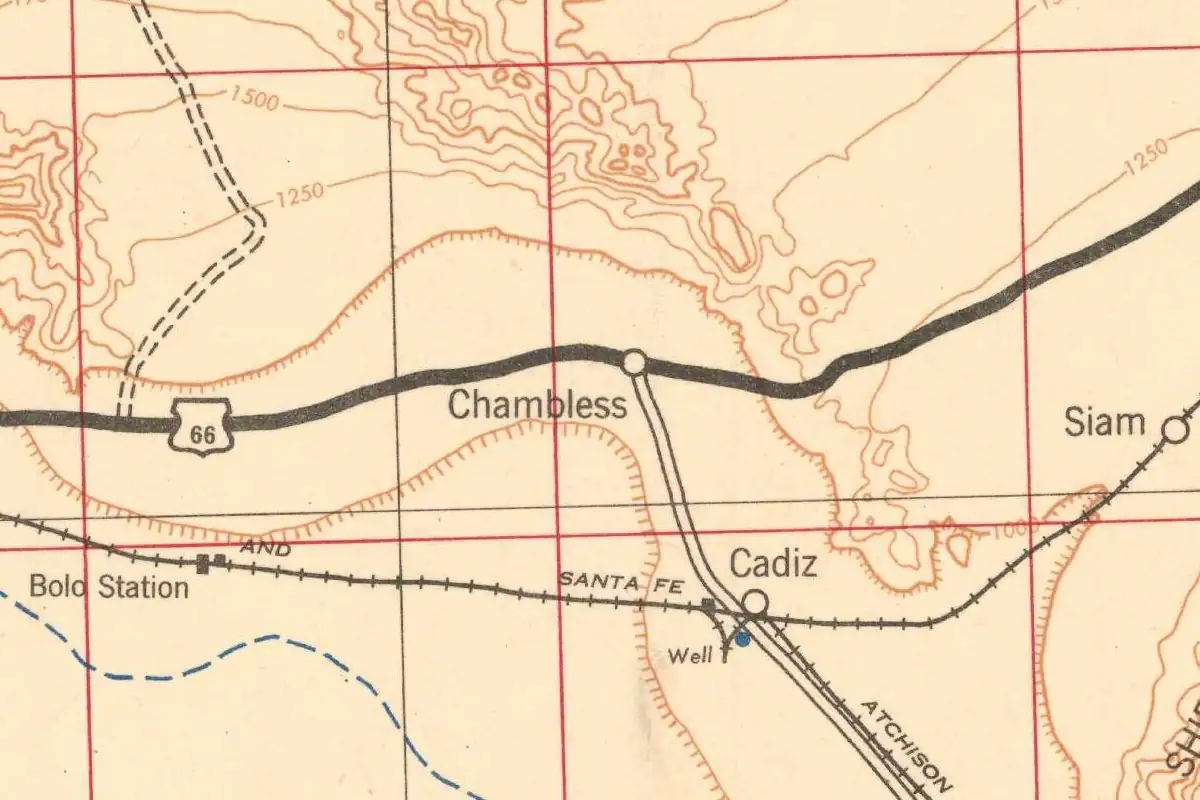
- U.S. Army Corps of Engineers, Amboy sheet (1942). The map at the top of this page, the oldest in the USGS historical collection that shows Bagdad.
- GNIS feature 1660291, Bagdad (U.S. Geological Survey). The gazetteer entry with the official name, county and coordinates of the site.
Sponsored
Gear up for your next road trip
Explore rooftop tents, vehicle awnings and outdoor gear from TOPOAK Overland.
Shop TOPOAK overlanding gearWe may earn a commission if you buy through this link. It never changes what we write. Read our affiliate disclosure
Spot something wrong, or know more? Tell us here. You can also email us or use our contact page. Corrections are noted here with their date, never made silently.