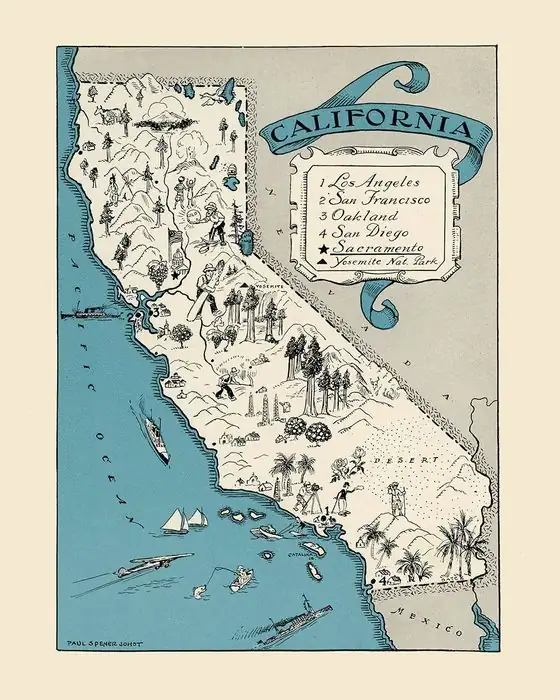
Amboy, California: The A in a Desert Railroad Alphabet
Amboy, California, is the A in a railroad alphabet: in 1883 it led a string of Mojave stations named Amboy, Bristol, Cadiz, Danby, Edson and Fenner. Why the railroad picked the word Amboy for its A is another matter: Erwin G. Gudde’s California Place Names says it came “apparently” from one of the Amboys “back East,” and nobody has pinned down which one.
A to G across the Mojave
The best proof is a letter to the editor. In 1883, a correspondent who signed himself L. T. F. rode the Southern Pacific’s brand-new Mojave Division from Los Angeles to the Colorado River and wrote it up for the Los Angeles Herald. East of Ludlow and Ash Hill, he ticked off the stops one by one:
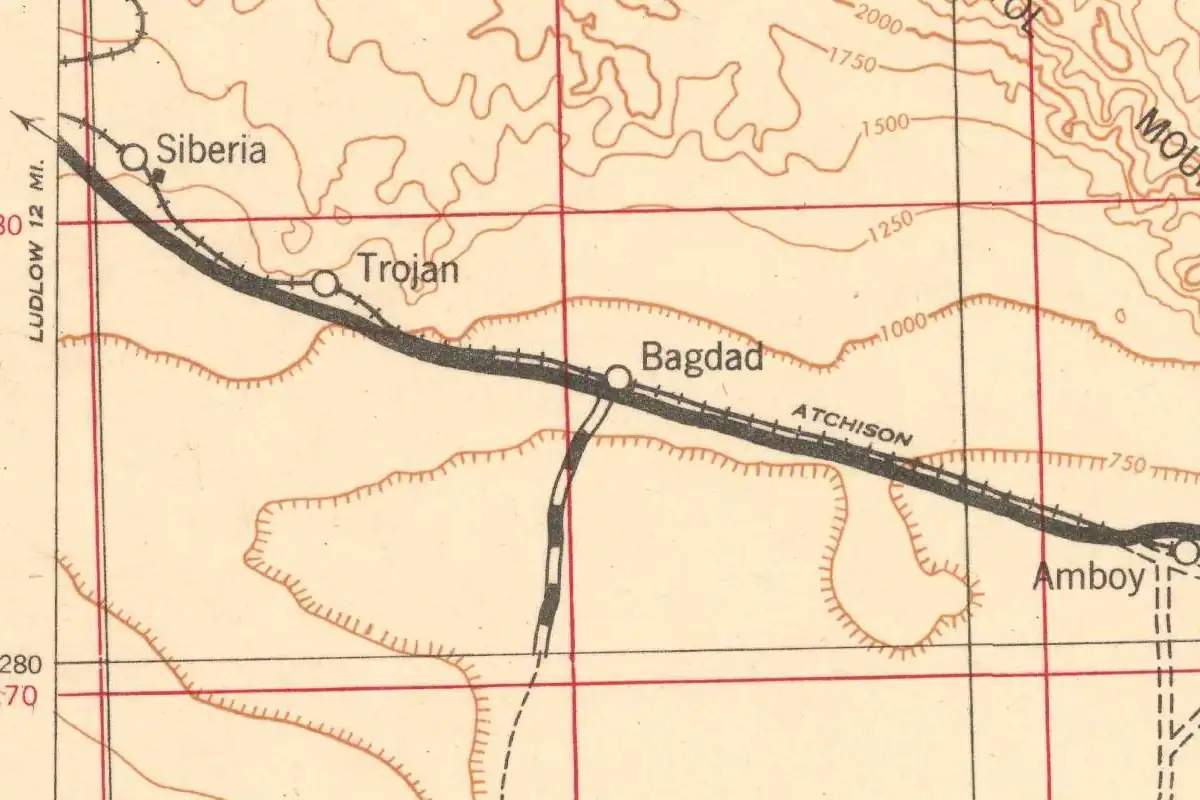
“Ten miles further brings the train to Siberia, named, perhaps, by way of sarcasm. Then comes Bagdad, seven miles; Amboy, seven miles; Bristol, six miles; Cadiz, seven miles; Danby, ten miles; Edson, eleven miles. These are mere stations, with no no points of interest.”
Fenner Station came seven miles after Edson, he wrote, and then Goff Station. Read the list again from Amboy and you’ve got A, B, C, D, E, F, G. The letter ran on June 5, 1883, so the alphabet was already on the ground by then. He didn’t say a word about it, though. Maybe he didn’t notice.
Later writers did. Gudde says the stations “from here to the Arizona line were originally (1883) in alphabetical order, named after places ‘back East,’” and he lists the same seven, Amboy to Goffs. He adds that all these names have counterparts elsewhere in the United States, and that another railway official seems to have tried to keep the alphabet going later on. In 1989 the Los Angeles Times gave the reason, citing railroad officials: the names went in alphabetical order to make them easy for rail workers to remember.
Who picked the letters
That part is less settled. Gudde says it was “probably” Lewis Kingman, a locating engineer of the railroad, the same man Kingman, Arizona is named for. Phil Townsend Hanna’s 1946 Dictionary of California Land Names drops the “probably.” He says that after the Santa Fe took over the Needles-to-Mojave line from the Southern Pacific in 1884, Kingman set out to build a series of sidings “from Amboy to the Colorado River” and named them in alphabetical order.
The date doesn’t fit the Herald, though. Amboy, Bristol, Cadiz and the rest were already in print in June 1883, on a line the paper called the Southern Pacific’s. The sources don’t even agree on the railroad: the Times in 1989 said the Southern Pacific created Amboy, Gudde says the Atlantic and Pacific named it, and Hanna and the Route 66 association say the Santa Fe. They’re all the same track, which the Santa Fe ended up owning. James Marshall’s 1945 history of that railroad says the Santa Fe “inherited perhaps the strangest string of station and siding names in America” along here, Amboy among them. So the alphabet is well documented. The name of the person who wrote it out isn’t.
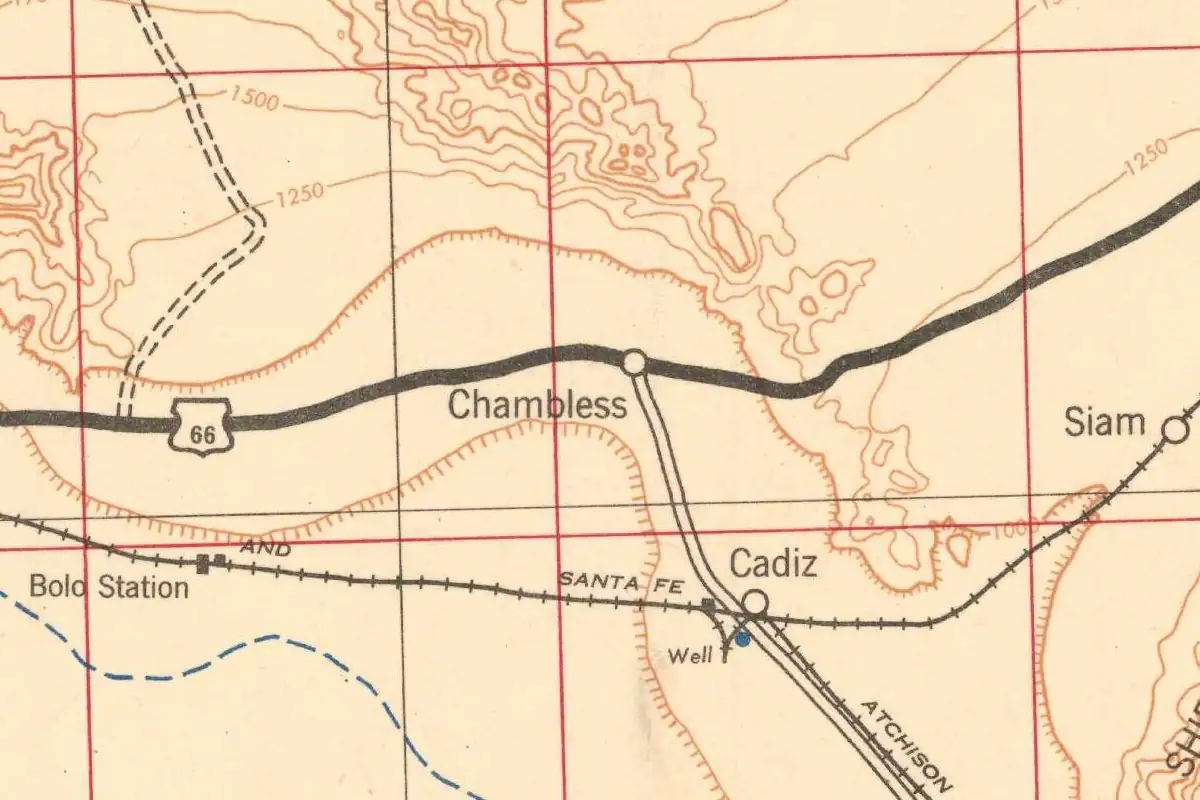
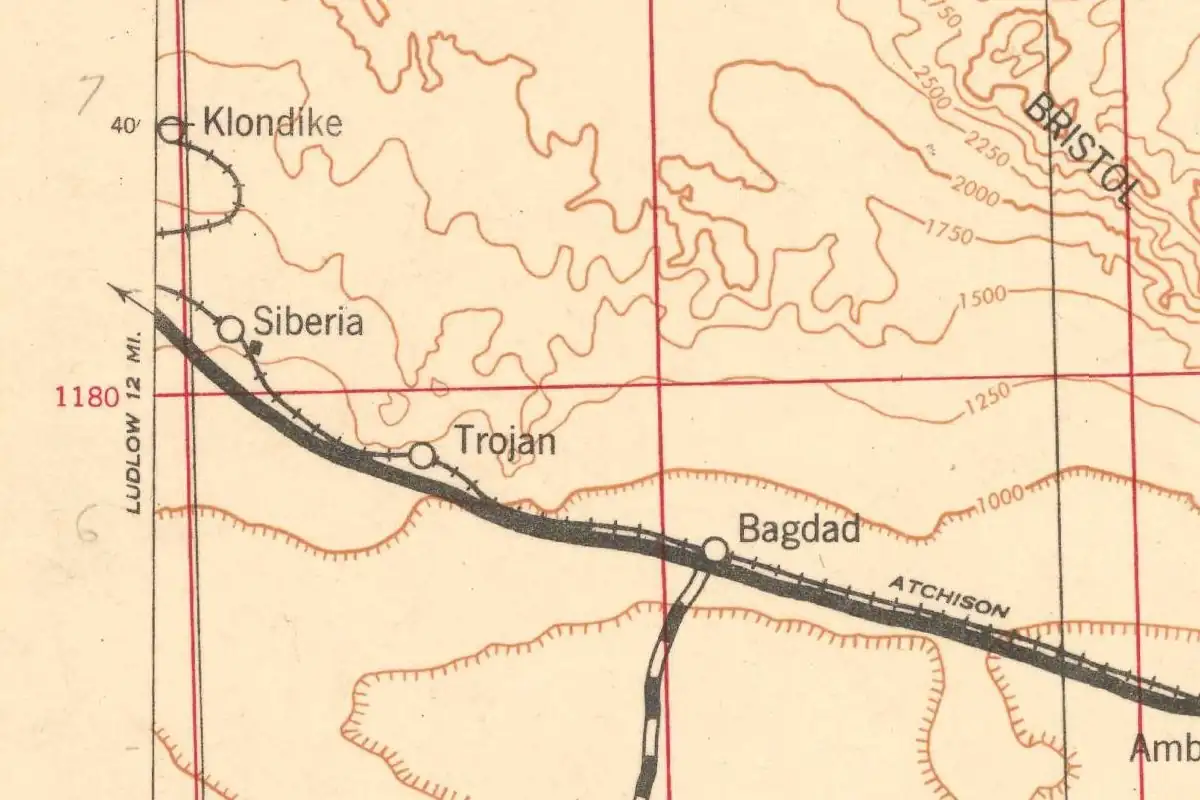
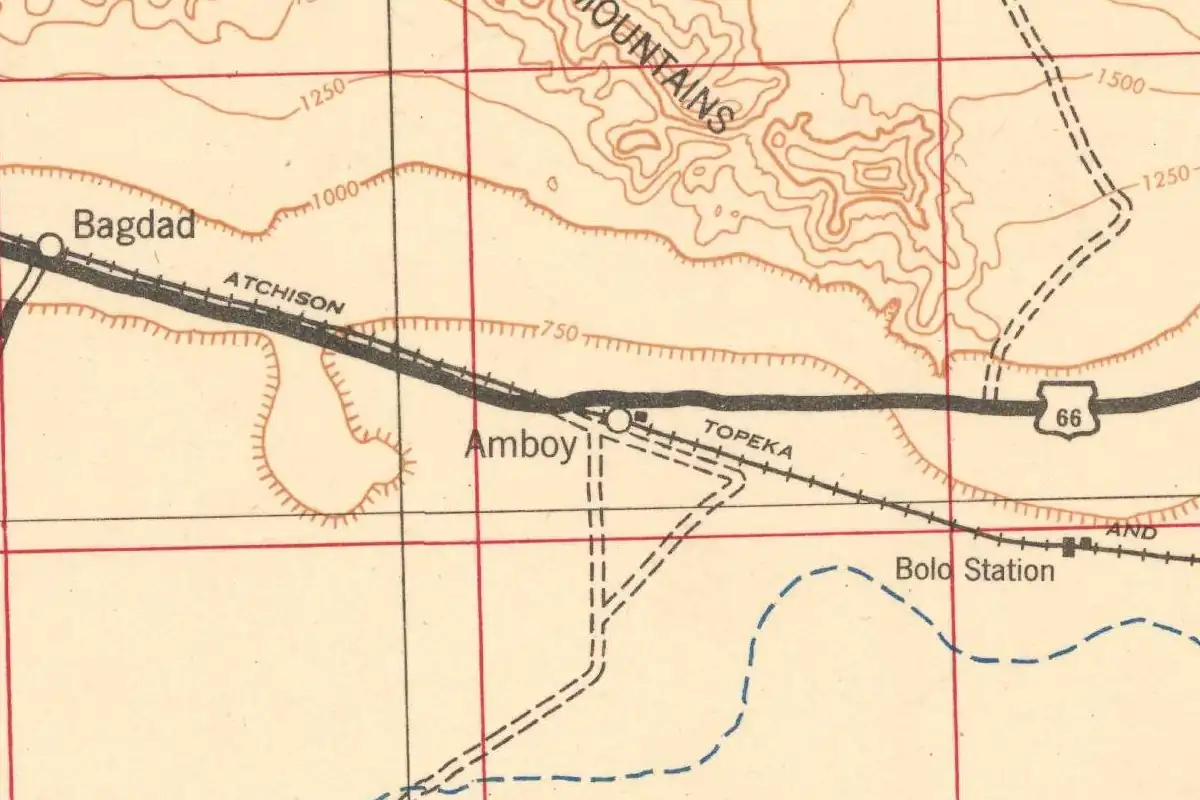
The list didn’t stay perfect, either. In Marshall, Hanna and the 1989 Times, the B is Bolo, and in the last two the E is Essex. The 1942 Army map at the top of this page shows a Bolo Station just southeast of Amboy. None of our sources explains when Bristol and Edson dropped out of the lineup.
Which Amboy?
There’s no shortage of Amboys back East. Henry Gannett’s 1905 book on American place names has an entry for the Amboys in Lee County, Illinois, and Miami County, Indiana, “and many other places,” which it calls “An Indian word, meaning ‘hollow inside,’ ‘like a bowl.’” Gannett gives no source for that translation and doesn’t mention the California station. Nothing ties that meaning to this one. There’s also Perth Amboy, New Jersey, which has a story of its own. None of our sources says the railroad was thinking of any of them in particular.
That’s why we say the alphabet explains the name only up to a point. You know why the station starts with A. You don’t know, and neither did Gudde, where the railroad found this particular A.
A typical highway stop
West of Amboy, the alphabet doesn’t apply. The next station, Bagdad, and Siberia beyond it come before Amboy in the Herald’s list and break the pattern.
Amboy was a water stop for steam engines and a place for telegraphers and linemen to stop off, the 1989 Times said. The Postal Service’s records list Charles M. Walker as Amboy’s postmaster in 1906, the earliest name on its list. Then Route 66 came through, and the town turned to cars. The WPA’s 1939 guide to California put Amboy 87 miles (140 km) west of the Arizona line on US 66:
“AMBOY, 87 m. (614 alt., 95 pop.), is another typical highway stop, blistered by temperatures that often soar above 120° in midsummer.”
The guide also sent drivers down a dirt road to Amboy Crater, about 1.5 miles (2.4 km) away, a cone of “dark gray pumice and lava.” It’s still there.
Roy’s and the bypass
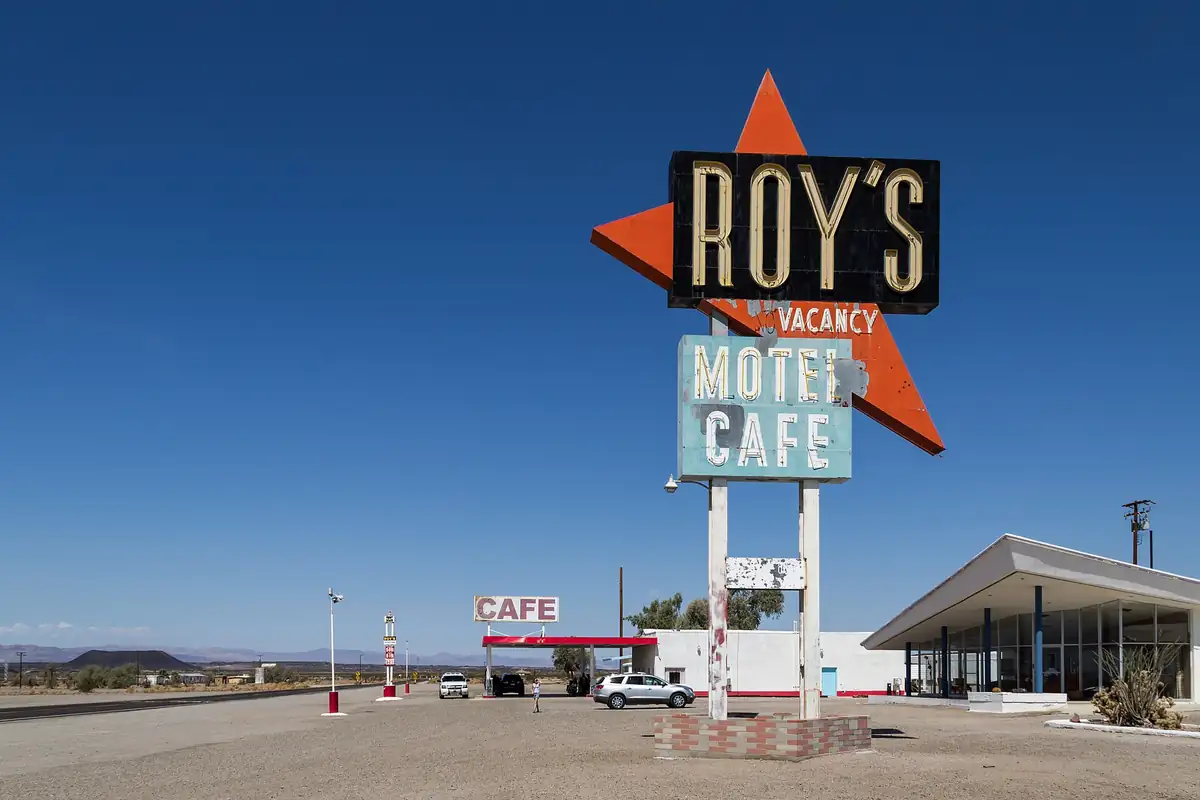
Roy’s Motel & Cafe opened in 1938, according to the California Historic Route 66 Association. The 2024 Times story says Roy Crowl started with a service station for Route 66 drivers and was soon joined by his son-in-law, Herman “Buster” Burris. The 1989 story tells it a bit differently: Burris came to Amboy in 1939 with his first wife and her parents, and they built the garage together. They added a cafe to feed customers waiting on repairs and then a motel for those stuck overnight. By 1952 there were 30 rooms at Roy’s, named for Burris’ father-in-law, the 1989 story said.
The town peaked at 600 people after a gypsum and salt mill opened nearby in 1940, the 1989 Times reported, and slid to 150 by 1980 as mining declined. Interstate 40, about 10 miles (16 km) to the north, took most of the through traffic. The Route 66 association dates the bypass to 1973; the Times in 2024 said 1972. When Burris put the whole town up for sale in 1989, the paper listed it as “Amboy (pop. 24),” with an asking price of $2.5 million.
Albert Okura, the founder of the Juan Pollo restaurant chain, bought Amboy in 2005, the association says. The 2024 Times story says he paid Burris’ widow $425,000 and promised to restore it. He reopened the gas station and restored the lobby, and in 2019 the 1959 Roy’s sign was lit again after about 30 years dark. The post office closed on November 5, 2011, with mail sent to Barstow, according to the Postal Service.
Population zero, still open
In June 2024, the Los Angeles Times reported Amboy’s permanent population as zero. The school had been closed since 1999, and the post office and church sat empty. But Roy’s store and gas pumps were open. They belong to Okura’s son, Kyle, who inherited the town from his father in 2023. If you stop, you’ll be in good company: in mid-May the paper found visitors from the Czech Republic, Poland, Britain, Brazil and Belgium.
Back in 1989, the Times noted that the stations after Amboy in the alphabet “still stand, intact, and almost entirely undeveloped.” Amboy was the letter that got a motel, a neon sign and a Route 66 crowd.
Quick answers
Why is Amboy, California, called Amboy?
It was the A in a row of railroad stations named in alphabetical order across the Mojave in 1883: Amboy, Bristol, Cadiz, Danby, Edson, Fenner and Goffs. Gudde says the word came “apparently” from one of the Amboys “back East,” but doesn’t say which.
Was Amboy named after Perth Amboy, New Jersey?
No source we found says so. Gudde only says “one of the Amboys,” and there are several, including towns in Illinois and Indiana.
Who named the alphabet stations?
It isn’t certain. Gudde says it was “probably” Lewis Kingman, a locating engineer, and Hanna’s 1946 dictionary credits Kingman in 1884. But a June 1883 newspaper letter already lists the stations on the Southern Pacific’s line.
Does anyone live in Amboy?
Not permanently, as of June 2024, when the Los Angeles Times reported the population as zero. Roy’s store and gas station were still open to travelers.
Key dates
- 1883By June, Amboy is a station on the Southern Pacific's new line across the Mojave, followed east by Bristol, Cadiz, Danby, Edson and Fenner.
- 1906Charles M. Walker is the first Amboy postmaster in the Postal Service's records.
- 1938Roy's Motel & Cafe opens, the California Historic Route 66 Association says.
- 1939The WPA guide to California lists Amboy on US 66 with 95 people.
- 1973Interstate 40 bypasses Amboy, the Route 66 association says. The Los Angeles Times gives 1972.
- 1989Buster Burris puts Amboy, population 24, up for sale for $2.5 million.
- 2005Albert Okura buys Amboy, the Route 66 association says.
- 2011The Amboy post office is discontinued on November 5, with mail sent to Barstow.
- 2019Roy's 1959 neon sign is lit again after about 30 years dark.
- 2024The Los Angeles Times reports Amboy's permanent population as zero.
Getting there
Open Amboy in Google Maps
Opens in a new tab. The pin is the center of Amboy in the USGS place-name record.
The closest airports, Amtrak stations and intercity bus stops, measured in a straight line from the center of Amboy.
Airports
- Palm Springs International (PSP) 67 mi 107 km
- Laughlin/Bullhead International (IFP) Bullhead City 79 mi 127 km
- Harry Reid International (LAS) Las Vegas 110 mi 178 km
Amtrak trains
- Palm Springs station (PSN) 65 mi 104 km
- Needles station (NDL) 68 mi 109 km
Distances are as the crow flies, not by road. We don't list schedules or fares because they change; check with the airline, Amtrak or the bus company before you go. Official data (FAA commercial service airports (2025), FAA airport locations, Amtrak stations and Intercity Bus Atlas) from the FAA and the U.S. Bureau of Transportation Statistics, checked Nov 10, 2026.
Sponsored
Staying in Amboy?
Compare hotels in Amboy, California, on Expedia.
See hotels in AmboyWe may earn a commission if you buy through this link. It never changes what we write. Read our affiliate disclosure
Historical Sources & References
- “The New Route,” letter signed L. T. F., Daily Los Angeles Herald (June 5, 1883). p. 3: a trip “over the Mojave Division” of the Southern Pacific “as far as the Colorado River,” with the stations Siberia, Bagdad, Amboy, Bristol, Cadiz, Danby and Edson (“These are mere stations, with no no points of interest”), then Fenner and Goff.
- Erwin G. Gudde, California Place Names, 3rd ed. (1969). Entry “Amboy”: named by the Atlantic and Pacific in 1883, “apparently after one of the Amboys ‘back East’”; “probably” Lewis Kingman named the stations from here to the Arizona border in alphabetical order (Amboy, Bristol, Cadiz, Danby, Edson, Fenner and Goffs); all the names have counterparts elsewhere; a later official tried to continue the alphabet. Read in search excerpts, without page numbers. Also online: Gudde, 1000 California Place Names (1959), entry “Amboy”: stations “originally (1883) in alphabetical order, named after places ‘back East.’”
- Phil Townsend Hanna, The Dictionary of California Land Names (1946). Kingman’s sidings “from Amboy to the Colorado River,” named in alphabetical order after the Santa Fe took over the line from the Southern Pacific in 1884; the list Amboy, Bolo, Cadiz, Danby, Essex, Fenner, Goffs, Homer, Ibis, Java and Klinefelter. Read in search excerpts, without page numbers.
- James Marshall, Santa Fe: The Railroad That Built an Empire (1945). p. 189: the Santa Fe “inherited perhaps the strangest string of station and siding names in America,” including Amboy and Bolo.
- Henry Gannett, The Origin of Certain Place Names in the United States, 2nd ed. (1905). p. 23: the Amboy entry, for towns in Illinois and Indiana “and many other places,” called “An Indian word, meaning ‘hollow inside,’ ‘like a bowl.’” No entry for the California station.
- Federal Writers’ Project, California: A Guide to the Golden State (1939). Tour 12 (US 66), p. 611: Amboy at 87 miles from the Arizona line, “another typical highway stop,” with 95 people, and the road to Amboy Crater.
- Sheryl Kornman, “After 50 Years in Amboy, Aging Proprietor Puts His Town Up for Sale,” Los Angeles Times (October 1, 1989). Amboy created by the Southern Pacific in 1883 as a water stop and a stop for telegraphers and linemen; the alphabetical names, “railroad officials say,” to help rail workers remember them; Buster Burris’s arrival in 1939; 30 rooms by 1952; the population peak of 600, 150 in 1980 and 24 in 1989; Interstate 40 about 10 miles north; the $2.5 million asking price.
- Alex Wigglesworth, “Amboy, population 0,” Los Angeles Times (June 9, 2024). Roy Crowl and Buster Burris; Interstate 40 in 1972; Albert Okura’s purchase for $425,000; the 2019 relighting; the school closed in 1999; a permanent population of zero; Kyle Okura; the visitors at Roy’s.
- California Historic Route 66 Association, “Amboy”. Roy’s opening in 1938, the I-40 bypass in 1973, Okura’s purchase in 2005, and the 1959 sign relit in 2019 after 30 years dark.
- U.S. Postal Service, Postmaster Finder. Search “Amboy, California”: postmasters from Charles M. Walker (1906) on; discontinued November 5, 2011, with mail to Barstow (Postal Bulletin 22324).
- U.S. Army Corps of Engineers, Amboy sheet (1942). The map at the top of this page, the oldest in the USGS historical collection that shows Amboy.
- GNIS feature 238579, Amboy (U.S. Geological Survey). The national gazetteer’s populated-place entry for Amboy, on the Amboy map sheet, with its coordinates.
Sponsored
Gear up for your next road trip
Explore rooftop tents, vehicle awnings and outdoor gear from TOPOAK Overland.
Shop TOPOAK overlanding gearWe may earn a commission if you buy through this link. It never changes what we write. Read our affiliate disclosure
Spot something wrong, or know more? Tell us here. You can also email us or use our contact page. Corrections are noted here with their date, never made silently.