Why Is It Called Steamboat Springs? A Spring That Puffed
Steamboat Springs is named for a noise. A mineral spring by the Yampa River made a puffing sound that reminded Frank Hall, writing in 1895, of a river steamer; Henry Gannett's 1905 place-name book also credits the sound. The city says French trappers heard it in the early 1800s, but none of these sources quotes a trapper's own account.
A spring by the Yampa River that puffed like a river steamer gave Steamboat Springs, Colorado, its name, though the sources don’t say who heard it first. The noise is well documented. Who first compared it to a boat is harder to pin down.
Puffing like a river steamer
Frank Hall’s History of the State of Colorado reached Routt County in its fourth volume, in 1895. He had a lot to say about the springs, and he started with the name:
“Steamboat Springs, so called from the peculiar puffing sounds emitted by them, and reminding one of large river steamers in full action…”
He put the number at eighty springs, some very cold and one as hot as 156 degrees, and thought the place could become “one of the great sanitariums of the world” once a railroad reached it. That’s the whole idea in one line: a spring that sounded like a big river steamer working hard.
Henry Gannett’s 1905 book on American place names kept it shorter. The town in Routt County was “so named because of the sound which issues from an opening in the rocks.” You’ll notice he didn’t say who did the naming, and neither did Hall.
Already on the books in 1874
The name was in use before there was a town. Story B. Ladd, a topographer with Ferdinand Hayden’s federal survey of the territories, wrote up the northern part of Colorado after the 1874 season. Writing about the Yampa valley, he noted that “the Steamboat Springs are located right at the bend of the Yampah, on both sides of the river, and close to the bank on the north side.” He found the water lukewarm and full of sulphur.
That same summer, on July 25, 1874, James H. Crawford made what Hall calls the first actual settlement in the county, right at Steamboat Springs. So the springs had their name by that season, a decade before anyone laid out a town, and the town just took it.
The French trapper story
So who came up with “steamboat”? The City of Steamboat Springs tells it this way: the name “is thought to have originated around the early 1800s when French trappers thought they heard the chugging sound of a steamboat’s steam engine.” The sound, it says, turned out to be a mineral spring, which became the Steamboat Spring.
It’s a good story, and trappers did work this valley. Hall mentions that early trappers called the Yampa the Bear River, for all the bears they saw there. But we couldn’t find a trapper’s diary or letter that describes the noise, and the city is careful to say “thought to.” Treat the trappers as tradition, and the sound as the part you can actually check.
The spring that went quiet
The town grew slowly. According to the city’s history, Crawford organized the Steamboat Springs Townsite Company in 1884 with backers from Boulder, the town was incorporated in 1900 with Crawford as its first mayor, and the railroad finally arrived in 1909. Hall had been waiting for that railroad, and it came with a twist. The city says building it “silenced the Steamboat Spring’s chugging noise forever.”
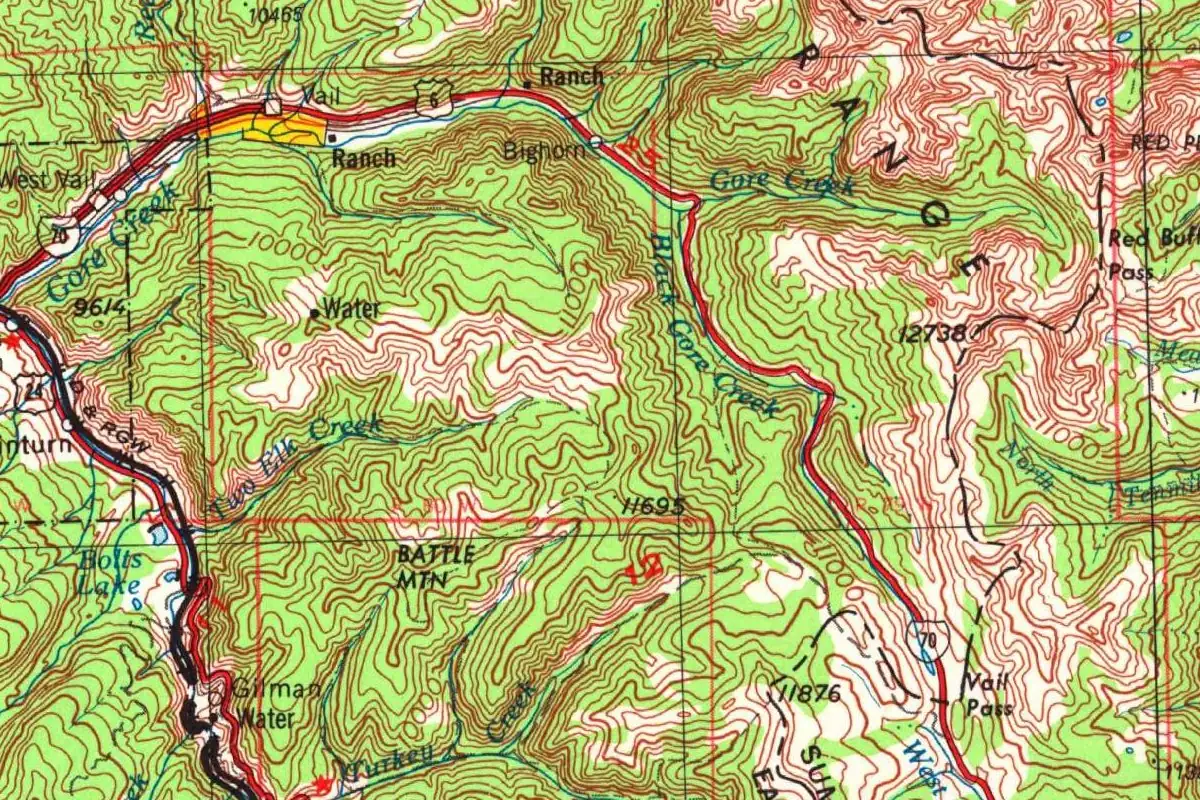
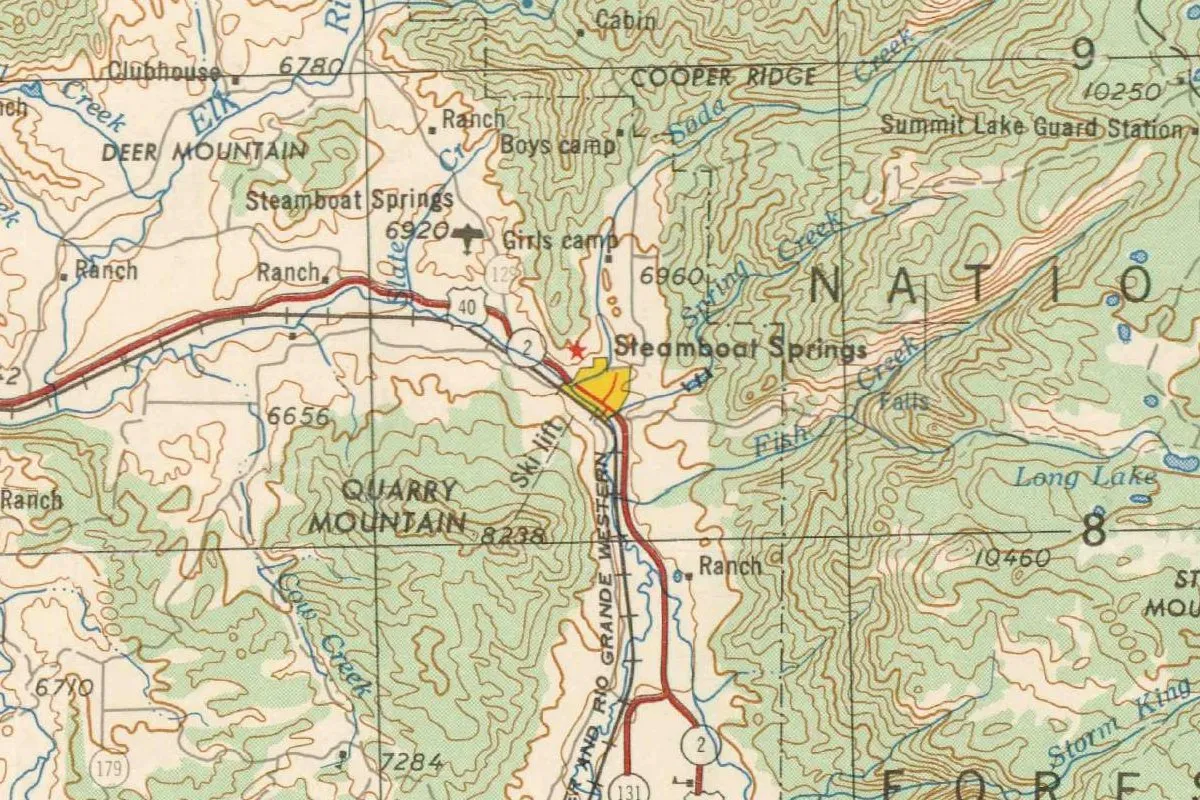
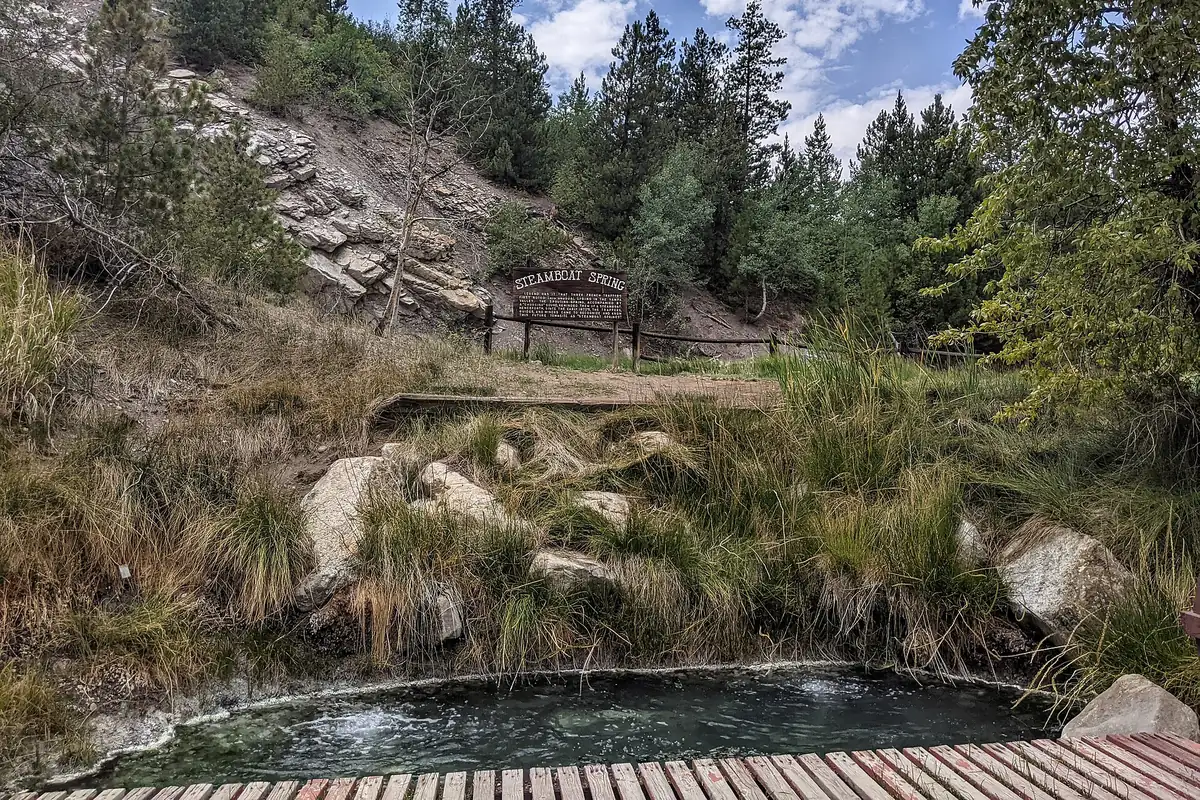
You can still visit the spring, with its marker sign and a pool of bubbling water by a boardwalk. On the survey’s 1957 map of the area, the town is a small yellow patch where U.S. 40 meets the railroad, with Soda Creek and Spring Creek running down to it and a ski lift on the slope across the way. The name stuck around in Colorado long after the noise that earned it went quiet.
Quick answers
Why is it called Steamboat Springs?
Because of a sound. Hall’s 1895 history says the springs were named for “peculiar puffing sounds” like river steamers, and Gannett’s 1905 book says the name came from “the sound which issues from an opening in the rocks.”
Did French trappers name Steamboat Springs?
Maybe, but the sources cited here don’t show it. The city says the name is “thought to have originated” with French trappers in the early 1800s; none of the sources cited here quotes a trapper’s own account.
Does the Steamboat Spring still chug?
No, according to the city. Its history says the construction of the railroad, which arrived in 1909, silenced the spring’s chugging noise.
Who first settled at Steamboat Springs?
James H. Crawford, on July 25, 1874, according to Hall, who calls it the first actual settlement in Routt County.
Key dates
- 1874A Hayden survey report on that year's work places the Steamboat Springs at the bend of the Yampa, on both sides of the river.
- 1874July 25: James H. Crawford makes the first settlement in what became Routt County, at Steamboat Springs.
- 1884Crawford and Boulder businessmen organize the Steamboat Springs Townsite Company, according to the city.
- 1895Frank Hall writes that the springs are so called from their puffing sounds, like large river steamers.
- 1900The town is incorporated, with Crawford as its first mayor, according to the city.
- 1909The railroad arrives. The city says its construction silenced the Steamboat Spring's chugging for good.
Getting there
Open Steamboat Springs in Google Maps
Opens in a new tab. The pin is the center of Steamboat Springs in the USGS place-name record.
The closest airports, Amtrak stations and intercity bus stops, measured in a straight line from the center of Steamboat Springs.
Airports
- Yampa Valley (HDN) Hayden 20 mi 33 km
- Eagle County Regional (EGE) 58 mi 94 km
- Denver International (DEN) 122 mi 196 km
Amtrak trains
- Granby station (GRA) 55 mi 88 km
- Fraser-Winter Park station (WIP) 65 mi 105 km
Intercity buses
- Bustang Outrider Bustang · Steamboat Springs 1 mi 2 km
- Colorado Department of Transportation Bustang · Eagle Chambers PnR 57 mi 92 km
Distances are as the crow flies, not by road. We don't list schedules or fares because they change; check with the airline, Amtrak or the bus company before you go. Official data (FAA commercial service airports (2025), FAA airport locations, Amtrak stations and Intercity Bus Atlas) from the FAA and the U.S. Bureau of Transportation Statistics, checked Nov 13, 2026.
Sponsored
Staying in Steamboat Springs?
Compare hotels in Steamboat Springs, Colorado, on Expedia.
See hotels in Steamboat SpringsWe may earn a commission if you buy through this link. It never changes what we write. Read our affiliate disclosure
Sponsored
Want the spooky side of Steamboat Springs?
The name has its story above. For the ghost stories, US Ghost Adventures runs walking ghost tours in Steamboat Springs.
See ghost tours in Steamboat SpringsWe may earn a commission if you book through this link. It never changes what we write. Read our affiliate disclosure
Historical Sources & References
- Frank Hall, History of the State of Colorado, vol. 4 (1895), pp. 299-300, 302. The trappers’ name Bear for the Yampa, and the Steamboat Springs “so called from the peculiar puffing sounds emitted by them,” with their number and temperatures (pp. 299-300); James H. Crawford’s first settlement on July 25, 1874 (p. 302). Also online: p. 302.
- Henry Gannett, The Origin of Certain Place Names in the United States (USGS, 1905), p. 289. Steamboat Springs “so named because of the sound which issues from an opening in the rocks.”
- F. V. Hayden, Annual Report for 1874 (1876), report of Story B. Ladd, p. 438. The Steamboat Springs “right at the bend of the Yampah,” with lukewarm, sulphur water.
- City of Steamboat Springs, “History of Steamboat Springs”. The French trapper tradition, the 1884 townsite company, the 1900 incorporation with Crawford as mayor, the railroad of 1909 and the end of the spring’s chugging.
- GNIS feature 172749 (U.S. Geological Survey). Steamboat Springs listed as a populated place in Routt County.
- U.S. Geological Survey, Craig sheet (1:250,000), 1957. The 1957 sheet with the town where U.S. 40 meets the Denver and Rio Grande Western, Soda and Spring creeks and a ski lift.
Spot something wrong, or know more? Tell us here. You can also email us or use our contact page. Corrections are noted here with their date, never made silently.