Glenwood Springs, Colorado: How Defiance Got an Iowa Name
Glenwood Springs is named for Glenwood, Iowa, and for its hot springs, Henry Gannett wrote in 1905. The town was first called Defiance. Colorado's 1941 WPA guide says Glenwood was the birthplace of one of the founders, while Visit Glenwood Springs credits Sarah Cooper, wife of founder Isaac Cooper, whose hometown it was.
Glenwood Springs, Colorado, started out as Defiance and took its new name from Glenwood, Iowa, plus the hot springs that made it famous. The water had a name long before the town did. The Ute called it Yampah, which the resort’s history and a federal preservation page both translate as “big medicine.”
A town called Defiance
James Landis came first, according to the town’s tourism site, Visit Glenwood Springs. “In 1882, town founders Isaac Cooper, John Blake and others purchased Landis’ property for $1500 and formed the Defiance Town and Land Company.”
Colorado’s 1941 WPA guide gives a reason for that first name: “The town, originally known as Defiance, for a near-by fort, was laid out in 1883, four years before the arrival of the railroad.” It doesn’t say which fort. The Advisory Council on Historic Preservation’s Preserve America page puts the two old names side by side, calling the place “Yampah (big medicine) to the Ute Indians and Defiance to the gold rush settlers,” and says Glenwood Springs was incorporated in 1885.
Whose Glenwood?
Both histories point to the same Iowa town, but they don’t credit the same person. The WPA guide says the town “was later named for Glenwood, Iowa, the birthplace of one of its founders.” Visit Glenwood Springs names a woman: “It was because of Cooper’s wife Sarah that the name Defiance was eventually changed to Glenwood Springs, after her hometown of Glenwood, Iowa.” Neither one gives a date for the change.
Gannett (1905) fits both halves into one line: “Glenwood Springs; town in Garfield County, Colorado, named from the city in Iowa and the famous hot springs in the neighborhood.” And if you look one entry up on the same page, you’ll find where the Iowa name came from, at least by Gannett’s account: “Glenwood; township and city in Mills County, Iowa, named for a Presbyterian minister, Glenn Wood.”
The springs in the name
The “Springs” half needs less explaining. The resort’s history says Capt. Richard Sopris and his party found the springs in 1860. The WPA writers describe what came before the pools: the early settlers’ bathtubs were “holes scooped in the ground and shielded by pine boughs, an idea borrowed from the Indians who brought their sick here for treatment.” The Ute kept coming to the springs long after they’d been moved to their reservation, the guide adds, and Chief Colorow “was a familiar figure in the town.”
Then came the resort. Visit Glenwood Springs says Cooper joined forces with Walter Devereux, a wealthy mining engineer, to build a spa resort. The railroad, the Denver & Rio Grande, reached town in 1887. That same year Doc Holliday came, hoping the springs could help his tuberculosis, and he died in town that November. The resort dates its pool to 1888 and calls it “the world’s largest hot springs pool.” The WPA guide gives 1891 for the open-air pool and bathhouse, built, it says, by “An English syndicate.” The Hotel Colorado followed in 1893.
You’ll find the same idea in towns far from Colorado. Hot Springs, South Dakota, kept the plain description, Eureka Springs, Arkansas, added a Greek exclamation to its healing spring, and Calistoga, California, blended California and Saratoga for Sam Brannan’s hot springs resort. In Colorado, Steamboat Springs also put its spring in its name.
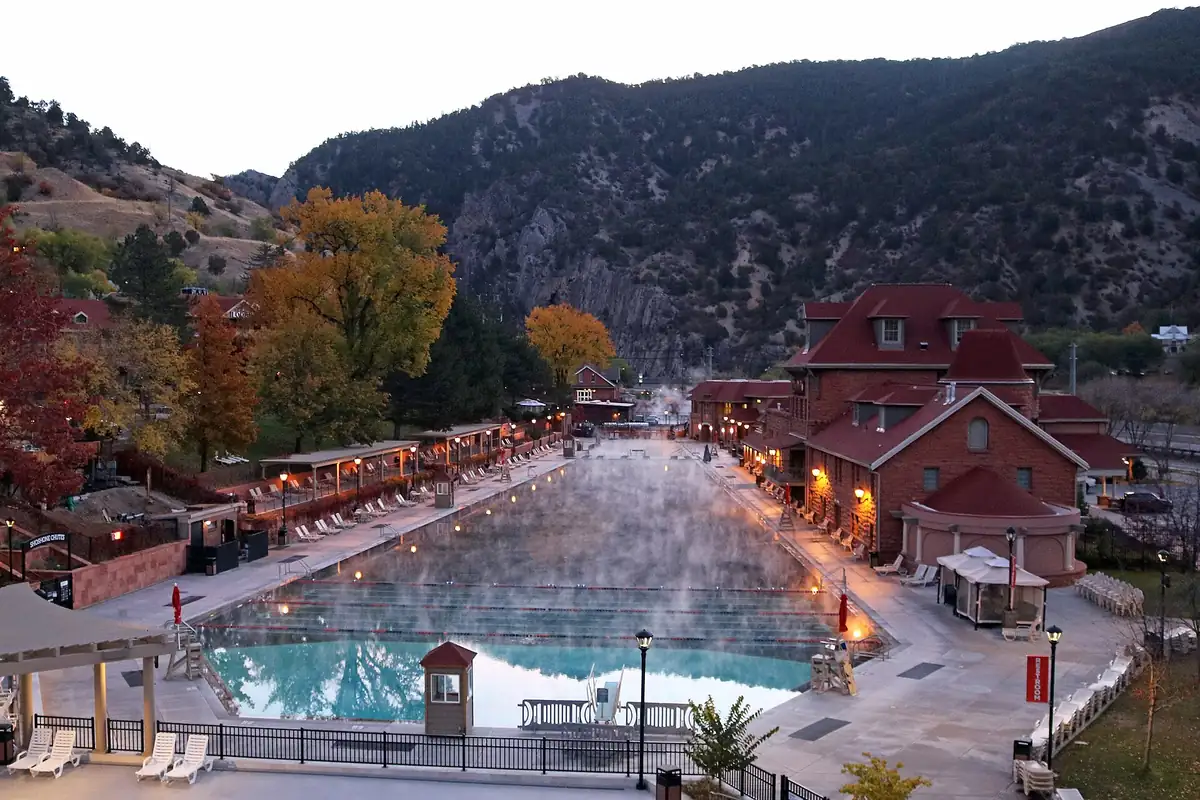
The photo below shows the pool in October 2020, with steam rising off the water.
The 1927 map
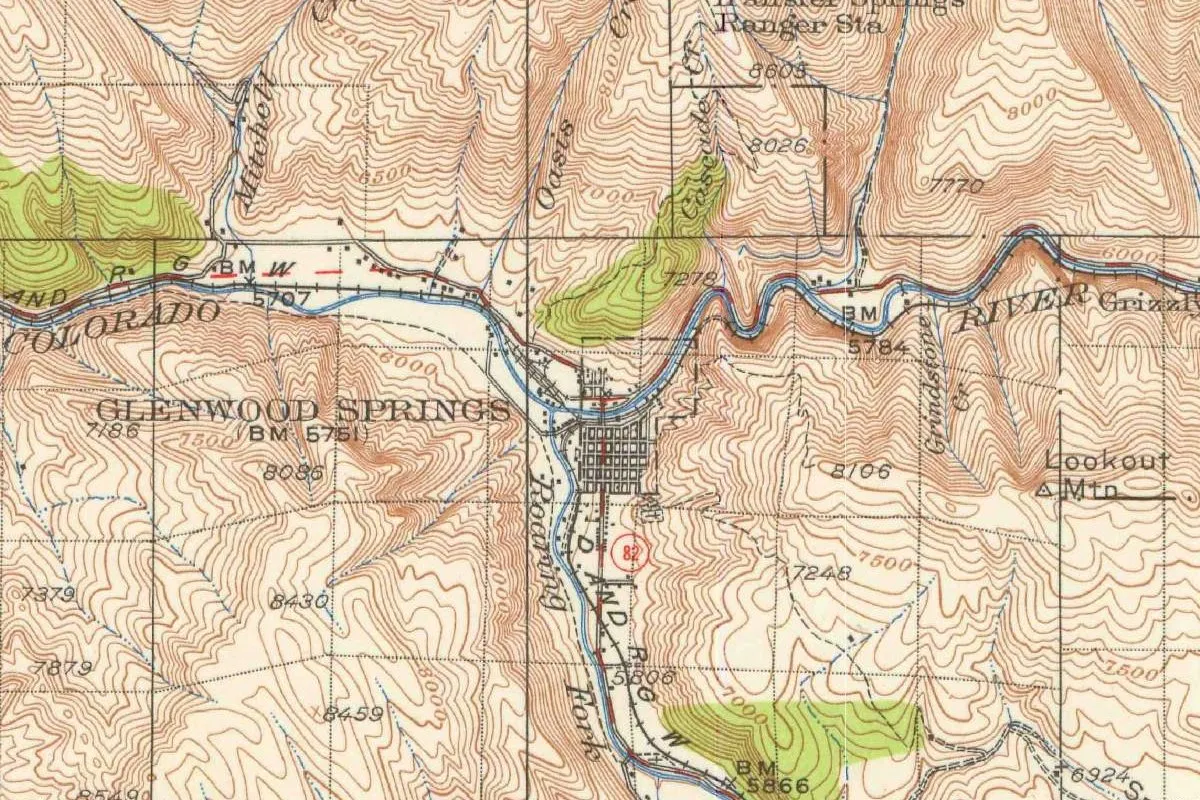
The map at the top of this page comes from the Geological Survey’s Glenwood Springs sheet, with topography by B. A. Jenkins and S. T. Penick, surveyed in 1925 and 1927. The copy shown is a later printing, dated 1956 in its margin. The town’s street grid sits right where the Roaring Fork River runs into the Colorado, with the railroad, marked D and RGW, following both rivers. Where the road leaves the bottom of the sheet, a red note gives the miles still to go: Carbondale, 8.9 (14.3 km), and Aspen, 37 (60 km).
Quick answers
Why is it called Glenwood Springs?
Glenwood, Iowa, and the hot springs. Gannett (1905) says the town was “named from the city in Iowa and the famous hot springs in the neighborhood.”
What was Glenwood Springs called before?
Defiance. The WPA guide (1941) says the name came from “a near-by fort,” and the Defiance Town and Land Company was formed in 1882, Visit Glenwood Springs says.
Who named Glenwood Springs after Glenwood, Iowa?
Sarah Cooper, by one account. Visit Glenwood Springs says the name changed “because of” her, after her hometown. The WPA guide only says Glenwood was the birthplace of “one of its founders.”
What does Yampah mean?
The resort and the Preserve America page say “big medicine.” Both give that meaning for the Ute name of the springs; neither is a language source.
Key dates
- 1860Capt. Richard Sopris and his party reach the springs, the resort's history says.
- 1882Isaac Cooper, John Blake and others buy James Landis's property and form the Defiance Town and Land Company.
- 1883The town, still called Defiance, is laid out, the WPA guide says.
- 1885Glenwood Springs is incorporated.
- 1887The Denver & Rio Grande arrives, and Doc Holliday comes for the springs and dies in town in November.
- 1888The hot springs pool opens, by the resort's account.
- 1891An English syndicate builds the open-air pool and bathhouse, by the WPA guide's date.
- 1893The Hotel Colorado welcomes its first guests.
Things to do in Glenwood Springs, Colorado
Glenwood Hot Springs Resort
Home of what the resort calls the world's largest hot springs pool, along with the Hot Therapy Pool, the Sopris Splash Zone and the Hanging Lake Falls Pool, a 107-room Lodge and the boutique Hotel 1888.
Yampah Spa & Vapor Caves
Three rock chambers where vapor rises from 125°F (52°C) geothermal water and temperatures hover around 110-112°F (43-44°C). The spa calls it the only 'natural' vapor cave in North America, and says the current building opened in 1893.
Glenwood Caverns Adventure Park
Reached by the Glenwood Gondola, the park bills itself as America's only mountaintop theme park, at 7,160 feet (2,182 m), with two National Natural Landmark cave tours and an Alpine Coaster.
Glenwood Springs Historical Society
The town's historical society celebrates the history of Glenwood Springs with artifacts and exhibits, and it also offers guided history tours.
Getting there
Open Glenwood Springs in Google Maps
Opens in a new tab. The pin is the center of Glenwood Springs in the USGS place-name record.
The closest airports, Amtrak stations and intercity bus stops, measured in a straight line from the center of Glenwood Springs.
Airports
- Eagle County Regional (EGE) 23 mi 36 km
- Aspen-Pitkin County/Sardy Field (ASE) 33 mi 54 km
- Denver International (DEN) 143 mi 229 km
Amtrak trains
- Glenwood Springs station (GSC) under 1 mi 0.3 km
- Grand Junction station (GJT) 75 mi 120 km
Intercity buses
- Colorado Department of Transportation Bustang · West Glenwood Park & Ride 2 mi 3 km
- Greyhound Glenwood Springs W Glenwood Mall 2 mi 3 km
- Bustang Outrider Bustang · Crested Butte 51 mi 81 km
Distances are as the crow flies, not by road. We don't list schedules or fares because they change; check with the airline, Amtrak or the bus company before you go. Official data (FAA commercial service airports (2025), FAA airport locations, Amtrak stations and Intercity Bus Atlas) from the FAA and the U.S. Bureau of Transportation Statistics, checked Nov 17, 2026.
Sponsored
Staying in Glenwood Springs?
Compare hotels in Glenwood Springs, Colorado, on Expedia.
See hotels in Glenwood SpringsWe may earn a commission if you buy through this link. It never changes what we write. Read our affiliate disclosure
Historical Sources & References
- Henry Gannett, The Origin of Certain Place Names in the United States (1905), p. 138. Glenwood Springs named from the Iowa city and the hot springs, and Glenwood, Iowa, named for Glenn Wood. Checked against the page image.
- Federal Writers’ Project, Colorado: A Guide to the Highest State (1941), p. 239. Defiance “for a near-by fort,” the town laid out in 1883, Glenwood, Iowa, as a founder’s birthplace, the English syndicate’s pool of 1891, the settlers’ bathtubs and Chief Colorow. Checked against the page image.
- Visit Glenwood Springs, “Settling in Glenwood Springs”. Landis, the purchase of 1882 and the Defiance Town and Land Company, Sarah Cooper and her hometown, Devereux, the railroad of 1887, Doc Holliday and the Hotel Colorado in 1893.
- Advisory Council on Historic Preservation, Preserve America, “Glenwood Springs, Colorado”. Yampah, “big medicine,” Defiance and the incorporation of 1885.
- Glenwood Hot Springs Resort, “History”. Yampah as “Big Medicine,” Sopris in 1860 and the pool of 1888.
- Glenwood Hot Springs Resort; Yampah Spa & Vapor Caves; Glenwood Caverns Adventure Park; Glenwood Springs Historical Society. The details in the things-to-do list.
- GNIS feature ID 204659 (U.S. Geological Survey). Glenwood Springs in the national gazetteer, in Garfield County, with its coordinates.
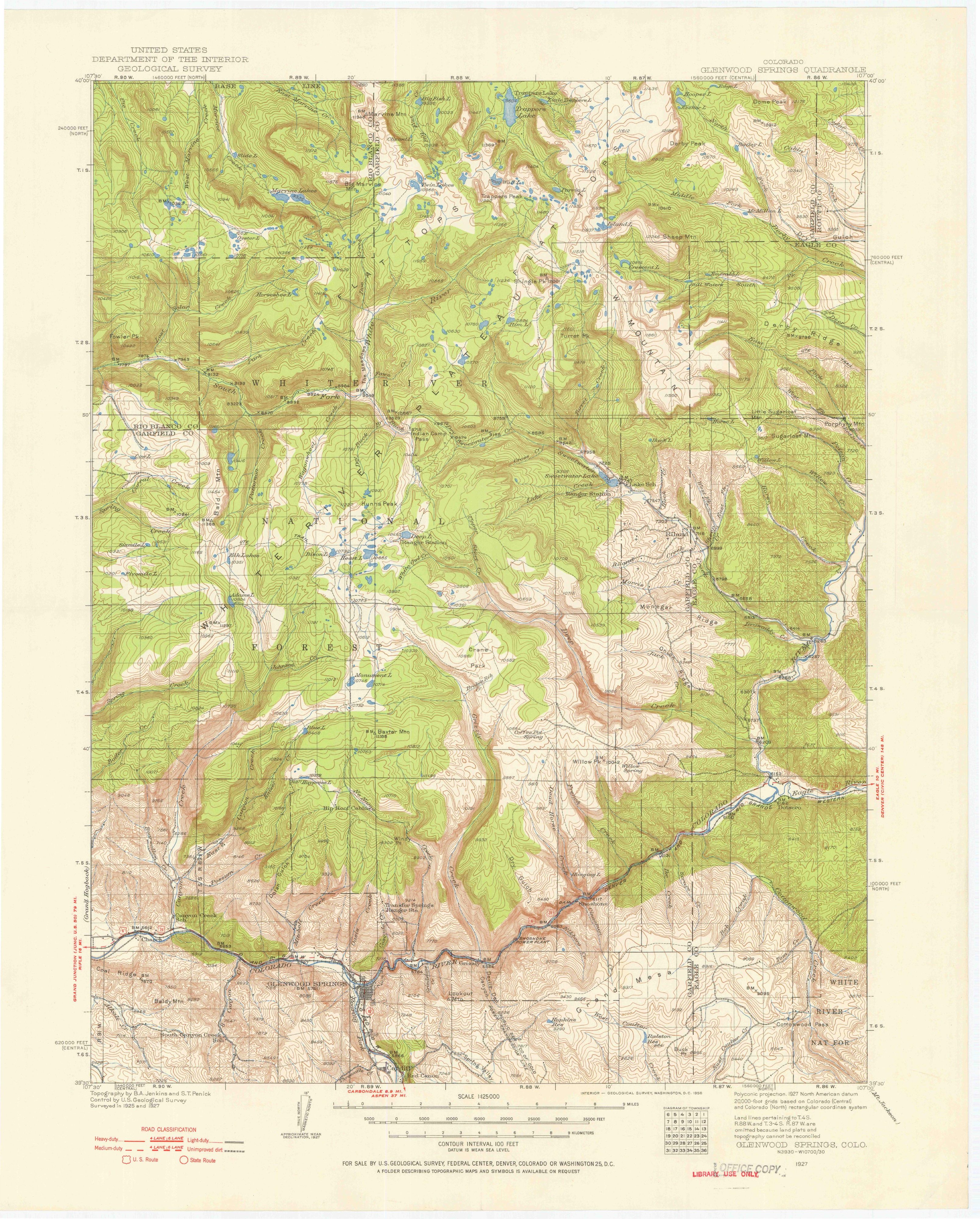
- U.S. Geological Survey, Glenwood Springs sheet (1927). The 1:125,000 sheet, in its 1956 printing, that the map at the top of this page was cropped from, with the road notes for Carbondale and Aspen at the edge of the sheet.
Sponsored
Put this 1927 map on your wall
The Geological Survey's 1927 Glenwood Springs sheet (a 1956 printing) is in the public domain. Download the full-size scan for free, then have it printed on canvas with CanvasOnTheCheap.
Print a map on canvasDownload the full-size mapWe may earn a commission if you buy through this link. It never changes what we write. Read our affiliate disclosure
Spot something wrong, or know more? Tell us here. You can also email us or use our contact page. Corrections are noted here with their date, never made silently.