Telluride, Colorado: The Ore Name That Replaced Columbia
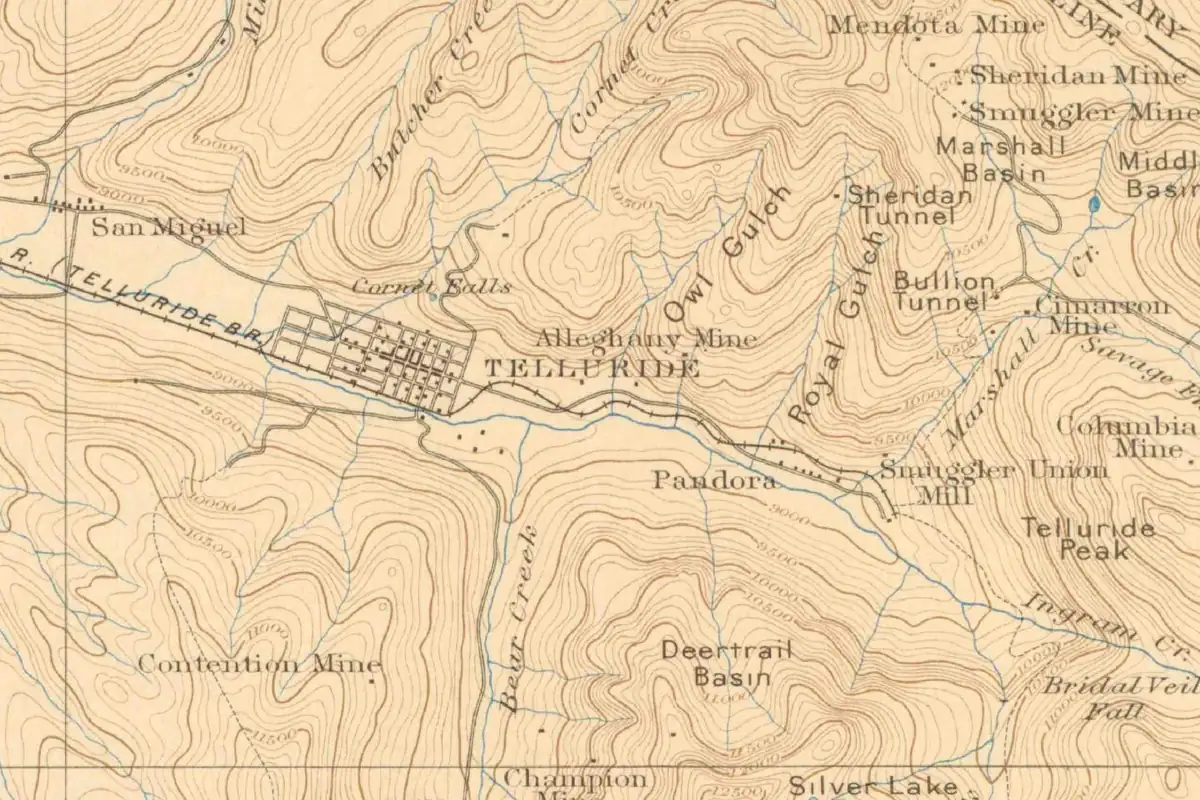
Telluride, Colorado, got its mining name for the post office while the town was still Columbia; a 1910 account ties the choice to tellurium ore. The name was already in use by 1880, years before Columbia officially adopted it in 1887. The familiar “to-hell-you-ride” line came along as a joke about the name.
Columbia for the town, Telluride for the mail
The problem was another Columbia, in California. Looking back in February 1910, The Telluride Journal explained that postal officials wouldn’t accept the Colorado camp’s name: there was already a Columbia post office in California, and the petitioners had to choose something else.
Postal historian Ray Newburn dates the establishment of the Telluride office to July 26, 1880. The town kept Columbia until June 1887, when it adopted the postal name. Those are two different events, which is why a simple “renamed in 1887” leaves part of the story out.
You can catch both names in George Crofutt’s 1881 Grip-Sack Guide of Colorado. He describes a new mining camp “situated in the town of Columbia, upper San Miguel.” His list of nearby mines includes the Sheridan, Mendota and Ajax. Readers in 1881 were already seeing the two names side by side.
The assayer’s suggestion
The Journal supplied a person behind the choice. Its February 17, 1910, note began with a different town’s postal problem: Redlands was becoming Redvale because California already had a Redlands. Telluride, the paper explained, had run into the same obstacle.
Then it gave this account:
“Under the impression that tellurium was a frequent ore hereabouts the name Telluride was suggested by Geo. Andrus…”
It identified Andrus as an assayer and metallurgist who had worked in town and was living in Globe, Arizona, by 1910.
The important word is “impression.” The paper linked the choice to what people thought the district contained. It wasn’t reporting an assay that proved them right. This was the paper’s recollection roughly thirty years after the naming.
The mining explanation also appears in the old name dictionaries. Henry Gannett’s 1905 USGS bulletin says Telluride was named for ore found nearby. J. Frank Dawson’s 1954 Colorado dictionary identifies tellurium and notes the earlier name Columbia. Their entries give you the mineral connection in a few words; the newspaper fills in who suggested it.
Was there any tellurium in Telluride?
Tellurium and telluride aren’t quite the same thing. Tellurium is an element; tellurides are compounds containing it. A USGS fact sheet explains that telluride minerals can contain gold, silver or platinum. Both words belong to the mining vocabulary behind the town’s name.
Whether the local rocks justified the choice is another question. Gannett said the ore was found nearby. Five years later, the Journal said it wasn’t known that even a pound of tellurium had been found in the camp.
Newburn, on page 12 of his postal history, says an isolated patch of sylvanite, a gold-silver telluride, in the Sheridan mine “is said to have suggested the name.” He adds that telluride minerals never served as ores near Telluride. His distinction leaves room for a small mineral occurrence, while agreeing with the Journal’s doubts about local ore and differing from Gannett’s account. A patch in a mine and an ore deposit worth working are two different things.
Where “to-hell-you-ride” fits
If you’ve heard “to-hell-you-ride,” you’ve heard the conductor’s version. Ray Newburn’s postal history says it was a favorite quip of train conductors, who’d announce the town that way.
The town’s own history places the railroad’s arrival in 1890, after Telluride was already a postal name. It describes the Rio Grande Southern linking this mountain country with Durango. A conductor could make something memorable out of Telluride; that doesn’t make the joke its source.
The post office needed a usable name. Columbia took a few more years to adopt it, and the conductors found a way to say it with a wink.
Quick answers
What does Telluride mean?
A compound containing tellurium. For the Colorado town, the naming accounts point to mining: a 1910 newspaper attributed the suggestion to an assayer who believed tellurium ore was common nearby.
Was Telluride called Columbia?
Yes. Crofutt used both names in 1881, describing Telluride within the town of Columbia. Newburn dates the town’s adoption of its postal name to June 1887.
Why did Columbia change its name to Telluride?
Another Columbia already had a post office in California. The Telluride Journal said postal applicants in Colorado had to find a different name; the town later adopted the name already used by its post office.
Does Telluride come from “to-hell-you-ride”?
Not according to the naming account in the Telluride Journal. It credits a mining suggestion by Geo. Andrus, while Newburn records the similar-sounding phrase as a conductor’s joke.
Key dates
- 1880July 26: the Telluride post office is established, according to Ray Newburn's postal history. The town is still Columbia.
- 1881Crofutt's guide describes Telluride as a mining camp within the town of Columbia.
- 1887June: Columbia adopts its post office's name, Telluride, according to Newburn.
Getting there
Open Telluride in Google Maps
Opens in a new tab. The pin is the center of Telluride in the USGS place-name record.
The closest airports, Amtrak stations and intercity bus stops, measured in a straight line from the center of Telluride.
Airports
- Telluride Regional (TEX) 5 mi 9 km
- Montrose Regional (MTJ) 40 mi 64 km
Amtrak trains
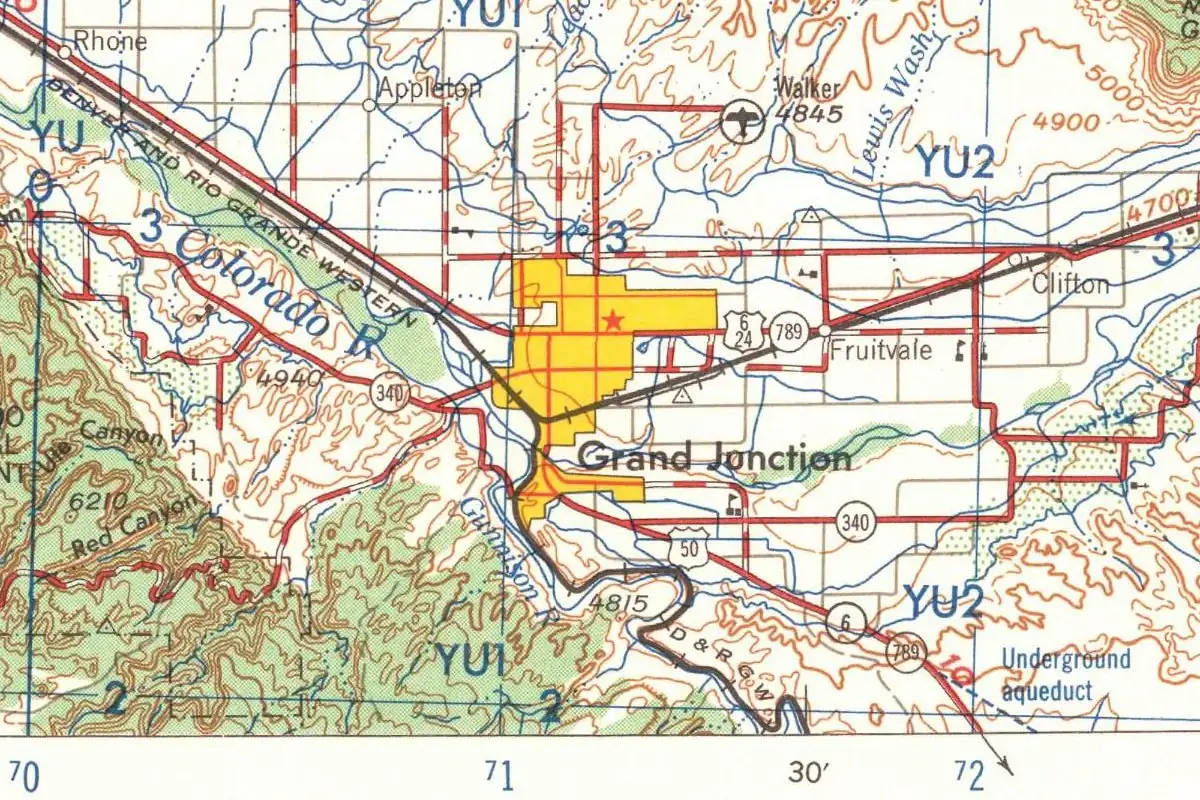
- Grand Junction station (GJT) 88 mi 142 km
Intercity buses
- Bustang Outrider Bustang · Telluride 3 mi 5 km
- Greyhound Durango W 8th St 46 mi 74 km
Distances are as the crow flies, not by road. We don't list schedules or fares because they change; check with the airline, Amtrak or the bus company before you go. Official data (FAA commercial service airports (2025), FAA airport locations, Amtrak stations and Intercity Bus Atlas) from the FAA and the U.S. Bureau of Transportation Statistics, checked Nov 9, 2026.
Sponsored
Staying in Telluride?
Compare hotels in Telluride, Colorado, on Expedia.
See hotels in TellurideWe may earn a commission if you buy through this link. It never changes what we write. Read our affiliate disclosure
Historical Sources & References
- The Telluride Journal, February 17, 1910, p. 3. An untitled note about Redvale recalls Columbia’s postal-name problem, credits Geo. Andrus with proposing Telluride and questions the local presence of tellurium. Original newspaper image and text, Colorado Historic Newspapers Collection.
- George A. Crofutt, Crofutt’s Grip-Sack Guide of Colorado (1881), p. 148. A contemporary description places the camp within Columbia and lists nearby mines.
- Henry Gannett, The Origin of Certain Place Names in the United States, 2nd ed. (USGS, 1905), p. 298. Connects Telluride’s name with ore found nearby, without identifying a source for that statement.
- J. Frank Dawson, Place Names in Colorado (1954), entry “Telluride”. Gives tellurium as the namesake and Columbia as the earlier name.
- Ray L. Newburn, Jr., “Postal History of the Colorado San Juan,” Western Express, April 1978, pp. 12–13. Postal chronology, the cautiously reported sylvanite explanation and the conductors’ quip; an early postmark appears on p. 13.
- Richard J. Goldfarb, Tellurium: Providing a Bright Future for Solar Energy (USGS, 2015). Explains the element and telluride minerals; it doesn’t establish who named the town.
- Town of Telluride, “History of Telluride”. Columbia’s early history, the railroad’s arrival and its connection with Durango.
- GNIS feature 204747 (U.S. Geological Survey). Telluride’s geographic identification: a populated place in San Miguel County, Colorado. The downloadable state record supplies its coordinates.
Spot something wrong, or know more? Tell us here. You can also email us or use our contact page. Corrections are noted here with their date, never made silently.