Why Is It New Albany, Indiana? A Nod to New York's Capital
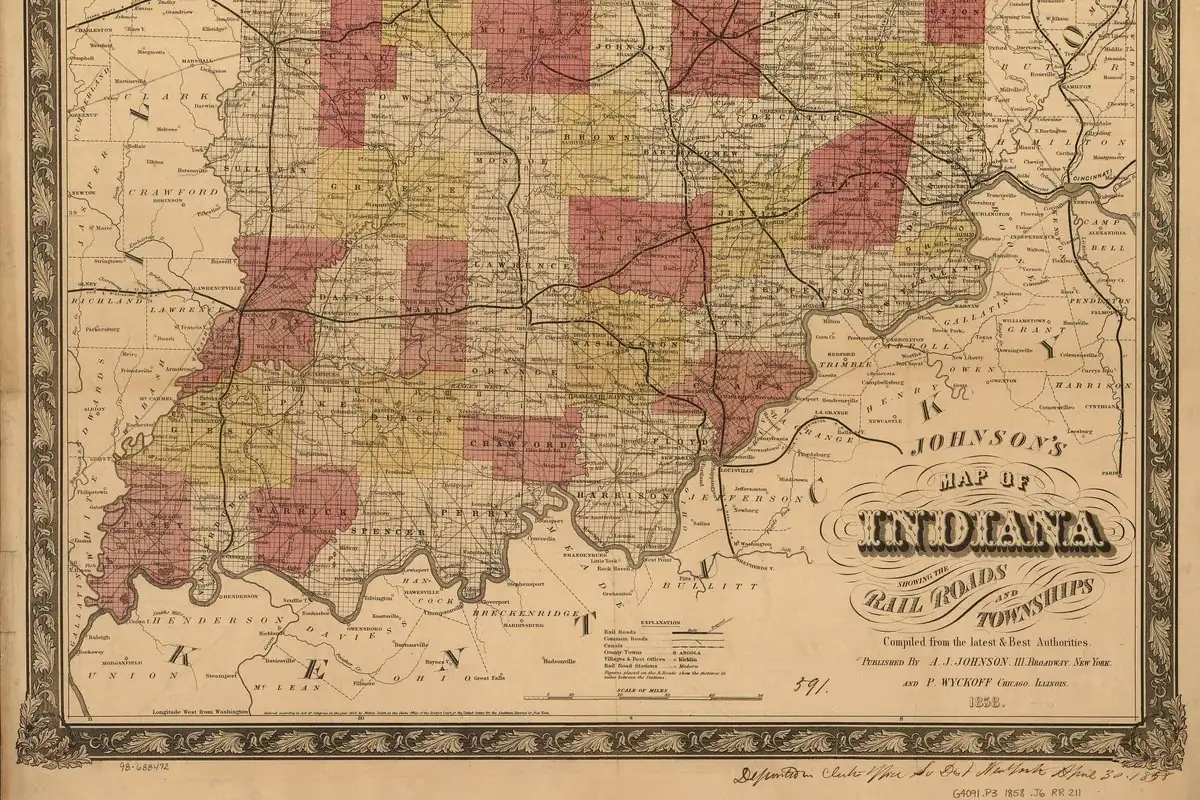
The Scribner brothers, Joel, Nathaniel and Abner, named it after Albany, New York, when they laid out the town below the Falls of the Ohio in 1813. An 1882 county history says so in passing, and a National Register nomination says they honored the capital of their native state. Their own 1813 sale handbill doesn't explain the name.
Three brothers and a borrowed capital
Three Scribner brothers laid out New Albany, Indiana, on the Ohio River in 1813, and an 1882 history says they named it after Albany, New York. The “New” was the giveaway: this was a fresh town carrying an older one’s name west.
The brothers were Joel, Nathaniel and Abner Scribner. The 1882 History of the Ohio Falls Cities and Their Counties says their father had settled in Connecticut and later moved to Dutchess County, New York, where Joel was born in 1772. Joel was running a grocery business in New York City when he decided to try his luck out west. He left the city on October 8, 1811, with his brother-in-law, William Waring, headed for Cincinnati.
The War of 1812 upset that plan. In the fall of 1812 his younger brothers Nathaniel and Abner joined him, and that winter the three went down the Ohio looking for land.
Abner’s mill and the land below the Falls
The county history gives Abner most of the credit for the site. By the book’s account he was quick-witted and pushing, with a head full of mill sites, and when the brothers reached the Falls of the Ohio he saw water power. They wanted land on the Indiana shore, the book says, because “they did not wish to own any land in a slave State.” The ground nearest the Falls was taken, so they bought out John Paul’s tract for $8,000.
That’s where the name turns up, almost as an aside. Abner, the book says, made himself and plenty of other people believe that “New Albany (named after Albany, New York,) would become in time the largest interior city on the continent.” That’s page 141. It’s the oldest statement of the name’s origin in the sources for this article, written 69 years after the founding.
A much later study backs it up and adds a reason. The National Register nomination for New Albany’s Cedar Bough Place Historic District says the brothers “named it New Albany in honor of the capital of their native state of New York.”
“This town is just laid out”
The Scribners cut their first tree on March 2, 1813, to clear a spot for a double log cabin. A surveyor named John K. Graham drew the plat. Then the proprietors printed a handbill to sell lots, and the 1882 history reprints it on page 144:
“This town is just laid out, with spacious streets, public squares, markets, etc. It is situated on the bank of the Ohio river, at the crossing place from Louisville to Vincennes, about two miles below the falls, in the Indiana Territory…”
It’s signed “The Proprietors” and dated “New Albany, July 8, 1813.” So the name was in use within months of that first tree, before Indiana was even a state. What the handbill doesn’t do is explain the name. You get spring water, ship timber and a promise of schools, but not a word about New York.
Where Albany got its name
Follow the borrowed name back and you end up with a royal duke. Henry Gannett’s 1905 bulletin on American place names says Albany, New York, was “named for the Duke of York, whose Scotch title was ‘Duke of Albany,’ afterwards James II of England.” The entry just above it, for an Albany in Illinois, adds that many other places were “named from the city in New York.” His entry for New Albany itself, on page 222, says the Floyd County city was “named from Albany in New York.” Albany, New York has its own story on this site.
The Scribners’ town did grow, if not quite into the biggest inland city on the continent. The Indiana Historical Bureau’s marker says that in the 1840s and 1850s New Albany was the largest city and the leading commercial and industrial center in Indiana.
Quick answers
Why is it called New Albany?
Because the founders named it after Albany, New York. The 1882 History of the Ohio Falls Cities says so, and a National Register nomination says the Scribners were honoring the capital of their native state.
Who founded New Albany, Indiana?
Joel, Nathaniel and Abner Scribner, in 1813, according to the Indiana Historical Bureau marker and the 1882 county history.
Is New Albany older than the state of Indiana?
Yes. The proprietors’ handbill dated July 8, 1813, describes the new town as “in the Indiana Territory.”
Key dates
- 1772Joel Scribner, one of the founders, is born at South East, in Dutchess County, New York.
- 1811October 8: Joel Scribner leaves New York City for Cincinnati with his brother-in-law, William Waring.
- 1813March 2: the Scribners cut the first tree to clear a cabin site on the land they bought below the Falls of the Ohio.
- 1813July 8: the proprietors date their handbill announcing that New Albany is "just laid out" and that lots will be sold in November.
Getting there
Open New Albany in Google Maps
Opens in a new tab. The pin is the center of New Albany in the USGS place-name record.
The closest airports, Amtrak stations and intercity bus stops, measured in a straight line from the center of New Albany.
Airports
- Louisville Muhammad Ali International (SDF) 9 mi 15 km
- Blue Grass (LEX) Lexington 68 mi 110 km
- Cincinnati/Northern Kentucky International (CVG) Hebron 82 mi 131 km
Amtrak trains
- Cincinnati station (CIN) 90 mi 144 km
Intercity buses
- FlixBus Louisville Bus Station 4 mi 6 km
- Miller Transportation Louisville 4 mi 6 km
- Barons Bus Lines Louisville 4 mi 6 km
Distances are as the crow flies, not by road. We don't list schedules or fares because they change; check with the airline, Amtrak or the bus company before you go. Official data (FAA commercial service airports (2025), FAA airport locations, Amtrak stations and Intercity Bus Atlas) from the FAA and the U.S. Bureau of Transportation Statistics, checked Nov 13, 2026.
Sponsored
Staying in New Albany?
Compare hotels in New Albany, Indiana, on Expedia.
See hotels in New AlbanyWe may earn a commission if you buy through this link. It never changes what we write. Read our affiliate disclosure
Sponsored
Want the spooky side of New Albany?
The name has its story above. For the ghost stories, US Ghost Adventures runs walking ghost tours in New Albany.
See ghost tours in New AlbanyWe may earn a commission if you book through this link. It never changes what we write. Read our affiliate disclosure
Historical Sources & References
- History of the Ohio Falls Cities and Their Counties, vol. 2 (1882), pp. 140-144. The Scribner family, Joel’s birth in Dutchess County and his departure from New York City on October 8, 1811 (p. 140); the trip down the Ohio, the $8,000 purchase, the “slave State” remark and the line “named after Albany, New York” (p. 141); the first tree on March 2, 1813, and John K. Graham’s plat (p. 143); the proprietors’ handbill of July 8, 1813, quoted above (p. 144).
- Henry Gannett, The Origin of Certain Place Names in the United States (USGS, 1905), pp. 19, 222. Albany, New York, named for the Duke of York and Albany, later James II, and other places named from that city (p. 19); New Albany, Floyd County, “named from Albany in New York” (p. 222).
- National Register of Historic Places nomination, Cedar Bough Place Historic District. The three brothers “from New York,” the $8,000 purchase, and the town named “in honor of the capital of their native state of New York.”
- Indiana Historical Bureau, “New Albany” marker. Founded in 1813 by Joel, Nathaniel and Abner Scribner; Indiana’s largest city in the 1840s and 1850s.
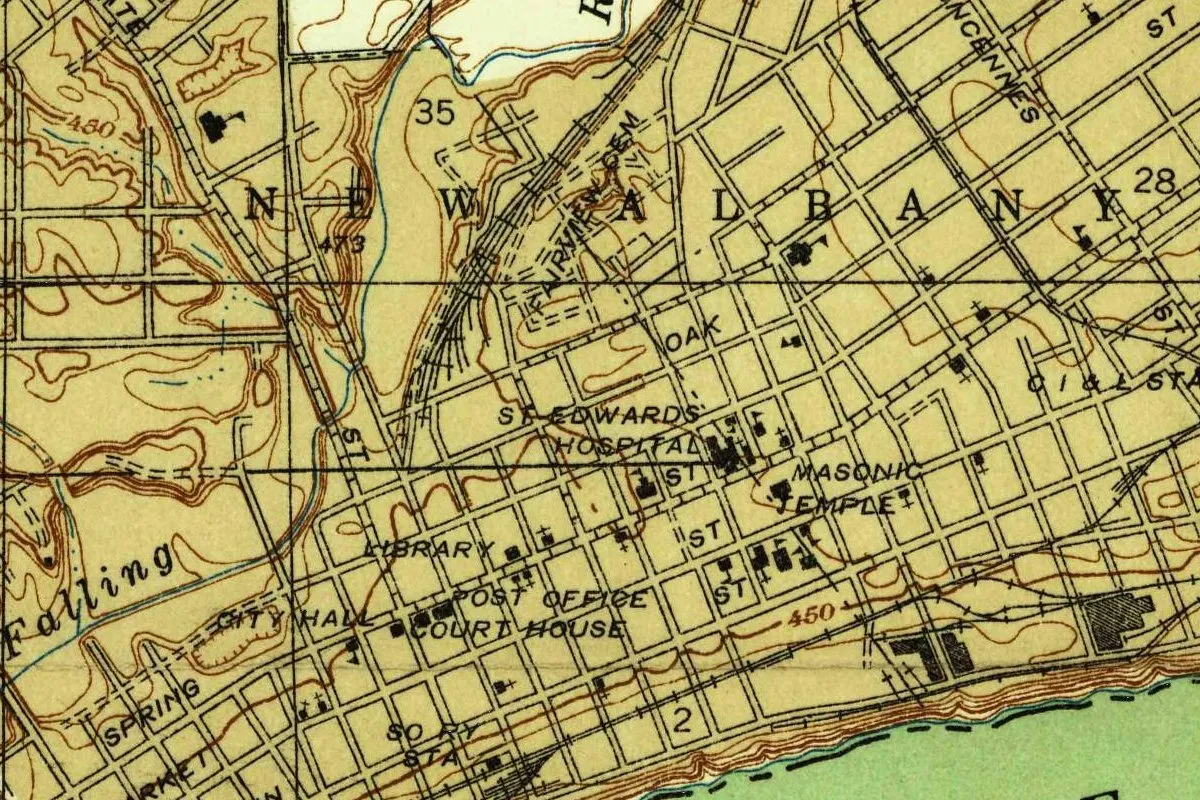
- GNIS feature 440013 (U.S. Geological Survey). Floyd County and the feature’s coordinates; the 1939 crop sits a little north and east of that point so the town’s name fits.
- U.S. Geological Survey, New Albany sheet (1939). The 1939 quadrangle showing downtown, Falling Run and the Ohio waterfront.
Spot something wrong, or know more? Tell us here. You can also email us or use our contact page. Corrections are noted here with their date, never made silently.