Bloomington, Indiana: Flowers or a Man Named Bloom?
The sources don't settle it. Monroe County's commissioners named the county seat Bloomington on April 10, 1818, and the city says no precise record explains the choice. One tradition says early settlers were struck by the flowers and foliage they saw from a hill; another says the town honors an early settler, William Bloom.
Named on day one
Bloomington, Indiana, got its name the first day Monroe County’s commissioners ever met, in April 1818, and the city says there’s no record of why. Two explanations go around: a hillside full of blossoms, or a settler named William Bloom.
The city itself doesn’t pick one. Its 2018 comprehensive plan says flatly that “no precise evidence or record suggests the basis on which the name Bloomington was adopted.”
A county, a square and a barrel of whisky
The county came first. The Monroe County Public Library’s timeline says the legislature created Monroe County on January 14, 1818, named for President James Monroe, with the new county taking effect on April 10. That’s the day its commissioners held their first recorded meeting, at the house of Abner Blair. The county’s own name, at least, is no mystery: it honors the fifth president.
They didn’t waste time. Charles Blanchard’s 1884 history of Morgan, Monroe and Brown counties, which worked from the old county record, says that “on the 10th of April, 1818, the first day of the first meeting of the County Commissioners, the county seat was ordered laid off and was named ‘Bloomington.’” The library adds that the same session ordered 12 townships laid out.
The plan was specific. Blanchard says the public square was to measure 276 feet (84 m), the lots 66 by 132 feet (20 by 40 m) and the streets 82½ feet (25 m) wide. The first sale of lots was set for June 22, 1818, and advertised in papers as far off as Vincennes and Cincinnati. Then Blanchard copies out one more entry from the county board:
“On motion of Bartlett Woodward, Ordered, that the agent of this county procure one barrel of whisky and have it at the sale of town lots in Bloomington.”
Blanchard thought the board knew what it was doing. The first sale brought in $14,326.85, which he called an “enormous sum,” and he concluded that “the action of the board was not misplaced.”
Three days after the first meeting, on April 13, the library says, the commissioners also created Bloomington Township, named for the town. So within three days the word was on a county seat and a township, and before long on a whisky order too. That’s how early the name shows up. It’s right there in the minutes, and the reason for it isn’t. Blanchard, writing over 65 years later, reports the naming as a plain fact and moves straight on to the street widths.
The flowers
The first explanation is the pretty one. The Indiana State Library, in its guide to Monroe County, quotes a Depression-era Works Progress Administration account: the name was “suggested when a group of early settlers, gazing from an elevation commanding a view of the site, was impressed by the flowers and foliage.”
You can see why it stuck. A town called Bloomington named for blooms needs no explaining. But notice how the State Library frames it: as “one local legend,” among “differing stories.” The story names no settler, no date and no hill.
The man named Bloom
The other explanation is a person. “Another tradition says the name honors an early settler, William Bloom,” the State Library writes, and the city’s plan repeats it, describing Bloom as “one of the first settlers.”
That’s as far as these sources go. The library’s timeline names the men who bought the first tracts in what became Bloomington, George Ritchey, George Hedrick, David Rogers and Joseph Taylor, and Bloom isn’t among them. That doesn’t rule him out. It just means the Bloom version, like the flower version, rests on tradition rather than on a document from 1818.
So you’ve got two stories and no tiebreaker. The State Library calls both of them stories; the city says there’s no record either way. Of the two, neither has the edge on paper.
A town on a wheat field
What the records do describe is the ground. Visit Bloomington, the county’s tourism office, says the public square was laid out on what had been a wheat field. A 1914 history of Lawrence and Monroe counties gets more specific: when the first lots were laid out in June 1818, “a wheat crop was growing on land purchased of Mr. Rogers.” By the following January, Visit Bloomington says, 30 families had moved in, with stores and taverns around the square. The first courthouse went up in logs.
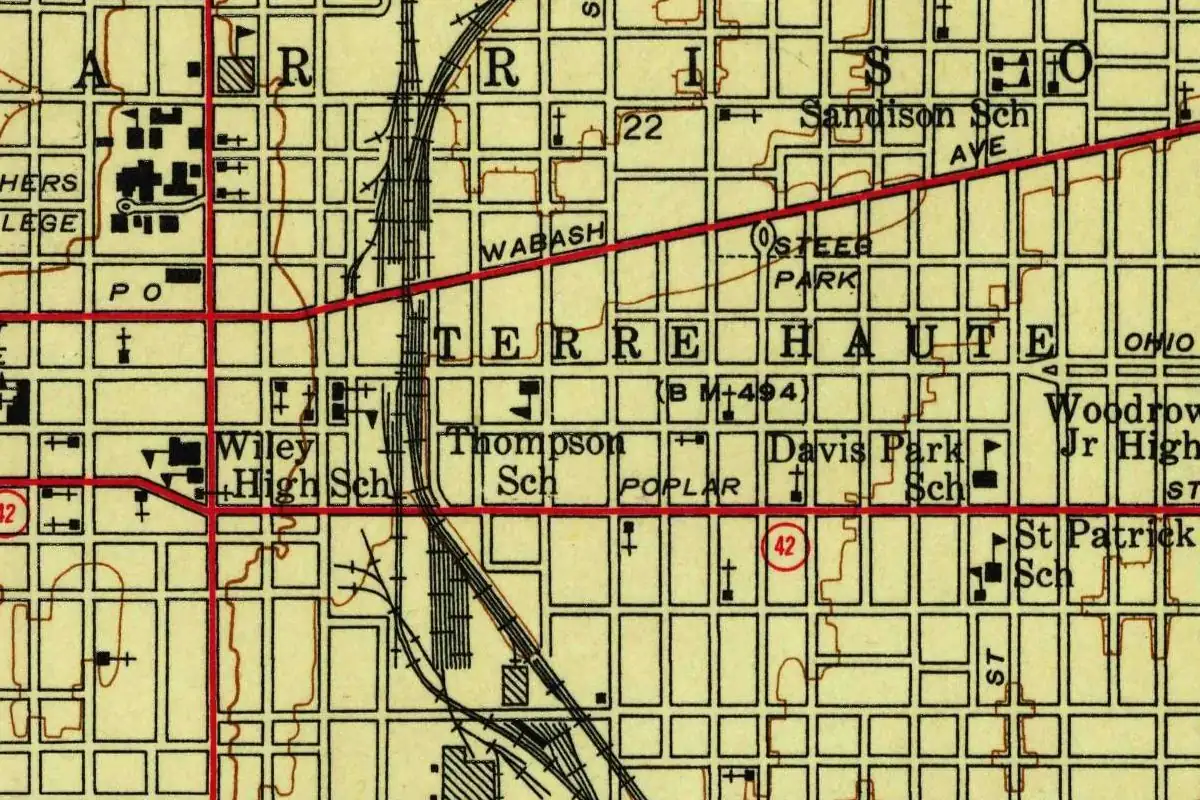
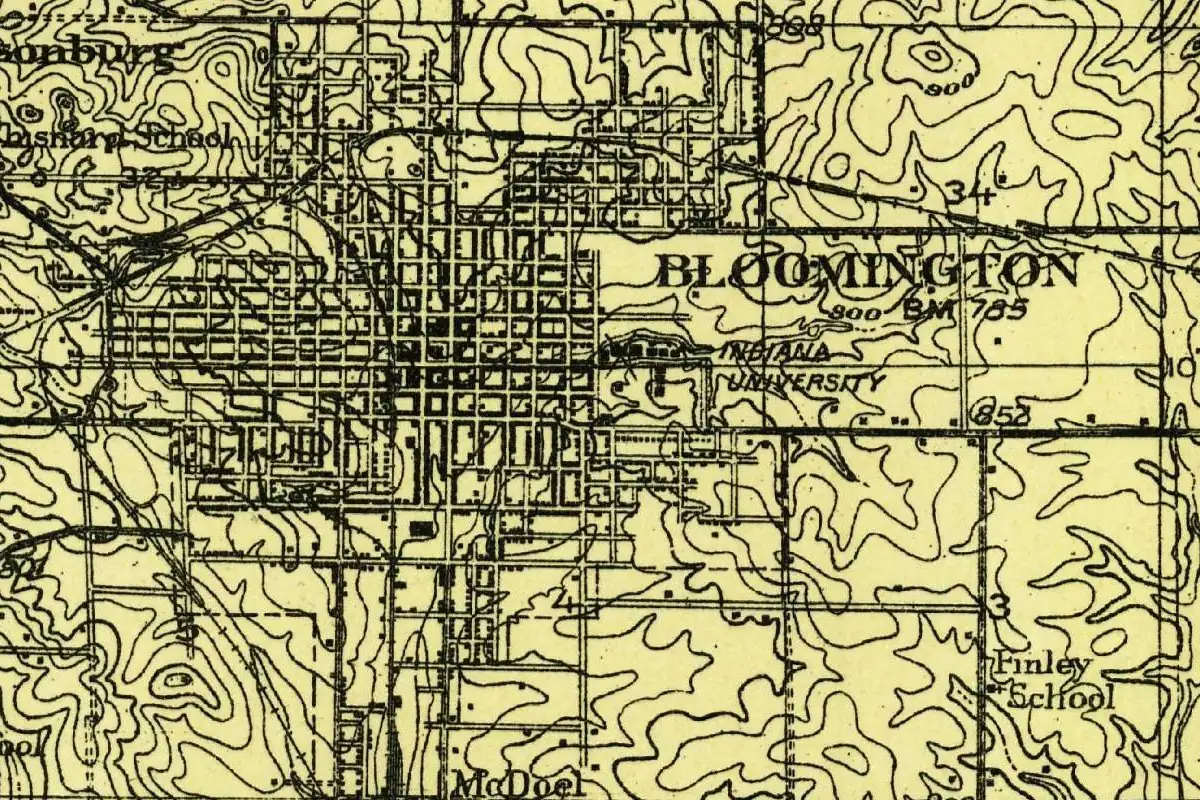
The town got its big break two years later. In 1820, Visit Bloomington says, the state confirmed it as the site of the Indiana Seminary, the school that became Indiana University. The 1908 survey map above shows the result: a tight street grid around the square and, just to the east, the words “Indiana University.”
Early Indiana handed out names in a hurry, and not always with an explanation. Three years after Monroe County’s commissioners settled on Bloomington, the legislature picked a name for the new state capital, and Indianapolis got a laugh on the House floor before it got a vote. Kokomo, farther north, ended up with competing stories of its own.
Bloomington’s is a two-way tie that a barrel of whisky can’t break. Whether it was the blossoms or a man named Bloom, the name went into Monroe County’s record on April 10, 1818, and it’s been on the map of Indiana ever since.
Quick answers
Is Bloomington, Indiana, named after flowers?
Maybe. One local legend, quoted by the Indiana State Library, says settlers were impressed by the flowers and foliage they saw from a high spot. The city says there’s no precise record of why the name was chosen.
Was Bloomington named after William Bloom?
That’s the other tradition. The Indiana State Library and the city’s 2018 plan both mention William Bloom, an early settler, but neither treats it as proven.
When did Bloomington, Indiana, get its name?
On April 10, 1818, the first day of the first meeting of the Monroe County commissioners, when they ordered the county seat laid out and named it Bloomington.
Key dates
- 1818Monroe County takes effect on April 10; at the commissioners' first meeting that day, the county seat is ordered laid out and named Bloomington.
- 1818The first public sale of town lots is held on June 22 and 23.
- 1820The state confirms Bloomington as the site of the Indiana Seminary, which later becomes Indiana University.
Things to do in Bloomington, Indiana
Monroe County History Center
The county's history museum and historical society, housed in Bloomington's Neoclassical Carnegie library building on the site of an 1854 school, with exhibit galleries on how the community came to be.
Wylie House Museum
The restored 1835 home of Andrew Wylie, Indiana University's first president, on East Second Street, interpreted with original artifacts and archival collections.
Eskenazi Museum of Art
Indiana University's art museum, in the heart of the Bloomington campus, with treasures from antiquity and sub-Saharan Africa, paintings by Monet, Picasso and Pollock, and more than 47,000 works collected since 1941.
Monroe Lake
Indiana's largest land-bound body of water, nearly 11,000 surface acres built by the U.S. Army Corps of Engineers in the 1960s, with beaches, boat ramps, fishing and hiking.
Getting there
Open Bloomington in Google Maps
Opens in a new tab. The pin is the center of Bloomington in the USGS place-name record.
The closest airports, Amtrak stations and intercity bus stops, measured in a straight line from the center of Bloomington.
Airports
- Indianapolis International (IND) 40 mi 65 km
- Louisville Muhammad Ali International (SDF) 81 mi 130 km
Amtrak trains
- Indianapolis station (IND) 46 mi 73 km
- Crawfordsville station (CRF) 64 mi 103 km
Intercity buses
- FlixBus Bloomington IN under 1 mi 0.6 km
- Miller Transportation Bloomington under 1 mi 0.6 km
- OurBus Bloomington, IN (E. Third Street in front of Forest Quadrangle) under 1 mi 1 km
Distances are as the crow flies, not by road. We don't list schedules or fares because they change; check with the airline, Amtrak or the bus company before you go. Official data (FAA commercial service airports (2025), FAA airport locations, Amtrak stations and Intercity Bus Atlas) from the FAA and the U.S. Bureau of Transportation Statistics, checked Nov 14, 2026.
Sponsored
Staying in Bloomington?
Compare hotels in Bloomington, Indiana, on Expedia.
See hotels in BloomingtonWe may earn a commission if you buy through this link. It never changes what we write. Read our affiliate disclosure
Historical Sources & References
- Charles Blanchard (ed.), Counties of Morgan, Monroe and Brown, Indiana (1884), p. 453. The county seat “named ‘Bloomington’” on April 10, 1818; the size of the square, lots and streets; the June 22 sale and its advertising; the barrel of whisky ordered on Bartlett Woodward’s motion. No reason is given for the name.
- History of Lawrence and Monroe Counties, Indiana (1914), p. 369. The wheat crop growing on land bought from Rogers when the first lots were laid out in June 1818.
- Indiana State Library, “By County: Monroe County”. Monroe County named for James Monroe; the “differing stories,” with the WPA’s flowers-and-foliage legend and the William Bloom tradition.
- City of Bloomington, Comprehensive Plan (2018), p. 34. “No precise evidence or record suggests the basis on which the name Bloomington was adopted”; both theories, with Bloom as “one of the first settlers.”
- Monroe County Public Library, Monroe County Timeline. The county created January 14, 1818, effective April 10; the first commissioners’ meeting at Abner Blair’s house, with 12 townships and the town ordered laid out; the first land buyers.
- Visit Bloomington, “Community History”. The square on a wheat field; 30 families by January; the log courthouse; the Indiana Seminary confirmed in 1820.
- GNIS feature 431207 (U.S. Geological Survey). The USGS name database entry for Bloomington, a populated place in Monroe County.
- U.S. Geological Survey, Bloomington sheet (1908). The 1:48,000 map showing the town grid and Indiana University at the top of this page.
Spot something wrong, or know more? Tell us here. You can also email us or use our contact page. Corrections are noted here with their date, never made silently.