How New Harmony, Indiana, Got Its Name: Harmonists and Owen
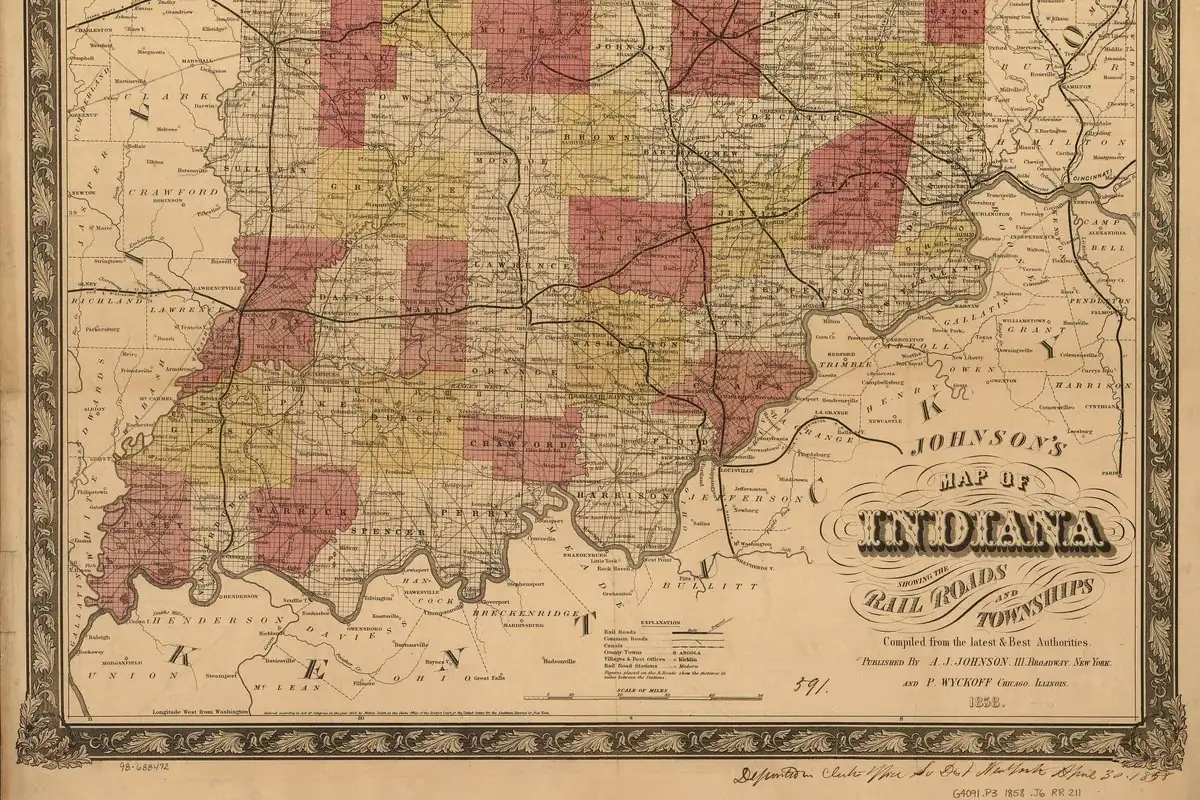
The Harmonists, a religious society led by George Rapp, gave New Harmony its name. They founded a village called Harmonie in Posey County in 1814-1815, after their first home in Pennsylvania. Robert Owen bought it in 1825. Leffel's county history says the Harmonists already said New Harmony; Lockwood's 1905 history ties that name to Owen's purchase.
A village called Harmonie
New Harmony gets its name from the Harmonists, George Rapp’s sect from Württemberg, who started a town on the Wabash in 1814 and called it Harmonie. Robert Owen bought the whole place about ten years later and kept the name, and somewhere along the way it picked up the “New.”
Henry Gannett’s 1905 bulletin on American place names gives the short version: New Harmony, a town in Posey County, was “settled by the ‘Harmonists,’ and named for that sect.” That’s the part all three books used here agree on.
The Harmonists, also called Rappites, had already built one town before this one. John C. Leffel’s 1913 History of Posey County says they followed George Rapp from Württemberg to Butler County, Pennsylvania. Gannett’s entry for that first settlement, Harmony, Pennsylvania, explains the choice of word: it was “named by a colony of Germans to indicate the principle of its organization.” So the name was a statement about how they meant to live together, not a tribute to a person or a place.
By 1812 they wanted a new home farther west. Leffel says Frederick Rapp, George Rapp’s adopted son and business manager, scouted six western states and territories and settled on “a beautiful tract of land on the Wabash river, a few miles above its mouth.” They sold out in Pennsylvania, and then Leffel puts it plainly: “Their home in Pennsylvania had been called ‘Harmonie’ and for this reason they called their new home Harmonie, or New Harmony.”
1814 or 1815?
You’ll see both years given as the founding, and the two main books agree more than it looks. Leffel says part of the colony arrived in 1814, “began the requisite clearing and founded the town,” and the rest came early in 1815, about 700 people in all. George B. Lockwood’s The New Harmony Movement, also from 1905, says the Harmonists “early in 1815 went down in boats and founded the village of ‘Harmonie,’” where an advance party had started clearing the previous June. Same story, counted from a different boat.
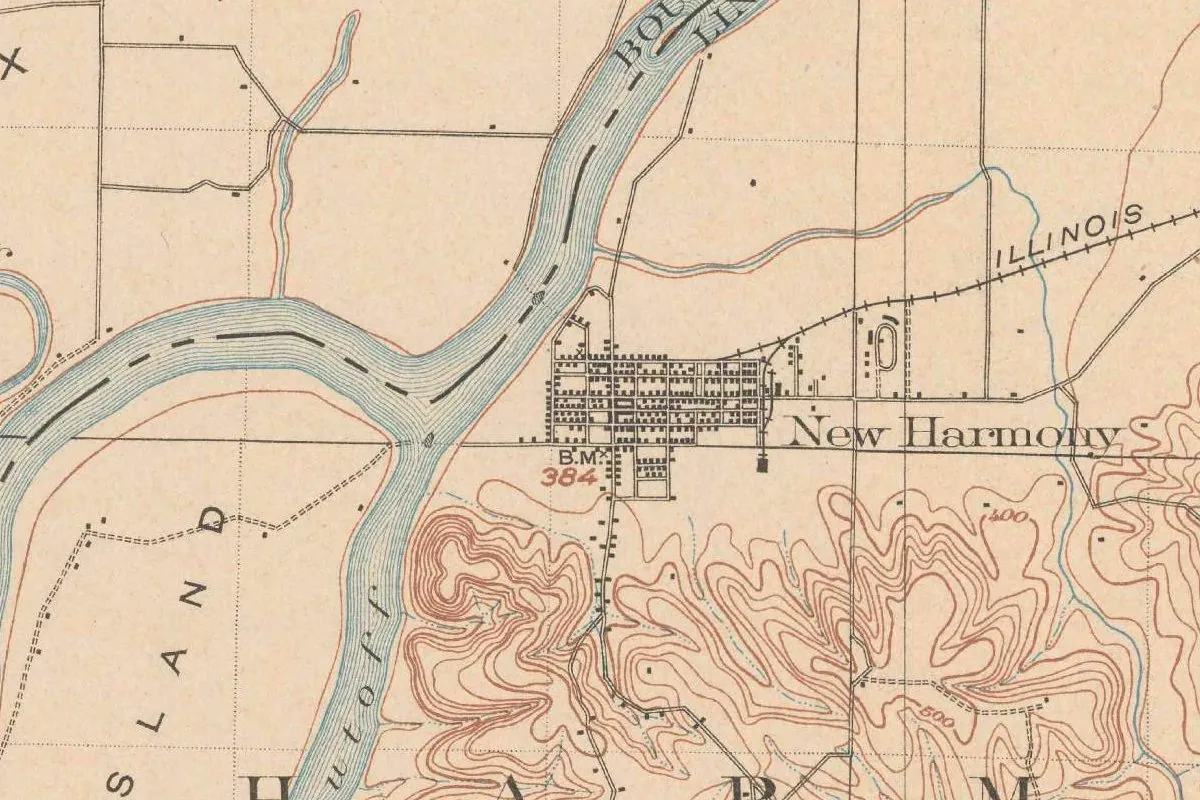
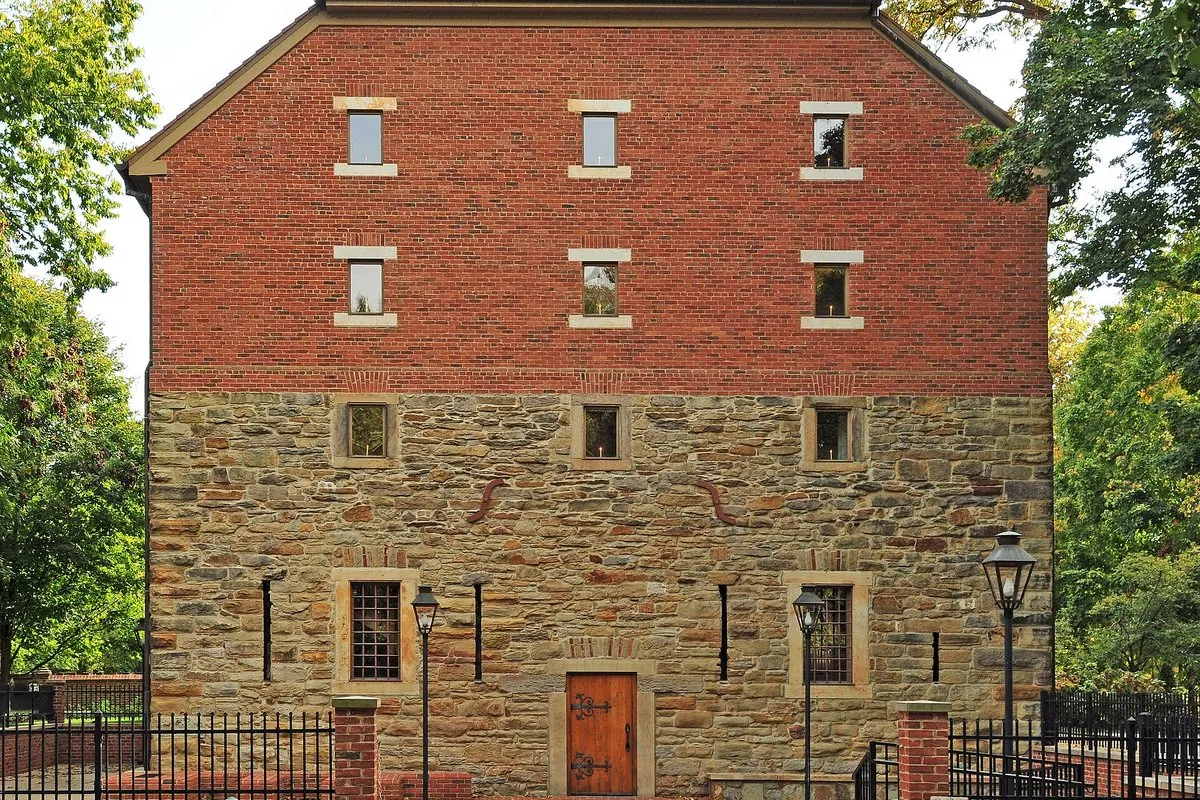
They built to last. Leffel describes a stone granary with walls two feet thick, a tile roof and loopholes that made it “serviceable also as a fortress.” In later years, he says, it came to be known as the “old fort,” and it was still standing when he wrote. He also mentions a water mill at the cut-off in the river, about two miles (3 km) below town. On the 1903 survey map you can still find a channel lettered “Cutoff” along the Wabash below the town.
“New Lanark or Harmony?”
The Harmonists didn’t stay. Lockwood says George Rapp wanted to move the colony back to Pennsylvania, and Richard Flower arrived in England “bearing a commission from George Rapp to sell the great Harmonist estate,” found Robert Owen frustrated with his plans at home, and “suggested ‘Harmonie’” as a place to try out the community ideas Owen had been promoting for years.
Owen’s son, Robert Dale Owen, remembered how the family made up its mind. Lockwood quotes him:
“I listened with delight to Mr. Flower’s account of a frontier life, and when, one morning, my father asked me, ‘Well, Robert, what say you, New Lanark or Harmony?’ I answered without hesitation, ‘Harmony.’”
New Lanark was where the family lived, in Scotland, so the choice was between the old home and the Indiana one. Notice the son’s word, too: in his memory the Indiana town was just “Harmony.”
So who added the “New”?
This is where the sources split, so don’t expect one tidy answer.
Leffel’s line suggests the Harmonists themselves used both forms: “Harmonie, or New Harmony.” Lockwood tells it differently. He says that in December 1824 Owen came over “to complete the purchase of the property afterward officially known as New Harmony,” and the bargain closed in the spring of 1825. In the same passage he still calls the place “the village of Harmony, with its great church.” By his account, the “New” belongs to Owen’s era.
What’s clear is that the name was in official use very soon after the sale. Lockwood says that on April 27, 1825, Owen gave an address in the old Rappite church, which had been turned into the “Hall of New Harmony,” and that on May 1 the “Preliminary Society of New Harmony” was formed under the constitution he’d proposed.
Neither book prints an order or vote that renamed the town, so this article doesn’t give one. What you can say is that the name traces back to the Harmonists either way. Owen’s followers kept it, and it’s still on the map of Indiana today.
Quick answers
Who named New Harmony?
The Harmonists, the religious society led by George Rapp. Gannett’s 1905 bulletin says the town was “named for that sect,” and Leffel’s 1913 county history says they reused the name of their Pennsylvania home, Harmonie.
Why is it called New Harmony?
Because the Harmonists’ first town in Pennsylvania was also called Harmonie. The books differ on the “New”: Leffel says the Harmonists said “Harmonie, or New Harmony,” while Lockwood says the property was “afterward officially known as New Harmony” under Robert Owen.
Did Robert Owen found New Harmony?
No. Leffel and Lockwood both have the Harmonists founding the village in 1814-1815. Owen bought it from them, closing the deal in the spring of 1825, and started his community there.
Key dates
- 1814Part of the Harmonist colony reaches the Wabash, starts clearing land and founds a town called Harmonie, per Leffel's county history.
- 1815Early in the year the rest of the colony arrives by boat. Leffel counts about 700 people in all.
- 1824December: Robert Owen comes to the United States to complete the purchase of the Harmonist property.
- 1825The sale closes in the spring. On May 1 the Preliminary Society of New Harmony is formed under a constitution Owen proposed on April 27.
Getting there
Open New Harmony in Google Maps
Opens in a new tab. The pin is the center of New Harmony in the USGS place-name record.
The closest airports, Amtrak stations and intercity bus stops, measured in a straight line from the center of New Harmony.
Airports
- Evansville Regional (EVV) 23 mi 37 km
- Veterans Airport of Southern Illinois (MWA) Marion 64 mi 103 km
- St Louis Lambert International (STL) St. Louis 139 mi 223 km
Amtrak trains
- Centralia station (CEN) 71 mi 114 km
- Du Quoin station (DQN) 71 mi 115 km
Intercity buses
- Miller Transportation Evansville 23 mi 36 km
- Greyhound Evansville IN (EVN) 23 mi 36 km
Distances are as the crow flies, not by road. We don't list schedules or fares because they change; check with the airline, Amtrak or the bus company before you go. Official data (FAA commercial service airports (2025), FAA airport locations, Amtrak stations and Intercity Bus Atlas) from the FAA and the U.S. Bureau of Transportation Statistics, checked Nov 13, 2026.
Sponsored
Staying in New Harmony?
Compare hotels in New Harmony, Indiana, on Expedia.
See hotels in New HarmonyWe may earn a commission if you buy through this link. It never changes what we write. Read our affiliate disclosure
Sponsored
Want the spooky side of New Harmony?
The name has its story above. For the ghost stories, US Ghost Adventures runs walking ghost tours in New Harmony.
See ghost tours in New HarmonyWe may earn a commission if you book through this link. It never changes what we write. Read our affiliate disclosure
Historical Sources & References
- Henry Gannett, The Origin of Certain Place Names in the United States (USGS, 1905), pp. 150 and 223. New Harmony “settled by the ‘Harmonists,’ and named for that sect” (p. 223); Harmony, Pennsylvania, named by a German colony “to indicate the principle of its organization” (p. 150).
- George B. Lockwood, The New Harmony Movement (1905), pp. 14, 31, 57-58, 83-84. The move by boat early in 1815 and the advance party of the previous June (p. 14); Rapp’s wish to take the colony back to Pennsylvania (p. 31); Richard Flower’s commission from George Rapp and his suggestion of “Harmonie” (p. 57); Robert Dale Owen’s “New Lanark or Harmony?” and the purchase begun in December 1824 and closed in spring 1825 (p. 58); the “Hall of New Harmony” address of April 27, 1825, and the Preliminary Society of May 1, 1825 (pp. 83-84).
- John C. Leffel, ed., History of Posey County, Indiana (1913), pp. 98-101. The Rappites’ move from Württemberg to Butler County, Pennsylvania (p. 98); Frederick Rapp’s search from 1812, the 1814 arrival, about 700 people by early 1815, “Harmonie, or New Harmony,” and the mill at the cut-off (p. 100); the stone granary called the “old fort” (p. 101).
- GNIS feature 440051 (U.S. Geological Survey). Name spelling, Posey County and feature class for the town.
- U.S. Geological Survey, New Harmony sheet (1903). The 1903 survey cropped for the map: the little town grid, the bends of the Wabash and the channel marked Cutoff.
Spot something wrong, or know more? Tell us here. You can also email us or use our contact page. Corrections are noted here with their date, never made silently.