Sioux City, Iowa: Named for the Big Sioux, and the Sioux
Sioux City is named for the Big Sioux River, which joins the Missouri at the city, and, through the river, for the Sioux people. An 1890 county history says the city "took its name from the Sioux river" and "originally from the Indian tribe by the same name." Dr. John K. Cook platted the town in 1854-55.
Sioux City, Iowa, took its name from the Big Sioux River where it meets the Missouri, and the river took its name from the Sioux people. By Henry Gannett’s account in 1905, “Sioux” came from a neighboring people’s word for them, not from their own.
A city named after a river named after a nation
An 1890 history of Woodbury and Plymouth counties puts the whole chain in one sentence. It describes “Sioux City, which took its name from the Sioux river (which has its confluence with the Missouri at this point), and originally from the Indian tribe by the same name.”
The river it means is the Big Sioux, which meets the Missouri right here. The Advisory Council on Historic Preservation, a federal agency, says the same thing more directly: Sioux City “was named in honor of the Sioux Indians and the Big Sioux River.”
So you’ve got a city named for a river, and a river named for a people. Neither source says who wrote “Sioux City” down first.
Where the word “Sioux” came from
In 1905 Henry Gannett wrote about the word, not the city: his Bulletin 258 has an entry for “Sioux” and none for Sioux City. Under “Sioux” he lists “counties in Iowa and Nebraska, and eight other places, so named from the Dakota or Sioux Indians of Dakota and Minnesota,” and then explains the word: “The word is an abbreviation of their Ojibwa name, signifying ‘little snakes,’ i. e., ‘enemies.’”
That’s Gannett’s explanation. By his account, the name that ended up on the river, the county and the city came from what the Ojibwe called their neighbors, not from what those neighbors called themselves. Gannett himself writes “Dakota or Sioux.” The City of Sioux City’s own history, for its part, names the Yankton Sioux and the Omaha as the communities that lived along these rivers.
Before Dr. Cook arrived
The city’s official history starts long before anyone drew a street. It says Yankton Sioux and Omaha communities built settlements along the waterways, and that the Lewis and Clark Expedition came through in 1804. One of its men, Sergeant Charles Floyd, died that August and was buried on a bluff above the Missouri. The National Park Service quotes William Clark naming a small stream nearby “Floyds river” and the hill “Sergts. Floyds Bluff.” So Floyd got a river too. The city’s name came from the bigger one.
Then came the traders. The city’s history says French-Canadian trader Theophile Bruguier settled at the rivers’ meeting with Chief War Eagle’s family in 1849. The 1890 county history adds a detail about money. A trader named Joseph Leonais bought Bruguier’s claim at the mouth of Perry Creek for $100 and settled there in 1852. In the spring of 1855 he sold it to Dr. John K. Cook and a partner named Ryder for $3,000. According to the book, they told him they wanted the land for an orchard, “all of which pioneer Leonais did not believe,” though he thought $3,000 was a good price and took it.
Dr. John K. Cook and the town plat
The 1890 county history and the ACHP both connect Cook with the start of the city. The book calls him “a government surveyor who surveyed northwestern Iowa into sections” and also says he was a practicing physician, the only one around for some time. It says he came with instructions from “an association of leading politicians and capitalists of the state,” among them Gen. George W. Jones of Dubuque, whom the book calls “the first representative the territory of Iowa had in congress,” “to choose for them the site of a city.”
The book says that in December 1854, Cook began platting Sioux City. At the mouth of the Floyd River he found many Indians camped with their chief, Smutty Bear, who ordered him to stop surveying. Cook answered, through a French interpreter, with threats of his own, and the camp moved off. The weather was so mild, the book says, that “men drove stakes, in their shirt sleeves,” and the Missouri froze over for only eleven days that winter. The work was finished on January 9, 1855.
The ACHP sums it up as “Dr. John Cook platted the city in 1854” and ties the name to that moment. None of the sources we read says in so many words that Cook picked the name himself, so we’ve left that line blank in the quick facts.
Which date is right?
You’ll see a few dates depending on where you look, and three of them come from the same 1890 book. Its chapter on early settlement has Cook starting in December 1854 and finishing that January. Its list of town plats says “Sioux City (proper) was platted May 5, 1855, by Dr. John K. Cook and others.” And its city chapter says the history of Sioux City “dates from May 5, 1855.”
The simplest way to read it is that the survey started in the winter of 1854-55 and the plat of Sioux City proper was dated that May. The ACHP and the city’s own history use 1854. Either way, the name was there from the start of the town.
Siouxland on the 1955 map
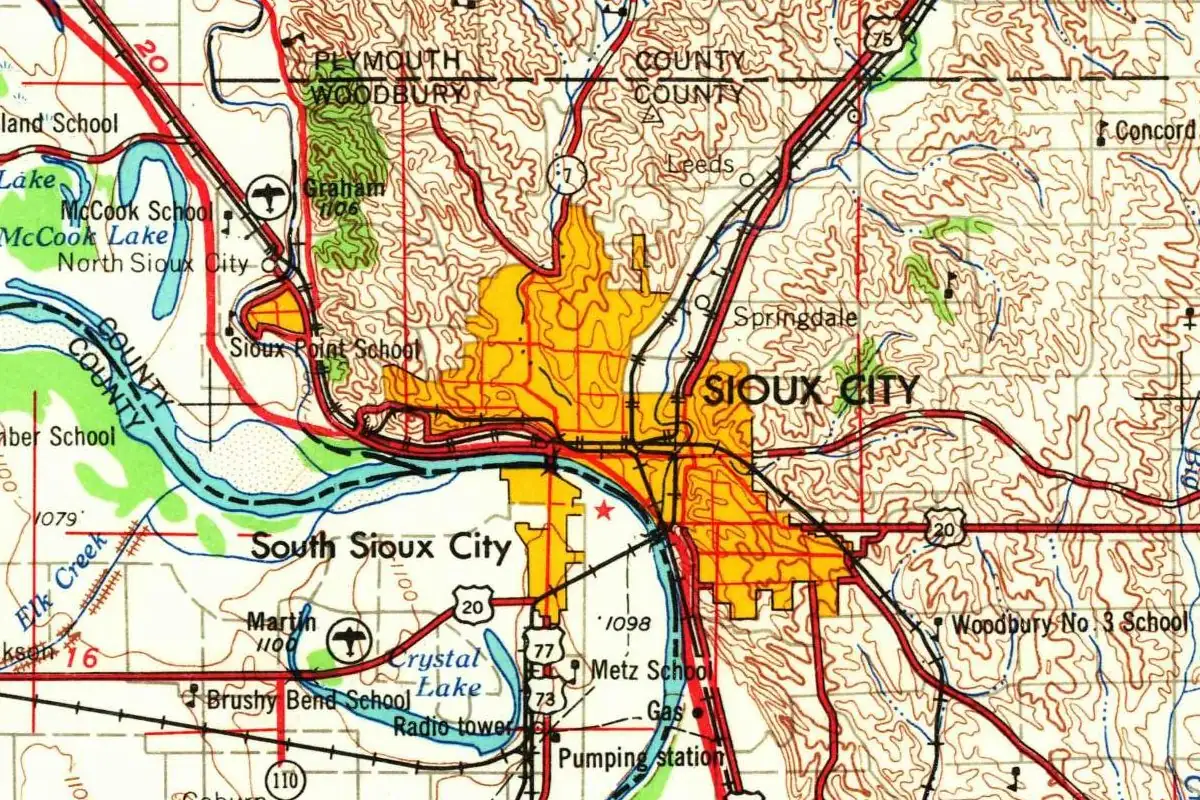
The map at the top of this page is the U.S. Geological Survey’s 1955 Sioux City sheet. Look at how many places share the name: Sioux City in big capitals, South Sioux City across the Missouri in Nebraska, and North Sioux City upstream on the South Dakota side. The ACHP notes that the area where the three states meet is sometimes called Siouxland.
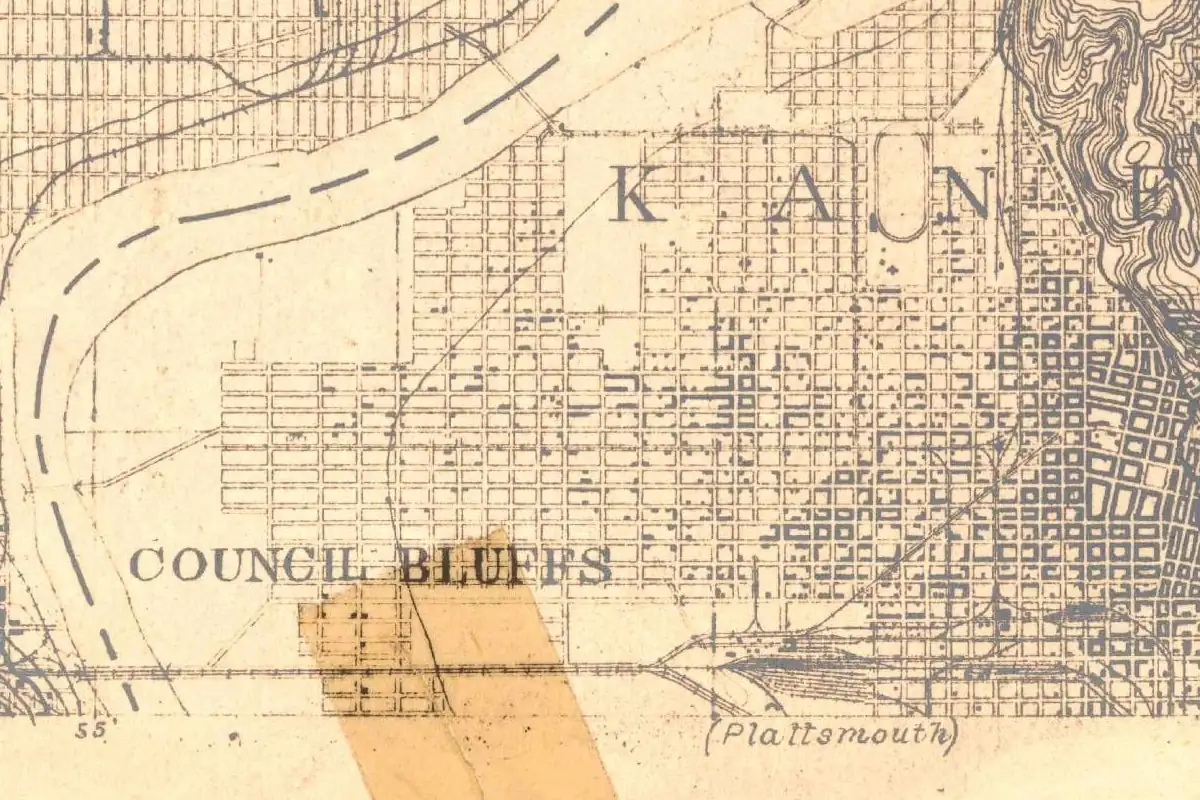
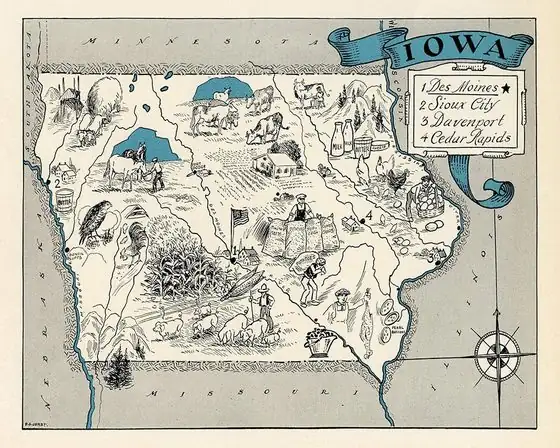
Another Missouri River town with a Lewis and Clark chapter is Council Bluffs, downstream. For the rest of the state’s place names, start at our Iowa page.
Quick answers
Why is it called Sioux City?
Because it sits where the Big Sioux River meets the Missouri. An 1890 county history says the city “took its name from the Sioux river” and “originally from the Indian tribe by the same name.” The ACHP says it was named for the Sioux Indians and the Big Sioux River.
What does the word Sioux mean?
Henry Gannett wrote in 1905 that “Sioux” is “an abbreviation of their Ojibwa name, signifying ‘little snakes,’ i. e., ‘enemies.’” In his account, it’s an outsiders’ name, not the people’s own.
Who founded Sioux City, Iowa?
Dr. John K. Cook, a physician and government surveyor, platted the town. The 1890 county history says he began in December 1854, and it dates the plat of Sioux City proper to May 5, 1855.
Who was in the Sioux City area before Cook?
The city’s history names Yankton Sioux and Omaha communities, the Lewis and Clark Expedition in 1804, and trader Theophile Bruguier, who settled at the rivers’ meeting with Chief War Eagle’s family in 1849.
Key dates
- 1804The Lewis and Clark Expedition passes through; Sergeant Charles Floyd dies and is buried on a bluff above the Missouri.
- 1849Trader Theophile Bruguier settles at the meeting of the rivers with Chief War Eagle's family, according to the city's history.
- 1854Dr. John K. Cook begins platting Sioux City in December.
- 1855The first survey is finished on January 9; the 1890 county history dates the platting of Sioux City proper to May 5.

Things to do in Sioux City, Iowa
Sergeant Floyd Monument
A 100-foot (30 m) obelisk of Kettle River sandstone in a 23-acre (9 ha) park marks the grave of Sergeant Charles Floyd, the only member of the Corps of Discovery to die on the journey. Clark named the river and the bluff for him.
Sergeant Floyd River Museum & Welcome Center
A museum of Missouri River history housed aboard a dry-docked motor vessel, the M.V. Sergeant Floyd, on Sioux City's riverfront, next to the Lewis and Clark Interpretive Center.
Sioux City Lewis and Clark Interpretive Center
A center on the riverfront that presents the story of the Siouxland leg of the Lewis and Clark Expedition, with children's classes and programs for adults and families through the year.
Stone State Park
An urban wildlife sanctuary on the edge of Sioux City in the heart of the Loess Hills, with entrance portals, a shelter and a stone lodge built by the Civilian Conservation Corps in the 1930s and more than 15 miles (24 km) of trails.
Getting there
Open Sioux City in Google Maps
Opens in a new tab. The pin is the center of Sioux City in the USGS place-name record.
The closest airports, Amtrak stations and intercity bus stops, measured in a straight line from the center of Sioux City.
Airports
- Sioux Gateway/Brig General Bud Day Field (SUX) Sioux City 7 mi 11 km
- Joe Foss Field (FSD) Sioux Falls 77 mi 123 km
- Eppley Airfield (OMA) Omaha 87 mi 140 km
Amtrak trains
- Omaha station (OMA) 90 mi 144 km
Intercity buses
- Jefferson Lines Sioux City under 1 mi 0.6 km
Distances are as the crow flies, not by road. We don't list schedules or fares because they change; check with the airline, Amtrak or the bus company before you go. Official data (FAA commercial service airports (2025), FAA airport locations, Amtrak stations and Intercity Bus Atlas) from the FAA and the U.S. Bureau of Transportation Statistics, checked Nov 14, 2026.
Sponsored
Staying in Sioux City?
Compare hotels in Sioux City, Iowa, on Expedia.
See hotels in Sioux CityWe may earn a commission if you buy through this link. It never changes what we write. Read our affiliate disclosure
Historical Sources & References
- History of the Counties of Woodbury and Plymouth, Iowa (1890), p. 180. The quoted sentence on Sioux City taking its name “from the Sioux river” and “originally from the Indian tribe by the same name,” and the list of men who sent Cook to choose a city site. Checked against the page image.
- History of the Counties of Woodbury and Plymouth, Iowa (1890), p. 179. Cook as “a government surveyor,” and the city’s history dating “from May 5, 1855.”
- History of the Counties of Woodbury and Plymouth, Iowa (1890), pp. 59-60. Cook as a practicing physician, the start of the platting in December 1854, Smutty Bear, the mild winter, and the work finished January 9, 1855. Also online: p. 60.
- History of the Counties of Woodbury and Plymouth, Iowa (1890), p. 89. “Sioux City (proper) was platted May 5, 1855, by Dr. John K. Cook and others.”
- History of the Counties of Woodbury and Plymouth, Iowa (1890), p. 53. Bruguier’s claim, Leonais’s $100 purchase, and the $3,000 sale to Cook and Ryder “for an orchard.”
- Henry Gannett, The Origin of Certain Place Names in the United States, 2nd ed. (1905), p. 284. The entry “Sioux” and Gannett’s explanation of the word as an Ojibwa name. Checked against the page image.
- Advisory Council on Historic Preservation, “Sioux City, Iowa”. Named for the Sioux Indians and the Big Sioux River when Dr. John Cook platted the city in 1854; Siouxland.
- City of Sioux City, “Sioux City History”. Yankton Sioux and Omaha communities, Lewis and Clark in 1804, Floyd’s burial, Bruguier and Chief War Eagle’s family in 1849, and the 1854 platting.
- National Park Service, “Sergeant Floyd Monument”. Clark’s journal naming Floyd’s River and Floyd’s Bluff.
- GNIS feature 461653 (U.S. Geological Survey). The GNIS entry for Sioux City, Woodbury County, with its coordinates.
- U.S. Geological Survey, Sioux City sheet (1955). The 1:250,000 map the image at the top of this page was cropped from.
Spot something wrong, or know more? Tell us here. You can also email us or use our contact page. Corrections are noted here with their date, never made silently.