Winterset, Iowa: The Cold-Weather Answer to Summerset
Winterset got its name in 1849, when the commissioners of Madison County's new seat heard Summerset proposed and picked a wintry name because of the cold. The details vary: J. J. Davies wrote in 1869 of a chilly July day and a drowsy commissioner, William Combs, while the surveyor Alfred D. Jones remembered the deep snow of the winter before.
Winterset, Iowa, was nearly called Summerset in 1849, and the town’s early accounts all credit cold weather for the switch to Winterset. Where they part ways is on the details: whose idea it was, whether the man who said it was sober, and which cold spell did it.
A new county seat in 1849
Madison County needed a seat of government, and in 1849 it got one. J. J. Davies, whose History and Business Directory of Madison County came out in 1869, says the town was located in July of that year, with William Gentry, David Bishop and William Combs serving as commissioners. Alfred D. Jones surveyed and platted it on July 18, 1849, with Enos Berger and P. M. Boyles helping. John Guiberson deeded the 175 acres (71 ha) of the original town site to the county for $194.50.
The city’s own history is shorter. It says only that the town was laid out during the summer of 1849, that the plan was to call it Summerset, and that unseasonable cold made the commissioners turn the name around.
Three versions of a cold day
The 1869 version. Davies tells it as a comic scene. The commissioners had spent the day helping the surveyors, it was cold and blustery for the season, and they gathered, chilled and worn out, at Enos Berger’s house to pick a name. Independence came up, along with plenty of others. Then one of them offered “Somerset.” Here’s how Davies says William Combs, half asleep and “partly under the influence of ‘sod corn,’” answered:
“I think we’d better a darned sight call her Winter-(hic)-set!” (Davies, p. 100)
The room laughed, Davies writes, but liked it. Jones lettered “Winterset” in big capitals and held the paper to the window light to see how it looked, and everyone agreed. Davies adds that no other town anywhere had the name, and he passes along a toast Jones gave at a later Fourth of July: “By the scrutiny of a Combs, the perseverance of a Gentry and the candor of a Bishop, Winterset was prevented from taking a Summerset.” Note the spelling. In the toast it’s Summerset, the same as the city’s version, though Davies has the commissioner say Somerset.
The December version. Herman Mueller’s 1915 History of Madison County opens its section on the name by admitting “there is more than one account.” In the first, the county commissioners rejected Independence, the name the locating commission had chosen, because Iowa already had a town by that name. Someone proposed Summerset. Then, “it being in December and the weather very cold,” a commissioner suggested Winterset, the clerk wrote it out, and it stuck.
Jones’s own version. Mueller then quotes Alfred D. Jones himself, from an article in the 1879 county history. Iowa’s Department of Transportation, in its plan for the county’s covered-bridges byway, dates Jones’s letter to March 18, 1878, and describes him as an early settler who later served as county surveyor and prosecuting attorney. In his telling, Jones was the one who objected to Independence, warning it would get the mail mixed up. After a long run of rejected names, somebody said Summerset, and Combs, stretched out on a bench, said they’d better call it Winterset, “in derision, for we had a terrible scourge with the deep snow that winter.”
So in Jones’s story the cold wasn’t that day’s weather. It was the winter before. And Combs didn’t want his own joke adopted: he argued that cold names would keep newcomers away. Jones took the other side. He checked the postal register, found nothing close “except Winterseat in the State of North Carolina,” and kept writing the name and pinning it to the wall until the commissioners got used to it. Mueller’s editor added a note in brackets: Jones’s explanation “seems to be generally accepted as the correct one.”
You’ll see small differences if you compare quotations. The Iowa DOT plan quotes the same letter with “Winterset” in North Carolina instead of “Winterseat,” and it spells Jones’s helper P.M. Boyle. Mueller’s 1915 page is the older printing of the two, and it’s the one quoted here.
What the stories share
Strip away the jokes and the three versions line up. Each one has Summerset, or Somerset, on the table, and each one has somebody pointing out that the place had just been cold. Davies and Jones also put the same three men in the room: Combs, Bishop and Gentry show up in both, though Davies calls them the locating commissioners and Jones names a different trio, Babbitt, Gillaspy and Bond, for that job.
They don’t agree on the month. Davies has a cold day in July. The first account in Mueller has December. Jones, writing almost 30 years later, blames the snow of the previous winter. None of the sources settles it, and that’s why this page doesn’t either.
The national names database files Winterset under Madison County, Iowa, and the John Wayne museum puts it about 35 miles (56 km) southwest of Des Moines, a city with its own near miss: the Army captain who built the fort there named it Raccoon. And Winterset has company among cold-sounding names: Siberia, California, was a Southern Pacific siding named in 1883 out in the Mojave heat.
The Rock Island and the town that grew
Winterset stayed small at first. The DOT plan cites an 1860 count of 915 people, the only town in the county. Then in 1872 the Chicago, Rock Island & Pacific ran a branch line down from Des Moines, the same railroad that later put a stop on the prairie at Chickasha, Oklahoma, before there was a town. The plan says the branch line marked the end of Winterset’s pioneer days.
The town’s most famous son came along a generation later. The John Wayne Birthplace & Museum says Clyde and Mary Brown Morrison’s son was born in town on May 26, 1907, and named Marion Robert Morrison. He grew up to be John Wayne.
Winterset on the 1952 map
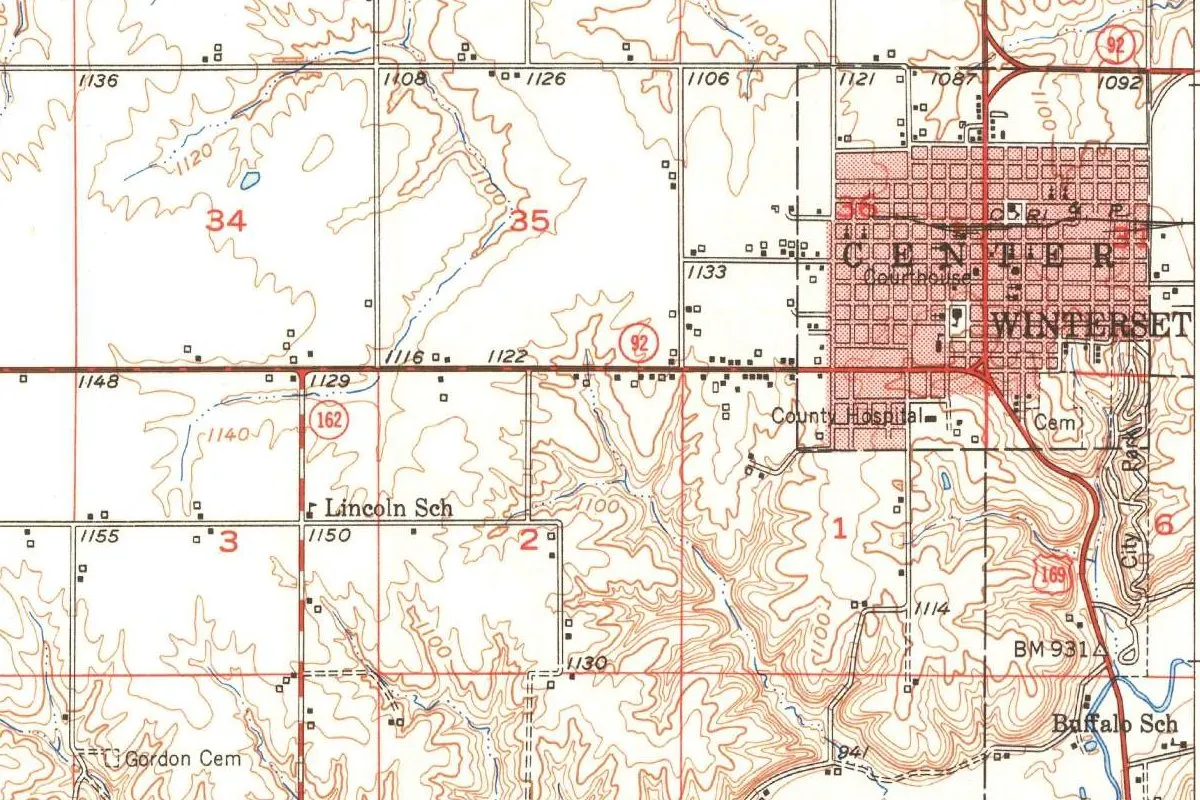
The map at the top of this page is a detail of the Geological Survey’s Winterset quadrangle, at a scale of 1:62,500. The margin says it was mapped, edited and published by the Geological Survey, with topography from aerial photographs taken in 1947 and a field check in 1952. The sheet carries the date 1952, and the printer’s line at the bottom reads 1954, so this copy is a later printing of the 1952 edition.
The town sits near the east edge of the sheet, and the crop has been shifted to keep the margin out. In it you can see Winterset tinted red, with the Courthouse, the County Hospital, City Park and Lincoln School labeled. Highways 92, 169 and 162 run through, and the Rock Island line is marked C R I & P. The township name across the area is CENTER. Out in the country you’ll find Buffalo School and Gordon Cemetery.
Quick answers
Why is it called Winterset?
Because of the cold. The city says unseasonable cold made the commissioners swap Summerset for Winterset in 1849. Davies (1869) blames a chilly July day; Jones blamed the deep snow of the winter before.
Who named Winterset?
The county commissioners adopted it. Davies says William Combs blurted out the word; Jones says Combs said it mockingly and Jones himself pushed until the commissioners took it.
Was Winterset almost called Summerset?
Yes, in every account here. Davies has the suggestion as “Somerset,” but the toast he quotes says Summerset. Mueller’s first account and Jones both say Independence was turned down before that.
Was John Wayne born in Winterset?
Yes. His birthplace museum gives his birth name as Marion Robert Morrison and the date as May 26, 1907.
Key dates
- 1849The county seat is surveyed and platted in July, Davies says, and the commissioners turn down Independence and Summerset for Winterset.
- 1869J. J. Davies prints the story of the cold day, the sleepy commissioner and the toast about a Summerset.
- 1872A branch of the Chicago, Rock Island & Pacific reaches Winterset from Des Moines, the Iowa DOT's byway plan says.
- 1878On March 18, Alfred D. Jones writes his own account of the naming, as the byway plan dates it.
- 1907John Wayne comes into the world in Winterset on May 26, under the name Marion Robert Morrison.
- 1915Mueller's county history sets the accounts side by side and calls Jones's the one generally accepted.
- 1952The Geological Survey's Winterset quadrangle is field-checked; the copy shown here was printed in 1954.
Things to do in Winterset, Iowa
Winterset City Park
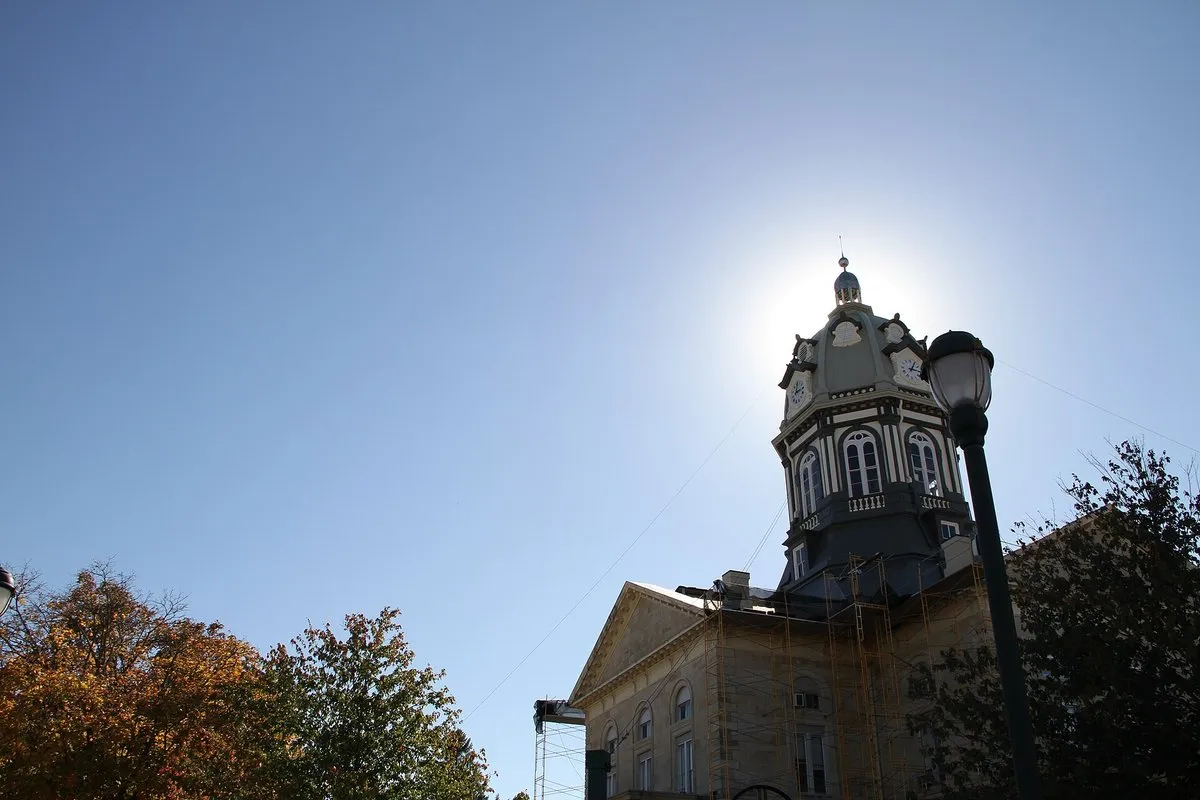
A historic city park whose features include Clark Tower from 1926, the Bennett cabin, stone bridges and the Cutler-Donahoe covered bridge, as listed by the county's historic preservation commission.
John Wayne Birthplace & Museum
The four-room house where the actor was born in 1907, restored to look as it did that year, beside a museum of his posters, costumes, scripts, letters and a car custom-built for him late in his life.
Roseman Bridge
A covered bridge of 1883 over the Middle River, 7.5 miles (12 km) southwest of Winterset, built as a Town lattice truss with a queenpost truss added on top, according to the Iowa DOT.
Hogback Bridge
A covered bridge of 1884 over the North River, 4.2 miles (6.8 km) northwest of Winterset. The Iowa DOT calls it the last all-timber truss the county built.
Getting there
Open Winterset in Google Maps
Opens in a new tab. The pin is the center of Winterset in the USGS place-name record.
The closest airports, Amtrak stations and intercity bus stops, measured in a straight line from the center of Winterset.
Airports
- Des Moines International (DSM) 23 mi 37 km
- Eppley Airfield (OMA) Omaha 98 mi 157 km
Amtrak trains
- Osceola station (OSC) 24 mi 39 km
- Creston station (CRN) 26 mi 42 km
Intercity buses
- Jefferson Lines Osceola 23 mi 37 km
- Greyhound Des Moines 30 mi 48 km
Distances are as the crow flies, not by road. We don't list schedules or fares because they change; check with the airline, Amtrak or the bus company before you go. Official data (FAA commercial service airports (2025), FAA airport locations, Amtrak stations and Intercity Bus Atlas) from the FAA and the U.S. Bureau of Transportation Statistics, checked Nov 18, 2026.
Sponsored
Staying in Winterset?
Compare hotels in Winterset, Iowa, on Expedia.
See hotels in WintersetWe may earn a commission if you buy through this link. It never changes what we write. Read our affiliate disclosure
Historical Sources & References
- City of Winterset, “About Winterset”. Laid out in summer 1849, meant to be “Summerset,” renamed for the unseasonable cold; six covered bridges in the county, one in City Park.
- J. J. Davies, History and Business Directory of Madison County, Iowa (1869), pp. 98-100. The commissioners, the survey of July 18, 1849, Guiberson’s deed, the cold day at Enos Berger’s house, “Winter-(hic)-set,” and Jones’s toast. Checked against the page images.
- Herman A. Mueller, ed., History of Madison County, Iowa, and Its People, vol. 1 (1915), pp. 33-34. “There is more than one account,” the December version, and Jones’s recollection from the 1879 county history, with the editor’s note. Checked against the page image.
- Iowa DOT, Covered Bridges Scenic Byway Corridor Management Plan. Jones’s letter of March 18, 1878, his later offices, the 1860 population and the Rock Island branch of 1872.
- John Wayne Birthplace & Museum; Madison County Historic Preservation Commission, “Winterset City Park”; Iowa DOT, Roseman Bridge and Hogback Bridge. Wayne’s birth and the details in the things-to-do list.
- U.S. Geological Survey, GNIS feature 463138. Where the national names database puts Winterset, in Madison County.
- Winterset quadrangle, 1952 edition, 1954 printing. The sheet the map at the top was cropped from.
Spot something wrong, or know more? Tell us here. You can also email us or use our contact page. Corrections are noted here with their date, never made silently.