Arches National Park: History, Name and Visiting
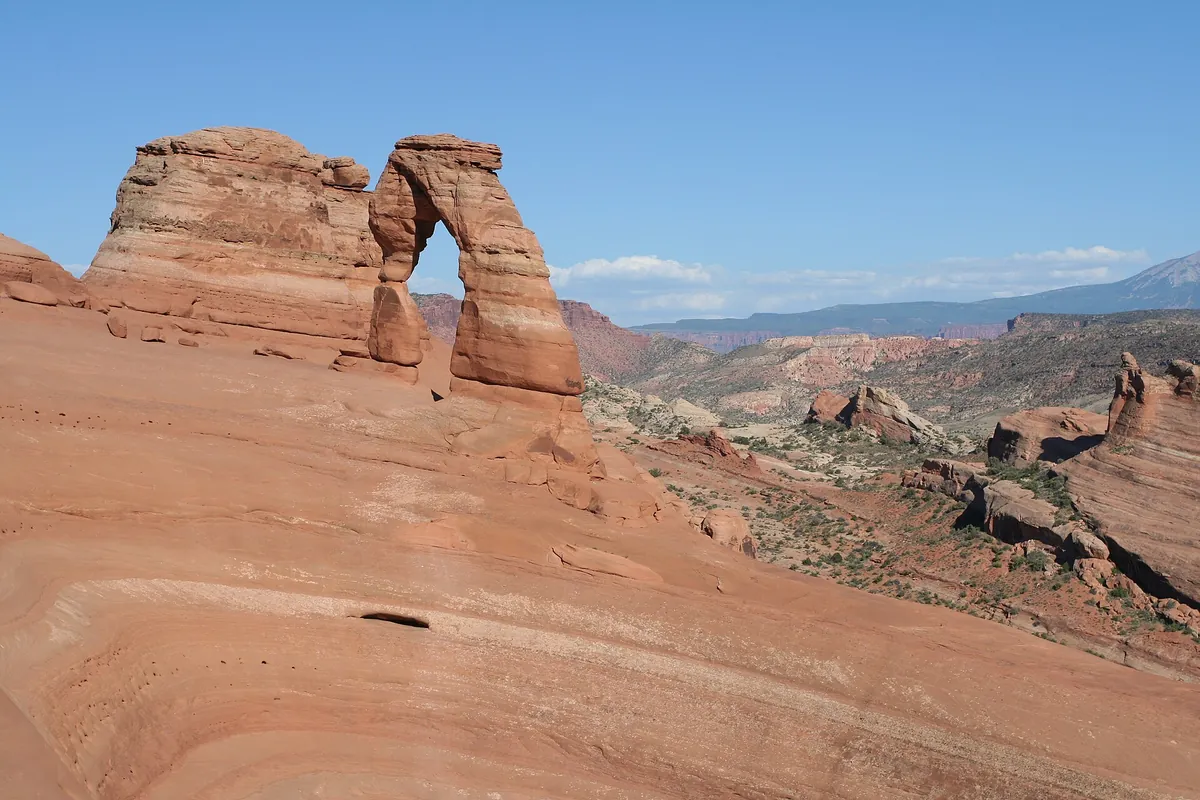
Arches National Park takes its name from its stone arches, and a Park Service superintendent, Frank Pinkley, first wrote the name down in 1925. It sounds too obvious to need a history, but the place went through a Devil’s Garden, Castle Windows and a couple of misplaced surveys before anyone settled on the plain word. You’ll also find that the most famous arch here had several earthier names before it got a polite one.
Arches National Park History
The push to protect this country started with a prospector. Alexander Ringhoffer, a Hungarian-born miner, came across the fins and arches of what’s now the Klondike Bluffs on December 24, 1922, according to David E. Purcell’s 2019 administrative history of the park, and he called the place “The Devil’s Garden.” The Park Service says he wrote to the railroad in 1923 to drum up interest, and Richard Firmage’s history of Grand County, Utah, says a railroad officer, Frank Wadleigh, then wrote to Park Service Director Stephen Mather suggesting a national monument.
Then the name wandered. The administrative history says the General Land Office sent surveyors in 1924 and 1925 to look at “Devil’s Garden,” and the second one, F. J. Safley, ended up on the east side of Salt Valley, at a different cluster of fins and arches. His spot kept the name, and it’s the Devils Garden you can hike today. Ringhoffer’s original garden is the Klondike Bluffs.
Pinkley came into it by chance. He ran the Park Service’s Southwestern Monuments and stopped at the Windows area on a trip between Colorado and Arizona. Locals called it “The Castle Windows,” and Pinkley didn’t like that. Purcell says he noted that these were arches, not natural bridges. On July 24, 1925, he wrote to Mather urging him to set aside “The Arches National Monument.” Purcell calls that letter the first use of the name, and Firmage says simply that Pinkley gave the monument its name.
It took four more years. A proclamation that Herbert Hoover signed on April 12, 1929, created Arches National Monument from two small pieces of land “known locally as the ‘Devil’s Garden’ and the ‘Windows.’” The proclamation describes “gigantic arches, natural bridges, ‘windows,’ spires, balanced rocks.” It puts the Devil’s Garden at about 2,600 acres and the Windows at 1,920. One thing to know if you check the Park Service page that prints it: its introduction gives 1,600 acres for the Windows, but the proclamation text right below says 1,920, and Firmage’s total of 4,520 acres matches the higher number.
The monument kept growing. The Park Service timeline lists a big enlargement on November 25, 1938, which Firmage says took it to 33,680 acres and brought in Delicate Arch and the Courthouse Towers. Edward Abbey’s book Desert Solitaire, about his seasons as a ranger here, came out in 1968. Then Public Law 92-155, signed November 12, 1971, declared the land “established as the Arches National Park” and, in the next line, said the monument “is hereby abolished.”
Delicate Arch’s name came last. Moab’s paper put the arch on its front page on March 9, 1917, calling it a “gigantic window,” according to Firmage. Before that it went by other names, Firmage says, including “the Schoolmarm’s Bloomers and the Chaps.” Frank Beckwith, who edited a paper in Delta, Utah, led a survey expedition in 1933 and 1934, and the administrative history credits his report as the first to call it Delicate Arch in print. Landscape Arch and Tower Arch got their names from him too.
Visiting Arches National Park
By the Park Service’s count, the park holds more than 2,000 documented arches. A 2,000th was logged in 1995 and named for that count, the administrative history says. To make the official list, an opening needs to measure three feet (1 m) or more in some direction. The park’s geology page also sorts out Pinkley’s distinction: a natural bridge crosses over running water, or a spot where water used to run, and the park has very few. A “window” is just a big arch high on a fin or wall, or one that frames a view.
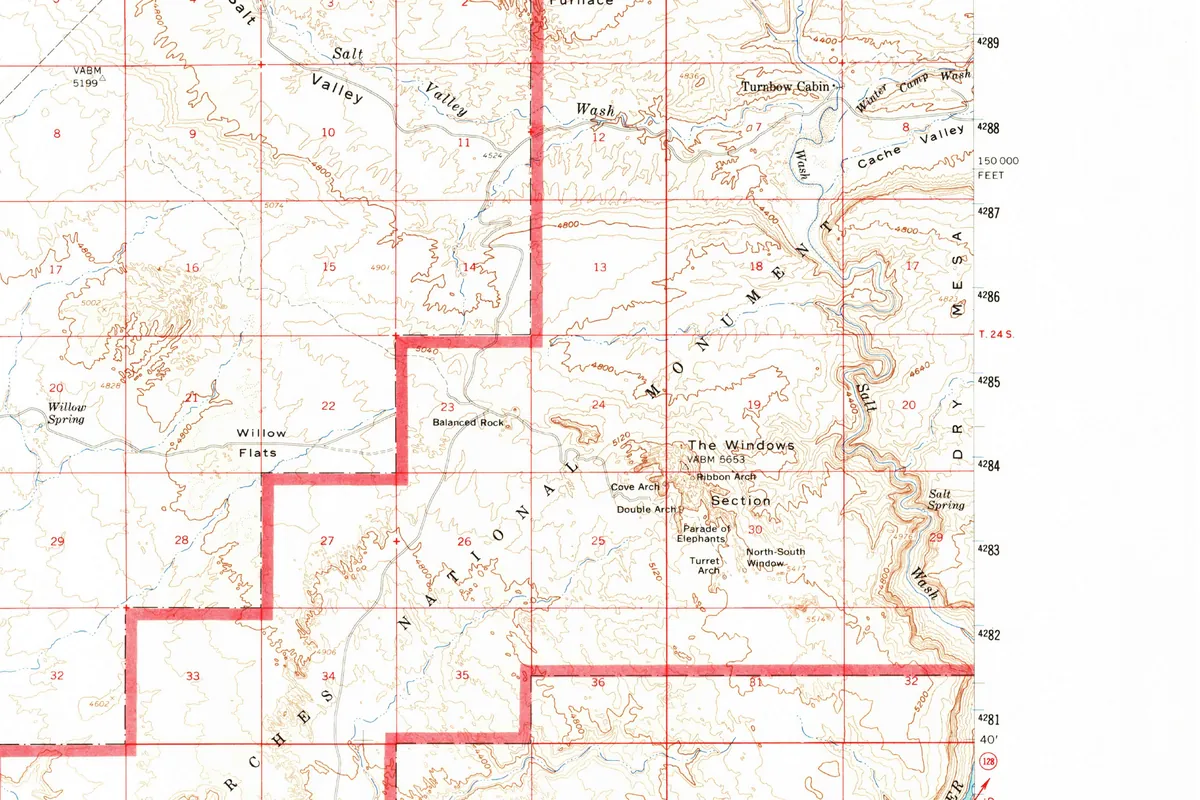
That makes the Windows Section a good first stop if you want to see where the name started. The 1959 Geological Survey map at the bottom of this page shows it inside the monument’s red boundary, with Double Arch, Turret Arch and the North-South Window marked, and Balanced Rock just to the west.
For 2026, the Park Service says you don’t need a timed-entry reservation to drive in, though rangers may turn cars away from the entrance when the park gets too crowded. You’ll still need reservations for the Devils Garden Campground and for Fiery Furnace hikes, guided or on your own. Rules have changed from year to year, so check the park’s Plan Your Visit page before you go.
The nearest town is Moab, named from the Bible, and in 1890 a petition signed by 59 residents asked the new county court for the name Vina. And Utah itself almost wasn’t Utah: the settlers’ choice was Deseret, the Book of Mormon’s word for honeybee, and Congress picked the Ute people’s name instead.
Quick answers
Why Is It Called Arches National Park?
For its natural stone arches, over 2,000 of them by the Park Service’s count. Frank Pinkley proposed “The Arches National Monument” in 1925, after pointing out that the formations were arches rather than natural bridges.
What Was Arches National Park Called Before?
Arches National Monument, from 1929 to 1971. Before that, locals used names like “The Devil’s Garden” and “The Castle Windows” for parts of it.
Where Can Visitors Check Current Arches Entry Requirements?
On the park’s Plan Your Visit page at nps.gov. For 2026 it says timed-entry reservations aren’t required, but Devils Garden Campground and Fiery Furnace hikes still need them.
Is Delicate Arch the Same as Arches National Park?
No. Delicate Arch is a single arch within the park. The arch sat outside the 1929 monument and only came in with the 1938 enlargement.
Key dates
- 1917Moab's newspaper runs Delicate Arch on its front page as a "gigantic window," long before it has its name.
- 1922December 24: prospector Alexander Ringhoffer comes on the Klondike Bluffs and calls them "The Devil's Garden."
- 1925July 24: Frank Pinkley's letter to Stephen Mather proposes "The Arches National Monument," the name's first known use.
- 1929April 12: President Herbert Hoover proclaims Arches National Monument, in two sections.
- 1934Frank Beckwith's expedition report is the first to call it Delicate Arch in print.
- 1938November 25: Franklin D. Roosevelt enlarges the monument, taking in Delicate Arch.
- 1971November 12: Public Law 92-155 makes it Arches National Park and abolishes the monument.
Find it in Google Maps
Opens in a new tab. The pin is a point from the USGS place-name record, so it may not be the middle of the area.
Sponsored
Planning a visit?
Compare hotels in the area on Expedia.
See hotels nearbyWe may earn a commission if you buy through this link. It never changes what we write. Read our affiliate disclosure
Historical Sources & References
- National Park Service, “Presidential Proclamation 1875”. Hoover’s proclamation of April 12, 1929: “Devil’s Garden” and “Windows,” “approximately 2,600 acres and 1,920 acres, respectively”; “gigantic arches, natural bridges, ‘windows,’ spires, balanced rocks.” The page’s introduction gives 1,600 acres for the Windows.
- National Park Service, “Public Law 92-155”. November 12, 1971: “established as the Arches National Park”; “The Arches National Monument is hereby abolished.”
- David E. Purcell, An Administrative History of Arches National Park (2019). Ringhoffer’s “The Devil’s Garden” (Klondike Bluffs), December 24, 1922; the 1924 and 1925 Land Office surveys and Safley’s misplaced Devil’s Garden; Pinkley’s letter of July 24, 1925, “the first use of this name,” arches rather than natural bridges, and “The Castle Windows”; Beckwith first to print “Delicate Arch” (1934) and his naming of Landscape and Tower Arches; the 2,000th arch, 1995.
- Richard A. Firmage, “Arches National Monument” (Utah History to Go). Ringhoffer, born in Hungary in 1869; Wadleigh’s letter to Mather; Pinkley “gave the name for the monument”; the 4,520-acre monument of 1929; the 1917 front page and its “gigantic window”; Delicate Arch’s older names, “the Schoolmarm’s Bloomers and the Chaps”; Beckwith’s 1933-34 expedition; the 1938 enlargement to 33,680 acres.
- National Park Service, “Arches National Park Timeline”. November 25, 1938; Abbey’s Desert Solitaire, 1968; November 12, 1971.
- National Park Service, “Founders of Arches”. Ringhoffer’s 1923 letter to the railroad and the hikes he led for its executives.
- National Park Service, “Geologic Formations”. Over 2,000 documented arches; the three-foot (1 m) rule; what counts as a window and a natural bridge.
- National Park Service, Arches “Plan Your Visit”. “In 2026, advanced timed-entry reservations will not be required”; reservations still needed for Devils Garden Campground and Fiery Furnace.
- U.S. Geological Survey, Moab sheet (1:62,500), 1959. The map at the bottom of this page, a federal work in the public domain.
- GNIS feature 1455716, Arches National Park (U.S. Geological Survey). The park’s entry in the federal place-names database, the identifier Wikidata gives for it.
Spot something wrong, or know more? Tell us here. You can also email us or use our contact page. Corrections are noted here with their date, never made silently.