How Kennebunkport, Maine, Got Its Name (Kennebunk Was Taken)
In 1821 the town of Arundel became Kennebunk-port. Its people had asked to be called Kennebunk, the name merchants knew from the port, but the eastern part of Wells petitioned first and became Kennebunk in 1820. Charles Bradbury, who wrote the town's history in 1837, called the result "the less convenient name."
Second in line for Kennebunk
Arundel, Maine, wanted to be called Kennebunk, but a neighboring town filed first, so in 1821 it settled for Kennebunkport. The “port” was a consolation prize, a way to keep the famous name while making it clear which town was which.
Charles Bradbury, who published a history of the town in 1837, only 16 years after the change, explains the problem. Ships and cargo went in and out under the name of the port of Kennebunk, so that name “was generally known in the commercial world, while Wells and Arundel, which composed the district, were almost wholly unknown.” So Arundel asked the Legislature to rename it Kennebunk. The trouble was that the eastern end of Wells wanted the same name, and it got its petition in first. That part of Wells was incorporated as the town of Kennebunk in June 1820.
“In consequence,” Bradbury writes, “Arundel took the less convenient name of Kennebunk-port, February 19, 1821.” He prints the act itself:
“…from and after the passing of this act, the name of the town of Arundel shall cease, and the said town shall hereafter be called and known by the name of Kennebunk-port, any law to the contrary notwithstanding…”
It wasn’t the first try, either. Earlier, in a passage Bradbury sets just before 1813, the town had voted to have its selectmen petition for the name Kennebunk, but “it does not appear that the vote was complied with.” By the time Arundel got around to it, the name was gone. The Town of Arundel’s history adds the timing: Maine had just become a state in 1820, and it was the first Maine Legislature that approved the change.
Before Arundel, a cape named for porpoises
The town had already been through two names. The first was Cape Porpus, after the cape on the coast. Bradbury thought Captain John Smith “probably gave the name” in 1614, “in consequence of seeing a shoal of porpoises,” and he tracks the spelling from Smith’s “Porkpiscis” to “Porpus” when the town was incorporated in 1653. On July 5 of that year the people of Cape Porpus signed their submission to Massachusetts at a court in Wells, and Bradbury counts it as “the fifth incorporated town in Maine.”
War emptied the town late in the 1600s. The Town of Arundel’s history puts the Indian wars at 1680 to 1720 and says they forced an evacuation. When the place was resettled, it got a new name. On June 5, 1719, the Massachusetts council voted “that the name of the accepted town on Cape Porpoise be Arundel,” and the House concurred on June 8. Bradbury says it was “called Arundel in compliment to the Earl of Arundel, descendant of Thomas, Earl of Arundel, one of the original proprietors of New England.” He passes along a story that the earl offered the town a bell that was never sent for, and he marks it as tradition.
Arundel didn’t get rich fast. Bradbury says it was so poor that neighboring towns had to send help, and it “acquired the name of ‘Poor Arundel,’ by which appellation it was known for a great number of years.” By 1821, he adds, the new Kennebunk-port was “no longer ‘Poor Arundel,’” but second in wealth in the new state, behind only Portland.
What does Kennebunk mean?
That’s the part nobody can pin down. Henry Gannett’s 1905 federal bulletin on place names calls it “An Indian name, said to mean ‘long water place.’” Joyce Butler, writing as Kennebunk’s town historian in 1996, says the name means “long cut bank,” probably for Great Hill at the mouth of the Mousam River. Those are two different readings, and neither source cites a linguist or a dictionary of the language, so treat both as possibilities. The word itself is old: Bradbury, describing the 1640s, writes the river as the “Kennibonke.”
If you’re keeping score, Kennebunkport’s name is a river word nobody can translate for sure, plus a plain English “port,” taken second-hand because the neighbors got to “Kennebunk” first.
Arundel comes back
The story has one more turn. According to the Town of Arundel, farmers in the inland part of Kennebunkport decided they shouldn’t pay higher taxes for services on the coast, and the Legislature agreed to split the town, effective at the 1916 town meeting. The new inland town was called North Kennebunkport. In 1957 it voted to change its name back to Arundel. So if you look at a map of York County today, you’ll find the town that gave up the name Arundel right next to the one that took it back.
Quick answers
What was Kennebunkport called before 1821?
Arundel. Before 1719 the town was Cape Porpus, also written Cape Porpoise, a name that still belongs to the cape and the village by the harbor.
Why didn’t Arundel just become Kennebunk?
Because the eastern part of Wells asked for the same name and filed first. It became Kennebunk in June 1820, so Arundel took “Kennebunk-port” on February 19, 1821.
What does Kennebunk mean?
It isn’t settled. Gannett’s 1905 bulletin says it was “said to mean ‘long water place,’” while Kennebunk’s town historian wrote in 1996 that it means “long cut bank.”
Is Arundel, Maine, the same town as Kennebunkport?
No. Today’s Arundel is the inland part that split from Kennebunkport in 1916 as North Kennebunkport and took back the old name Arundel in 1957.
Key dates
- 1653July 5: the people of Cape Porpus submit to Massachusetts at a court in Wells. Bradbury calls it the fifth incorporated town in Maine.
- 1719June: the Massachusetts council votes that "the name of the accepted town on Cape Porpoise be Arundel," and the House concurs.
- 1820June: the eastern part of Wells, which petitioned first, is incorporated as the town of Kennebunk.
- 1821February 19: the Maine Legislature ends the name Arundel, and the town becomes Kennebunk-port.
- 1916The inland farm district splits off at the town meeting as North Kennebunkport, the Town of Arundel says.
- 1957North Kennebunkport votes to change its name back to Arundel.
Getting there
Open Kennebunkport in Google Maps
Opens in a new tab. The pin is the center of Kennebunkport in the USGS place-name record.
The closest airports, Amtrak stations and intercity bus stops, measured in a straight line from the center of Kennebunkport.
Airports
- Portland International Jetport (PWM) 21 mi 34 km
- Portsmouth International at Pease (PSM) 26 mi 42 km
- General Edward Lawrence Logan International (BOS) Boston 74 mi 119 km
Amtrak trains
- Wells station (WEM) 7 mi 12 km
- Saco station (SAO) 9 mi 15 km
Intercity buses
- Greyhound Wells Sanford Road 7 mi 12 km
- Concord Coach Lines Portland 22 mi 36 km
- FlixBus City of Portland 23 mi 36 km
Distances are as the crow flies, not by road. We don't list schedules or fares because they change; check with the airline, Amtrak or the bus company before you go. Official data (FAA commercial service airports (2025), FAA airport locations, Amtrak stations and Intercity Bus Atlas) from the FAA and the U.S. Bureau of Transportation Statistics, checked Nov 13, 2026.
Sponsored
Staying in Kennebunkport?
Compare hotels in Kennebunkport, Maine, on Expedia.
See hotels in KennebunkportWe may earn a commission if you buy through this link. It never changes what we write. Read our affiliate disclosure
Sponsored
Want the spooky side of Kennebunkport?
The name has its story above. For the ghost stories, US Ghost Adventures runs walking ghost tours in Kennebunkport.
See ghost tours in KennebunkportWe may earn a commission if you book through this link. It never changes what we write. Read our affiliate disclosure
Historical Sources & References
- Charles Bradbury, History of Kennebunk Port (1837). John Smith, the porpoises and the spellings up to “Porpus” (p. 17); the “Kennibonke” river (p. 25); the submission of July 5, 1653, and “the fifth incorporated town in Maine” (p. 27); the vote of June 5, 1719, naming the town Arundel, the House concurrence of June 8 and the compliment to the Earl of Arundel (p. 108); “Poor Arundel” (p. 177); the earlier vote to petition for Kennebunk (p. 189); the port’s reputation, Kennebunk incorporated in June 1820, “the less convenient name of Kennebunk-port,” the act of February 19, 1821, and the town second in wealth to Portland (p. 196).
- Henry Gannett, The Origin of Certain Place Names in the United States (USGS, 1905), p. 173. Kennebunk and Kennebunkport: “An Indian name, said to mean ‘long water place.’”
- Town of Kennebunk, “History of Kennebunk,” by Joyce Butler (1996). The reading “long cut bank,” probably for Great Hill at the mouth of the Mousam River.
- Town of Arundel, “History of Arundel”. The Indian wars of 1680 to 1720 and the resettlement under the name Arundel, the first Maine Legislature’s approval of the name change, the split effective at the 1916 town meeting, North Kennebunkport and the return to the name Arundel in 1957.
- GNIS feature 581640 (U.S. Geological Survey). Kennebunkport’s place-name record, written as one word and assigned to York County.
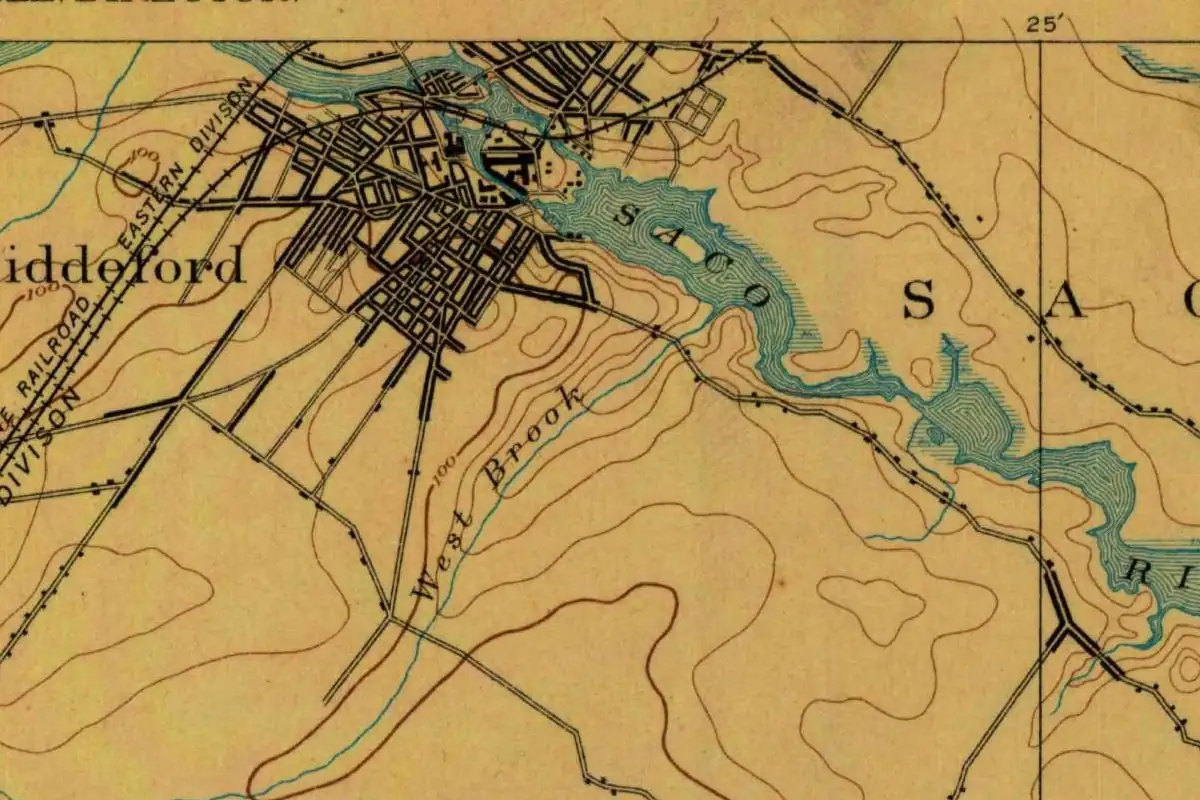
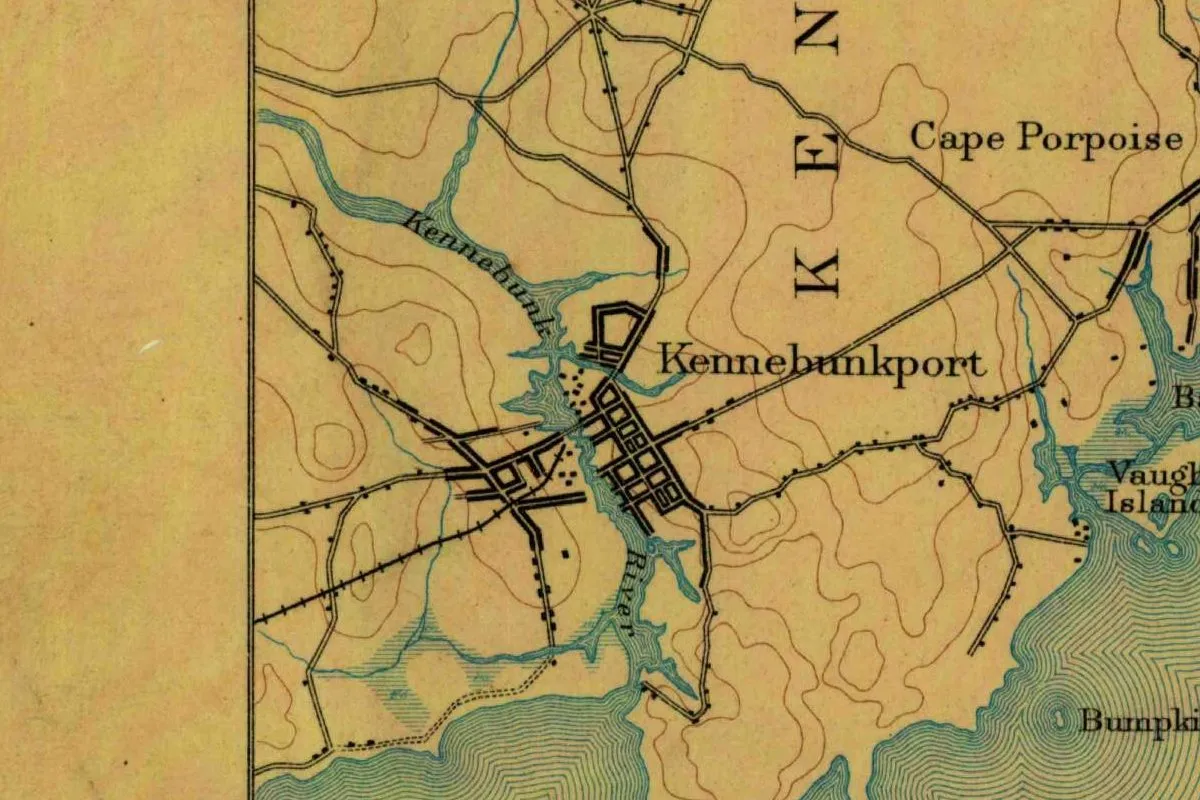
- U.S. Geological Survey, Biddeford sheet (1891). An 1891 sheet at 1:62,500, named for Biddeford, that covers Kennebunkport, the Kennebunk River and Cape Porpoise.
Spot something wrong, or know more? Tell us here. You can also email us or use our contact page. Corrections are noted here with their date, never made silently.