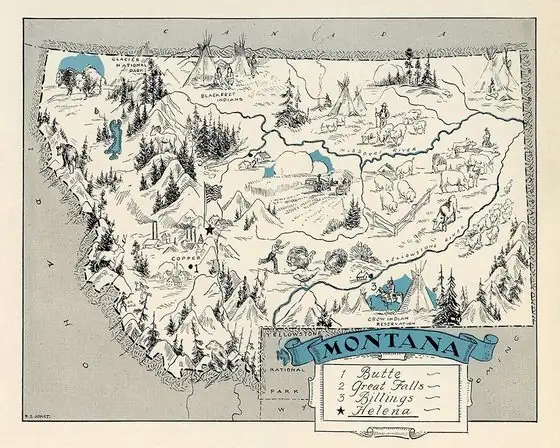
Anaconda, Montana: Why Daly's Copperopolis Got a New Name
Anaconda was first called Copperopolis, the name Marcus Daly wanted for his smelter town. Postmaster Clinton H. Moore said he knew Montana already had a Copperopolis, so in 1883 he sent the name Anaconda to Washington, after the Anaconda mine in Butte. Gannett (1905) says the town was named for the Anaconda Company.
Anaconda, Montana, was nearly Copperopolis, until its first postmaster noted that Montana already had one and wrote in a mine’s name instead. That mine was in Butte, 26 miles (42 km) to the east, and its name came out of a Civil War story.
Marcus Daly’s smelter town
Anaconda exists because of copper. Marcus Daly, one of Montana’s “Copper Kings,” founded the town while he was paying for a smelter on Warm Springs Creek, write Mark Spero and Rick Graetz in a University of Montana feature. The Advisory Council on Historic Preservation dates the founding to 1883 and calls Daly’s plant the world’s largest non-ferrous mineral reduction plant.
The 1939 WPA guide to Montana says Daly picked the spot himself, for its water and limestone, and it passes along a story about how fast he made up his mind. Looking over the valley, he saw a cow standing there and told his engineers that Main Street “will run north and south straight through that cow.”
Copperopolis, already taken
The guide puts the naming problem plainly: “The city, first called Copperopolis, was platted in 1883.” When the postmaster, Clinton H. Moore, learned that a Copperopolis already existed in Meagher County, he went looking for another name.
Moore told the story himself forty years later. The Anaconda Standard printed his account on July 1, 1923, and the Anaconda Leader reprinted it in its 2023 visitors guide:
“Mr. Daly suggested the name of ‘Copperopolis,’ but I reminded him that a Copperopolis already existed in the eastern part of the state. I suggested ‘Anaconda,’ but Mr. Daly, at the time, did not seem to favor it.”
Daly gave no reason, Moore said, and he never learned why. Then the papers for his 1883 appointment as postmaster came, with a request from Washington to name the post office. “I wrote ‘Anaconda’ and returned them to Washington,” Moore recalled. That was that. Daly wanted one name, and the man filling out the form wrote another.
The two accounts place the other Copperopolis a little differently. Moore said the eastern part of the state; the WPA writers said Meagher County. Spero and Graetz tell the story with a twist of their own: they say Daly filed the paperwork, found Copperopolis taken, and went with Moore’s suggestion. They also call Moore the U.S. postmaster general, but the Leader’s reprint and the WPA guide make him the local postmaster, appointed in 1883.
A snake from a war report
So where did Moore get “Anaconda”? The WPA guide says he “thought of the important Anaconda Mine in Butte.” The mine’s discoverer, Mike Hickey, had named it after reading in an account of the closing campaign of the Civil War that “Grant encircled Lee like a giant anaconda.”
Dick Gibson’s radio history of Butte, produced by KBMF and the Butte-Silver Bow Public Archives, tells it a bit differently. In his version, Hickey named the mine for a Civil War article by Horace Greeley that described McClellan’s army encircling Lee’s forces “like a giant anaconda snake,” and Hickey, a veteran of McClellan’s army, staked the claim in October 1875. Gibson adds that Marcus Daly took a one-third interest in the mine at the end of 1876. You’ll notice the two versions disagree on the general. Neither source quotes Greeley’s actual words, and we haven’t found the article.
Henry Gannett, two decades on, skips the mine and the snake altogether when he reaches the town in 1905. His entry calls Anaconda a “township and city in Deerlodge County, Montana, named for the Anaconda Company.” That doesn’t really conflict with Moore. The company, the mine and the town all carried the same name by then.
The stack and the smelter
Daly had big plans for his town. The WPA guide says he founded the Anaconda Standard in 1889 to push Anaconda’s bid to become the state capital. That campaign failed: the same guide says Helena won the capital vote in 1892, with Anaconda the runner-up, and won again in 1894, with Daly backing Anaconda. The smelter, though, kept growing. Spero and Graetz say it reached its largest size in 1919, with the stack that still stands, and that it shut down in 1980. Montana Fish, Wildlife & Parks puts the stack at 585 feet (178 m), 30 feet (9 m) taller than the Washington Monument.
Today the town is part of Anaconda-Deer Lodge County, a consolidated city-county government, the ACHP says. As Montana’s state parks agency puts it, the stack dominates the landscape the way the company once dominated the area’s economic life.
The 1893 map
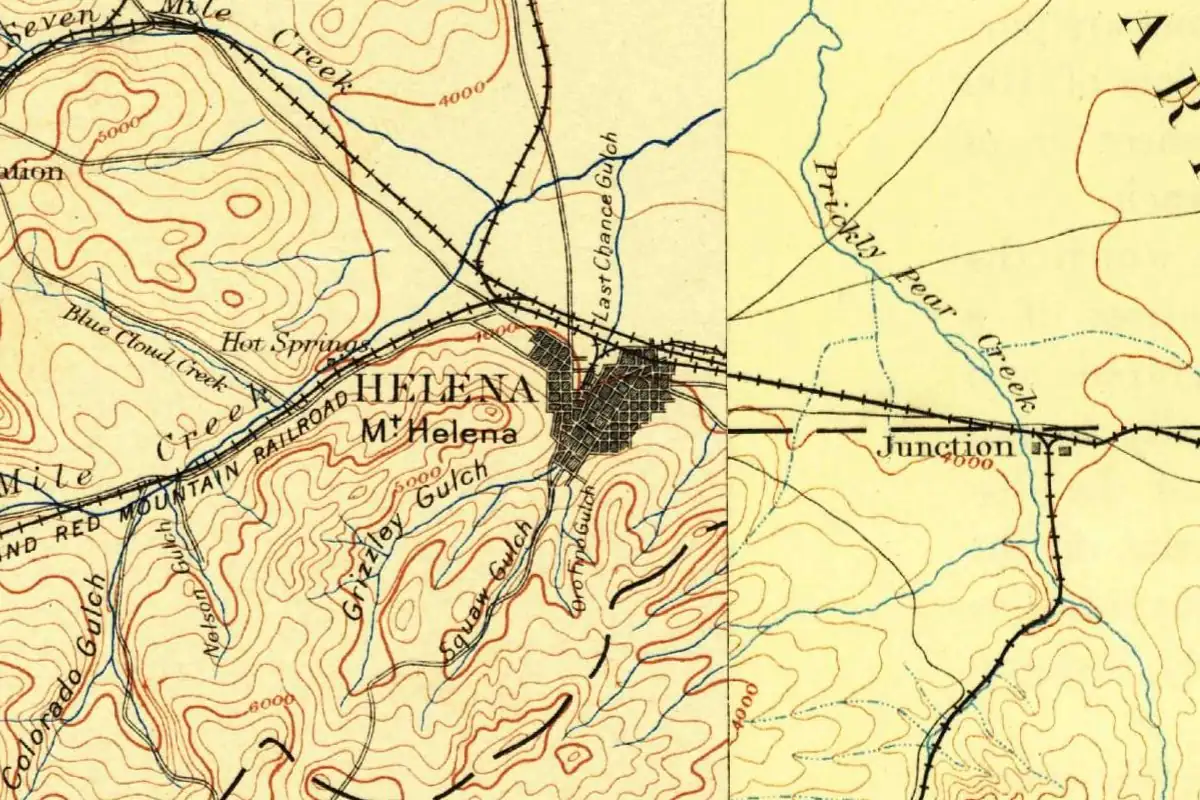
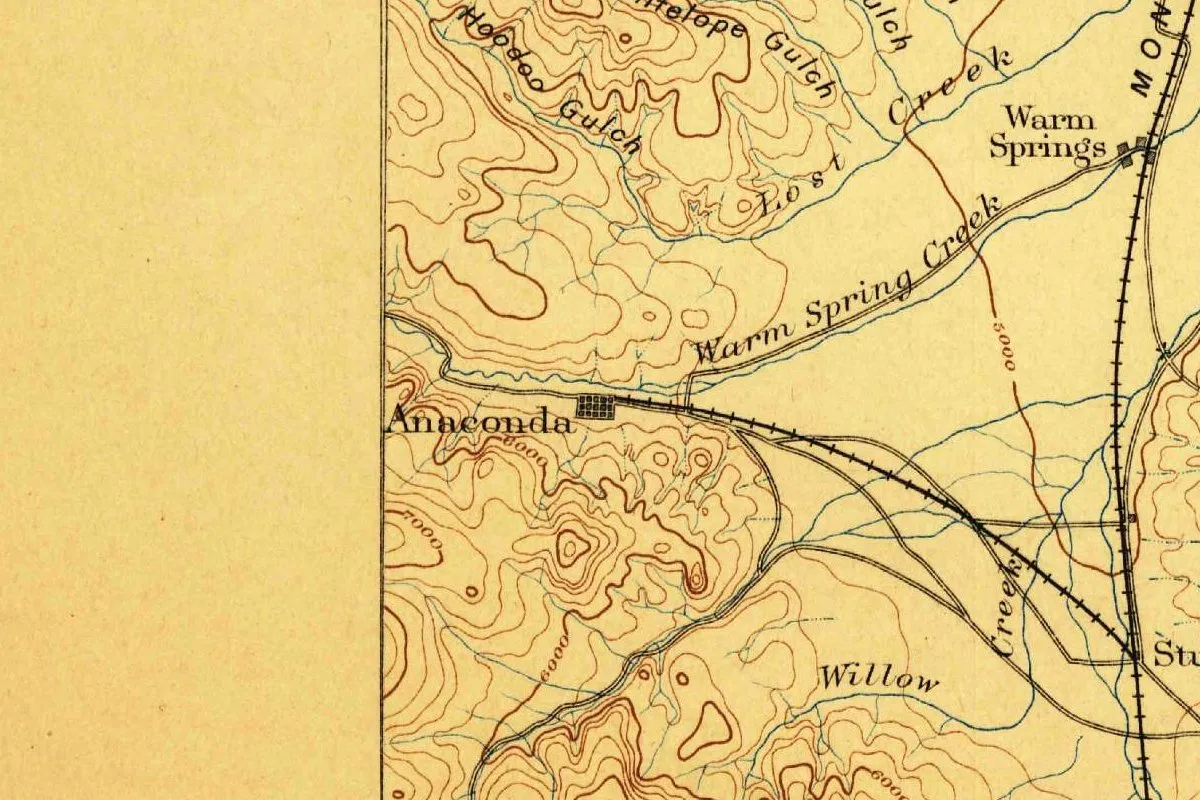
The map at the top of this page is a corner of the U.S. Geological Survey’s Helena sheet, printed in 1893. You’ll find Anaconda right at the sheet’s western edge, a small black grid with a railroad running off to the southeast and a road up Warm Spring Creek to Warm Springs. Warm Spring Creek and Lost Creek wind across the valley, and the contour lines climb past 6,000 and 7,000 feet (1,830 and 2,130 m) in the hills south of town. Ten years after Moore filled in his form, the mapmakers spelled it the way he did.
Quick answers
What was Anaconda, Montana, originally called?
Copperopolis. The 1939 WPA guide says the city was “first called Copperopolis,” and postmaster Clinton H. Moore recalled in 1923 that Marcus Daly suggested that name.
Who named Anaconda, Montana?
Clinton H. Moore, the first postmaster. In his 1923 account he said he wrote “Anaconda” on his 1883 appointment papers and sent them back to Washington.
Why didn’t Anaconda keep the name Copperopolis?
Because Montana already had a Copperopolis, according to Moore and the WPA guide. Moore placed it in the eastern part of the state; the guide says Meagher County.
Where does the name Anaconda come from?
From the Anaconda mine in Butte, the WPA guide says. Its discoverer, Mike Hickey, named it after a Civil War account of Grant encircling Lee “like a giant anaconda”; Dick Gibson’s version credits Greeley and McClellan instead.
Key dates
- 1875Michael Hickey stakes the Anaconda claim in Butte in October, according to Dick Gibson's radio history.
- 1883The smelter town is platted as Copperopolis; postmaster Clinton H. Moore sends in the name Anaconda.
- 1889Marcus Daly founds the Anaconda Standard, according to the 1939 Montana guide.
- 1919The 585-foot (178 m) smelter stack is completed.
- 1923On July 1, the Anaconda Standard prints Moore's own account of how he named the town.
- 1980The Anaconda smelter shuts down.
Things to do in Anaconda, Montana
Anaconda Smoke Stack State Park
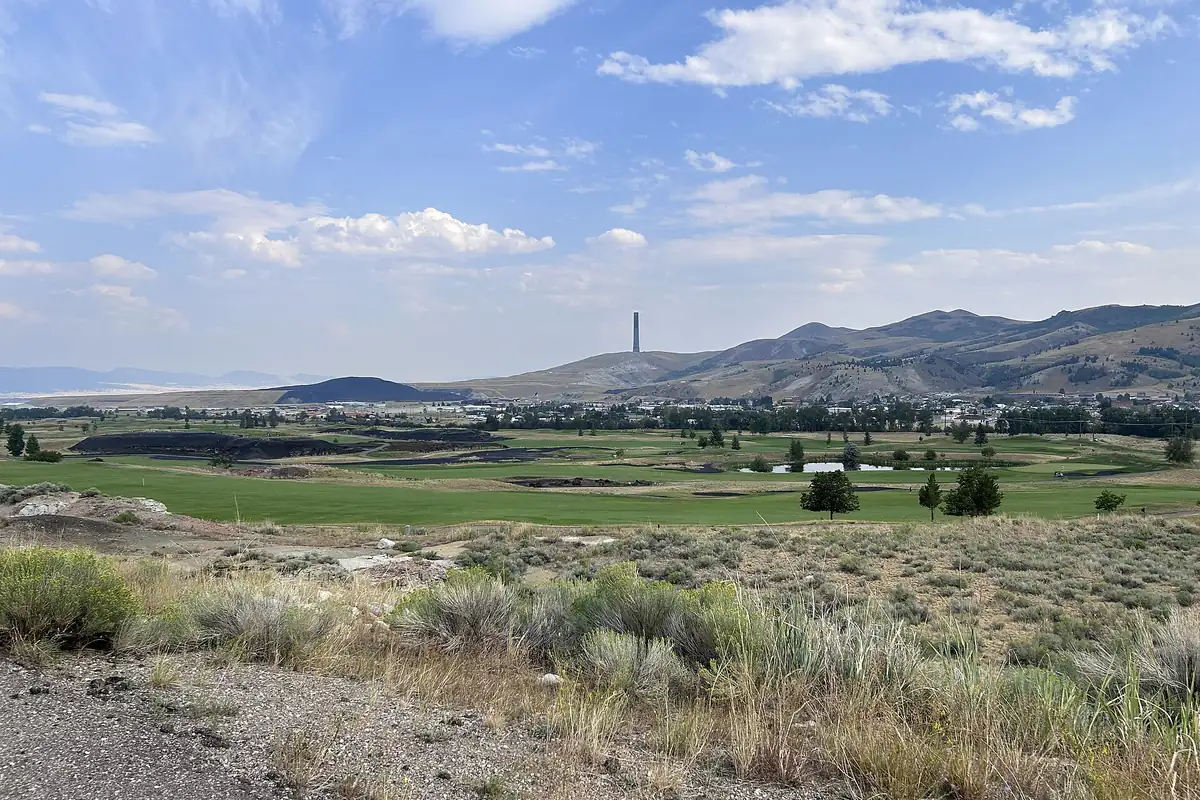
The Anaconda Copper Company's smelter stack, finished in 1919, stands 585 feet (178 m) tall, taller than the 555-foot (169 m) Washington Monument. It's viewed only from a distance, from a site near Goodman Park with interpretive signs.
Old Works Golf Course
A Jack Nicklaus course built on the site of Anaconda's first copper smelter, later a Superfund cleanup site. Its bunkers are filled with black slag from the smelting process.
Copper Village Museum and Arts Center
Founded in 1971 as a cultural center, it later added a museum of Deer Lodge County history and shows art in its Engine House Gallery. It moved into the City Hall Center in 1988.
Lost Creek State Park
Gray limestone cliffs and pink and white granite rise 1,200 feet (370 m) above the canyon floor. A short trail leads to Lost Creek Falls, a 50-foot (15 m) drop, and bighorn sheep are frequently seen on the cliffs above.
Getting there
Open Anaconda in Google Maps
Opens in a new tab. The pin is the center of Anaconda in the USGS place-name record.
The closest airports, Amtrak stations and intercity bus stops, measured in a straight line from the center of Anaconda.
Airports
- Bert Mooney (BTM) Butte 24 mi 39 km
- Helena Regional (HLN) 56 mi 91 km
Intercity buses
- Jefferson Lines Butte 22 mi 35 km
- Salt Lake Express Butte 22 mi 35 km
Distances are as the crow flies, not by road. We don't list schedules or fares because they change; check with the airline, Amtrak or the bus company before you go. Official data (FAA commercial service airports (2025), FAA airport locations, Amtrak stations and Intercity Bus Atlas) from the FAA and the U.S. Bureau of Transportation Statistics, checked Nov 15, 2026.
Sponsored
Staying in Anaconda?
Compare hotels in Anaconda, Montana, on Expedia.
See hotels in AnacondaWe may earn a commission if you buy through this link. It never changes what we write. Read our affiliate disclosure
Historical Sources & References
- Federal Writers’ Project, Montana: A State Guide Book (1939), pp. 137, 164, 369-370. Anaconda 26 miles (42 km) west of Butte (p. 137); Helena’s capital wins of 1892 and 1894 over Anaconda (p. 164); Daly’s choice of the smelter site and the cow story (p. 369); “first called Copperopolis,” Moore and the Meagher County Copperopolis, the Anaconda Mine and Hickey’s “giant anaconda” (pp. 369-370); the Anaconda Standard of 1889 and the capital campaign (p. 370). Checked against the page images.
- The Anaconda Leader, 2023 Visitors Guide, p. 12. Clinton H. Moore’s account as printed in the Anaconda Standard on July 1, 1923, including the quoted passage. We read the 2023 reprint, not the 1923 newspaper.
- Mark Spero and Rick Graetz, “Anaconda: A Montana Gem,” University of Montana. Daly founding the town with the smelter on Warm Springs Creek, their version of the Copperopolis story, the smelter’s peak in 1919 and its closing in 1980.
- Dick Gibson, “Butte, America’s Story, Episode 144,” The Verdigris Project. Hickey, Greeley and McClellan, the claim of October 1875, and Daly’s entry into the mine in 1876.
- Henry Gannett, The Origin of Certain Place Names in the United States, 2nd ed. (1905), p. 24. “Named for the Anaconda Company.” Checked against the page image.
- Advisory Council on Historic Preservation, “Anaconda-Deer Lodge County, Montana”. The 1883 founding, Daly’s reduction plant and the consolidated city-county government.
- Montana Fish, Wildlife & Parks, Anaconda Smoke Stack State Park; Lost Creek State Park; Visit Montana, Old Works Golf Course; Copper Village Museum and Arts Center. The stack’s height and the details in the things-to-do list.
- GNIS feature 779015 (U.S. Geological Survey). The USGS names database entry for Anaconda, Deer Lodge County, with its coordinates.
- U.S. Geological Survey, Helena sheet (1893). The 1:250,000 map that the image at the top of this page was cropped from.
Spot something wrong, or know more? Tell us here. You can also email us or use our contact page. Corrections are noted here with their date, never made silently.