Jamestown, North Dakota: A Virginia Name With One Witness
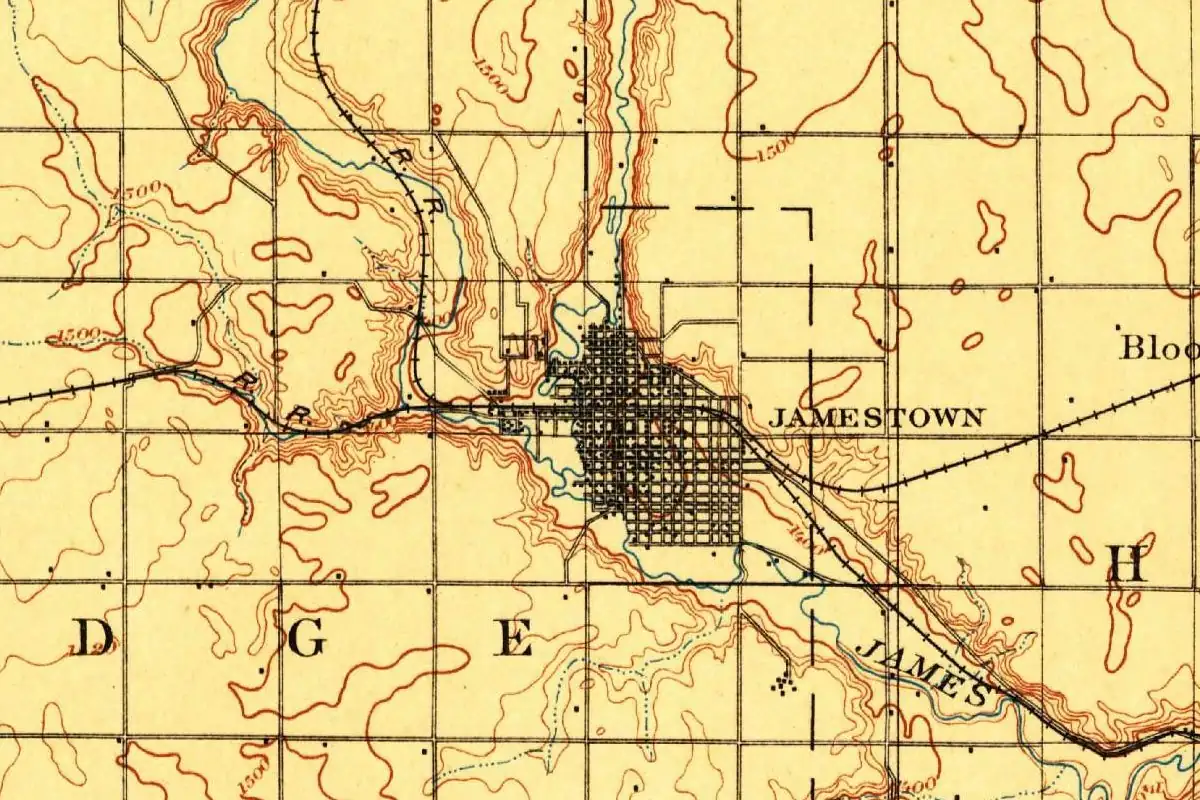
Jamestown, North Dakota, may have borrowed its name from Jamestown, Virginia, but only one book, from 1988, says so, and it credits a railroad engineer. Douglas Wick’s North Dakota Place Names says the Northern Pacific townsite was “named by Gen. Thomas LaFayette Rosser for his hometown of Jamestown, VA, which also is on a James River.”
That’s a neat story. But we couldn’t find anyone before Wick who tells it. The 1938 state guide, Clement Lounsberry’s 1917 history and the Northern Pacific’s own 1883 book of reference all mention the town or Rosser, and none of them says where the name came from. The parts of Wick’s entry we could read don’t point to a document either, so this page lists the origin as unknown.
The engineer in the story
Rosser was certainly there. The Northern Pacific’s own 1883 book of reference records that in 1871 “the salary of General Rosser, Assistant Engineer, was fixed at $5,000,” and that in 1873 “General Thomas L. Rosser was placed in charge of the Dakota Division as Division Engineer.” Wick adds the bigger picture: the names of all these Jamestowns “ultimately trace to King James I of England.”
If Wick is right, you can follow the name back to a king, by way of a Virginia colony and a railroad engineer. The railroad’s records show Rosser on the job; they just don’t show him picking the name.
Engineers in a winter camp
The town grew out of the railroad’s needs. The state’s Depression-era guide, published in 1938, says the first settlement “was made in the fall of 1871, when a corps of five or six N. P. Ry. engineers spent the winter here,” with soldiers from Fort Ransom guarding them. A military post followed in June. Clement Lounsberry’s 1917 history says it was “at first called Fort Cross” and later “changed to Seward, in honor of William H. Seward.”
Lounsberry names A. W. Kelly as the first settler. Kelly drove 130 head of cattle down to the camp and “located on May 9, 1872,” then became postmaster that December. On September 13, 1872, according to the state guide, the first train crossed the river into town.
The river came first
The James River had its name long before the railroad showed up, and you’ll find a story about that too. The 1938 guide tells it carefully, as “the story is told”: a French-Indian hunter who got lost was so happy to find the stream that he gave it his own name, “Riviere de Jacques.” The guide doesn’t say who he was, and neither does anyone else we read, so it stays a story.
So the river and the town’s name are two separate stories. Wick’s 1988 entry gives one reason for the name, Rosser’s hometown, and mentions the Virginia town’s own James River only in passing. If you want the naming confirmed, there’s still no earlier record we could find.
Quick answers
Is Jamestown, North Dakota, named after Jamestown, Virginia?
Possibly. Wick (1988) says Gen. Thomas L. Rosser named the townsite for Jamestown, Virginia, which is also on a James River. We found no earlier source or document that says so.
Did a railroad engineer name Jamestown?
Only Wick’s 1988 book says so, naming Gen. Thomas L. Rosser. The railroad’s own records list Rosser as an assistant engineer in 1871 but say nothing about the name.
What was the fort at Jamestown called?
Lounsberry says the 1872 post was first called Fort Cross and then renamed Fort Seward, for William H. Seward.
Key dates
- 1871Fall: a crew of Northern Pacific engineers winters at the James River crossing.
- 1872May 9: A. W. Kelly, the first settler, arrives.
- 1872June: a military post, first called Fort Cross, is set up.
- 1872September 13: the first train enters Jamestown.
Getting there
Open Jamestown in Google Maps
Opens in a new tab. The pin is the center of Jamestown in the USGS place-name record.
The closest airports, Amtrak stations and intercity bus stops, measured in a straight line from the center of Jamestown.
Airports
- Jamestown Regional (JMS) 2 mi 3 km
- Devils Lake Regional (DVL) 84 mi 135 km
Amtrak trains
- Devils Lake station (DVL) 83 mi 134 km
- Fargo station (FAR) 91 mi 146 km
Intercity buses
- Jefferson Lines Jamestown under 1 mi 0.3 km
Distances are as the crow flies, not by road. We don't list schedules or fares because they change; check with the airline, Amtrak or the bus company before you go. Official data (FAA commercial service airports (2025), FAA airport locations, Amtrak stations and Intercity Bus Atlas) from the FAA and the U.S. Bureau of Transportation Statistics, checked Nov 6, 2026.
Sponsored
Staying in Jamestown?
Compare hotels in Jamestown, North Dakota, on Expedia.
See hotels in JamestownWe may earn a commission if you buy through this link. It never changes what we write. Read our affiliate disclosure
Historical Sources & References
- Douglas A. Wick, North Dakota Place Names (1988). Jamestown as an NPRR townsite founded in 1871 next to Fort Seward and “named by Gen. Thomas LaFayette Rosser for his hometown of Jamestown, VA, which also is on a James River,” with all such names tracing “to King James I of England” (seen only as search excerpts; the scan is a library loan).
- Federal Writers’ Project, North Dakota: A Guide to the Northern Prairie State (1938), Tour 8. The engineers’ winter camp of 1871, Fort Cross (later Fort Seward), the first train on September 13, 1872, and the told-as-a-story origin of the river’s name, “Riviere de Jacques.”
- Clement A. Lounsberry, North Dakota History and People, vol. 1 (1917), pp. 512-513. The post “at first called Fort Cross” and changed to Seward; A. W. Kelly, the first settler, located May 9, 1872, and postmaster that December.
- Northern Pacific Railroad, Book of Reference (1883), pp. 82, 103. The 1871 salary of “General Rosser, Assistant Engineer,” and his 1873 appointment as Division Engineer of the Dakota Division.
- GNIS feature 1029648 (U.S. Geological Survey). The federal gazetteer page for Jamestown, in Stutsman County, with the note “Founded in 1872.”
Spot something wrong, or know more? Tell us here. You can also email us or use our contact page. Corrections are noted here with their date, never made silently.