Medora, North Dakota: A Marquis Named It for His Wife
Medora is named for Medora von Hoffman, the wife of the Marquis de Morès. The National Park Service says the French nobleman claimed six square miles (16 km²) of Little Missouri river bottom on April 1, 1883, and founded the town of Medora, "which he named after his wife." Her family's money paid for his ventures there.
Medora, North Dakota, has the first name of Medora von Hoffman, a New York banker’s daughter whose husband, a French marquis, founded the town in 1883. He named it for her, and her family’s money paid for his ventures. The National Park Service puts it bluntly: his wife “was the source of his wealth.”
A banker’s daughter and a marquis
The man was Antoine Amédée Marie Vincent Manca de Vallambrosa, known by his title, the Marquis de Morès. The Park Service calls him “an entrepreneurial Frenchman” who was “as well known for grandiose moneymaking schemes as for his skill as a rifleman.” His wife, Medora von Hoffman, was “the daughter of a wealthy Wall Street banker of German descent.”
His plan was meat. Instead of shipping live cattle east to the Chicago stockyards, he would slaughter range cattle in the North Dakota badlands and send the dressed beef to market in refrigerated rail cars. The State Historical Society of North Dakota says he incorporated the Northern Pacific Refrigerator Car Company in April 1883 “with the help of his father-in-law, Baron Von Hoffman.”
April 1, 1883, across the river from Little Missouri
According to the Park Service, “On April 1, 1883, the Marquis de Morès claimed a six square mile area of Little Missouri river bottom and founded the town of Medora, which he named after his wife.” That’s about 16 km². He put it close to the existing settlement of Little Missouri on purpose, the Park Service adds, “as an affront to its unwelcoming residents.”
Hermann Hagedorn’s Roosevelt in the Bad Lands, published in 1921, tells the same story from the ground. The marquis bought scrip “to the flat on the other side of the river and six square miles around it,” and on April Fool’s Day, 1883, “he pitched his tent in the sagebrush and founded the town of Medora.” When Roosevelt first saw the place in September, Hagedorn writes, a flat on the eastern bank that “six months previous had been a paradise for jack-rabbits” now held a few houses and a chorus of hammers. “The settlement called itself Medora. The air was full of vague but wonderful stories of a French marquis who was building it and who owned it, body and soul.”
The state historical society’s version is just as plain. The marquis started “a new town which he called Medora, in honor of his wife.” In 1905, when Henry Gannett boiled certain American place names down to short entries for the Geological Survey, Medora’s line ended with “named for the wife of the Marquis de Mores.” The Advisory Council on Historic Preservation says the same and dates the founding to 1883.
Medora herself
The town’s namesake was more than a name on a plat. The Park Service says she “fit in well in the Dakota Territory as an excellent rider and marksman,” and the historical society says both she and the marquis were skilled hunters. The 26-room frame house that neighbors called “the chateau” was ready for her arrival in the spring of 1884. The couple’s two children, Athenais and Louis, came along, and the family lived there seasonally for three years, going back to New York for the winters.
When the plant closed
The packing plant could process 150 beef carcasses a day, but the business failed. The historical society blames drought, competition from the big Chicago packers, bad weather and the marquis’s inexperience. The plant closed in November 1886, the marquis left, and the empty building burned in 1907. Its brick chimney still stands.
The name stayed, and so did some of what Medora’s money built. “Still standing in the town he named for his wife,” the historical society says, “is the home he built for his in-laws, the wealthy von Hoffmans from New York, and a Catholic church his wife had constructed.” The marquis’s sons gave the town a bronze statue of their father in 1926, and in 1936 the chateau and its grounds were given to the state.
The marquis also ran a stagecoach line between Medora and Deadwood, the historical society says. If you’ve read about Belle Fourche, South Dakota, you’ve met him already: a townsite at the spot was laid out in 1884 and called De Mores, after him. And if a founder naming a town for his wife sounds familiar, Hattiesburg, Mississippi is named for Hattie, the wife of railroad builder W. H. Hardy.
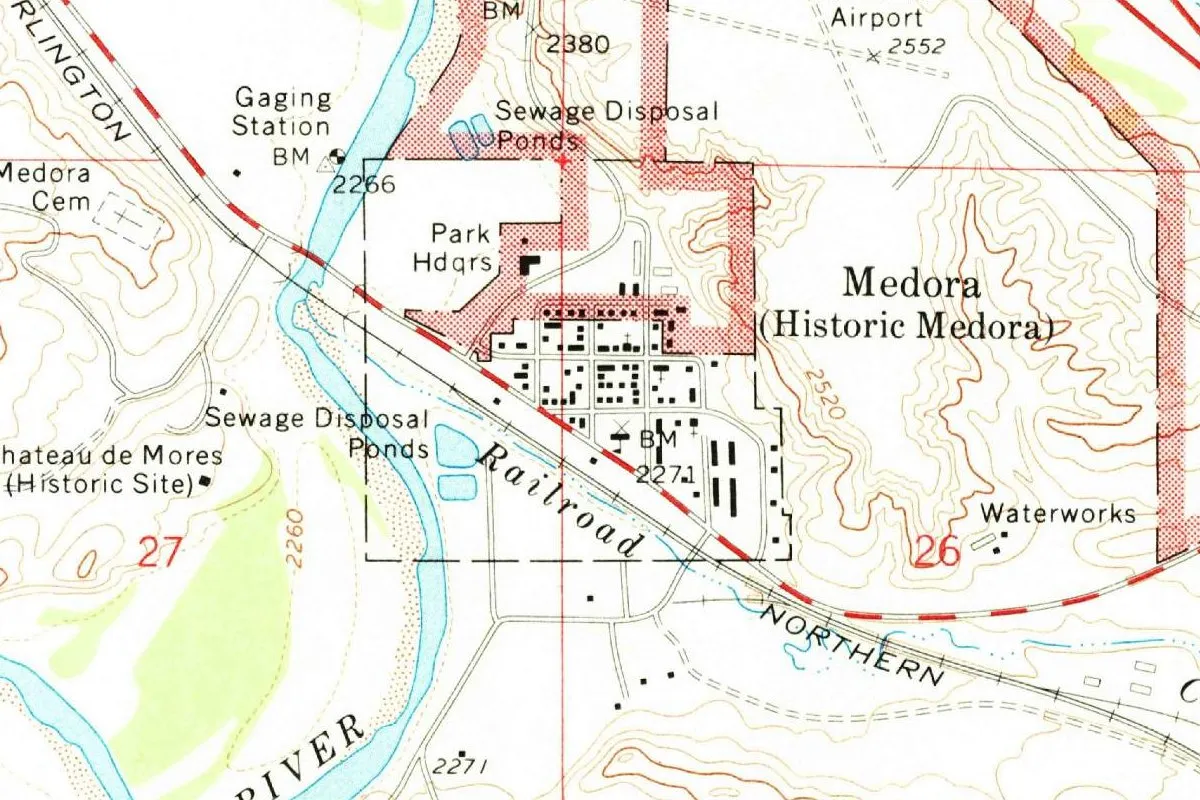
The town and the chateau on the 1970 map, printed in 1973
The map at the top of this page is the Geological Survey’s Medora quadrangle, made from aerial photographs taken in 1970 and field checked the same year. The copy scanned for the Survey’s historical collection was printed in 1973, according to the imprint line in its margin, and carries a file stamp of April 26, 1973. It shows you the layout the sources describe. The street grid of “Medora (Historic Medora)” sits on the east side of the river, with the railroad running through it and a benchmark at 2271 feet (692 m). Across the river to the west is “Chateau de Mores (Historic Site).”
Hagedorn placed Medora “on the eastern bank” in 1883. Nearly nine decades later, the Survey’s map still shows the town and the marquis’s house on opposite sides of the water.
Quick answers
Who is Medora, North Dakota, named after?
Medora von Hoffman, the wife of the Marquis de Morès. She was the daughter of a wealthy Wall Street banker, and the National Park Service says her family’s money funded her husband’s ventures.
Who founded Medora, North Dakota?
The Marquis de Morès, a French nobleman, on April 1, 1883, according to the National Park Service and Hermann Hagedorn’s 1921 book Roosevelt in the Bad Lands.
Did Theodore Roosevelt name Medora?
No. None of the sources connects Roosevelt with the name. The marquis named the town for his wife in 1883, the same year Roosevelt first came to the badlands to hunt.
Key dates
- 1883April 1: the Marquis de Morès founds Medora on the Little Missouri and names it for his wife, per the National Park Service.
- 1884Medora von Hoffman arrives in the spring, and the 26-room house later called the chateau is ready for her, per the State Historical Society.
- 1886The meatpacking plant closes in November, and the marquis leaves Medora.
- 1907The abandoned packing plant burns, leaving its brick chimney standing.
- 1926The marquis's sons donate a bronze statue of him for De Mores Memorial Park.
- 1936The chateau and its grounds are given to the state, according to the Advisory Council on Historic Preservation.
Things to do in Medora, North Dakota
Chateau de Mores State Historic Site
The 26-room, two-story frame house the marquis built in 1883 as his family's summer residence, now a historic house museum with many of the de Mores family's original furnishings, run by the State Historical Society of North Dakota.
De Mores Memorial Park
A park in downtown Medora with a bronze statue of the marquis donated in 1926 by his sons, set in a flagstone courtyard built as a WPA project in 1938.
Chimney Park
The site of the marquis's packing plant, which once held a slaughterhouse, three icehouses, a rail spur and a corral. The building burned in 1907, and its tall chimney of native clay brick still stands, with a picnic area next to it.
Maltese Cross Cabin
Theodore Roosevelt's ranch cabin, built of ponderosa pine logs in 1883 and restored, which you can tour behind the South Unit Visitor Center of Theodore Roosevelt National Park, according to the National Park Service.
Getting there
Open Medora in Google Maps
Opens in a new tab. The pin is the center of Medora in the USGS place-name record.
The closest airports, Amtrak stations and intercity bus stops, measured in a straight line from the center of Medora.
Airports
- Dickinson/Theodore Roosevelt Regional (DIK) 35 mi 56 km
- Williston Basin International (XWA) 94 mi 151 km
Amtrak trains
- Williston station (WTN) 85 mi 137 km
Intercity buses
- Jefferson Lines Dickinson 34 mi 55 km
Distances are as the crow flies, not by road. We don't list schedules or fares because they change; check with the airline, Amtrak or the bus company before you go. Official data (FAA commercial service airports (2025), FAA airport locations, Amtrak stations and Intercity Bus Atlas) from the FAA and the U.S. Bureau of Transportation Statistics, checked Nov 17, 2026.
Sponsored
Staying in Medora?
Compare hotels in Medora, North Dakota, on Expedia.
See hotels in MedoraWe may earn a commission if you buy through this link. It never changes what we write. Read our affiliate disclosure
Historical Sources & References
- National Park Service, “Marquis de Morès”. The marquis’s full name, Medora von Hoffman as “the source of his wealth,” the founding of April 1, 1883, on six square miles (16 km²) of river bottom, the town “named after his wife,” and the closing in 1886.
- State Historical Society of North Dakota, Chateau de Mores State Historic Site, with site history page 1 and page 2. “A new town which he called Medora, in honor of his wife,” the refrigerator car company of April 1883, the chateau and Medora’s arrival in 1884, the plant’s closing in 1886 and fire in 1907, the statue of 1926, and the house and church still standing.
- Advisory Council on Historic Preservation, “Medora, North Dakota”. “Medora bears the name of the wife of the Marquis de Mores,” the founding in 1883, the chateau’s transfer to the state in 1936, and Roosevelt’s arrival in the badlands in 1883.
- Henry Gannett, The Origin of Certain Place Names in the United States (1905), p. 204. “Named for the wife of the Marquis de Mores.”
- Hermann Hagedorn, Roosevelt in the Bad Lands (1921), pp. 3-4, p. 8 and p. 61. Roosevelt’s arrival in September, Medora “on the eastern bank,” “The settlement called itself Medora,” and the founding on April Fool’s Day, 1883.
- National Park Service, “Maltese Cross Cabin”. Roosevelt’s 1883 cabin behind the South Unit Visitor Center and his first trip to the badlands to hunt bison.
- GNIS feature 1035000 (U.S. Geological Survey). Medora’s listing as a populated place in Billings County, with its coordinates.
- U.S. Geological Survey, Medora quadrangle (1970, printed 1973). The 1:24,000 sheet the map at the top was cropped from, with the town and the chateau on opposite banks.
Spot something wrong, or know more? Tell us here. You can also email us or use our contact page. Corrections are noted here with their date, never made silently.