Marfa, Texas: Named From a Novel, but Which One?
Marfa is named for a character in a novel, reportedly suggested by a railroad executive's wife who was reading it in 1883. The Handbook of Texas says it was Marfa Strogoff in Jules Verne's Michael Strogoff. Visit Marfa names Dostoyevsky's The Brothers Karamazov, and the chamber of commerce says only 'a Russian novel.'
Marfa, Texas, reportedly got its name from a character in a novel a railroad wife was reading in 1883, but sources can’t agree on which novel. One names a book by Jules Verne, another a book by Fyodor Dostoyevsky, and a third just “a Russian novel.” None of them gives the woman a name.
One sentence, two books
Start with the Handbook of Texas, the Texas State Historical Association’s encyclopedia. Lee Bennett’s entry says Marfa “was established in 1883 as a water stop and freight headquarters for the Galveston, Harrisburg and San Antonio Railway.” Then comes the name: “Reportedly, the wife of a railroad executive suggested the name Marfa from the character Marfa Strogoff in Jules Verne’s Michael Strogoff (1876), which she was reading at the time.”
Now open the history page of Visit Marfa, the site of the Marfa Visitor Center. It uses almost the same sentence, word for word, with one swap: “Reportedly, the wife of a railroad executive suggested the name MARFA from Fyodor Dostoyevsky’s The Brothers Karamazov, which she was reading at the time.” Same wife, same water stop, same “reportedly.” Different book.
The Marfa Chamber of Commerce tells it a third way: “In 1883, the wife of the president of the Texas and New Orleans Railroad named a small West Texas railroad water stop Marfa after a character in a Russian novel that she was reading at the time.” That version names another railroad, makes the husband its president, and leaves the book unnamed. None of the three points to a letter, a diary or a newspaper from 1883, so this page doesn’t choose between them.
Two Marfas on the page
Both novels really do have a Marfa in them, and you can check them yourself. In an English edition of Verne’s Michael Strogoff published in London by Sampson Low, the hero is the czar’s courier, and on page 25 we learn about his family in Siberia: “his mother, Marfa Strogoff, lived there still,” in the town of Omsk.
In Constance Garnett’s translation of The Brothers Karamazov, Marfa is a servant. On page 90 of the Heinemann edition, the lodge of old Fyodor Pavlovitch’s house has “only three servants: old Grigory, and his old wife Marfa, and a young man called Smerdyakov.” A few lines down she gets her full name, Marfa Ignatyevna.
So either book could have supplied the name. One Marfa is a hero’s mother, the other an old servant, and none of the sources says which one the reader had in her hands.
A water stop becomes a county seat
By 1885, Bennett writes, Marfa had one or two saloons, a hotel and a general store, Humphris and Company, which also held the bank, a restaurant and the post office, established in 1883. Traveling salesmen came in by train, set up at the St. George Hotel and took stagecoaches out to Shafter, Fort Davis, Valentine and Presidio to show their wares.
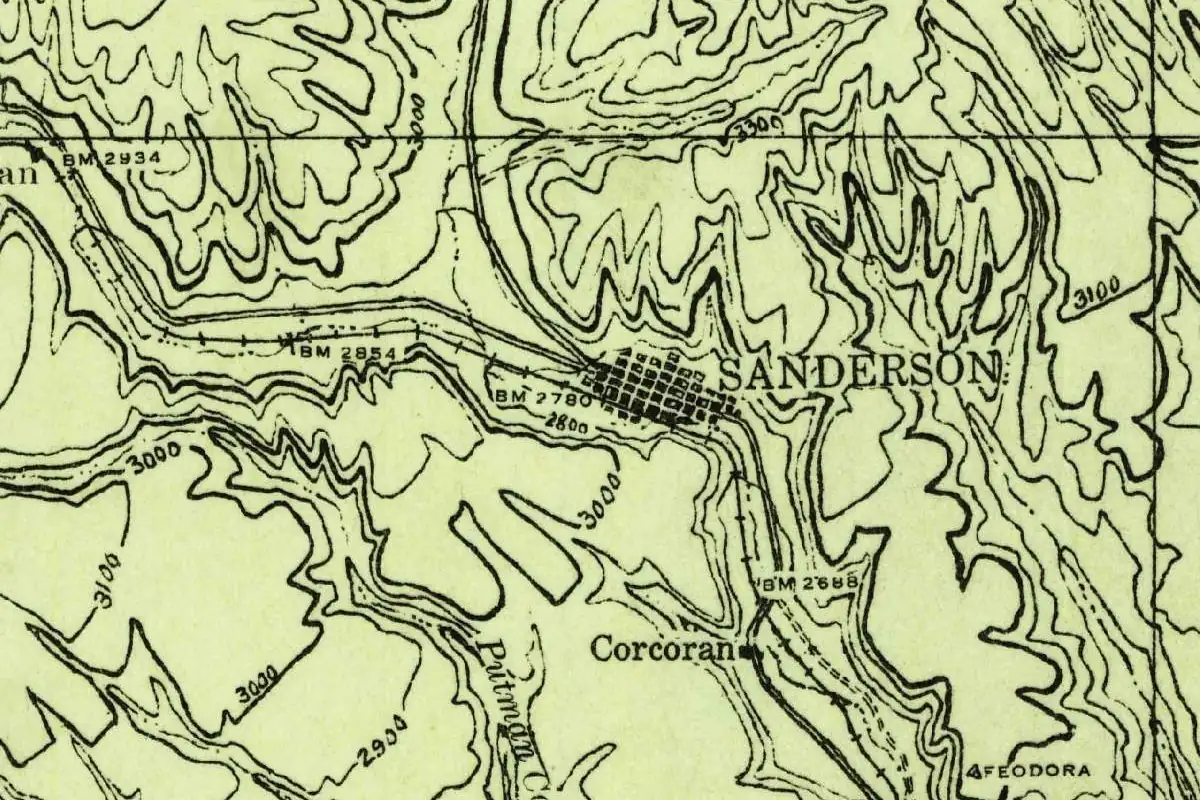
That same year, 1885, Marfa replaced Fort Davis as the Presidio County seat, and in July the public records were moved to Marfa. Our Fort Davis story tells it from the losing side, which went on to get a county of its own. The Galveston, Harrisburg and San Antonio turns up in the story of Sanderson, too, where the name that stuck in 1882 honored a railroad engineer, not a character in a book.
Marfa didn’t forget the date. The Handbook says Marfa’s 2,466 residents celebrated the 100th on March 5, 6 and 7, 1983, and about 5,000 friends, relatives and former Marfans came back for it.
Other towns named from a book
Texas isn’t alone here. In North Dakota, Enderlin also has a railroad story with a book in it: Douglas Wick’s North Dakota Place Names says the name came from a character in a book, suggested by one of two wives of Soo Line officials, and none of the sources in that story identifies the book. And Hermiston, Oregon, took the title of a Robert Louis Stevenson novel he never finished.
Marfa on the 1895 map
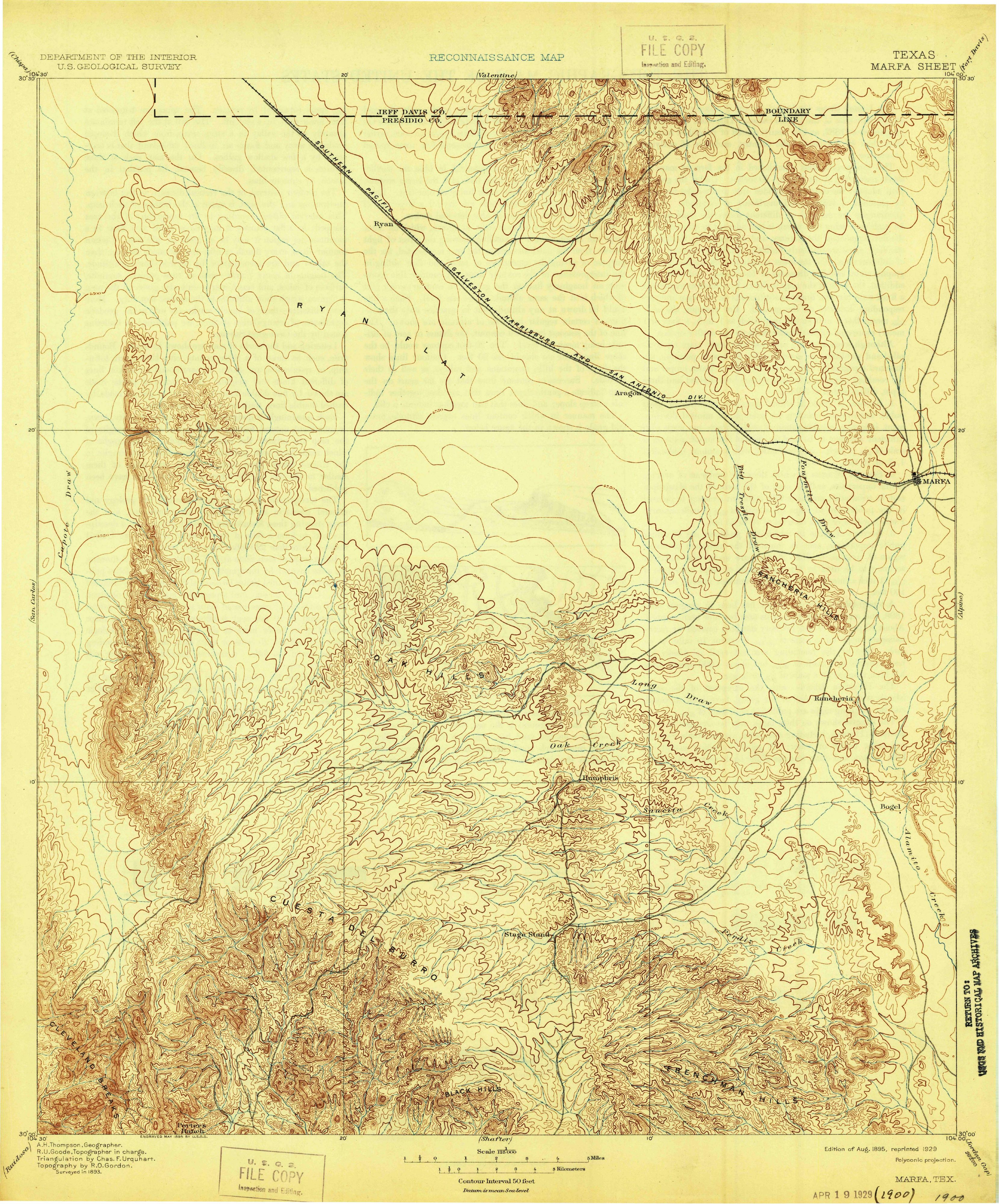
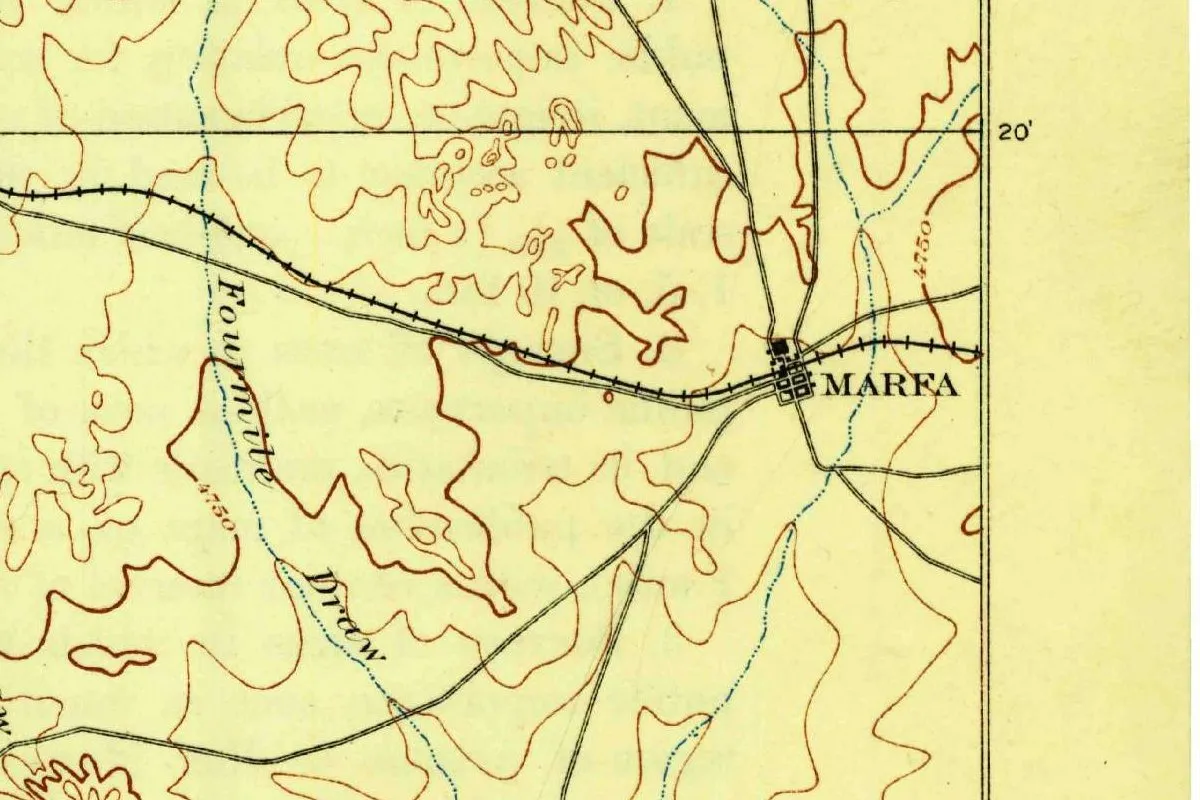
The map at the top of this page comes from the Geological Survey’s Marfa sheet. Its margin calls it a “Reconnaissance Map,” surveyed in 1893, and reads “Edition of Aug. 1895, reprinted 1929,” so what you’re looking at is the 1929 reprint. Marfa is a tiny grid of blocks on the railroad, drawn as a line with cross ticks, with roads fanning out from town and a dotted blue stream labeled Fourmile Draw off to the west.
The Handbook puts Marfa at 4,830 feet (1,472 m), on a highland plain known as the Marfa Plateau. Whichever Marfa the railroad wife had in mind, a dozen years later her choice was engraved on a federal map.
Quick answers
What novel is Marfa, Texas, named after?
It’s disputed. The Handbook of Texas says Jules Verne’s Michael Strogoff, Visit Marfa says Dostoyevsky’s The Brothers Karamazov, and the Marfa Chamber of Commerce says only “a Russian novel.” All three say a railroad wife was reading it.
Who named Marfa?
A railroad wife whose name isn’t recorded in these sources. The Handbook says she was “reportedly” the wife of a railroad executive, while the chamber of commerce calls her the wife of the president of the Texas and New Orleans Railroad.
Who is Marfa in Michael Strogoff?
The hero’s mother. In the English edition cited here, Marfa Strogoff still lives in Omsk, in Siberia.
Key dates
- 1883Marfa becomes a water stop and freight headquarters for the Galveston, Harrisburg and San Antonio Railway and gets a post office, per the Handbook of Texas.
- 1885Marfa replaces Fort Davis as the Presidio County seat, and the county records move in July.
- 1983On March 5, 6 and 7, the town celebrates its 100th birthday.
Things to do in Marfa, Texas
The Chinati Foundation
The museum Donald Judd founded in 1986 for the permanent installation of large-scale art, on 340 acres (138 ha) at the former Fort D. A. Russell. It opened to the public in 1987; on view today are 15 of Judd's concrete pieces outdoors and 100 of his mill-aluminum pieces inside two former artillery sheds.
Judd Foundation, La Mansana de Chinati/The Block
Guided visits to the Marfa home and studio where Judd took on some of his first architectural projects at large scale, set up his early work for good and kept a library of more than 13,000 books.
Blackwell School National Historic Site
A school built in 1909 that the National Park Service presents as a story of 'separate but equal' schooling for Marfa's Mexican and Mexican American residents, in the years of what the Park Service calls 'de facto segregation,' 1889 to 1965.
Marfa Lights Viewing Area
The official spot for watching for the Marfa Lights, 9 miles (14 km) east of town on U.S. 90 toward Alpine. Visit Marfa says the source of the lights is still a point of contention.
Getting there
Open Marfa in Google Maps
Opens in a new tab. The pin is the center of Marfa in the USGS place-name record.
The closest airports, Amtrak stations and intercity bus stops, measured in a straight line from the center of Marfa.
Amtrak trains
- Alpine station (ALP) 22 mi 35 km
- Sanderson station (SND) 97 mi 157 km
Intercity buses
- All Aboard America Marfa 1 mi 2 km
Distances are as the crow flies, not by road. We don't list schedules or fares because they change; check with the airline, Amtrak or the bus company before you go. Official data (FAA commercial service airports (2025), FAA airport locations, Amtrak stations and Intercity Bus Atlas) from the FAA and the U.S. Bureau of Transportation Statistics, checked Nov 17, 2026.
Sponsored
Staying in Marfa?
Compare hotels in Marfa, Texas, on Expedia.
See hotels in MarfaWe may earn a commission if you buy through this link. It never changes what we write. Read our affiliate disclosure
Historical Sources & References
- Lee Bennett, “Marfa, TX,” Handbook of Texas Online. The water stop of 1883, the “reportedly” and Marfa Strogoff, the post office, the 1885 county seat, the centennial of March 1983 and the elevation of 4,830 feet (1,472 m).
- Visit Marfa, “History”. The same story with The Brothers Karamazov as the book.
- Marfa Chamber of Commerce, “About Marfa”. The wife of the president of the Texas and New Orleans Railroad and “a Russian novel.”
- Jules Verne, Michael Strogoff, the Courier of the Czar, p. 25. Marfa Strogoff, the courier’s mother, in Omsk. Checked against the page image.
- Fyodor Dostoevsky, The Brothers Karamazov, trans. Constance Garnett, p. 90. Marfa Ignatyevna, Grigory’s wife. Checked against the page image.
- The Chinati Foundation; Judd Foundation; Blackwell School National Historic Site; Visit Marfa, “Mystery”. The details in the things-to-do list, including the 9 miles (14 km) to the lights viewing area.
- GNIS feature 1340942 (U.S. Geological Survey). Marfa as a populated place in Presidio County, with its coordinates.
- U.S. Geological Survey, Marfa sheet (1895, reprinted 1929). The 1:125,000 reconnaissance sheet the map at the top was cropped from, surveyed in 1893.
Sponsored
Put this 1895 map on your wall
The Geological Survey's Marfa sheet, surveyed in 1893 and first issued in 1895 (this copy is a 1929 reprint), is in the public domain. Download the full-size scan for free, then have it printed on canvas with CanvasOnTheCheap.
Print a map on canvasDownload the full-size mapWe may earn a commission if you buy through this link. It never changes what we write. Read our affiliate disclosure
Spot something wrong, or know more? Tell us here. You can also email us or use our contact page. Corrections are noted here with their date, never made silently.