McAllen, Texas: A Rancher, His Son and a Railroad Town
The Handbook of Texas says the town was named for John McAllen, who with his son James gave land so a railroad would cross their Santa Anita Ranch in 1904. A 1924 history of Texas credits the son, James B. McAllen, instead. Both point to the same family's surname, on the family's land.
Two McAllens, a rancher and his son, have each been named in print as the man behind McAllen, Texas, and the land under the town was theirs either way. The Handbook of Texas gives the honor to John McAllen, who gave land for a railroad in 1904; a history of the state printed in 1924 gives it to his son, James B. McAllen.
A ranch that came down through Salomé Ballí
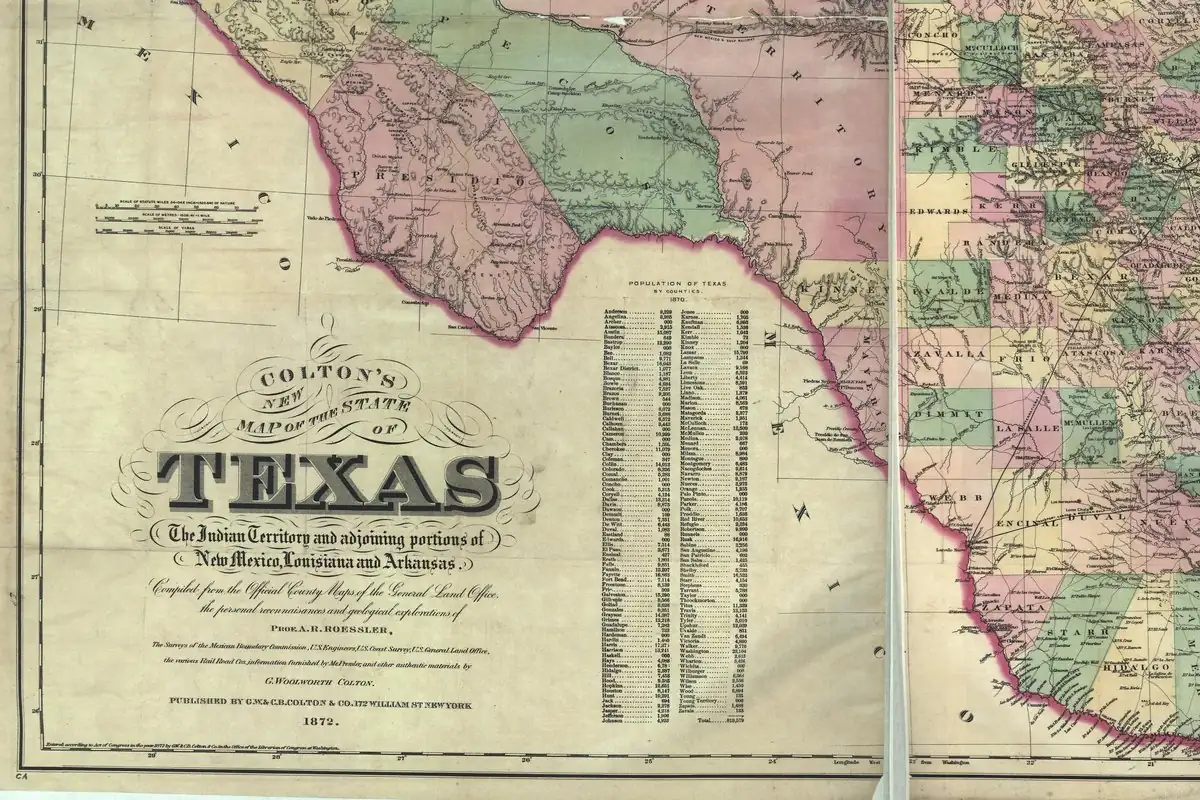
Before there was a town, there was the Santa Anita Ranch. The Handbook says José Manuel Gómez set it up around 1797 and got the grant from Spain in 1800. The land passed down to his great-granddaughter, Salomé Ballí, and about 1848 she married John Young, a businessman from Brownsville.
Young died in 1859. His assistant, John McAllen, managed the holdings, and in 1861 he married Salomé Ballí de Young. The Handbook’s entry on the McAllen Ranch fills in who he was: born in Londonderry, Ireland, in 1826, he’d landed in Matamoros in 1849 on his way to California and ended up clerking in Young’s Brownsville store. In 1862 the couple had a son, James Ballí McAllen. The Handbook says that, as the family kept adding land, the ranch was renamed the McAllen Ranch, and the site of today’s city lay inside its boundaries. So the family name was on the land before it was on a town.
Land for the tracks, a name for the depot
The railroad changed everything. On August 20, 1904, the Hidalgo and San Miguel Extension of the St. Louis, Brownsville and Mexico Railway reached the Santa Anita Ranch, and the Handbook says John McAllen and his son James donated land to have the tracks cross their property. On December 5 of that year, the two McAllens, Uriah Lott, Leonidas C. Hill Sr. and John J. Young formed the McAllen Townsite Company.
Here’s the Handbook’s line on the name: “The new community, which was named for John McAllen, had the depot nearest to the county seat, Hidalgo, eight miles to the south.” The national place-name record agrees on the timing, though it doesn’t name anyone. Its note for McAllen reads simply “Founded in 1904 and incorporated in 1911.” Not much of a town at first, though. The Handbook counts a general store, a restaurant and eight or nine tents.
The other McAllen in the record
If you go looking for an older source, you’ll find a different answer. Louis J. Wortham’s five-volume History of Texas, published in Fort Worth in 1924, has a short paragraph on the town, and it doesn’t mention John at all:
“It was founded in June, 1907, by William Briggs, a promoter, and named for James B. McAllen, who owned the property of the present site of the town.”
Wortham also dates the incorporation to April 1, 1910, not 1911. So his book disagrees with the Handbook on the person, the founder and both dates.
There’s a likely reason, and it’s our reading, not Wortham’s. The Handbook says that on May 16, 1907, William Briggs, O. E. M. Jones and John Closner started a competing town two miles (3 km) east of the original one, and it came to be known as East McAllen. Wortham’s founder and founding year match that second town, not the 1904 townsite. Father or son, the surname came from the family whose ranch the town grew on.
East McAllen swallows West McAllen
For a few years there were two McAllens. The 1904 townsite grew slowly, the Handbook says, and the newer town to the east pulled ahead: a canal, hardware and furniture stores, two lumberyards and around 300 people by 1908. A post office named McAllen had opened in 1907. By 1911 East McAllen had about 1,000 residents, and “West McAllen had ceased to exist.” That year the town got its charter of incorporation under the plain name McAllen.
The federal Advisory Council on Historic Preservation tells it as a merger rather than a takeover. It says the rival developers named their tract East McAllen in 1907 and that “the two groups soon joined forces.” Merger or takeover, the “East” dropped off, and the name that stuck in this part of Texas is the one already on the family’s ranch.
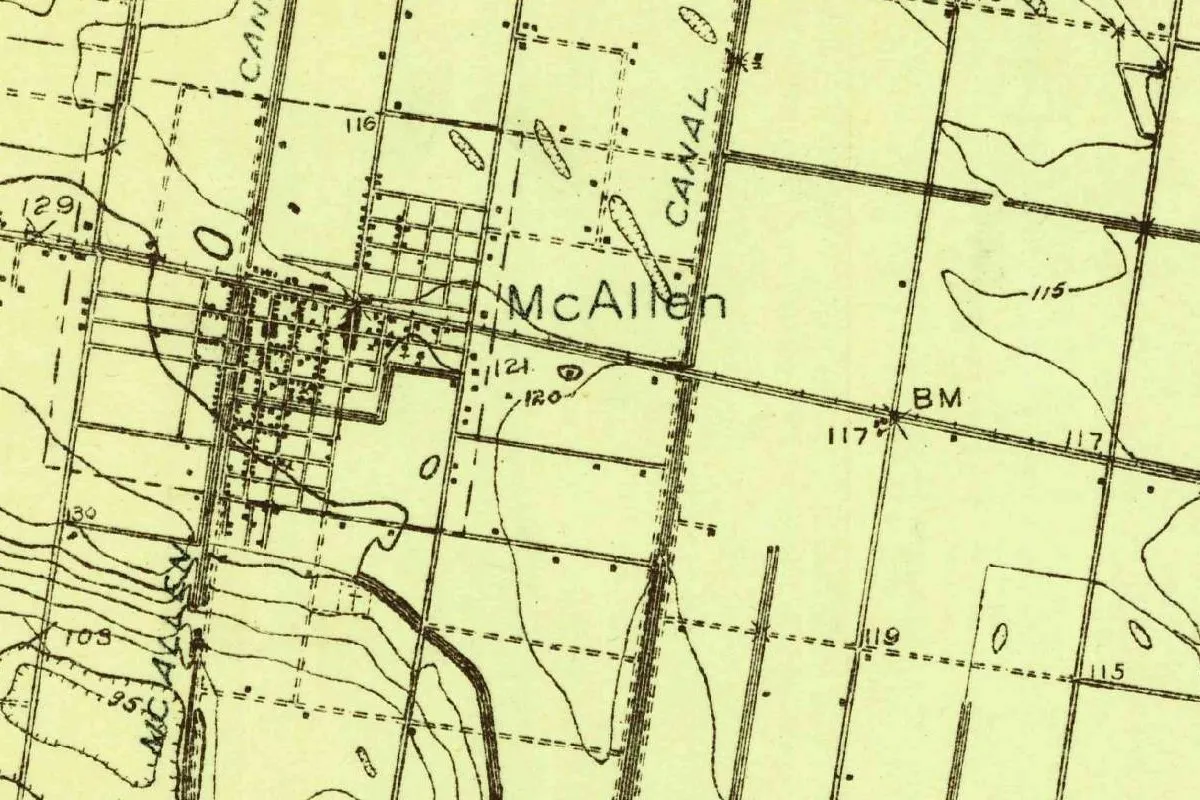
You can still see that early layout on the 1914 federal survey map: the word McAllen printed next to a small grid of streets, with canals running past it. The city that grew from there took the nickname “City of Palms” by 1940, but it kept the family’s name.
Quick answers
Who was McAllen, Texas, named after?
There are two answers in print. The Handbook of Texas says John McAllen, the rancher who gave land for the railroad in 1904; Louis J. Wortham’s 1924 history says his son, James B. McAllen.
When was McAllen, Texas, founded?
It depends on which town you count. The McAllen Townsite Company was formed on December 5, 1904, after the railroad arrived; the rival town that became East McAllen was started on May 16, 1907, and Wortham dates McAllen’s founding to June 1907.
Was East McAllen a different town?
Yes, at first. It was a separate town started two miles (3 km) east in 1907, and by 1911 the Handbook says West McAllen had ceased to exist and the town was incorporated as McAllen.
Key dates
- 1861John McAllen marries Salomé Ballí de Young, heir to the Santa Anita Ranch; their son, James Ballí McAllen, is born in 1862.
- 1904August 20: the railroad reaches the Santa Anita Ranch. December 5: the McAllen Townsite Company is formed.
- 1907A post office named McAllen opens, and on May 16 rival developers start a town two miles (3 km) east that comes to be known as East McAllen.
- 1911The town gets a charter of incorporation under the name McAllen, according to the Handbook of Texas.
- 1924Louis J. Wortham's history of Texas says the town was named for James B. McAllen.
Getting there
Open McAllen in Google Maps
Opens in a new tab. The pin is the center of McAllen in the USGS place-name record.
The closest airports, Amtrak stations and intercity bus stops, measured in a straight line from the center of McAllen.
Airports
- McAllen International (MFE) 2 mi 3 km
- Valley International (HRL) Harlingen 36 mi 57 km
Intercity buses
- Greyhound McAllen Bus Station under 1 mi 0.6 km
Distances are as the crow flies, not by road. We don't list schedules or fares because they change; check with the airline, Amtrak or the bus company before you go. Official data (FAA commercial service airports (2025), FAA airport locations, Amtrak stations and Intercity Bus Atlas) from the FAA and the U.S. Bureau of Transportation Statistics, checked Nov 13, 2026.
Sponsored
Staying in McAllen?
Compare hotels in McAllen, Texas, on Expedia.
See hotels in McAllenWe may earn a commission if you buy through this link. It never changes what we write. Read our affiliate disclosure
Historical Sources & References
- Alicia A. Garza, “McAllen, TX,” Handbook of Texas Online. The Santa Anita Ranch, Salomé Ballí and John Young, John McAllen’s marriage in 1861 and James Ballí McAllen’s birth in 1862, the railroad on August 20, 1904, the land donation, the townsite company of December 5, 1904, “named for John McAllen,” the 1907 post office, East McAllen (May 16, 1907), the 1911 charter and the “City of Palms” nickname.
- Margaret H. McAllen and Mary Margaret McAllen, “McAllen Ranch,” Handbook of Texas Online. John McAllen’s birth in Londonderry, Ireland, in 1826, his arrival in Matamoros in 1849 and his work as a clerk in John Young’s Brownsville store.
- Louis J. Wortham, A History of Texas: From Wilderness to Commonwealth, vol. 5 (1924), p. 294. McAllen “founded in June, 1907, by William Briggs” and “named for James B. McAllen,” incorporated April 1, 1910.
- Advisory Council on Historic Preservation, “McAllen, Texas”. The 1904 townsite, the rival East McAllen of 1907, the two groups joining forces and incorporation in 1911.
- GNIS feature 1374829 (U.S. Geological Survey). McAllen’s place-name entry in Hidalgo County, whose history note reads “Founded in 1904 and incorporated in 1911.”
- U.S. Geological Survey, San Juan sheet (1:48,000), 1914. The 1914 survey of the San Juan quadrangle, where McAllen is a small grid of streets between two canals.
Spot something wrong, or know more? Tell us here. You can also email us or use our contact page. Corrections are noted here with their date, never made silently.