Shamrock, Texas: A Lucky Irish Name With Two Stories
Shamrock, Texas, has an Irish name in the eastern Texas Panhandle, and there are two stories about how it got there. The Handbook of Texas says an Irish sheep rancher named George Nickel suggested it in 1890, “for good luck and courage,” when he applied for a post office. The 1940 WPA guide to Texas tells a different story and lists Shamrock among the town names left behind by a ranch of British aristocrats.
George Nickel’s post office
The Handbook of Texas entry, written by Hugh Allen Anderson, gives the most detailed account:
“The name Shamrock was first suggested, for good luck and courage, by Irish immigrant sheep rancher George Nickel, when he applied in 1890 to open a post office at his dugout home six miles north of the present townsite.”
Federal postal officials accepted the name, the entry says, but Nickel’s office never opened, probably because his home burned that same year. A postmistress named Mary R. Jones ran another office nearby for a while.
So the name existed on paper for a dozen years before there was a town to put it on. That came with the Chicago, Rock Island and Gulf Railway in the summer of 1902. In August, lots were sold at the present townsite, which was then called Wheeler. When a storekeeper named Frank Exum applied for a post office and named it after himself, the Handbook says, the Shamrock office was closed. Then the railroad picked the old name for its stop in 1903, and the Shamrock post office reopened.
That’s a lot of back and forth, and the Handbook doesn’t untangle every step. What’s clear is that Shamrock, Wheeler and Exum all had a shot at the name, and the railroad’s choice settled it.
The Rocking Chair Ranch version
The WPA writers saw it differently. In its tour south from Shamrock along US 83, the 1940 guide tells the story of the Rocking Chair Ranch. In 1883, it says, a group of British noblemen led by the Baron of Tweedmouth and the Earl of Aberdeen bought 235 sections of land here and stocked it with about 15,000 cattle. Texas cowboys nicknamed it the Nobility Ranch. The venture failed, and the owners went home:
“Disgusted, they returned to England, leaving monuments to their memory in the town names of Tweedy, Shamrock, Wellington, Clarendon, and Aberdeen.”
If you’re wondering how a ranch run by British lords ended up with an Irish name, or who in the group chose it, the guide doesn’t say. It just puts Shamrock on the list. The Handbook’s version is more specific, with a person, a year and a reason, but we couldn’t find the 1890 application itself. That’s why we call the origin disputed: the two oldest accounts we could read don’t agree on who brought the name to the Panhandle.
A town on Route 66
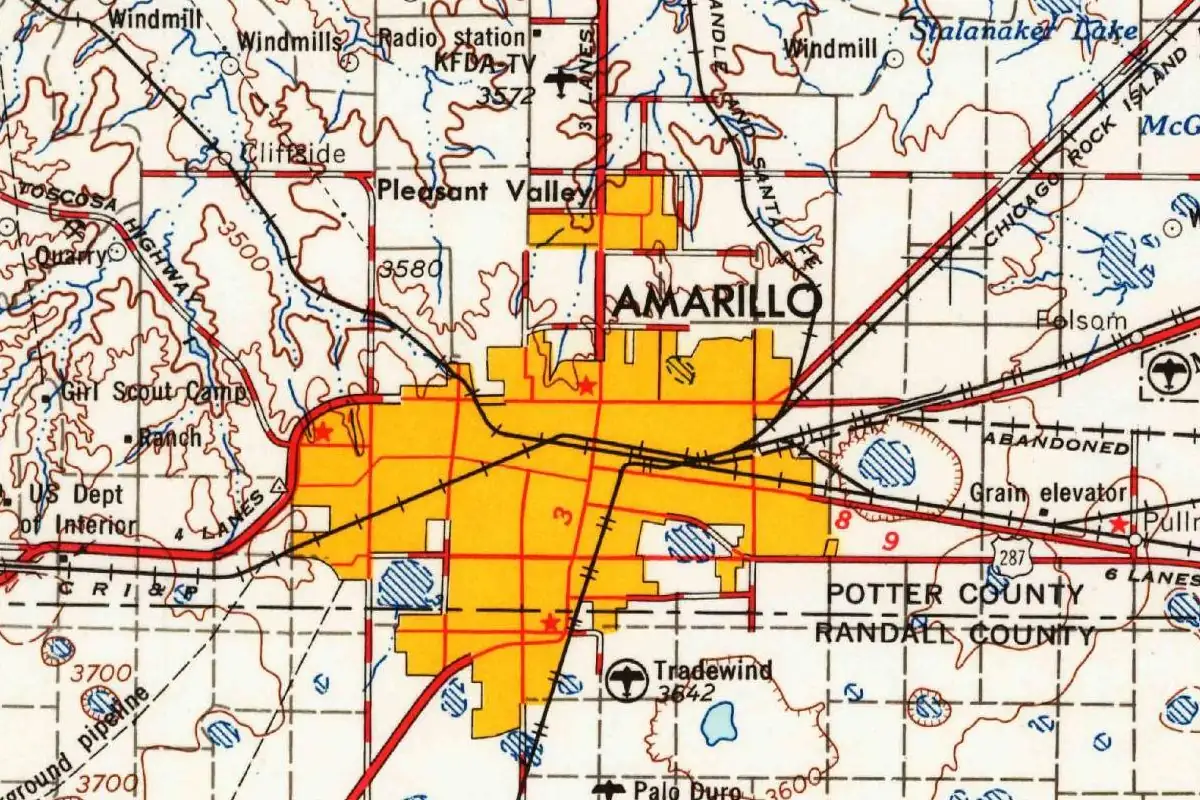
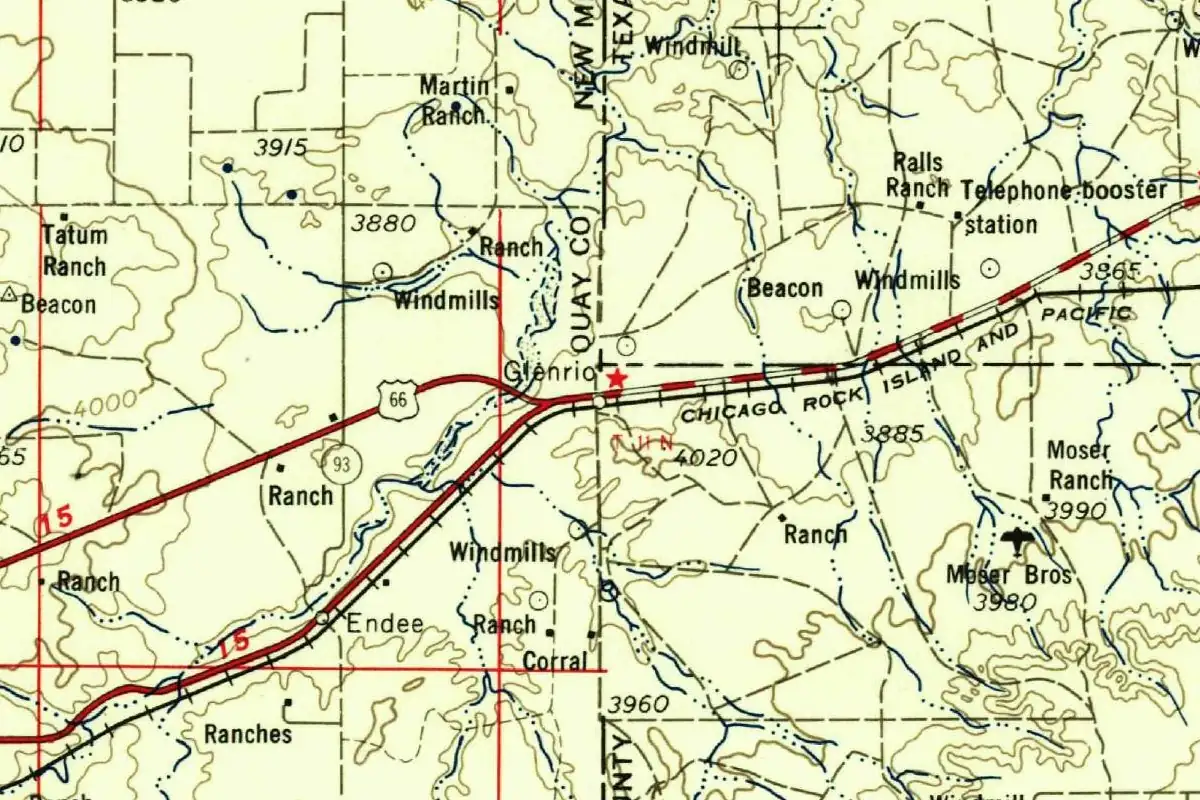
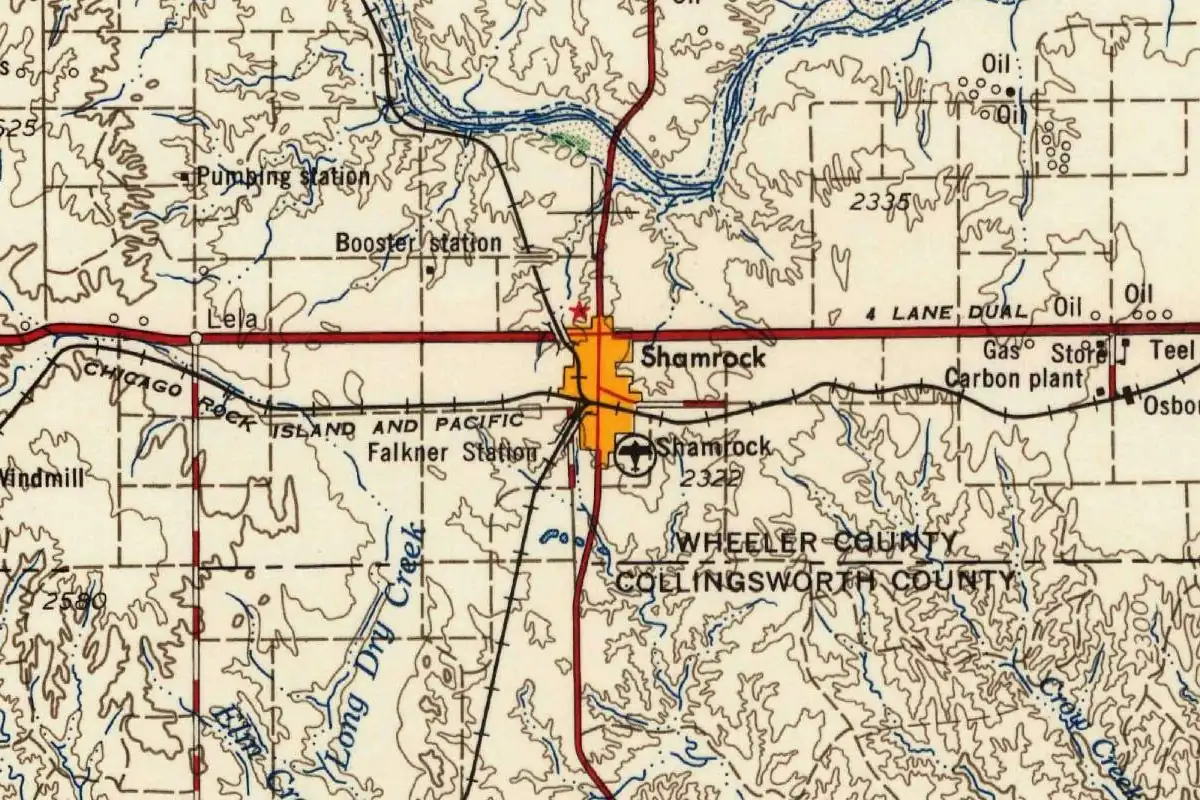
Shamrock grew with oil and gas after 1926, the Handbook says, and with the highway. When US 66 was improved, Shamrock’s main avenue filled with “garages, filling stations, restaurants, and tourist courts.” On the 1958 Geological Survey map at the top of this page, the road through town is marked “4 Lane Dual.”
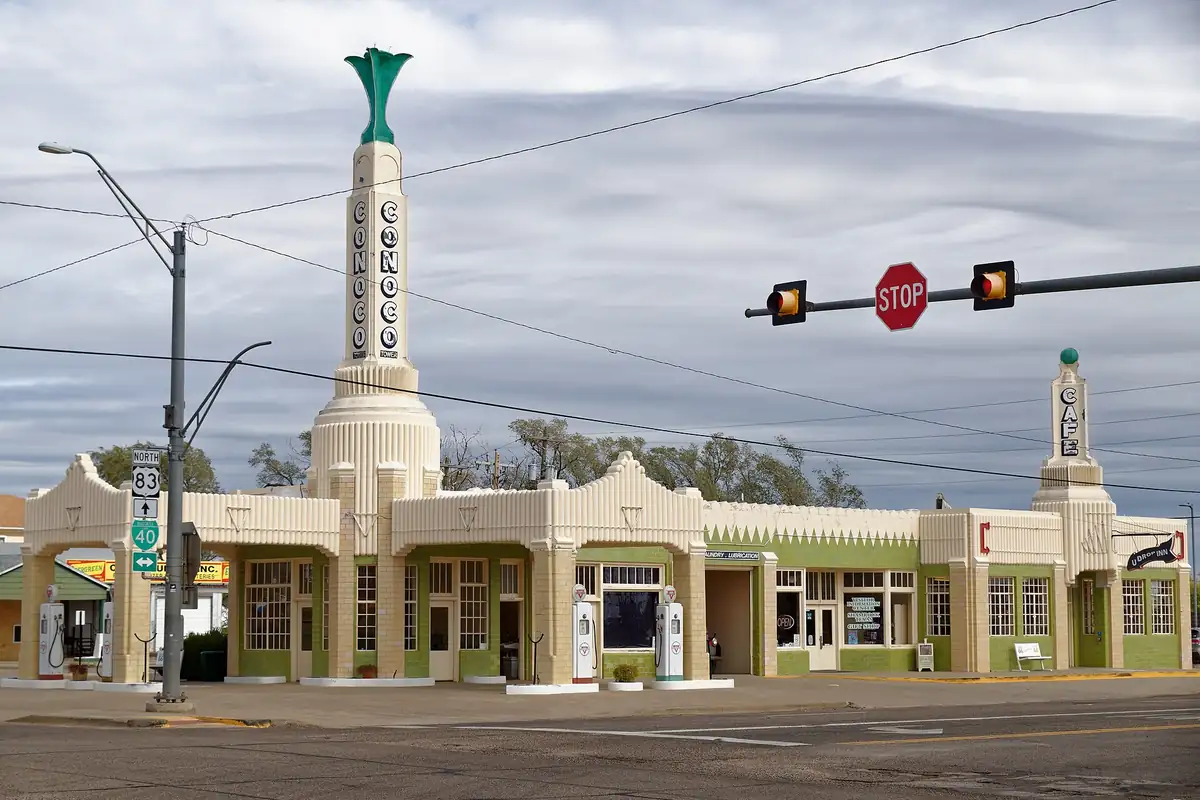
The building you’ll want to stop for is the Tower Station and U-Drop Inn Cafe. The National Park Service says J. M. Tindall and R. C. Lewis built it in 1936 for $23,000, after John Nunn drew the idea in the dirt with an old nail. The tower still spells out C-O-N-O-C-O, and the cafe got its name from a local schoolboy’s winning entry in a naming contest. The Park Service calls it the first commercial business on the newly designated Route 66 in Shamrock. Today the city owns it and runs it as a visitor center.
The town leans into the name, too. Since 1938, the Handbook says, Shamrock has held a St. Patrick’s Day celebration on the weekend nearest March 17, and a fragment of the Blarney Stone is mounted on a pillar in Elmore Park. It’s one of the Texas towns in our Route 66 towns collection, east of Amarillo on the old road.
Quick answers
Why is Shamrock, Texas, called Shamrock?
The Handbook of Texas says George Nickel, an Irish immigrant sheep rancher, suggested the name in 1890 “for good luck and courage” when he applied for a post office. The 1940 WPA guide instead lists Shamrock among names left by the British owners of the Rocking Chair Ranch.
Who named Shamrock, Texas?
It’s disputed. The Handbook credits George Nickel in 1890. The WPA guide credits the Rocking Chair Ranch’s British owners. The railroad gave its stop the name in 1903.
What was Shamrock, Texas, called before?
When lots were first sold in August 1902, the townsite was called Wheeler, according to the Handbook of Texas. The railroad named the stop Shamrock in 1903.
What is the U-Drop Inn in Shamrock?
An Art Deco service station and cafe built on Route 66 in 1936. The National Park Service says the U-Drop Inn name came from a schoolboy’s winning entry in a contest, and the building is now a visitor center.
Key dates
- 1883A group of British noblemen buys land in the eastern Panhandle for the Rocking Chair Ranch, the WPA guide says.
- 1890George Nickel applies for a post office called Shamrock at his dugout home. His house burns the same year.
- 1902Summer: The Chicago, Rock Island and Gulf Railway arrives. In August, lots are sold at a townsite then called Wheeler.
- 1903The railroad names its stop Shamrock, and the Shamrock post office reopens.
- 1911Shamrock is incorporated, with E. L. Woodley as its first mayor.
- 1936The Tower Station and U-Drop Inn Cafe opens on Route 66.
Getting there
Open Shamrock in Google Maps
Opens in a new tab. The pin is the center of Shamrock in the USGS place-name record.
The closest airports, Amtrak stations and intercity bus stops, measured in a straight line from the center of Shamrock.
Airports
- Rick Husband Amarillo International (AMA) 82 mi 132 km
- Lawton-Fort Sill Regional (LAW) 113 mi 182 km
Distances are as the crow flies, not by road. We don't list schedules or fares because they change; check with the airline, Amtrak or the bus company before you go. Official data (FAA commercial service airports (2025), FAA airport locations, Amtrak stations and Intercity Bus Atlas) from the FAA and the U.S. Bureau of Transportation Statistics, checked Nov 10, 2026.
Sponsored
Staying in Shamrock?
Compare hotels in Shamrock, Texas, on Expedia.
See hotels in ShamrockWe may earn a commission if you buy through this link. It never changes what we write. Read our affiliate disclosure
Historical Sources & References
- Hugh Allen Anderson, “Shamrock, TX,” Handbook of Texas Online. George Nickel’s 1890 application (“for good luck and courage”), the burned dugout, Mary R. Jones, the railroad’s arrival in 1902, the Wheeler townsite, Frank Exum, the railroad’s choice of Shamrock in 1903, incorporation in 1911, the US 66 boom, the St. Patrick’s Day celebration since 1938 and the Blarney Stone fragment.
- Writers’ Program, Texas: A Guide to the Lone Star State (1940). p. 499 (Tour 16): the Rocking Chair Ranch, bought in 1883, and its owners “leaving monuments to their memory in the town names of Tweedy, Shamrock, Wellington, Clarendon, and Aberdeen.” pp. 490-491 (Tour 14): Shamrock on US 66.
- National Park Service, “Texas: Tower Station and U-Drop Inn Cafe”. Built in 1936 by J. M. Tindall and R. C. Lewis for $23,000; John Nunn’s drawing; the schoolboy’s name; the first commercial business on the newly designated Route 66 in Shamrock; now a visitor center.
- National Park Service, “Route 66: Texas”. The City of Shamrock’s restoration of the Tower Station and U-Drop Inn.
- U.S. Geological Survey, Amarillo sheet (1958). The map at the top of this page.
- GNIS feature 1368050, Shamrock (U.S. Geological Survey). The official name, county and coordinates of the town.
Sponsored
Gear up for your next road trip
Explore rooftop tents, vehicle awnings and outdoor gear from TOPOAK Overland.
Shop TOPOAK overlanding gearWe may earn a commission if you buy through this link. It never changes what we write. Read our affiliate disclosure
Spot something wrong, or know more? Tell us here. You can also email us or use our contact page. Corrections are noted here with their date, never made silently.