What Does Havasu Mean? Lake Havasu City's 1939 Name
Lake Havasu City carries the name of Lake Havasu, the reservoir that Parker Dam created. In June 1939 the federal Board on Geographical Names picked Havasu Lake, the Metropolitan Water District's second choice after Lake Mathews, and noted that Havasu is a Mohave word meaning "blue." Robert McCulloch's planned city on its shore began in 1963.
Lake Havasu City, Arizona, carries a name for its reservoir that a water district proposed only as a backup and a federal board approved in June 1939. The board’s decision explained the name in one line: Havasu, it said, is a Mohave word meaning “blue.”
What does Havasu mean?
The lake came first. Parker Dam was going up on the Colorado River in the late 1930s, and the Metropolitan Water District of Southern California, whose aqueduct would draw from the new reservoir, wanted a say in what to call it. Its board’s first wish was Lake Mathews, after W. B. Mathews, a man the district credited with drafting much of the Boulder Canyon Project Act.
On September 10, 1938, Commissioner of Reclamation John C. Page wrote back to the district’s chairman, W. P. Whitsett, with a frank tour of the competition. Needles, California, had petitioned to have the lake named for itself. Arizona’s whole delegation in Congress wanted Lake Parker. Senator Ashurst floated Lake Chemehuevi as a compromise, and Senator Hayden suggested Lake Anson Smith, after the late editor of the Mohave County Miner in Kingman. Page doubted the Mathews name could win general support, and he explained how the federal naming board worked:
“It is not a christening agency. Its work principally is selecting the name for official usage when a single feature is known by a variety of names.”
The board, he added, liked older, simpler, more descriptive names “with color.” Five months later the district came back with a fallback. On February 10, 1939, its directors wrote that if Lake Mathews couldn’t win, they’d like Lake Havasu, and that “Havasu is the Mojave Indian word for blue.” The Mojave people had always known the Colorado as a muddy river, the letter said, and when the first of them visited the dam and saw clear water stored behind it, “they were amazed.” To many of them, it said, the reservoir was now the “Lake of the Blue Water.”
On June 2, 1939, Page sent Whitsett the decision of the Board on Geographical Names, word for word:
“Havasu Lake: an artificial lake, formed by the impounding of Colorado River by Parker Dam, and extending about 50 miles northwesterly in Yuma and Mohave Counties, Ariz. and in San Bernardino County, Calif. Havasu is a Mohave word which means ‘blue’.”
Page told Whitsett the name had seemed “the most generally acceptable and appropriate of those proposed.” Whitsett’s reply of June 15 is a gracious loser’s note: since Lake Mathews hadn’t been chosen, the directors regarded Havasu Lake “as the best second choice.” You’ll notice the two spellings, too. The district wrote Mojave; the board’s decision wrote Mohave, the spelling the county still uses.
A later government history tells it differently. In a 1997 history of the Parker-Davis Project for the Bureau of Reclamation, Toni Rae Linenberger writes that on January 5, 1939, a Mojave man “said to be 102 years old” and his wife, 97, looked down at the new lake from the shore, struck by the clear blue water, and called it “Havasu,” which she renders as “blue water.” In her account the name was approved by the federal board on May 26, 1939.
The district’s February letter also mentions Mojave visitors amazed by the clear water, but it names no one and gives no ages. Linenberger’s history, for its part, doesn’t mention the district’s campaign for Mathews. If you want the paper trail, it’s the letters; if you want the scene on the riverbank, it’s her account, with its own “said to be.”
One word of caution about a name that sounds close. The Havasupai Tribe, whose official website gives its home as Supai, Arizona, calls itself the “People of the Blue Green Water” there. It’s a different nation, and none of our sources ties the lake’s name to it.
Lake Havasu City history
The city didn’t exist for another quarter century. According to the city’s tourism office, Robert McCulloch, whose company McCulloch Motors made outboard engines, was scouting from the air for a testing spot in 1963 when he decided the land on the Arizona shore could hold a city. On September 30, 1963, the Mohave County Board of Supervisors created the Lake Havasu Irrigation and Drainage District, which the tourism office calls the moment Lake Havasu City became a legal entity. The county calls it a planned community, built to stand on its own, that McCulloch founded that year.
McCulloch teamed up with C. V. Wood, who had designed Disneyland, and in four years the partners put together 16,520 acres (6,685 ha) for lease. With only one rough road into town, McCulloch flew buyers in instead: between 1964 and 1978, the tourism office counts 2,702 flights carrying 137,000 prospects, mostly from colder places. The last parcel sold in 1978, and the city incorporated that same year.
None of our sources records how the city’s name was chosen. The irrigation district of 1963 already had the lake’s name in it. And the man Senator Hayden wanted on the lake, Anson Smith, had edited the paper up the road in Kingman, another Mohave County town.
The same thing happened in Missouri a generation earlier. When the Lake of the Ozarks filled behind Bagnell Dam, the first postmaster of a new town beside it, Frank Andrews, gave the post office the name Lake Ozark in 1932. In California’s San Bernardino Mountains, Big Bear Lake also sits on a reservoir, created by a dam built in 1884, though the name itself comes from grizzly bears a party came upon there in 1845.
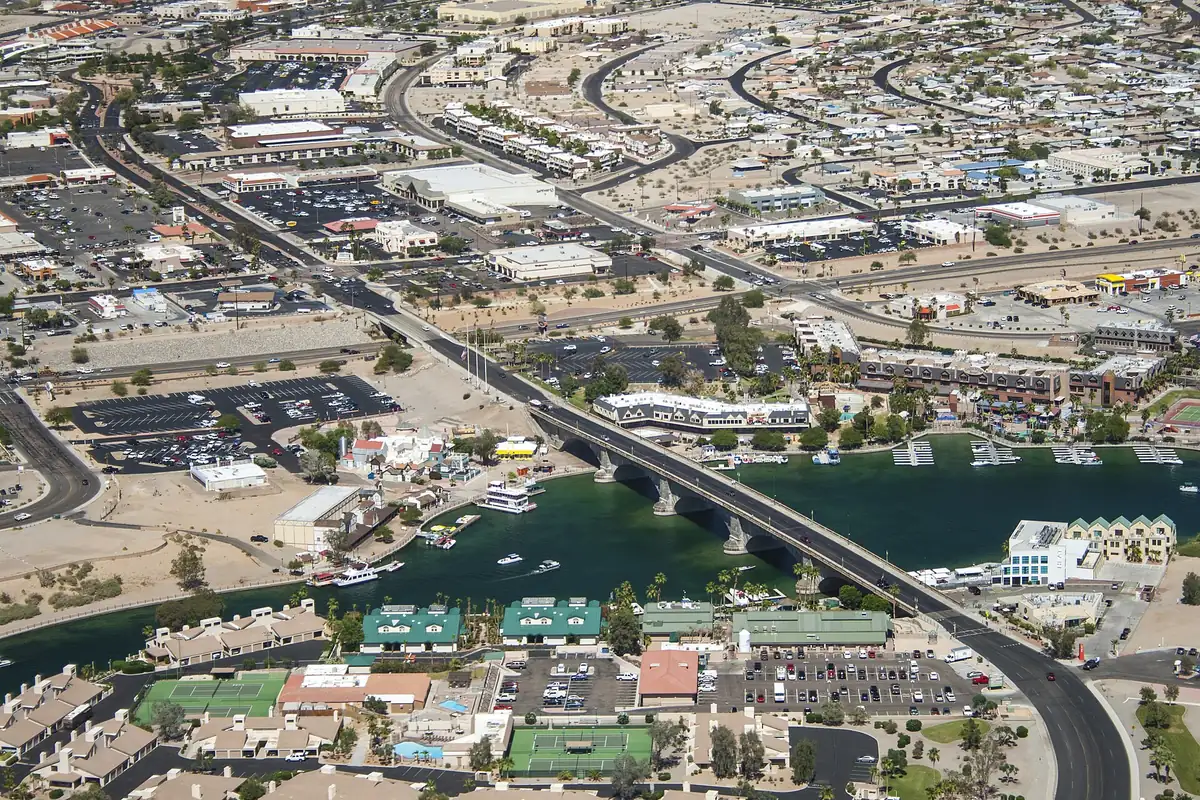
London Bridge Lake Havasu history
The London Bridge that John Rennie designed, dedicated in 1831, had been sinking under automobile traffic, and in 1967 the City of London put it up for sale. McCulloch’s bid won on April 18, 1968: $2.4 million, a figure the tourism office says he got by taking twice what experts estimated it would cost to dismantle the bridge and adding $60,000, or $1,000 for each year he had lived. The county gives the price as $2,460,000.
The outer granite blocks were numbered, shipped through the Panama Canal, trucked from Long Beach and rebuilt over a steel frame. Then the dry land under the bridge was dredged out to make Bridgewater Channel. The bridge was dedicated on October 10, 1971. And no, he didn’t think he was buying Tower Bridge. The tourism office calls that a popular belief, not a fact.
So the bridge is the city’s famous postcard, but it isn’t the reason for the name. That goes back to a backup suggestion in a 1939 letter and a federal board that liked short names with color in them.
Lake Havasu City on the 1970 map
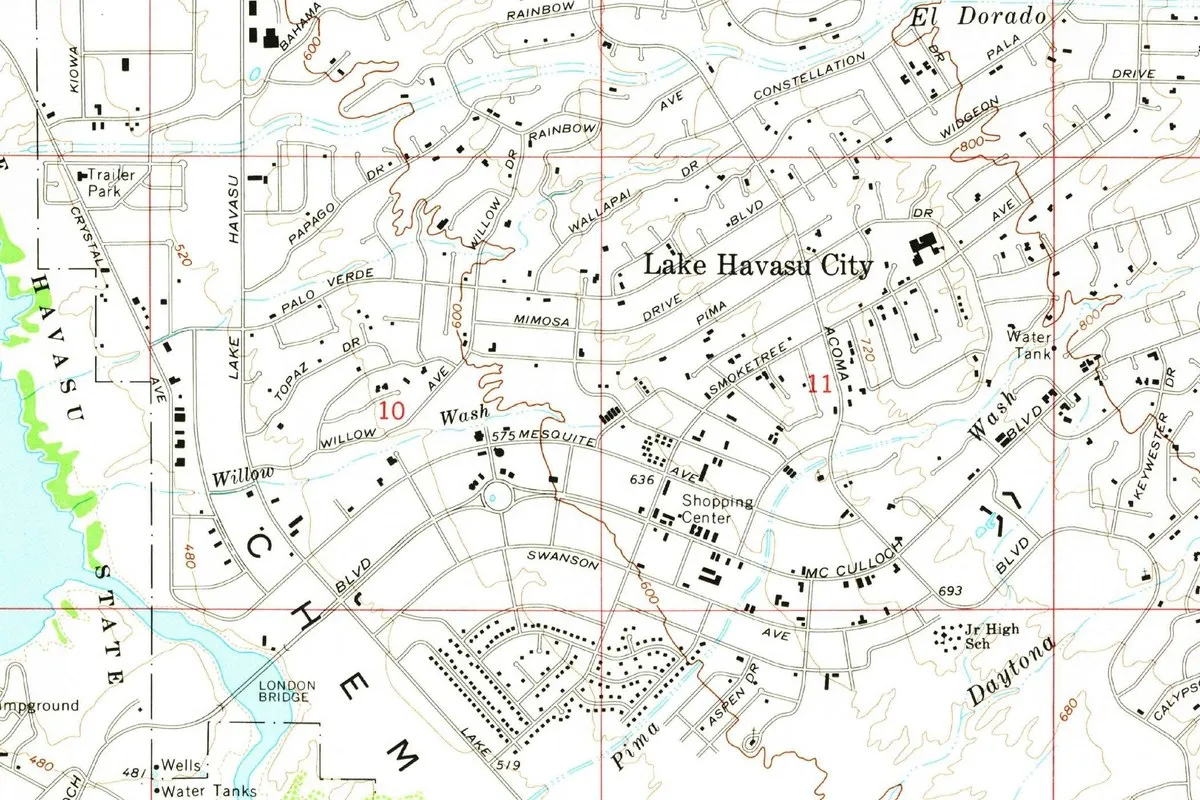
The oldest Geological Survey sheets for this spot, from 1911, predate Parker Dam. The first one we found that names Lake Havasu City is the Lake Havasu City South quadrangle of 1970, mapped from aerial photographs taken in 1969 and 1970 and field checked in 1970. Our copy carries a Government Printing Office line dated 1973. In the crop at the top of this page you can see the city’s label among streets like Mesquite, Smoketree and McCulloch, and on the left edge the words LONDON BRIDGE where a road crosses the water.
Quick answers
Is Lake Havasu City, Arizona, named after the lake?
It carries the lake’s name. The reservoir was named Havasu Lake in 1939, and the city’s first legal form in 1963 was already the Lake Havasu Irrigation and Drainage District. None of our sources says who chose the name for the city.
Is Havasu in Lake Havasu City, Arizona, the same word as Havasupai?
Our sources don’t connect them. The 1939 decision calls Havasu a Mohave word for “blue.” The Havasupai are a separate nation who call themselves the “People of the Blue Green Water.”
When was Lake Havasu City, Arizona, founded?
On September 30, 1963, when Mohave County created the irrigation and drainage district that the tourism office calls the city’s start as a legal entity. It incorporated as a city in 1978.
Key dates
- 1938The Metropolitan Water District asks to name the Parker Dam reservoir Lake Mathews; in September the reclamation commissioner sends rival names.
- 1939The district offers Lake Havasu as its alternative in February, and on June 2 the commissioner announces the federal decision: Havasu Lake.
- 1963Mohave County supervisors create the Lake Havasu Irrigation and Drainage District on September 30, the city's first legal form.
- 1968Robert McCulloch's bid for London Bridge wins on April 18.
- 1970The Geological Survey's Lake Havasu City South sheet puts the city's name on a topographic map.
- 1971The rebuilt London Bridge is dedicated on October 10.
- 1978The last parcel of land is sold and the city incorporates.
Things to do in Lake Havasu City, Arizona
London Bridge
The granite-faced bridge that once crossed the Thames, rebuilt over a steel frame here after McCulloch bought it in 1968. If you look closely, you can still see the numbers on many of the stones, marked for reassembly when the bridge was taken apart in England.
Lake Havasu Museum of History
A museum running since 2005, grown out of collections that early residents kept in garages and storage units, from McCulloch chainsaws to McCulloch Airlines cutlery and a record celebrating the bridge.
Lake Havasu State Park
A state park on the shore near the bridge, with boat ramps, campsites, beachside cabins and the Mohave Sunset Trail, about 1.75 miles (2.8 km) through low desert and along the water to the Arroyo-Camino Interpretive Garden.
Crack in the Wall Trail, SARA Park
A 5-mile (8 km) round-trip hike in the city's SARA Park that squeezes through a slot canyon and ends at a cove on the lake beside Balance Rock, a big mass of stone perched on a thin pillar.
Lake Havasu lighthouses
Twenty-eight scaled-down copies of famous American lighthouses that work as real navigation aids, built and kept up by the Lake Havasu Lighthouse Club. Some can be reached on foot; others only by boat.
Havasu National Wildlife Refuge
A federal refuge on the Colorado River north of the lake, where boaters, canoeists and kayakers can head into Topock Gorge and look for coyotes, jackrabbits and birds.
Getting there
Open Lake Havasu City in Google Maps
Opens in a new tab. The pin is the center of Lake Havasu City in the USGS place-name record.
The closest airports, Amtrak stations and intercity bus stops, measured in a straight line from the center of Lake Havasu City.
Airports
- Laughlin/Bullhead International (IFP) Bullhead City 48 mi 78 km
- Boulder City Municipal (BVU) 106 mi 170 km
- Harry Reid International (LAS) Las Vegas 120 mi 193 km
Amtrak trains
- Needles station (NDL) 29 mi 47 km
- Kingman station (KNG) 51 mi 82 km
Intercity buses
- Vegas Airporter Amtrak Connecting Service · Laughlin Amtrak Bus Stop 49 mi 79 km
- FlixBus Kingman S 51 mi 82 km
- Greyhound Kingman, AZ 54 mi 87 km
Distances are as the crow flies, not by road. We don't list schedules or fares because they change; check with the airline, Amtrak or the bus company before you go. Official data (FAA commercial service airports (2025), FAA airport locations, Amtrak stations and Intercity Bus Atlas) from the FAA and the U.S. Bureau of Transportation Statistics, checked Nov 21, 2026.
Sponsored
Staying in Lake Havasu City?
Compare hotels in Lake Havasu City, Arizona, on Expedia.
See hotels in Lake Havasu CityWe may earn a commission if you buy through this link. It never changes what we write. Read our affiliate disclosure
Historical Sources & References
- Metropolitan Water District of Southern California, Board of Directors records, June 1939. Page’s letter of June 2, 1939, with the board’s decision and the Mohave word for “blue” (p. 3); Whitsett’s “best second choice” (pp. 1-2); the district’s February 10, 1939, proposal of Lake Havasu (pp. 7-8); Page’s September 10, 1938, letter on the rival names and the naming board (pp. 11-12); and the district’s letter on W. B. Mathews and the Boulder Canyon Project Act (pp. 21-22).
- Toni Rae Linenberger, Parker-Davis Project (Bureau of Reclamation, 1997), pp. 17-18. The January 5, 1939, account of the Mojave elder and his wife, “blue water,” and the May 26, 1939, approval.
- Go Lake Havasu, “Lake Havasu City History” and “London Bridge”. McCulloch’s 1963 flight, the 1963 district, the land-buyer flights, the 1978 incorporation, the 1968 bid and the 1971 dedication.
- Mohave County, “Live in Our Communities”. The planned community of 1963, the bridge price and the 1978 incorporation.
- Havasupai Tribe, official website. “People of the Blue Green Water.”
- U.S. Geological Survey, GNIS feature 6840. Lake Havasu City in Mohave County.
- Lake Havasu City South quadrangle, 1970. The sheet the map at the top was cropped from.
Spot something wrong, or know more? Tell us here. You can also email us or use our contact page. Corrections are noted here with their date, never made silently.