Pike Place Market: Name, History and Visiting
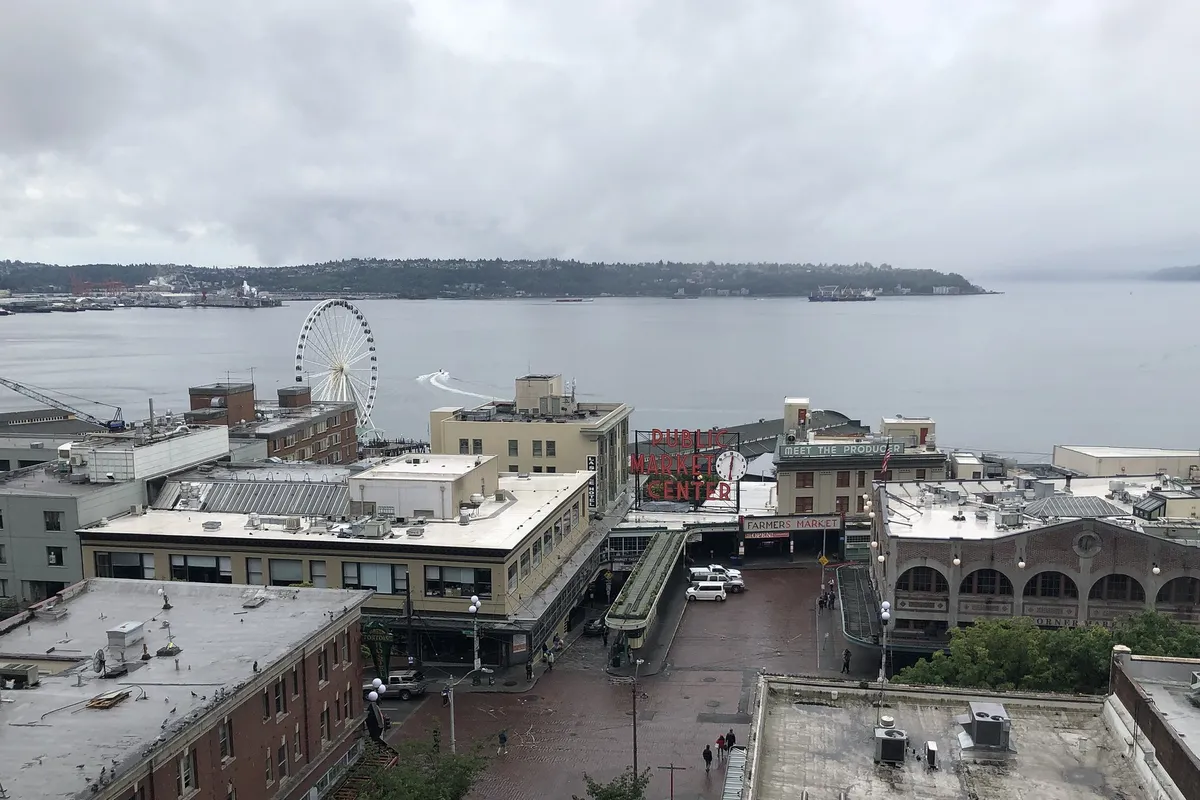
Pike Place Market is named for the street it opened on in 1907, and that street’s name goes back to John Henry Pike, the builder of Seattle’s first university. So the “Pike” in it isn’t a fishmonger, a founder or the explorer Zebulon Pike of Pikes Peak. It’s a carpenter who helped put up a two-story school in 1861.
Pike Place Market History: A Street Became a Market
Start with the street. Pike Street first shows up on Arthur A. Denny’s plat of an addition to Seattle, which went on file April 5, 1869, says Benjamin Lukoff’s guide to Seattle street names, Writes of Way. Denny named it for John Henry Pike, who’s best remembered as the builder of the first Territorial University of Washington. The University of Washington’s architecture database lists “John Pike (building contractor)” among the people who built that university’s main building, which went up in 1861 and came down in 1910.
HistoryLink, Seattle’s online encyclopedia, fills in the family. John Henry Pike joined a wagon train west from Illinois in 1852, spent several years in Oregon and reached Seattle in 1858. The family later lived on the street “that now honors them with the name Pike Street,” it says, and John did carpentry at the university. His son Harvey was a painter there, and he’s the Pike who tried to dig a canal linking Lake Union with Lake Washington in the 1860s. The two sources give John’s birth year one year apart, 1814 and 1815, but they agree on 1903 as the year he died.
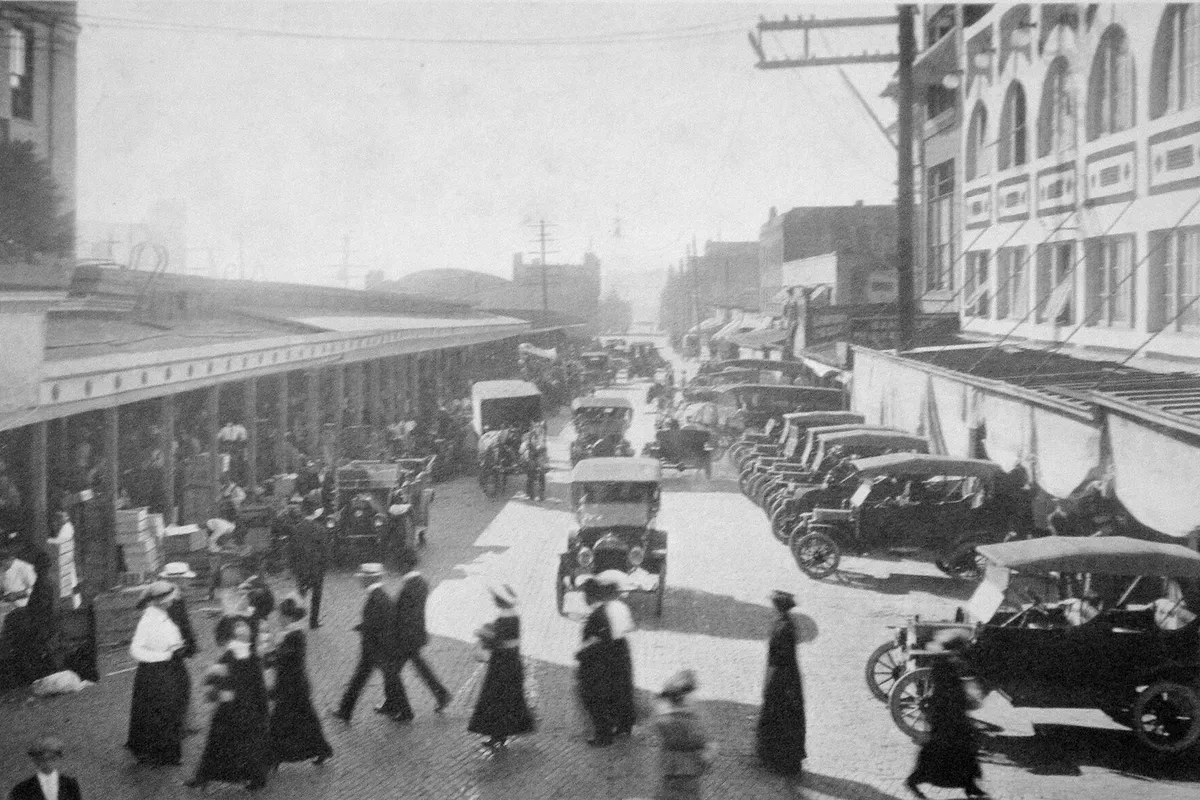
Pike Street begins at Pike Place, the street that’s home to the market, as Writes of Way puts it. When Seattle wanted a public market, Pike Place is where it put it. On August 5, 1907, the city passed Ordinance 16636, which set aside a portion of “Pike Place” for “the sale of garden, farm and other food products from wagons, or other similar vehicles,” in the words the Seattle Municipal Archives quotes. Council President Thomas Revelle had introduced it on July 29.
The reason was money. Food was expensive in town, and farmers were angry at the low prices the wholesale commission houses paid them. Walt Crowley’s history of the market for HistoryLink adds that Revelle found an older plan: the city council had authorized a public market back in 1896 and never built it.
The market opened on Saturday, August 17, 1907. Crowley writes that thousands of women came out in a summer rainstorm to a new plank roadway outside the Leland Hotel, where Pike Street meets 1st Avenue, and cleaned out the few farmers’ carts in no time. He calls the first day a “clamorous fiasco.” It didn’t stay one. Real estate developer Frank Goodwin, who owned the Leland, built a covered arcade that opened on November 30 of the same year.
Nobody had to invent a name. The ordinance put the market on Pike Place, and people called it after the street. Today the market’s public development authority holds trademark rights to “Pike Place Market,” so a street name from a pioneer carpenter’s family has become a registered brand.
The market came close to losing its people, and later its buildings. When the United States went to war in December 1941, Japanese American farmers ran maybe four out of every five stalls, Crowley writes. By April 1942 they had been forced from their homes and sent inland to what Crowley calls “concentration camps,” along with all the other Japanese Americans on the West Coast, and scores of stalls stood empty.
Then came the bulldozer plans. In the 1960s, downtown business leaders wanted to replace the old buildings with garages and offices. The Friends of the Market, a group organized by attorney Robert Ashley and architect Victor Steinbrueck, put an initiative on the ballot for a 7-acre (2.8-hectare) historic district. On November 2, 1971, voters picked it over a weaker city plan, 76,369 to 53,264.
Pike Place Fish Market: Why the Fish Didn’t Name the Market
Pike Place Fish, the stall where fishmongers toss a customer’s fish over the counter, is named for the market, not the other way around. The market’s own visitor page lists it among the four fish markets there and explains the throw: when someone buys a fish, it goes flying from the display out front to the fishmongers working behind the counter, who wrap it. The business says it’s “been at it since 1930,” which is 23 years after the market opened and more than six decades after Pike Street appeared on Denny’s plat.
Fish was part of the market well before that, though. The city’s Health Department ran a Municipal Fish Market there from 1917 to 1923, according to the Seattle Municipal Archives.
Visiting Pike Place Market
You don’t need a ticket. The market’s visitor page says there’s no entrance or admission fee, and you pay only for what you buy from the shops, restaurants, farmers and craftspeople. The market stretches across a 9-acre (3.6-hectare) historic district, bounded by 1st and Western avenues and running from Virginia Street to a little past Pike Street.
To follow the name, start where it started. The market’s information booth is on the corner of 1st and Pike, and Pike Street itself starts at Pike Place, where the Main Arcade stands beneath the clock sign reading Public Market Center. Crowley puts the farmers’ carts of the first morning on a plank roadway outside the Leland Hotel, in the same corner of town.
If you’ve come for the view as well, the Space Needle has a name story of its own, tied to the city’s space-themed 1962 World’s Fair. And Seattle itself has one older than any street: it’s named for Chief Seattle, whose name shows up as “See yat” in the Fort Nisqually journal of the 1830s, long before the city took it.
Quick answers
Why Is Pike Place Market Called Pike Place?
Because the city opened it on Pike Place. A 1907 ordinance set aside part of that street for farmers selling from wagons, and Pike Street, which Arthur Denny named for pioneer builder John Henry Pike, begins right there.
Was Pike Place Market Named After a Fish Seller?
No. Pike Street was on a city plat by 1869 and the market opened in 1907, while Pike Place Fish, the stall famous for throwing fish, says it’s been in business since 1930.
When Did Pike Place Market Open?
On August 17, 1907, twelve days after the city passed Ordinance 16636 to allow farmers to sell from wagons on Pike Place.
Do You Need Tickets to Visit Pike Place Market?
No. The market’s visitor page says there’s no entrance or admission fee; you only pay for what you buy.
Key dates
- 1869Pike Street appears on Arthur Denny's plat of an addition to Seattle, filed April 5.
- 1907Ordinance 16636 sets aside part of Pike Place for farmers' wagons on August 5, and the market opens August 17.
- 1930Pike Place Fish, the stall known for throwing fish, dates its business to this year.
- 1942Japanese American farmers, who held perhaps four-fifths of the stalls, are forced out by April.
- 1971Seattle voters approve the initiative that creates the Pike Place Market Historical District, on November 2.
Getting there
Open Pike Place Market in Google Maps
Opens in a new tab. The pin is an approximate point for Pike Place Market.
The closest airports, Amtrak stations and intercity bus stops, measured in a straight line from the center of Pike Place Market.
Airports
- Boeing Field/King County International (BFI) Seattle 6 mi 9 km
- Seattle-Tacoma International (SEA) 11 mi 18 km
Amtrak trains
- Seattle station (SEA) under 1 mi 1 km
- Tukwila station (TUK) 11 mi 18 km
Intercity buses
- Dungeness Line Travel Washington · Virginia Mason under 1 mi 1 km
- Northwestern Stage Lines Seattle (Amtrak) under 1 mi 1 km
- Amtrak Chartered Vehicle Amtrak Connecting Service · Seattle under 1 mi 1 km
Distances are as the crow flies, not by road. We don't list schedules or fares because they change; check with the airline, Amtrak or the bus company before you go. Official data (FAA commercial service airports (2025), FAA airport locations, Amtrak stations and Intercity Bus Atlas) from the FAA and the U.S. Bureau of Transportation Statistics, checked Nov 20, 2026.
Sponsored
Planning a visit?
Compare hotels near Pike Place Market on Expedia.
See hotels nearbyWe may earn a commission if you buy through this link. It never changes what we write. Read our affiliate disclosure
Historical Sources & References
- Seattle Municipal Archives, “Happy Birthday Pike Place Market” (2026): Ordinance 16636 of August 5, 1907, and its wording about “Pike Place” and wagons; Revelle’s introduction on July 29; the opening on August 17, 1907.
- Seattle Municipal Archives, “Pike Place Market Centennial”: the market “on the west side of Pike Place,” Frank Goodwin’s Leland Hotel “on the corner of Pike Street and Pike Place,” the Municipal Fish Market of 1917-1923 and Initiative 1 in 1971.
- Walt Crowley, “Pike Place Market (Seattle) – Thumbnail History,” HistoryLink.org: Pike Street “named for pioneer builder John Pike”; Revelle and the 1896 plan; the first day and the “clamorous fiasco”; Goodwin’s arcade; Japanese American farmers in 1941-1942; the 1971 vote, 76,369 to 53,264.
- Benjamin Lukoff, “Pike Street,” Writes of Way (2021): Pike Street on Arthur Denny’s plat filed April 5, 1869, named for John Henry Pike (1814-1903), builder of the Territorial University in 1861; Pike Street begins at Pike Place.
- HistoryLink.org Essay 3404, on Harvey Pike’s canal: John Henry Pike (1815-1903), the 1852 wagon train, Seattle in 1858, the family on the street “that now honors them,” John’s carpentry work at the university.
- Pacific Coast Architecture Database, “Territorial University of Washington, Main Building”: John Pike, building contractor; built 1861, demolished 1910.
- Pike Place Market PDA, “Market Visitor FAQ”: no admission fee; Pike Place Fish as one of four fish markets and how the fish throwing works; the information booth at 1st and Pike.
- Pike Place Market PDA, “Plan Your Visit”: the 9-acre district and its boundaries.
- Pike Place Market PDA, “History”: the PDA’s trademark on the market’s name.
- Pike Place Fish Market: the business’s own date, “since 1930.”
Spot something wrong, or know more? Tell us here. You can also email us or use our contact page. Corrections are noted here with their date, never made silently.