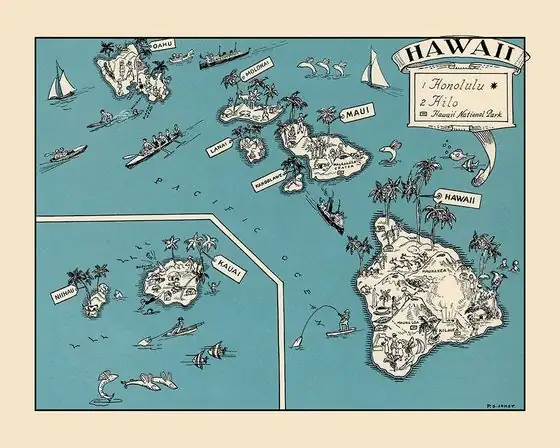
Honolulu Names: Waikiki, Diamond Head, Manoa and More
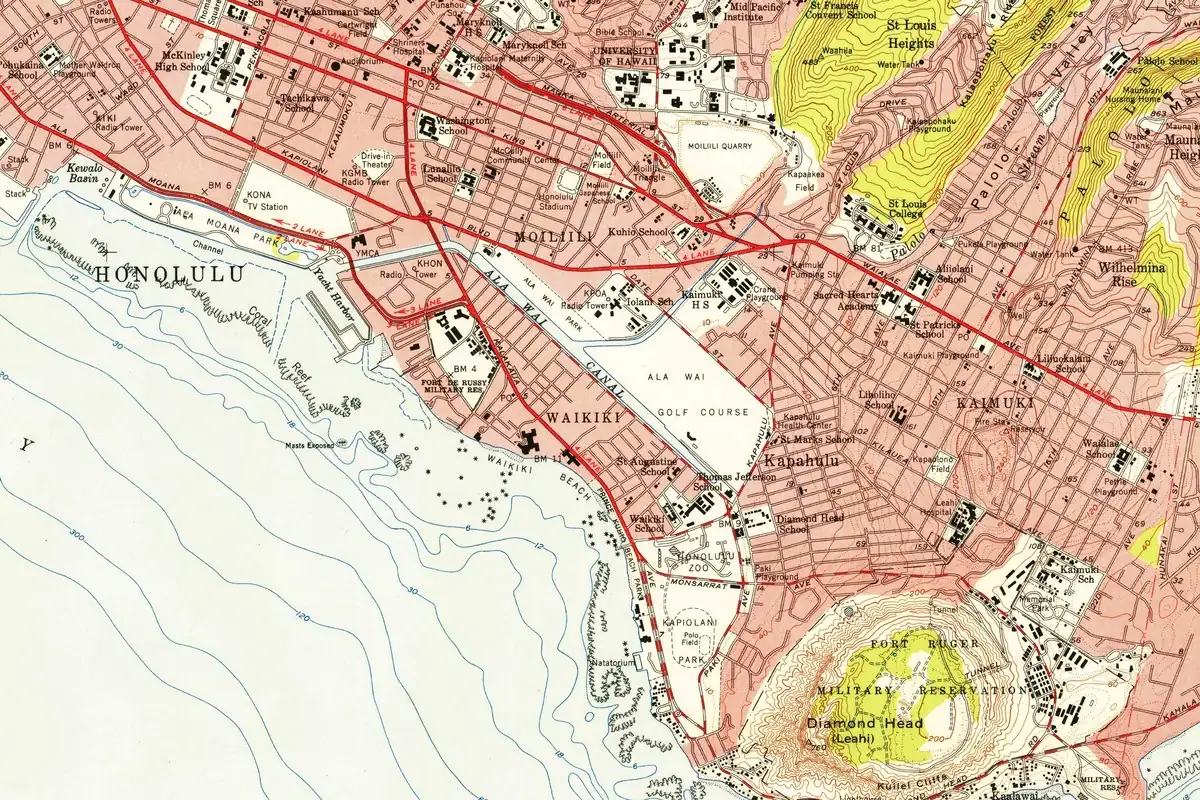
Most Honolulu place names are old Hawaiian names, plus a few English ones, like Diamond Head, named for crystals sailors mistook for diamonds. Waikiki, Manoa, Kaimuki and Moiliili are all Hawaiian names, and the old word lists give a translation for each one.
Planning a trip? Here’s where the names on your map came from. A word of warning first: translating Hawaiian place names is hard, and the experts who made the old lists said so themselves. So for each name we tell you who gave the translation and where, and when two lists disagree, we show you both.
Where Honolulu got its name
Honolulu is “quiet harbor or Fair Haven” in Alexander’s 1903 notes and “fair haven” in Thrum’s list of 1922. Our Honolulu page tells that story.
A note on the translations
W. D. Alexander, who compiled the names for the U.S. Coast and Geodetic Survey in 1903, opened his section on meanings with a warning: “It is very difficult, if not impossible, to translate most of these names, on account of their great antiquity and the changes which many of them have evidently undergone.” Thomas G. Thrum, whose list of place names was printed in the 1922 Hawaiian dictionary, wrote that “not a few definitions are given literally.” Keep that in mind as you read: these are the translations those men recorded, not the last word.
Landmarks
Diamond Head (Leahi)
Diamond Head got its English name from a mistake. The British ship Blonde was at Oahu in 1825, and the account of the voyage, published in 1826, explains it:
“Another of our excursions was to the Diamond Mountain, so called because some crystals found there had been mistaken by ignorant European sailors for diamonds, and therefore for a time the place had been tabooed.”
So the diamonds were never diamonds. The Hawaiian Annual for 1903, answering people who asked where the name Diamond Head came from, pointed to this same passage. Peter Corney, in his Voyages in the Northern Pacific, already called the crater “Diamond hill.” Its Hawaiian name is Leahi. Thrum’s 1922 list translates Leahi as “crest of the ahi fish,” and in the Hawaiian Annual that same year he wrote that the name “is said to have been originally ‘lae-ahi,’ the crest of the fish ahi,” which he preferred to “the mistakenly given one of ‘fire-wreath.’” The 1953 map at the top of this page prints both names: “Diamond Head (Leahi).”
Punchbowl (Puowaina)
Punchbowl’s Hawaiian name is Puowaina, and the old books link it to sacrifice. Alexander wrote in 1903 that Puowaina “is said by native pundits to be a contraction of puu-o-waiho-ana, ‘the hill of sacrifice.’” Thrum’s 1922 list gives “hill of sacrifice” too. W. D. Westervelt, in his 1915 Legends of Old Honolulu, called it a “hill of sacrifice” or “offering,” “and not ‘Wine-hill’ as many persons have said.” None of the books we read explains who first called the crater Punchbowl in English, or when.
Pearl Harbor
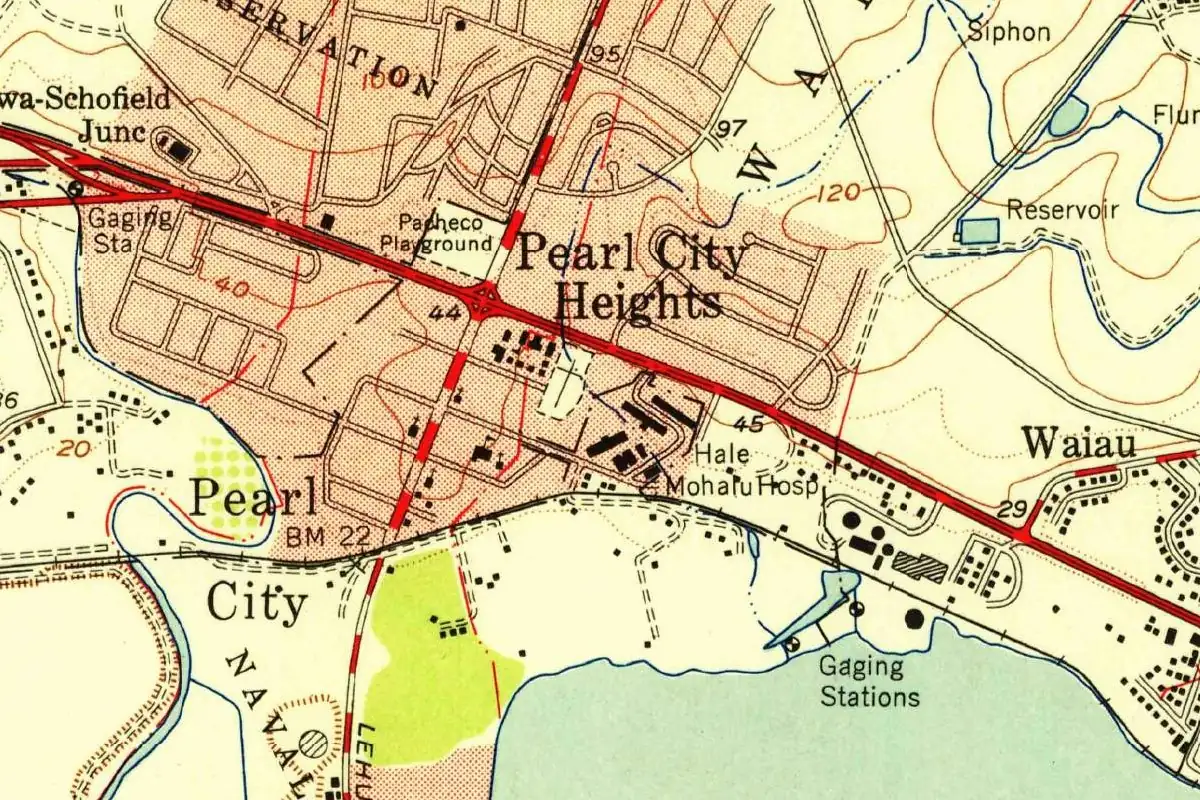
The old books tie Pearl Harbor’s name to pearl oysters. Peter Corney, who sailed to the islands in the days of Kamehameha I (about 1817, according to the 1903 Hawaiian Annual), called it “Wy Momi, or Pearl Water,” and wrote that “There are many divers employed here, diving for the pearl oysters, which are found in great plenty.” The Hawaiian Annual for 1903 says the harbor was more often called Pearl River in early days, “and took its name, evidently, from the existence there of pearl oysters at one time.” For the town next to the harbor, see our Pearl City page.
Koko Head
Koko Head has a short and blunt translation. Thrum’s 1922 list gives koko as “blood.”
Neighborhoods and valleys
Waikiki
Waikiki is translated “spurting water” in both of the big old lists, Alexander’s of 1903 and Thrum’s of 1922. In the 1826 account of the Blonde’s voyage it’s spelled the way the British heard it then: “the picturesque village of Waititi.”
Manoa
The lists don’t quite agree on what Manoa means, and Alexander doesn’t even agree with himself. His 1903 notes call it the “broad” valley, his glossary gives manoa as “thick, broad,” and the entry in his list says “thick, deep.” Thrum’s 1922 list says “thick, broad.”
Nuuanu
Alexander wrote that the name of Nuuanu Valley is made of nuu, “a step or terrace,” and anu, “cool.”
Kaimuki
Kaimuki, a hill and neighborhood in the city, has a name about cooking. Alexander translated it “the oven for ti root,” “where the saccharine root of the Cordyline terminalis was cooked for food.” His list also gives it an English name: Telegraph Hill. Thrum’s 1922 list gives the same “the oven for ti root.”
Moiliili
Moiliili is “the pebbly strip,” according to Alexander, who wrote it as Ka-moo-iliili. Thrum’s 1922 list says “pebbly or stony strip or ridge.”
Kalihi
Kalihi is the “outside edge,” Alexander wrote, “or boundary valley.” His list gives the Kalihi on Oahu as “border.”
Palolo
Palolo is the “clay” valley, according to Alexander.
Punahou
Punahou is “the new spring,” in Alexander’s notes and in Thrum’s list.
Kakaako, Kapahulu, Kewalo, Waialae, Moanalua and Hanauma
Thrum’s 1922 list gives a translation for each of these names: Kakaako, “prepare the thatching”; Kapahulu, “feather garment”; Kewalo, “outcry”; Waialae, “water of the mud hen”; Moanalua, “two encampments”; and Hanauma, the bay near Koko Head, “strength wrestling game.” As with the others, these are his translations, and he warned that not a few were given literally.
Downtown
Kou
Westervelt, in 1915, wrote of “Kou, the ancient Honolulu,” and placed Waikiki and Manoa Valley “beyond the boundaries of Kou and ancient Honolulu.” Alexander’s 1903 list also names the harbor “Honolulu Harbor or Kou.”
Fort Street
Fort Street is named for a fort. Westervelt wrote that the old Pakaka temple stood near the foot of Fort Street “long after the fort was built after which the street was named.”
Names we’re still checking
You might be wondering about Ala Moana, Kalakaua Avenue, Kapiolani Park, King Street, Beretania Street, the Ala Wai Canal, Aloha Tower and Thomas Square. We haven’t yet found an old source we can show you that explains how those names ended up on the map. Until we do, they stay off this page.
Quick answers
Why is it called Diamond Head?
Because of a mistake. The 1826 account of the voyage of H.M.S. Blonde says it was “so called because some crystals found there had been mistaken by ignorant European sailors for diamonds.”
What does Waikiki mean?
The old lists translate it “spurting water.” Both W. D. Alexander (1903) and Thomas G. Thrum (1922) give that meaning.
Why is it called Pearl Harbor?
Evidently for pearl oysters, says the 1903 Hawaiian Annual. Peter Corney called it “Wy Momi, or Pearl Water,” and saw divers there “diving for the pearl oysters.”
What does Manoa mean?
The old lists disagree a little. Alexander gives “broad,” “thick, broad” and “thick, deep,” and Thrum gives “thick, broad.”
Key dates
- 1817About this year, Peter Corney sees divers bringing up pearl oysters at "Wy Momi, or Pearl Water," today's Pearl Harbor.
- 1826The account of the voyage of H.M.S. Blonde explains the name "Diamond Mountain" for the crater now called Diamond Head.
- 1903W. D. Alexander publishes his list of Hawaiian geographic names for the U.S. Coast and Geodetic Survey, with translations.
- 1922Thomas G. Thrum's list of Hawaiian place names appears in the revised Hawaiian dictionary.
Sponsored
Planning a trip to Honolulu?
Compare hotels in Honolulu on Expedia.
See hotels in HonoluluWe may earn a commission if you buy through this link. It never changes what we write. Read our affiliate disclosure
Sponsored
Read up before your trip
Browse digital travel magazines on Magzter.
Browse travel magazinesWe may earn a commission if you buy through this link. It never changes what we write. Read our affiliate disclosure
Historical Sources & References
- Voyage of H.M.S. Blonde to the Sandwich Islands, in the Years 1824-1825 (1826). The “Diamond Mountain” and the crystals mistaken for diamonds (p. 144); “the picturesque village of Waititi” (p. 145).
- W. D. Alexander, Hawaiian Geographic Names (1903). The warning about translations, Honolulu as “quiet harbor or Fair Haven,” Puowaina, Nuuanu, Punahou and Manoa as the “broad” valley (p. 395); Palolo, Kaimuki, Kalihi and Moiliili (p. 396); manoa, “thick, broad,” in the glossary (p. 398); “Honolulu Harbor or Kou” (p. 403); Kaimuki or Telegraph Hill (p. 406); Kalihi, Oahu, “border” (p. 407); Manoa Valley, “thick, deep” (p. 416); Puowaina, “hill of sacrifice” (p. 422); Waikiki, “spurting water” (p. 424).
- Thomas G. Thrum, “Hawaiian Place Names,” in Andrews and Parker, A Dictionary of the Hawaiian Language (1922). “Not a few definitions are given literally” (p. 625); Hanauma (p. 631); Honolulu, “fair haven” (p. 633); Kaimuki and Kakaako (p. 639); Kapahulu (p. 644); Kewalo (p. 650); Koko Head (p. 652); Leahi (p. 656); Manoa and Moanalua (p. 659); Moiliili (p. 660); Puowaina and Punahou (p. 668); Waialae (p. 672); Waikiki (p. 673).
- Thomas G. Thrum, “Wrestling with Place Names,” Hawaiian Annual for 1922. Leahi as “lae-ahi,” not “fire-wreath” (p. 87).
- Hawaiian Almanac and Annual for 1903. Pearl River, named “evidently” for pearl oysters (p. 72); the Blonde’s explanation of the name Diamond Head (p. 72b).
- Peter Corney, Voyages in the Northern Pacific (1896). “Diamond hill” (p. 97); “Wy Momi, or Pearl Water” (p. 99); the pearl divers (p. 100).
- W. D. Westervelt, Legends of Old Honolulu (1915). Puowaina as a “hill of sacrifice,” “and not ‘Wine-hill’” (p. 4); Kou and Fort Street (p. 8).
- U.S. Geological Survey, Honolulu sheet (1953). The map at the top of this page, with “Diamond Head (Leahi)” labeled.
Sponsored
Want a local to show you around?
Book a private tour of Honolulu with a local guide on GoWithGuide. Each tour is just for your group, and you can change the plan with your guide before you go.
See private tours in HonoluluWe may earn a commission if you buy through this link. It never changes what we write. Read our affiliate disclosure
Spot something wrong, or know more? Tell us here. You can also email us or use our contact page. Corrections are noted here with their date, never made silently.