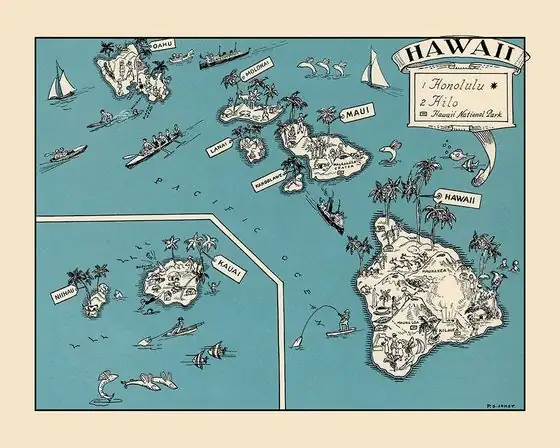
Lihue, Hawaii: A "Cold Chill" Name Brought From Oahu
Līhuʻe means literally "cold chill," according to Place Names of Hawaiʻi (1974); Thrum's 1922 list gives "goose flesh." The 1974 book also lists a former land division named Līhuʻe on Oʻahu, and Pat Griffin's history of the town says Governor Kaikioʻewa named the Kauaʻi town after the Oʻahu land he owned.
Lihue, Hawaii, is Līhuʻe in Hawaiian, literally “cold chill,” and the name is said to have come to Kauaʻi from a land of the same name on Oʻahu. So the county seat of Kauaʻi may be wearing a borrowed name, and a chilly one at that.
Two marks you don’t see on the road signs
Start with the spelling, because it tells you how to say the name. The U.S. Geological Survey’s official name for the town is Līhuʻe, with two marks that usually get dropped in English.
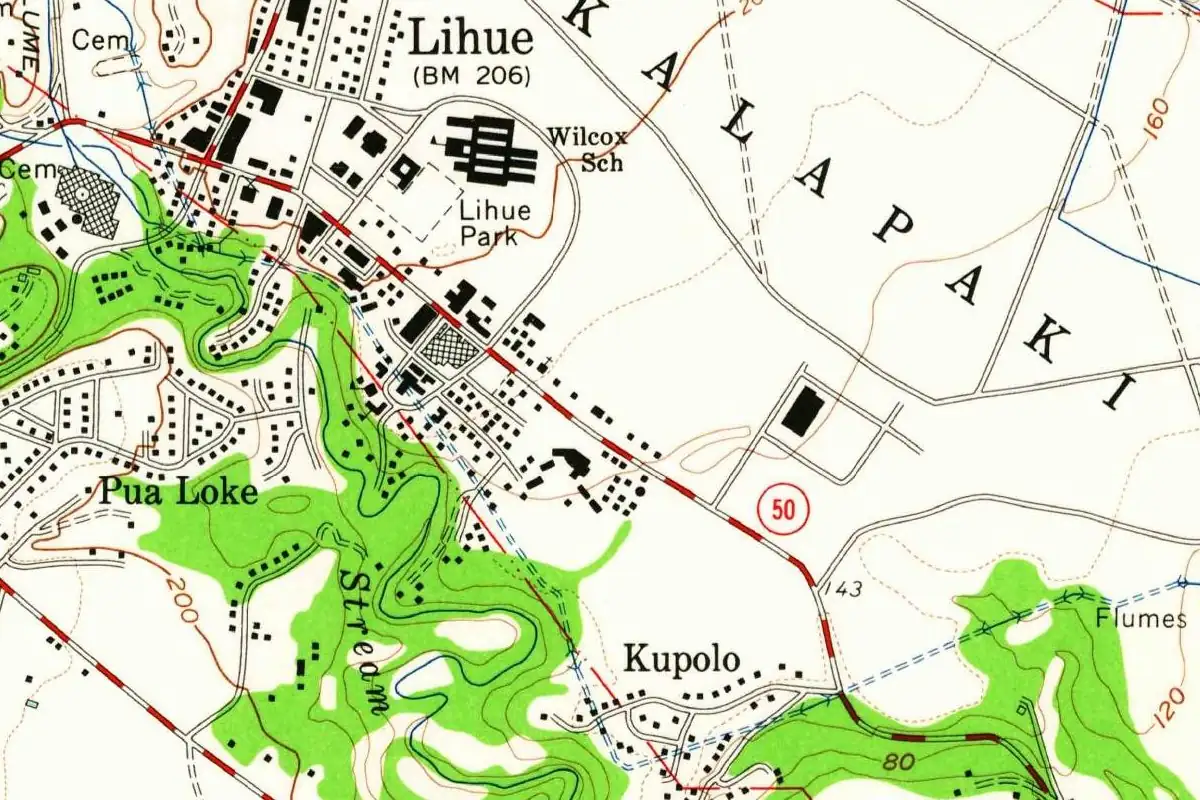
The line over the first i is a kahakō, which Mary Kawena Pukui and Samuel Elbert’s Hawaiian Dictionary defines simply as a “macron.” The little mark between the u and the e is an ʻokina, which the same dictionary defines as a “glottal stop.” Another dictionary on the University of Hawaiʻi at Hilo’s Wehewehe Wikiwiki site notes that in punctuation it took the form of a reversed single apostrophe. That’s why you’ll see the name written Lihue, Līhuʻe and sometimes Lihu’e, all for the same town. Even the federal mapmakers changed their minds. The 1963 survey map at the top of this page prints a plain “Lihue,” with no marks at all, while the Survey’s place-name database now uses the full Hawaiian spelling.
If you’re wondering how to say it, the oldest guide on this page is Thomas G. Thrum’s list of Hawaiian place names, printed in 1922 at the back of Andrews and Parker’s Hawaiian dictionary. He marks it “li-hu’e,” which is as close as the sources here come to a pronunciation guide.
“Cold chill,” or “goose flesh”
Now the meaning. Place Names of Hawaiʻi, the 1974 reference by Pukui, Elbert and Esther Mookini, which Wehewehe Wikiwiki reproduces, gives the entry in a few words:
“Līhuʻe. City and district, Kauaʻi. Former land division near Schofield Barracks, Oʻahu (UL 242). Lit., cold chill.”
“Lit.” means literally. The book is telling you what the word says, not why anyone chose it.
Thrum’s 1922 list says nearly the same thing with a different picture:
“Lihue (li-hu’e): goose flesh. Village, Puna, Kauai.”
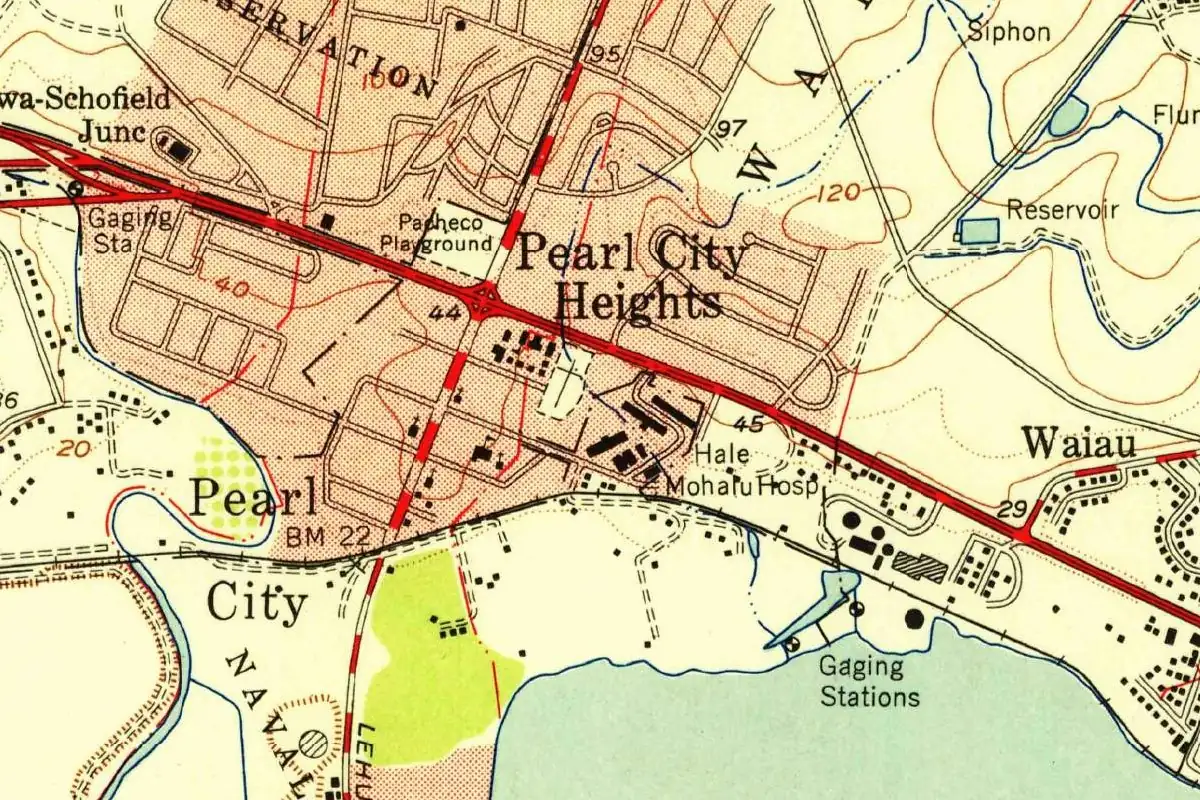
Cold chill, goose flesh. Either way, it’s the feeling of a shiver. None of the sources here explain why a place was called that, so we won’t guess. What the 1974 entry does give you is a second clue, and it’s the more interesting one. There was another Līhuʻe, a land division on Oʻahu, near what’s now Schofield Barracks.
The governor’s land on Oʻahu
That second Līhuʻe is where the town’s name seems to have come from. Pat Griffin’s history of the town, which Downtown Līhuʻe quotes on its community vision page, puts it this way: “Royal Governor Kaikioʻewa officially made it his governing seat in 1837, moving it from Waimea; he gave the town its name after the land he owned on Oahu by the same name.”
That’s a single modern source for who named the town, and it doesn’t quote a letter or a decree, so take it as Griffin’s account. But it fits neatly with the 1974 book, which lists a Līhuʻe on Oʻahu that it calls a “former land division.”
Kaikioʻewa had been running Kauaʻi for more than a decade by 1837. Hiram Bingham, the missionary who wrote a long history of his years in the islands, describes the moment after the fighting on Kauaʻi in 1824:
“Kaikioewa, one of the conqueror’s companions in former wars, a more sober and conciliatory chieftain than Kahalaia, was constituted governor of Kauai”
Bingham adds that Kaikioʻewa, with his wife Keaweamahi, helped restore quiet on the island and began building a chapel that, a fellow missionary reported, the governor said would be the best yet in the islands.
A minor village in the district of Puna
Before the governor moved in, Griffin writes, “Līhuʻe was a minor village.” It sat in the old district of Puna, on the southeastern coast of Kauaʻi, inside the ahupuaʻa (land division) of Kalapaki. Thrum’s list agrees on the district: “Village, Puna, Kauai.” Don’t mix it up with the Puna on the island of Hawaiʻi; Thrum’s list names land sections in both.
You can still see Kalapaki on the 1963 map at the top of this page. The name is spread in big slanting letters across the land east of town, while “Lihue” sits in smaller type above a cluster of buildings, a park and a school.
From governor’s seat to county seat
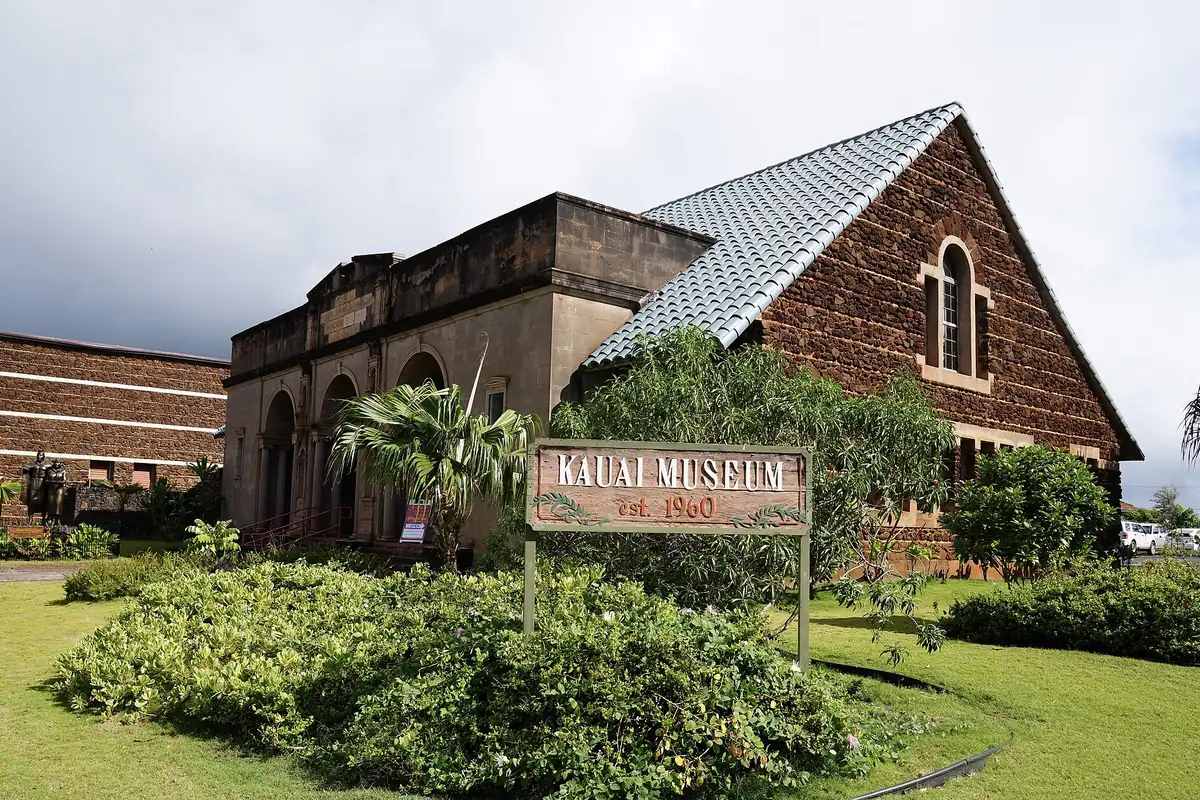
Griffin traces the town’s rise from there. By 1880 it was considered the most important town on the island. In 1888 it had several stores, two schools and a livery stable, and two years later enough travelers were passing through to justify a full hotel on the main road between the village and Nawiliwili. In 1905 it was the natural choice for county seat, and by the end of that decade officials had decided the county needed an imposing new building in the center of town. In 1912 the county bought five acres from Lihue Plantation along the main road to Nawiliwili, a road the maps then labeled simply “government road.” Today it’s Rice Street, and it’s where the Kauaʻi Museum, in the photo at the bottom of this page, stands.
So the name that once belonged to a piece of land on Oʻahu ended up on the government town of Kauaʻi. If you like these short, literal Hawaiian place names, Thrum’s same 1922 list also defines the island’s other big towns, like Hilo and Kailua-Kona. The rest of the state’s name stories are on our Hawaii page.
Quick answers
What does Līhuʻe mean in Hawaiian?
“Cold chill,” literally, according to Place Names of Hawaiʻi (1974). Thrum’s 1922 list gives “goose flesh.” Neither says why the place was called that.
How do you pronounce Lihue?
Thrum’s 1922 list marks it “li-hu’e.” The Hawaiian spelling, Līhuʻe, has a macron over the first i and an ʻokina, a glottal stop, before the final e.
Who named Lihue?
Pat Griffin’s history of the town says Kaikioʻewa, the royal governor of Kauaʻi, named the town after land he owned on Oʻahu called Līhuʻe, when he made it his governing seat in 1837.
Is there another Līhuʻe in Hawaii?
There was. Place Names of Hawaiʻi lists a former land division named Līhuʻe on Oʻahu, near Schofield Barracks.
Key dates
- 1837Governor Kaikioʻewa makes Līhuʻe his governing seat, moving it from Waimea, according to Pat Griffin.
- 1905Līhuʻe is chosen as the county seat of Kauaʻi.
- 1922Thomas Thrum's place-name list defines Lihue as "goose flesh."
Things to do in Lihue, Hawaii
Kauaʻi Museum
A museum that has kept and shown the history and artifacts of Kauaʻi since it opened on December 3, 1960, in a building next to the Wilcox library.
Grove Farm Museum
The preserved homestead of the Wilcox family, listed on the National Register of Historic Places, where docent-led tours tell the story of sugar, innovation and the immigrant laborers who settled on Kauaʻi.
Grove Farm historic locomotives
Four restored steam engines that once hauled sugarcane across Kauaʻi's plantations, kept in the original 1943 roundhouse in Puhi. The oldest, Paulo, dates from 1887.
Wailua River State Park
A river valley with the Fern Grotto, views of ʻŌpaekaʻa and Wailua falls, and the Wailua Complex of Heiau, a National Historic Landmark that was once an important seat of chiefly power.
Getting there
Open Lihue in Google Maps
Opens in a new tab. The pin is the center of Lihue in the USGS place-name record.
The closest airports, Amtrak stations and intercity bus stops, measured in a straight line from the center of Lihue.
Airports
- Lihue (LIH) 2 mi 3 km
- Daniel K Inouye International (HNL) Honolulu 103 mi 166 km
Distances are as the crow flies, not by road. We don't list schedules or fares because they change; check with the airline, Amtrak or the bus company before you go. Official data (FAA commercial service airports (2025), FAA airport locations, Amtrak stations and Intercity Bus Atlas) from the FAA and the U.S. Bureau of Transportation Statistics, checked Nov 14, 2026.
Sponsored
Staying in Lihue?
Compare hotels in Lihue, Hawaii, on Expedia.
See hotels in LihueWe may earn a commission if you buy through this link. It never changes what we write. Read our affiliate disclosure
Historical Sources & References
- Wehewehe Wikiwiki (University of Hawaiʻi at Hilo), “lihue”. Place Names of Hawaiʻi (1974): the quoted entry, “City and district, Kauaʻi. Former land division near Schofield Barracks, Oʻahu … Lit., cold chill.” Also Parker (1922), “goose flesh.”
- Thomas G. Thrum, “Hawaiian Place Names,” in Andrews and Parker, A Dictionary of the Hawaiian Language (1922), p. 656. The quoted entry: “Lihue (li-hu’e): goose flesh. Village, Puna, Kauai,” with the pronunciation marks.
- Wehewehe Wikiwiki, “kahakō”. Pukui and Elbert, Hawaiian Dictionary (1986): kahakō, “Macron.”
- Wehewehe Wikiwiki, “ʻokina”. Pukui and Elbert (1986): ʻokina, “Glottal stop.” Kent (1986): its printed form as a reversed single apostrophe.
- Downtown Līhuʻe, “Our Community Vision”. Excerpt from Pat Griffin’s Līhuʻe: the minor village, “cold chill,” Puna and Kalapaki, Kaikioʻewa’s governing seat in 1837 and the name taken from his land on Oʻahu, the town in 1880, the county seat in 1905, and the 1912 land on today’s Rice Street.
- Hiram Bingham, A Residence of Twenty-One Years in the Sandwich Islands (1847), p. 243. The quoted line on Kaikioewa “constituted governor of Kauai”; Keaweamahi and the chapel.
- GNIS feature 361837 (U.S. Geological Survey). The USGS entry for Līhuʻe, Kauai County, with its official spelling and coordinates.
- U.S. Geological Survey, Lihue quadrangle (1963). The 1:24,000 map the image at the top of this page was cropped from, with Lihue and Kalapaki labeled.
Sponsored
Cruising to Hawaii?
Compare Hawaii cruises on CruiseDirect.
See Hawaii cruisesWe may earn a commission if you buy through this link. It never changes what we write. Read our affiliate disclosure
Spot something wrong, or know more? Tell us here. You can also email us or use our contact page. Corrections are noted here with their date, never made silently.