Los Angeles Names: Hollywood, Malibu, Santa Monica and More
Los Angeles place names come from saints, Spanish ranchos, Native villages and land promoters, and some of the best-known ones began as something else. Santa Monica is named for the mother of St. Augustine, Malibu seems to go back to a Native village, and Broadway was Fort Street until it was widened.
Planning a trip? Here’s where the names on your map came from. Most of the old ones are Spanish, a handful are older than that, and a lot of the newer ones were picked by the people who were selling the land.
Where Los Angeles got its name
The first Spanish name here went to a river. On August 2, 1769, the Portolá expedition camped by it, the day after the feast of Our Lady of the Angels of Porciúncula. Father Juan Crespí wrote in his diary, in the translation J. M. Guinn printed in 1906:
“We stopped not very far from this river, to which we gave the name Porciuncula.”
That river is the Los Angeles River, and the dry streambed Crespí saw coming in from the north-northeast is the Arroyo Seco, Spanish for “dry creek.” The pueblo itself was founded on September 4, 1781, on Governor Felipe de Neve’s orders, and Guinn says the early documents called it El Pueblo Nuestra Señora de Los Angeles, the town of Our Lady of the Angels. Did the town take its name from the river? Guinn himself doubted it: “This I doubt,” he wrote, and he thought the pueblo was named for the Virgin Mary in her own right. The old histories split on it, and our Los Angeles article goes through both sides.
Downtown streets
Most of downtown’s street names go back to one map. In 1849 Lt. E. O. C. Ord of the U.S. Army was sent to survey the city, and he finished his Plan de la Ciudad de Los Angeles on August 29. Guinn says the street names on Ord’s plan were given in both Spanish and English.
Main and Spring streets
Main Street was the Calle Principal on Ord’s map. Spring Street was the Calle Primavera, and Guinn says it was “named for the season spring.” Charles Willard’s 1901 history agrees: the Spanish word Ord picked shows it was named “for the season, and not for any spring of water.” Willard also says Spring was one of the two oldest streets in the city, part of the old road to the Cahuenga Pass. The other was Aliso Street, at the end of the road from San Gabriel. Aliso means alder tree.
Broadway
Broadway was Fort Street. Willard says it was named for the fort built the year before Ord’s survey, “which looked down the street from the hill to the north.” That fort was finished by July 4, 1847, and named Fort Moore. Why Broadway? John Steven McGroarty’s 1923 county history says the widening of Fort Street began in 1888, “causing the change of name of that street to Broadway.” Willard dates the change to 1889.
Hill, Olive and Grand
West of Broadway, Ord’s names were simple: Calle Loma was Hill Street, and next to it came Olive Street. Grand Avenue had a sadder name. It was the Calle de Caridad, the street of charity, a name Ord moved over from the old road that’s now North Spring Street, where poor families lived. Willard says the people on what was then Charity Street got so tired of jokes about “living on charity” that the city council changed the name in 1886.
Figueroa Street
Figueroa was the street of the grasshoppers. On Ord’s map it was the Calle de los Chapules, and Guinn notes that people kept dairy ranches out on “Grasshopper street, now Figueroa.” Part of it was also called Pearl Street. Neither book says which Figueroa the street was later named for, so we won’t guess.
Boyle Heights
Boyle Heights is named for a city councilman. Guinn wrote in 1901 that A. A. Boyle, “after whom Boyle Heights is named,” was one of the most active opponents of a water deal the council pushed through.
Hollywood and the hills
Hollywood
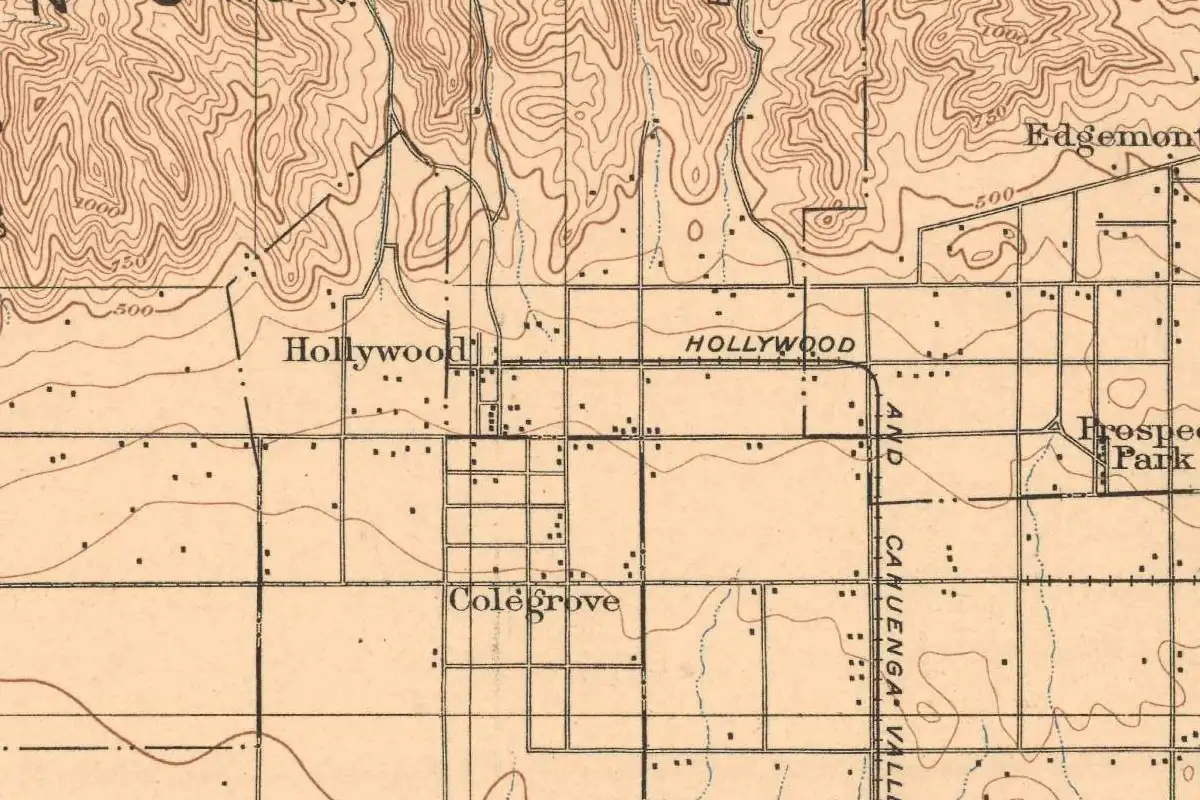
Hollywood is a newer name than most on this page. Guinn says H. H. Wilcox laid out the town in 1887 “near the entrance to the Cahuenga pass.” It grew slowly until an electric line to Santa Monica came through, and on January 24, 1910, it voted to join Los Angeles, 409 to 18. Why the town got that name is another matter. The old accounts don’t agree, and our Hollywood article lays out each version and its source.
Cahuenga Pass
Cahuenga is one of the few Native names left in the Los Angeles area. Guinn listed it in 1906 among the “very few Indian names” that survived in the south. A. L. Kroeber, in a 1916 University of California study of Native place names, wrote that it’s “undoubtedly” from a word in what he called the Gabrielino language, because of the ending -nga, which marks a place. He said Tujunga, the name of a river in the county, is “evidently” Gabrielino for the same reason. He didn’t say what either word means, and neither do we.
Los Feliz and Griffith Park
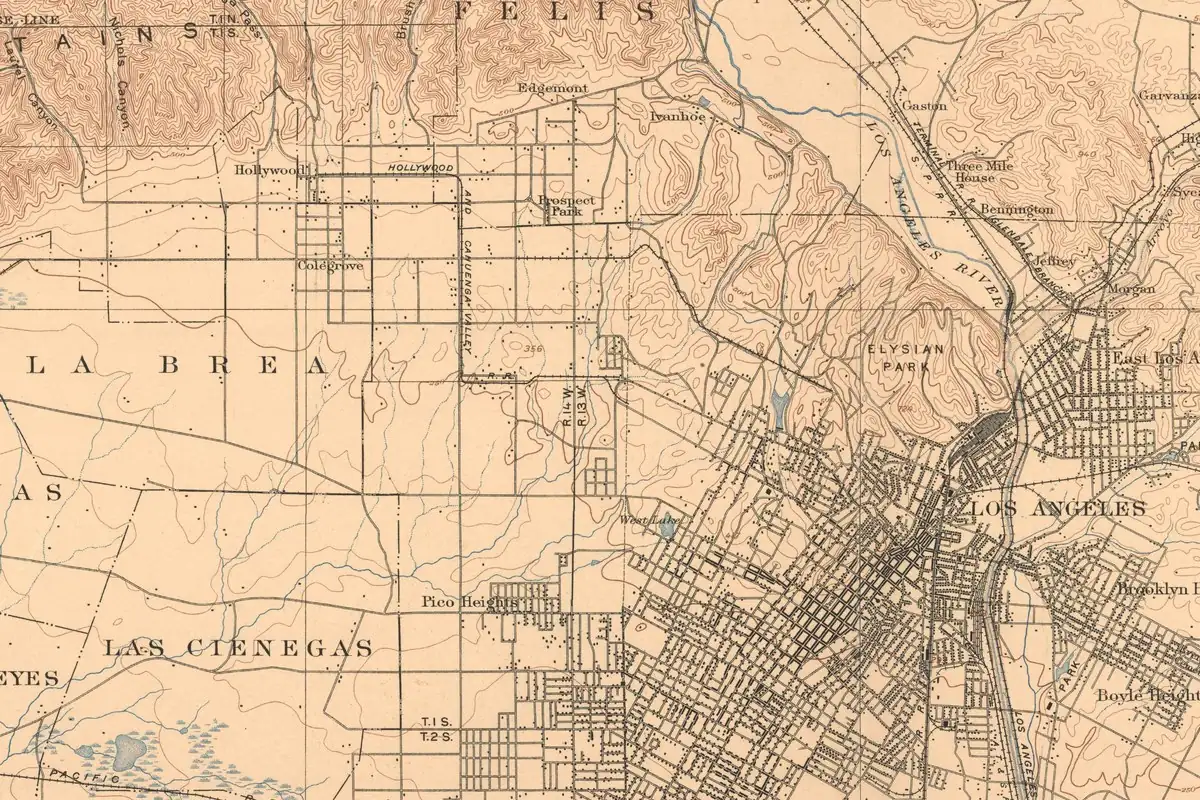
Los Feliz carries the name of a family that owned the land. Guinn mentions Domingo Feliz as “part owner of the Los Feliz Rancho,” and the 1894 map at the top of this page still prints the rancho’s name across the hills, spelled FELIS. Griffith Park, next door, is named for the man who gave it to the city, Col. Griffith J. Griffith. John Steven McGroarty’s 1923 county history calls it the largest city park in the country and places it between the Los Angeles River and a line half a mile (0.8 km) north of Los Feliz Avenue.
Elysian Park
Elysian Park started out as land nobody wanted. Guinn says it was part of the original pueblo lands, and when the city was giving its land away cheap, these hills “were considered worthless,” so the city kept them and eventually made a park.
La Brea and La Cienega
La brea means “the asphalt,” Nellie Van de Grift Sanchez explained in 1922. It was the name of the ranch with the famous asphalt beds near Los Angeles, where, as Ora Lovejoy put it in 1918, “the remains of the saber-tooth tiger were found.” La Cienega comes from the Spanish for swamp. Sanchez lists Cienega in Los Angeles County with that meaning, and the 1894 map shows a big tract marked LAS CIENEGAS, “the swamps,” south of La Brea.
Garvanza
Garvanza is a misspelled vegetable. Lovejoy called it “a section of Los Angeles” and wrote that the name “should be Garbanzo,” Spanish for chickpea.
The coast
Santa Monica
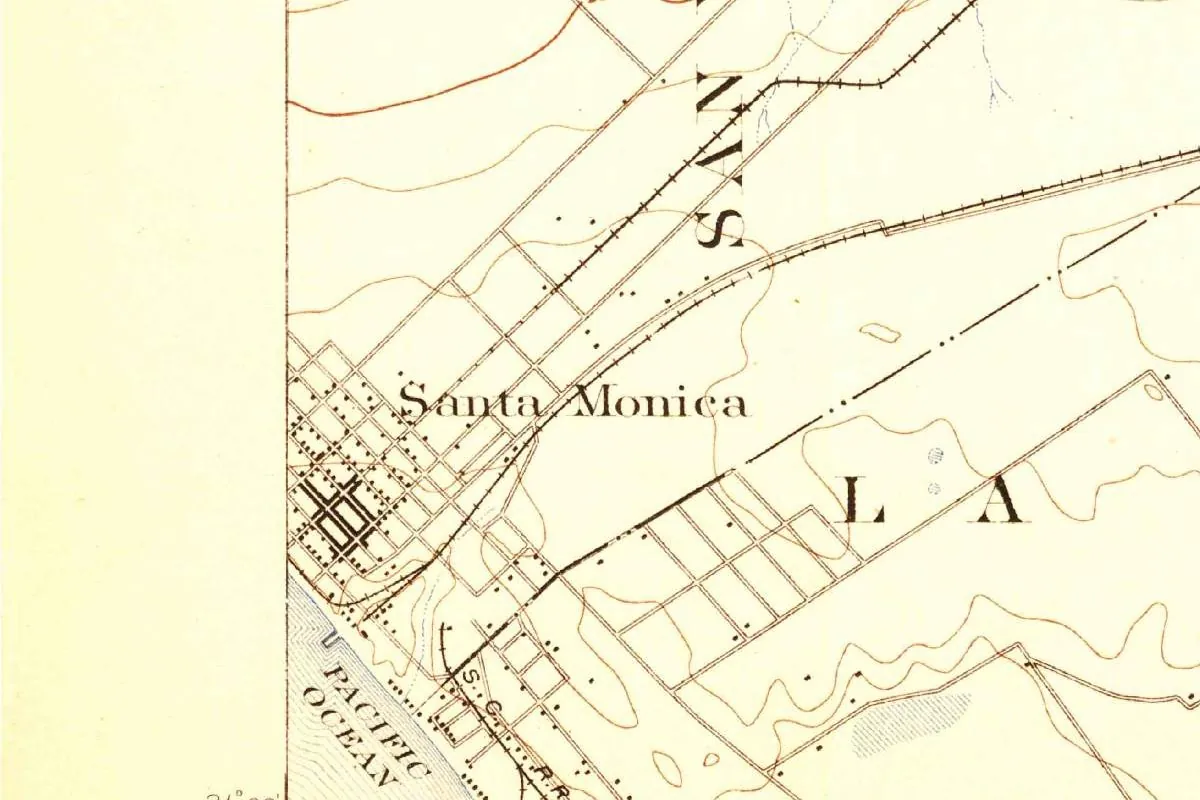
Santa Monica is named for a saint. Sanchez and Lovejoy both say St. Monica was the mother of St. Augustine. Lovejoy adds that she was a Christian married to a man who wasn’t. Sanchez calls her “the great patroness of the Augustinian nuns” and adds that she “might well be placed at the head of the world-wide order of ‘Anxious Mothers.’”
Malibu
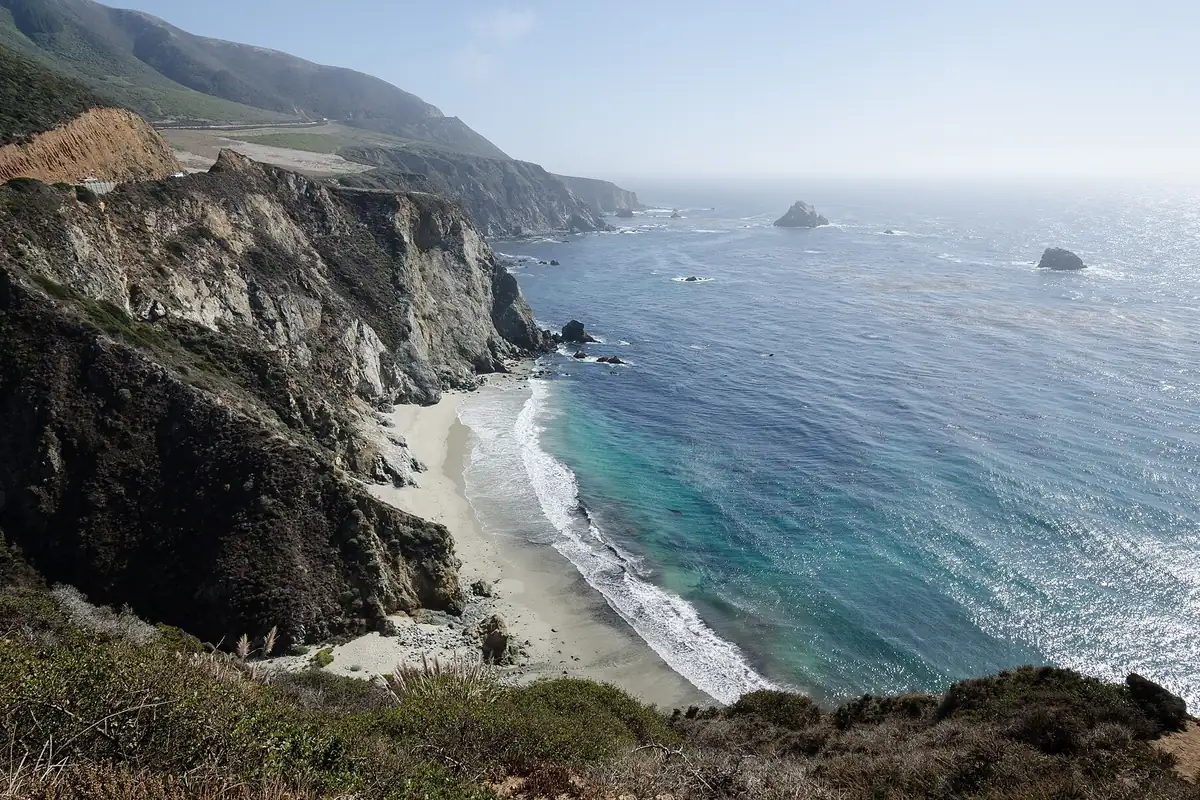
Malibu seems to go back to a Native village. Kroeber wrote in 1916 that the name “seems to go back” to a Chumash or Gabrielino village “called Maliwu in Chumash, which lay on the east side of the mouth of Malibu Creek.” He doesn’t give a meaning, and we haven’t found an old source we trust that does. Malibu, Topanga and a third name, Sequit, were all names of the same land grant, Kroeber says.
Topanga
Topanga Canyon, about four miles (6 km) west of Santa Monica in Kroeber’s day, also has a Native name. Kroeber says the -nga ending marks it as a Gabrielino place name. Like Cahuenga, it carries no meaning we can show you.
Venice
Venice started as Abbot Kinney’s “Venice of America.” Guinn says that at the start of 1904 the site was tide flats, sand dunes and saltwater lagoons. That year Abbot Kinney bought the southern end of the tract from his partners “for the purpose of building the Venice of America, with its canals, bridges and arcades.”
Redondo Beach and Hermosa Beach
Redondo means “round,” but Redondo Beach isn’t named for a round beach. Sanchez says it took its name from a land grant on the same spot called Sausal Redondo, “round willow-grove,” after a clump of willows. Hermosa, next door, simply means “beautiful,” Sanchez says.
The harbor
San Pedro
San Pedro is named for a saint, and not the one you’d think. Guinn says Sebastián Vizcaíno anchored in the bay on November 26 and put it on his map as San Andrés. But a description of the voyage compiled for Vizcaíno by Cabrera Bueno named it San Pedro, because November 26 belonged to a St. Peter: St. Peter, bishop of Alexandria, not St. Peter the apostle. Sanchez is a little more careful. She says “it seems probable” the bay was named for the Alexandrian saint. The two books don’t even agree on when he died: Guinn says 258, Sanchez 311.
Wilmington
Wilmington is named for a city on the other side of the country. On September 25, 1858, Phineas Banning founded a new town on the inner bay. Guinn says it was first called New San Pedro but “came to be called Wilmington after Banning’s birthplace, Wilmington, Del.” That’s Wilmington, Delaware. Guinn adds that the post office took the name in 1864, though it was another decade before the landing itself was officially called Wilmington.
The valleys
Pasadena
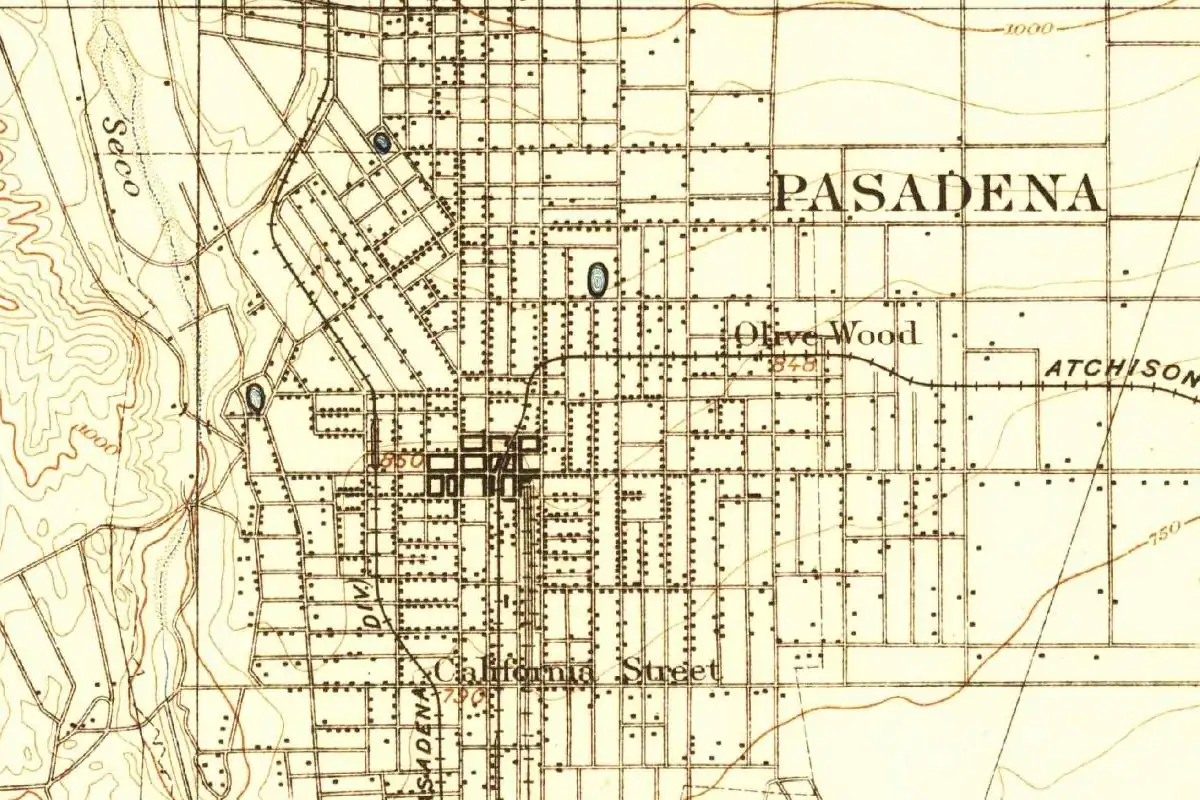
Pasadena is said to come from the Chippewa (Ojibwe) language. Sanchez wrote in 1922 that the full phrase was said to mean “Crown of the Valley,” and she also printed Kroeber’s doubts: he thought that phrase looked “coined by an American.” Sanchez had no patience for the other story going around: “Let no man believe in the absurd story that it means ‘Pass of Eden.’” Our Pasadena article tells how the word arrived by mail and why its meaning is still argued over.
Burbank
Burbank is named for a doctor. McGroarty’s county history says the town “was named in honor of the pioneer, Dr. Burbank,” who lived on the land before it became a town and later moved to Los Angeles.
Verdugo
Verdugo is a family name. Sanchez says the place called Verdugo was named for the Verdugo family, who owned the Rancho San Rafael, northeast of Los Angeles near the Verdugo Mountains, and that José María Verdugo was one of the men granted the Los Nietos land in 1784.
Names we’re still checking
You might be wondering about Beverly Hills, Mulholland Drive, Wilshire Boulevard, Sunset Boulevard, Rodeo Drive, Echo Park, Olvera Street and Pershing Square. We read about William Mulholland and Agustín Olvera in the old county histories, but we haven’t yet found a source we can show you that says how those names, or the others here, ended up on the map. Until we do, they stay off this page.
Quick answers
What does La Brea mean?
“The asphalt,” in Spanish. Sanchez says it was the name of the ranch with the famous asphalt beds.
What does Malibu mean?
The old sources don’t say. Kroeber wrote in 1916 that the name seems to go back to a village called Maliwu in Chumash, at the mouth of Malibu Creek, but he gave no meaning.
Who is Santa Monica named after?
St. Monica, the mother of St. Augustine, according to Sanchez (1922) and Lovejoy (1918).
Why is Broadway in Los Angeles called Broadway?
It used to be Fort Street, named for Fort Moore on the hill above it. McGroarty says the widening of the street, begun in 1888, caused the change to Broadway. Willard dates the new name to 1889.
Key dates
- 1769August 2: the Portolá expedition camps by a river and Father Crespí names it the Porciúncula. It's now the Los Angeles River.
- 1781September 4: the pueblo of Los Angeles is founded on Governor Felipe de Neve's orders.
- 1847By July 4: the U.S. Army finishes a fort on the hill above town and names it Fort Moore.
- 1849August 29: Lt. E. O. C. Ord finishes his map of the city, with Spring, Fort, Hill and Olive streets.
- 1858September 25: Phineas Banning founds New San Pedro, the town that becomes Wilmington.
- 1887H. H. Wilcox lays out Hollywood near the entrance to the Cahuenga Pass.
- 1889Fort Street, named for Fort Moore, becomes Broadway after the street is widened.
- 1904Abbot Kinney starts building Venice of America, with canals, bridges and arcades.
- 1910January 24: Hollywood votes to consolidate with Los Angeles.
Sponsored
Planning a trip to Los Angeles?
Compare hotels in Los Angeles on Expedia.
See hotels in Los AngelesWe may earn a commission if you buy through this link. It never changes what we write. Read our affiliate disclosure
Sponsored
Read up before your trip
Browse digital travel magazines on Magzter.
Browse travel magazinesWe may earn a commission if you buy through this link. It never changes what we write. Read our affiliate disclosure
Historical Sources & References
- J. M. Guinn, “Some California Place Names” (1906). Crespí’s diary on the Porciúncula and the dry Arroyo Seco (pp. 40-41); Guinn’s doubt that the expedition named the pueblo, and the pueblo’s name in early documents (p. 41); Vizcaíno, San Pedro and St. Peter of Alexandria, beheaded in 258 (p. 42); Cahuenga among the “very few Indian names” (p. 45).
- Ora A. Lovejoy, “A Study of Southern California Place Names” (1918). The pueblo founded September 4, 1781, La Brea and Santa Monica (p. 47); Aliso (p. 48); Garvanza (p. 49). The saber-tooth remains at La Brea (p. 47).
- Nellie Van de Grift Sanchez, Spanish and Indian Place Names of California (1922). La Brea (p. 55); Santa Monica (pp. 62-63); Hermosa (p. 80); Pasadena and Kroeber’s doubts (p. 82); Redondo Beach and Sausal Redondo (pp. 82-83); San Pedro and St. Peter of Alexandria, martyred in 311 (pp. 84-85); Verdugo (p. 86); Arroyo Seco (p. 157); Cienega (p. 373).
- A. L. Kroeber, California Place Names of Indian Origin (1916). Cahuenga (p. 36); Malibu and the village of Maliwu (p. 46); Sequit (p. 57); Tujunga River and the -nga ending (p. 62); Topanga (p. 63).
- J. M. Guinn, A History of California and an Extended History of Los Angeles, vol. 1 (1915). Domingo Feliz and the Los Feliz Rancho (p. 183); Lt. Ord sent by the governor to map the city (p. 266); Ord’s 1849 map and its street names, and Pearl Street (pp. 267-268); dairy ranches on Grasshopper Street (p. 292); Banning, New San Pedro and Wilmington (pp. 331-332, 334); Elysian Park (p. 356); Griffith Park (p. 361); Hollywood joins Los Angeles (p. 364); Hollywood laid out by H. H. Wilcox (pp. 442-443); Venice of America (pp. 457-458).
- J. M. Guinn, Historical and Biographical Record of Los Angeles and Vicinity (1901). A. A. Boyle, “after whom Boyle Heights is named” (p. 157).
- Charles Dwight Willard, The Herald’s History of Los Angeles City (1901). Fort Moore, finished by July 4, 1847 (p. 228); Aliso and Spring as the oldest streets, Charity Street, Fort Street renamed Broadway in 1889, and Spring named for the season (pp. 266-267).
- John Steven McGroarty, History of Los Angeles County, vol. 1 (1923). Fort Street widened from 1888 and renamed Broadway (p. 213); Griffith Park (pp. 216, 336); Banning names Wilmington after his old eastern city (p. 446); Burbank named for Dr. Burbank (p. 464).
- U.S. Geological Survey, Los Angeles sheet (1894). The map at the top of this page, with Hollywood, La Brea, Las Cienegas and Felis labeled.
Sponsored
Want a local to show you around?
Book a private tour of Los Angeles with a local guide on GoWithGuide. Each tour is just for your group, and you can change the plan with your guide before you go.
See private tours in Los AngelesWe may earn a commission if you buy through this link. It never changes what we write. Read our affiliate disclosure
Sponsored
Live in the Los Angeles area with kids?
GetOut sells a yearly membership for family attractions around Los Angeles and Southern California. Check which places are included before you buy, and keep in mind it renews automatically every year unless you turn renewal off in your account.
See GetOut Los AngelesWe may earn a commission if you buy through this link. It never changes what we write. Read our affiliate disclosure
Spot something wrong, or know more? Tell us here. You can also email us or use our contact page. Corrections are noted here with their date, never made silently.