San Francisco Names: Where the Golden Gate Got Its Name
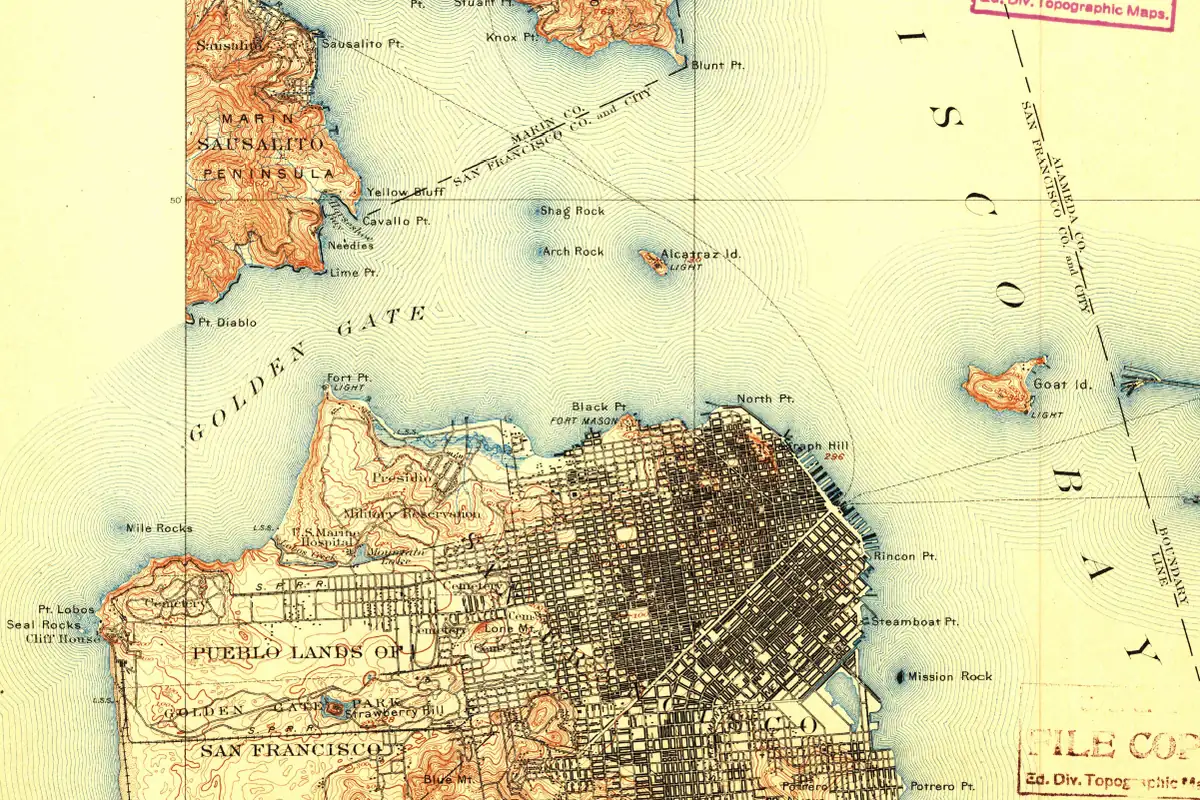
San Francisco’s Golden Gate got its name from John C. Frémont in 1848, and he borrowed the idea from the Golden Horn of old Byzantium. In his report to the Senate, Frémont explained that he called the strait Chrysopylae, “(golden gate),” on his map, on the same principle that the harbor of Byzantium was called Chrysoceras, “(golden horn.)”
Planning a trip? Here’s where the names on your map came from. Many of them go back to the Spanish of 1775 and 1776, or to the Americans who took over the little town in 1846 and 1847.
Yerba Buena becomes San Francisco
The village on the cove wasn’t called San Francisco at first. It was Yerba Buena, “good herb,” after the wild mint that grew all over the spot, according to The Annals of San Francisco, a big 1855 history by Frank Soulé, John H. Gihon and James Nisbet. Some maps already said San Francisco, but locally, the Annals says, the place was “only known” as Yerba Buena. Its authors thought the name probably started on the island in the bay and spread to the cove and then to the village.
Then the Americans arrived, and in January 1847 the alcalde, Washington A. Bartlett, a U.S. Navy lieutenant, settled the matter. His ordinance ran in the California Star on January 30:
“…to prevent confusion and mistakes in public documents, and that the town may have the advantage of the name given on the public map…”
From then on, it ordained, San Francisco was the name for all official papers. So the town traded a local herb for the name on the map. The name on the map was older than the town. Zoeth Eldredge’s The Beginnings of San Francisco (1912) shows the Spanish viceroy ordering a further exploration of “the port of San Francisco” in 1773. When the Spanish took formal possession of their presidio on September 17, 1776, Father Palou called Saint Francis the “patron of the presidio and fort.”
The bay and the waterfront
The Golden Gate
Frémont didn’t make it up out of nowhere. He explained in his Geographical Memoir upon Upper California that the shape of the entrance and its “advantages for commerce” made him think of Byzantium, whose harbor the Greeks called the Golden Horn. The name stuck to more than the strait. Eldredge says Golden Gate Avenue was first Tyler Street, for President John Tyler, and got its new name after Golden Gate Park opened and the street became the driveway to it.
Alcatraz
On the night of August 5, 1775, the Spanish ship San Carlos, under Juan Manuel de Ayala, became the first ship to anchor in San Francisco Bay, as Eldredge tells it. Eldredge says his crew named one island Isla de Alcatraces “because of the number of pelicans on it.” He adds a twist: the historian Bancroft had found the singular form, Isla del Alcatraz, already in use by 1797.
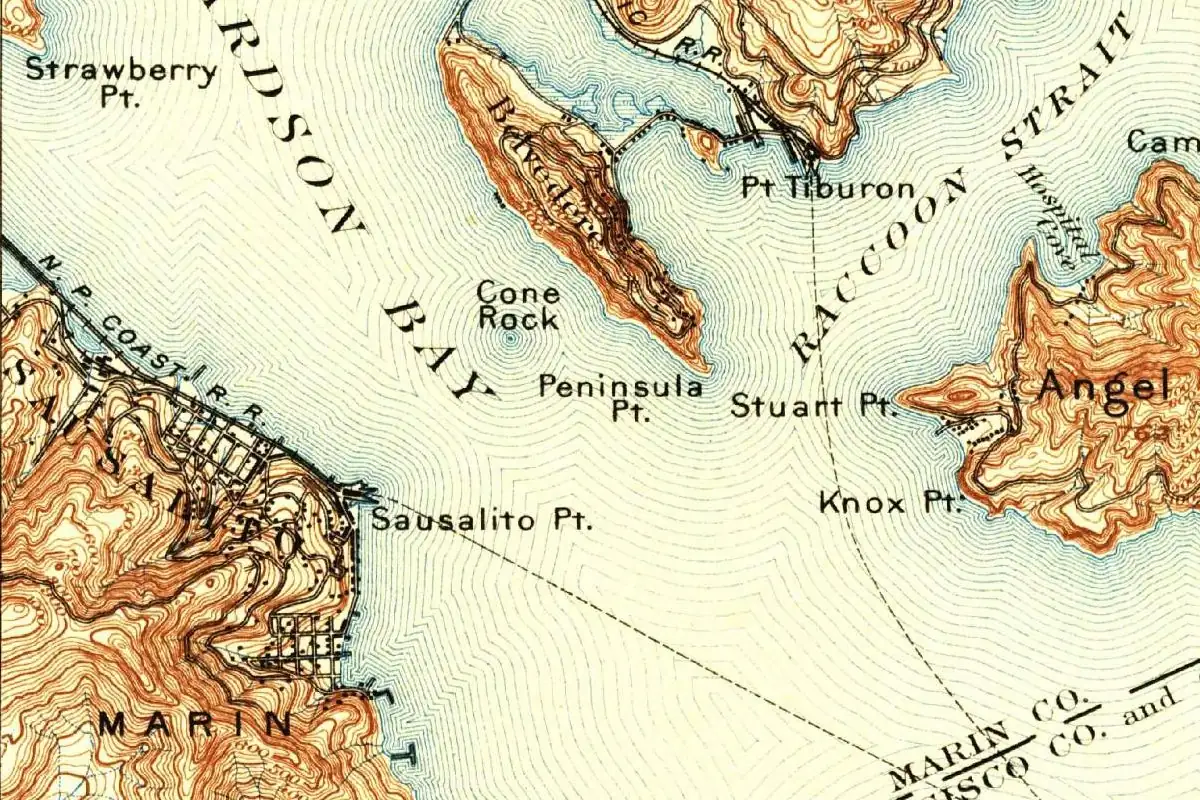
Angel Island
On the same voyage, Ayala’s men looked over the big island next door and named it Isla de Los Angeles. Eldredge says they found good anchorage, wood and water there. You’ll see it on your map as Angel Island.
Yerba Buena Island
The island out in the bay, “about two miles east of the city” in the words of the Annals, carries the name the city gave up. The Annals says the mint “grows abundantly” there, and its authors thought the island was probably where the name Yerba Buena started.
North Beach
North Beach is exactly what it sounds like. In 1855 the Annals described Telegraph Hill as rising between Yerba Buena Cove and “the cove farther to the north-west, now called the North Beach.” Today the name belongs to the neighborhood.
The Embarcadero
The Embarcadero is a newer name than it sounds. Eldredge says a city commission picked it in 1909, “The Embarcadero (the Landing),” for the street along the water. Before that, the stretch inside the seawall was called East Street North and East Street South, depending on which side of Market Street you were on.
The Spanish city
The Presidio
The Presidio is where the city began. The National Park Service says the Spanish arrived in 1776 to build the northernmost outpost of their empire in western North America. Eldredge describes the ceremony of September 17 that year: Mass, a blessing of the site, cannon from the San Carlos and volleys from the troops.
Mission Dolores and the Mission District
The Mission District’s name started with a creek and a day on the calendar. On March 29, 1776, Juan Bautista de Anza looked over a stream on the peninsula, and because it was the Friday of Sorrows, the Friday before Palm Sunday, he named it Arroyo de los Dolores. The mission founded nearby is Mission Dolores, and Eldredge says that name was “shortened in the vernacular to the ‘Mission.’” Dolores Street, he adds, was named for the mission and runs past its church.
Twin Peaks
The two hills in the middle of the city had a Spanish name first. Eldredge says the Arroyo de los Dolores rose in “Los Pechos de la Choca,” which he translated as “The breasts of the Indian girl,” and that these are “now Twin Peaks.”
Divisadero Street
Divisadero Street was “named for its position: the summit of a high hill,” Eldredge says. The word comes from the Spanish verb divisar, “to descry at a distance,” so a divisadero is “a point from which one can look far.” The Spanish called Lone Mountain El Divisadero.
Castro and Valencia streets
If you’re headed to the Castro, you might expect the street to honor General José Castro. Eldredge says it was named for the family of Joaquín Isidro de Castro, a soldier in Anza’s company. The general, he adds, “belonged to the Monterey family,” though the Castros of Monterey and of San Francisco “call each other cousin.” Valencia Street was named for the family of José Manuel Valencia, another of Anza’s soldiers. Guerrero, Sánchez and Noé streets in the same part of town are also named for early Californians.
A hill with a job
Telegraph Hill
Telegraph Hill was a working lookout. The Annals tells how early in 1849 the firm of Sweeny & Baugh put a station-house on the hill, which “commanded a view of the entrance to the Golden Gate,” and used signals that local merchants understood to announce what kind of ship was coming in. The book doesn’t stop to explain the name, but you can see why it fit.
Downtown streets
Portsmouth Square and Montgomery Street
On July 8, 1846, Captain John B. Montgomery of the U.S. sloop-of-war Portsmouth raised the American flag in the plaza of Yerba Buena. The Annals says that’s when the plaza “received the name of Portsmouth Square, and the street lying on the beach was called Montgomery Street.” There used to be a Montgomery Avenue too, but Eldredge says the 1909 commission renamed it Columbus Avenue to end the mix-ups.
Market Street
Market Street cuts across the grid at an angle and splits the city in two. Eldredge thought the name “was probably suggested by Market street, Philadelphia.” Mission Street, next to it, was the first street opened south of Market and followed the road to the mission.
Kearny and Stockton streets
Two downtown streets honor two American governors of California. Kearny Street is named for Stephen Watts Kearny, military governor from March to May 1847, and Stockton Street for Commodore Robert F. Stockton, governor from August 1846 to January 1847. Stockton’s name is also on a Central Valley city.
Grant Avenue
Grant Avenue is one of the oldest streets in town under a newer name. Eldredge says it was the original “Calle de la Fundacion” of Captain W. A. Richardson, who built the first house in Yerba Buena in 1835, according to the Annals. Then it was Dupont Street, for Captain Samuel F. Du Pont of the U.S. Navy. The street got a bad reputation, and after its “disreputable residents were removed,” the name was changed to Grant Avenue.
Geary and O’Farrell streets
Geary Street is named for John W. Geary, in Eldredge’s words the “first alcalde, 1849-50, and first mayor under the charter.” O’Farrell Street is for Jasper O’Farrell, the surveyor who extended the town plan in 1847. The Annals says his survey took in Telegraph Hill and the Rincon.
Vallejo Street
Vallejo Street is named for Mariano Guadalupe Vallejo, the Mexican-era commander who also gave his name to the city of Vallejo.
Van Ness Avenue
Van Ness Avenue honors James Van Ness, mayor in 1856. Eldredge says he wrote the Van Ness ordinance, which confirmed land titles west of Larkin Street to the people who actually held them.
West of downtown
Haight-Ashbury
Haight and Ashbury are the two streets that meet at the heart of the neighborhood, and only one of them is easy to explain. Eldredge says Haight Street was named for Fletcher M. Haight, a San Francisco lawyer who later became a U.S. district judge in Southern California. Ashbury Street is harder. A Monroe (or Munroe) Ashbury sat on the city’s Board of Supervisors in the 1860s, as John Dwinelle’s 1867 history shows, but we didn’t find a record that says the street was named for him.
Names we’re still checking
You might be wondering about the Tenderloin, Nob Hill, Russian Hill, Coit Tower, Union Square, Lombard Street and Fisherman’s Wharf. They’re some of the most searched names in the city, but we haven’t yet read a source we can show you for how they got their names. Until we do, they stay off this page.
Quick answers
Who named the Golden Gate?
John C. Frémont. In his 1848 memoir he said he called the strait Chrysopylae, “(golden gate),” on his map, on the model of Byzantium’s Golden Horn.
Why is it called Alcatraz?
Pelicans. Eldredge says Ayala’s crew named it Isla de Alcatraces in 1775 “because of the number of pelicans on it.”
Was San Francisco ever called Yerba Buena?
Yes. The village was Yerba Buena, “good herb,” until an ordinance published on January 30, 1847, made San Francisco its official name.
Is the Castro named after José Castro?
No, not according to Eldredge. He wrote in 1912 that Castro Street was named for the family of Joaquín Isidro de Castro, one of Anza’s soldiers. General José Castro, he wrote, “belonged to the Monterey family.”
Key dates
- 1775August: Juan Manuel de Ayala's San Carlos sails into the bay. His crew names Isla de Los Angeles and Isla de Alcatraces.
- 1776March 29: Juan Bautista de Anza names the Arroyo de los Dolores. September 17: the Spanish take formal possession of the presidio.
- 1846July 8: Captain Montgomery raises the U.S. flag in the plaza, which becomes Portsmouth Square.
- 1847January 30: an ordinance in the California Star makes San Francisco the town's official name instead of Yerba Buena.
- 1848John C. Frémont's memoir calls the entrance to the bay Chrysopylae, the golden gate.
- 1849Sweeny & Baugh put a signal station on Telegraph Hill to announce ships coming through the Golden Gate.
- 1909A city commission renames the waterfront The Embarcadero and Montgomery Avenue becomes Columbus Avenue.
Sponsored
Planning a trip to San Francisco?
Compare hotels in San Francisco on Expedia.
See hotels in San FranciscoWe may earn a commission if you buy through this link. It never changes what we write. Read our affiliate disclosure
Sponsored
Read up before your trip
Browse digital travel magazines on Magzter.
Browse travel magazinesWe may earn a commission if you buy through this link. It never changes what we write. Read our affiliate disclosure
Historical Sources & References
- Frank Soulé, John H. Gihon and James Nisbet, The Annals of San Francisco (1855). Yerba Buena and the mint, and the island (pp. 157-158); North Beach (pp. 158-159); Captain Richardson’s first house, 1835 (p. 157); Bartlett’s ordinance from the California Star of January 30, 1847 (pp. 178-179); O’Farrell’s survey (p. 180); Portsmouth Square and Montgomery Street (pp. 185-186); the Telegraph Hill signal station (pp. 465-466).
- Zoeth S. Eldredge, The Beginnings of San Francisco, vol. 1 (1912). “the port of San Francisco” in 1773 (p. 42); Ayala’s 1775 voyage, the first anchorage in the bay, Isla de Los Angeles and Isla de Alcatraces (pp. 45-47); Anza and the Arroyo de los Dolores (pp. 134-135); the founding of the presidio and Palou’s words on Saint Francis (pp. 150-151); Vallejo as comandante-militar (p. 234); the Castro family and General José Castro (p. 300); Los Pechos de la Choca and Twin Peaks (p. 330).
- Zoeth S. Eldredge, The Beginnings of San Francisco, vol. 2 (1912). The appendix on street names: The Embarcadero (p. 734), Montgomery, Columbus, Kearny, Grant and Stockton (p. 735), Vallejo (p. 736), Geary, O’Farrell and Golden Gate Avenue (p. 737), Haight (p. 738), Van Ness (p. 739), Divisadero (p. 740), Market and Mission (p. 742), Valencia, Dolores and Castro (p. 743).
- John Charles Frémont, Geographical Memoir upon Upper California (1848; reprint 1849). The footnote on Chrysopylae, “(golden gate),” and Chrysoceras, the Golden Horn (pp. 21-22 of the 1849 Philadelphia reprint).
- John W. Dwinelle, The Colonial History of the City of San Francisco (1867). Monroe Ashbury among the city’s supervisors (Introduction, p. xxii), spelled Munroe in a land bill of the 1865-66 legislature, vetoed by the governor, printed in the Addenda (p. 346).
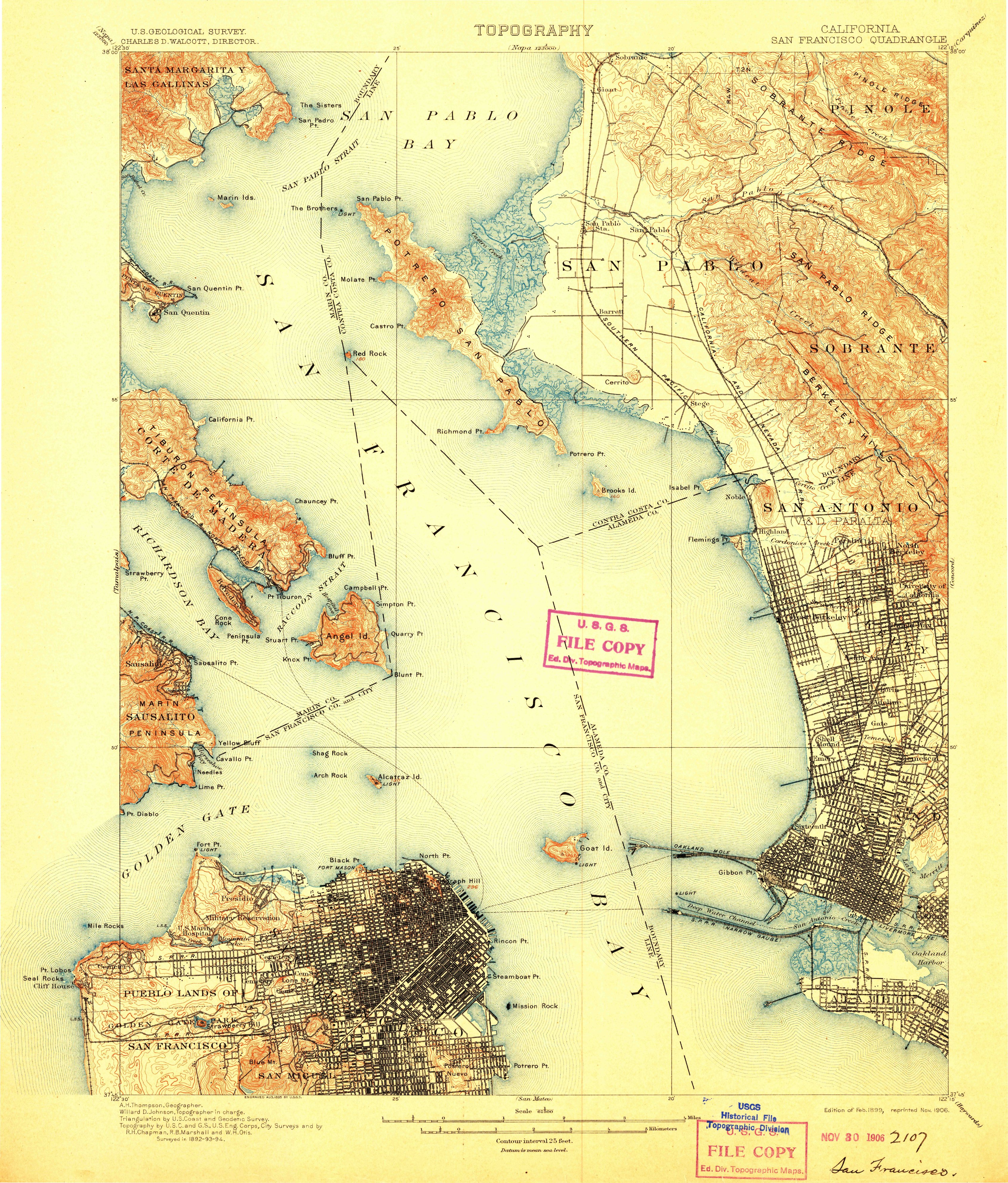
- U.S. Geological Survey, San Francisco topographic map (1899). The map at the top of this page, with the Golden Gate, Alcatraz and the Presidio labeled.
- National Park Service, Presidio of San Francisco. The Spanish arrival in 1776 to build the empire’s northernmost outpost in western North America.
Sponsored
Put this 1899 map on your wall
The 1899 USGS map of San Francisco Bay is in the public domain. Download the full-size scan for free, then have it printed on canvas with CanvasOnTheCheap.
Print a map on canvasDownload the full-size mapWe may earn a commission if you buy through this link. It never changes what we write. Read our affiliate disclosure
Sponsored
Want a local to show you around?
Book a private tour of San Francisco with a local guide on GoWithGuide. Each tour is just for your group, and you can change the plan with your guide before you go.
See private tours in San FranciscoWe may earn a commission if you buy through this link. It never changes what we write. Read our affiliate disclosure
Sponsored
Live in the Bay Area with kids?
GetOut sells a yearly membership for family attractions around the Bay Area and Northern California. Check which places are included before you buy, and keep in mind it renews automatically every year unless you turn renewal off in your account.
See GetOut Northern CaliforniaWe may earn a commission if you buy through this link. It never changes what we write. Read our affiliate disclosure
Spot something wrong, or know more? Tell us here. You can also email us or use our contact page. Corrections are noted here with their date, never made silently.