Bemidji, Minnesota: The Lake the Mississippi Cuts Across
Bemidji is named for Lake Bemidji. MNopedia spells its Ojibwe name Bemijigamaag and translates it as water running crosswise through the lake, for the Mississippi flowing across it. Upham (1920) says the city was named for a chief who carried the lake's name; the city says settlers mistook the lake's name for his.
When settlers reached Bemidji, Minnesota, in 1888, an Ojibwe man told them the name of the lake, and they took it for his own name, later accounts say. The man was Shaynowishkung. The settlers called him Chief Bemidji, and the lake’s name, cut short, became the name of the town.
The lake the river crosses
Start with the water. Upham describes Lake Bemidji as “crossed by the Mississippi,” and the lake’s Ojibwe name is a description of that crossing.
Warren Upham’s Minnesota Geographic Names, published by the Minnesota Historical Society in 1920, quotes Gilfillan’s translation: “the lake where the current flows directly across the water, referring to the river flowing squarely out of the lake on the east side, cutting it in two as it were, very briefly Cross lake.” MNopedia, the society’s online encyclopedia, spells the Ojibwe name Bemijigamaag and translates it as “water running crosswise through the lake.” The state park’s history spells it bemidjigamaag. The city’s own page gives “lake with cross waters.”
Upham found the same word elsewhere in Minnesota. Cross Lake in Pine County, he writes, is “a translation of its Ojibway name, Bemidji,” because the Snake River crosses it, and the name of Cross Lake in Crow Wing County means “the same as Lake Bemidji.” So you can drive to two other lakes in the state that carry this name in English.
Pamitchi Gumaug on the old maps
Explorers wrote the name down long before any town was here. In the narrative of his 1832 expedition to Lake Itasca, published in 1834, Schoolcraft wrote the lake as “Pamitchi Gumaug or Lac Travers,” Upham reports. On Nicollet’s map of 1843, it’s “Pemidji L.” Whatever the spelling, the river running through it is the Mississippi, the same river that later runs through Minneapolis.
Schoolcraft also named the smaller lake just south, Lake Irving, for the writer Washington Irving. Upham notes that the early settlers often called it Little Bemidji lake, a name that later dropped out of use.
Shaynowishkung and the 1888 mix-up
The people who lived on the south shore were Ojibwe. Upham says the band numbered about fifty and had their homes “on and near the south end of Lake Bemidji and around Lake Irving, including the site where white settlers founded this town.”
The Minnesota Department of Natural Resources tells the meeting this way in its state park history: in 1888, homesteaders met the Ojibwe elder Zhenaawishkang, also spelled Shaynowishkung, who “tells the settlers the name of the lake is bemidjigamaag (bay-midge-ih-gum-awg). They call it Lake Bemidji for short.”
The City of Bemidji’s page goes a step further. “When Shaynowishkung shared the name of Lake Bemijigamaag (lake with cross waters), the settlers thought he was sharing his name, so they mistakenly named the new village Bemidji after him.” MNopedia, in an article by Peter J. DeCarlo, agrees that the settlers misunderstood and “thought he was giving them his own name,” and adds that “some sources state that later on they named the city of Bemidji after him.”
Upham is one of those sources. Writing in 1920, he says flatly that “Bemidji township and city were named for an Ojibway chief” and that “His name was taken from the older Ojibway name of this lake.” Either way, the town’s name goes back to the lake’s.
He Who Rattles
His real name has its own meaning. MNopedia translates Shaynowishkung as “He Who Rattles” and says he carried zhiishiigwan, rattles shaken to ward off negativity; the city’s page shortens it to “He Rattles.” MNopedia also says he “was not a traditional chief, but a spokesman for about fifty Ojibwe people.”
The sources part ways on where he ended up. The state park history says the U.S. government removed his family to the Leech Lake Reservation, while the city says he was forced onto his allotment on the Cass Lake Reservation. The city adds that he died of pneumonia in 1904, and Upham dates his death to April 1904, at the age of 85.
Three statues
Bemidji has put up three statues of him. MNopedia says a lumberjack carved a wooden statue of him in 1901, and a second statue replaced it in 1952. Some residents were proud of it; others saw an offensive caricature.
The third came out of six years of work by a committee of about half Native and half white members. Sculptor Gareth Curtiss made it in bronze, 9 feet 3 inches (2.8 m) tall, with Shaynowishkung’s rattles, his diamond willow cane and his pipe. It was dedicated in Library Park on June 6, 2015. Both older statues went to the Beltrami County History Center, MNopedia notes.
Upham gives the date for the town itself: Bemidji was incorporated as a village on May 20, 1896. The state park history calls it the first city along the Mississippi River.
The 1954 map
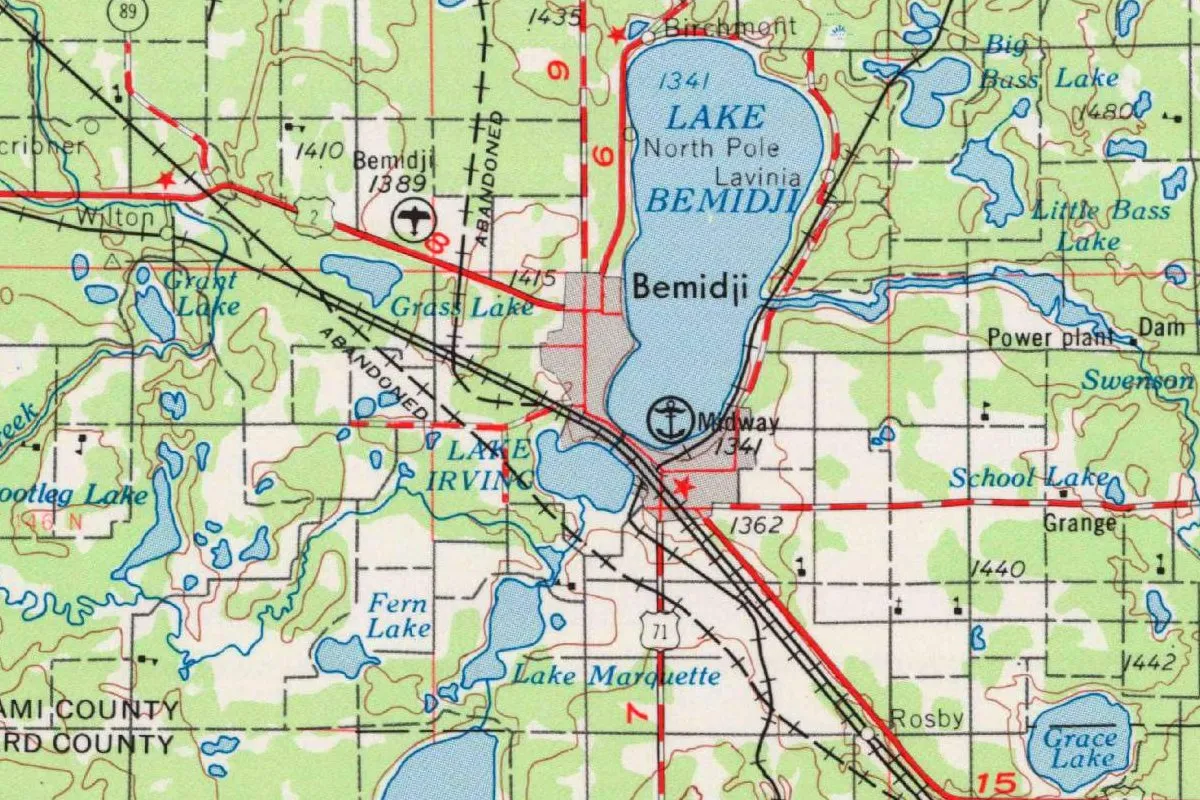
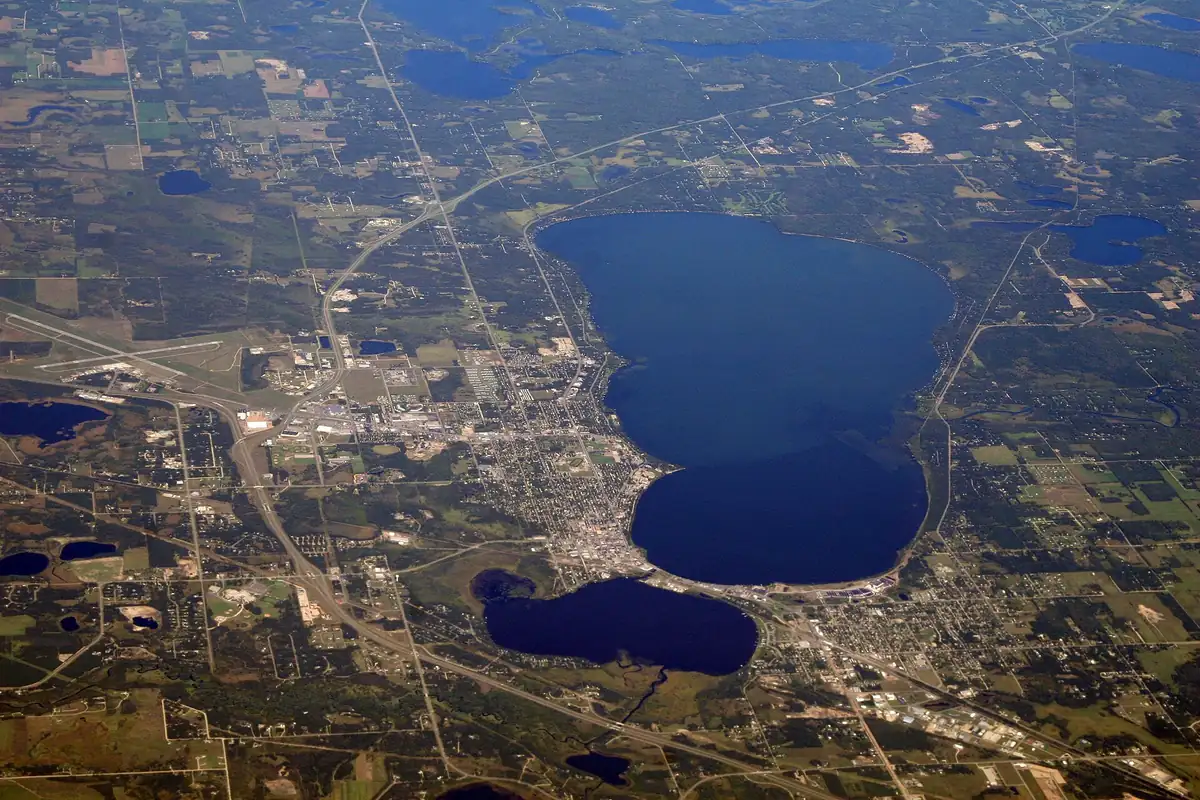
The map at the top of this page is the oldest Geological Survey sheet named for Bemidji, from 1954, at a scale of 1:250,000. It shows the city as a gray patch on the southwest shore of LAKE BEMIDJI, with LAKE IRVING tucked below it and the river leaving the lake on the east side past a power plant and dam. You can see the same pair of lakes from the air in the photo below.
Quick answers
What does Bemidji mean?
Water that crosses the lake. MNopedia translates the Ojibwe Bemijigamaag as “water running crosswise through the lake,” and Upham quotes Gilfillan’s “very briefly Cross lake,” for the Mississippi flowing through it.
Is Bemidji named after a chief?
Some sources say so. Upham (1920) says the city was named for an Ojibwe chief whose name came from the lake, and the city says settlers mistakenly named the village after Shaynowishkung, taking the lake’s name for his. MNopedia says only that “some sources” make that claim.
Who was Chief Bemidji?
Shaynowishkung, an Ojibwe man who lived on the south shore of Lake Bemidji and died in 1904. MNopedia says he was a spokesman for about fifty Ojibwe people rather than a traditional chief.
Key dates
- 1832Schoolcraft's expedition to Lake Itasca; his 1834 narrative writes the lake as Pamitchi Gumaug or Lac Travers, Upham reports.
- 1843Nicollet's map labels the lake Pemidji L.
- 1888Settlers arrive and Shaynowishkung tells them the lake's name, according to the state park and MNopedia.
- 1896Bemidji is incorporated as a village on May 20, Upham writes.
- 1901A wooden statue of Shaynowishkung, carved by a lumberjack, goes up in Bemidji.
- 1904Shaynowishkung dies; Upham gives April 1904 and an age of 85.
- 1952A second statue replaces the 1901 one.
- 2015A bronze statue of Shaynowishkung by Gareth Curtiss is dedicated in Library Park on June 6.
Things to do in Bemidji, Minnesota
Paul Bunyan and Babe the Blue Ox
The statues of the legendary lumberjack and his blue ox stand on the shore of Lake Bemidji at the Tourist Information Center, which also shows Paul Bunyan memorabilia and the Fireplace of States, built with 900 rocks from every state and every Canadian province.
Shaynowishkung (Chief Bemidji) statue
A bronze statue honoring Shaynowishkung, known as Chief Bemidji, and the Anishinabe people stands in Library Park, overlooking Lake Bemidji.
Bog Walk, Lake Bemidji State Park
A quarter-mile (0.4 km) boardwalk leads into a conifer bog with pitcher plants, sphagnum moss and orchids, with signs to help you name them. It's a one-mile (1.6 km) hike to reach the boardwalk.
Bemidji Sculpture Walk
Since 1999, more than 25 sculptures by area artists have been set out along the lake and through downtown. The lineup changes every year, and the walk starts at the Tourist Information Center.
Beltrami County History Center
The Beltrami County Historical Society's museum tells the county's story in the Great Northern Depot, built in 1912, at 130 Minnesota Avenue SW.
Getting there
Open Bemidji in Google Maps
Opens in a new tab. The pin is the center of Bemidji in the USGS place-name record.
The closest airports, Amtrak stations and intercity bus stops, measured in a straight line from the center of Bemidji.
Airports
- Bemidji Regional (BJI) 4 mi 6 km
- Brainerd Lakes Regional (BRD) 82 mi 132 km
Amtrak trains
- Detroit Lakes station (DLK) 64 mi 103 km
- Staples station (SPL) 77 mi 125 km
Intercity buses
- Jefferson Lines Bemidji (Bemidji State Univ.) 1 mi 2 km
Distances are as the crow flies, not by road. We don't list schedules or fares because they change; check with the airline, Amtrak or the bus company before you go. Official data (FAA commercial service airports (2025), FAA airport locations, Amtrak stations and Intercity Bus Atlas) from the FAA and the U.S. Bureau of Transportation Statistics, checked Nov 16, 2026.
Sponsored
Staying in Bemidji?
Compare hotels in Bemidji, Minnesota, on Expedia.
See hotels in BemidjiWe may earn a commission if you buy through this link. It never changes what we write. Read our affiliate disclosure
Historical Sources & References
- Warren Upham, Minnesota Geographic Names (1920), pp. 34-36. The village incorporation on May 20, 1896 (p. 34), and on p. 36 the band of about fifty, the chief’s death in April 1904, and Gilfillan’s translation. Checked against the page image. Cross Lake in Crow Wing County (p. 161) and Pine County (p. 413) comes from the same book.
- Warren Upham, Minnesota Geographic Names (1920), pp. 41-42. Schoolcraft’s “Pamitchi Gumaug or Lac Travers,” Nicollet’s “Pemidji L.” and Lake Irving, once Little Bemidji lake. Checked against the page image.
- Minnesota DNR, Lake Bemidji State Park, “History”. The 1888 meeting with Zhenaawishkang (Shaynowishkung), the name bemidjigamaag and its pronunciation, the Leech Lake Reservation and the first city on the Mississippi.
- City of Bemidji, “A Little History”. “He Rattles,” “lake with cross waters,” the settlers’ mistake, the Cass Lake Reservation and his death in 1904.
- Peter J. DeCarlo, “Shaynowishkung (Chief Bemidji) Memorial, Bemidji,” MNopedia (2021). “He Who Rattles,” the zhiishiigwan, “water running crosswise through the lake,” “some sources state,” and the statues of 1901, 1952 and 2015, with the bronze 9 feet 3 inches (2.8 m) tall.
- Paul Bunyan & Babe; Chief Bemidji; Sculpture Walk; Lake Bemidji State Park things to do; Beltrami County History Center. The details in the things-to-do list, including the quarter-mile (0.4 km) Bog Walk.
- GNIS feature 655325 (U.S. Geological Survey). Where the federal names database places Bemidji, in Beltrami County.
- U.S. Geological Survey, Bemidji sheet (1954). The 1:250,000 map that the image at the top of this page was cropped from.
Spot something wrong, or know more? Tell us here. You can also email us or use our contact page. Corrections are noted here with their date, never made silently.