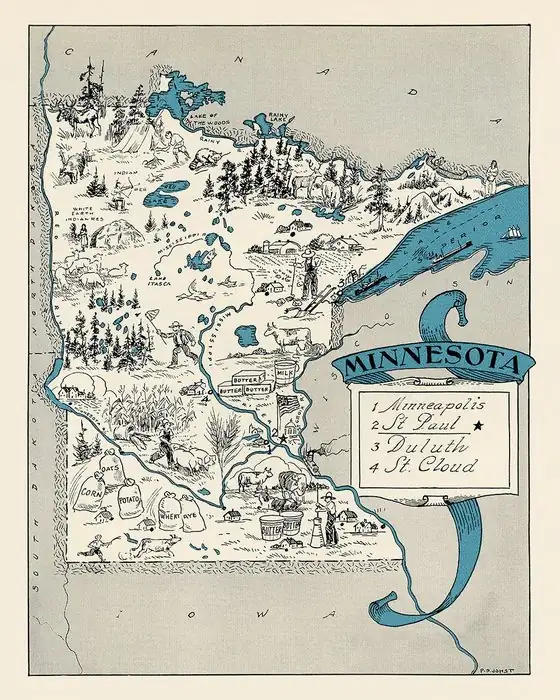
Why Is It Called Stillwater, Minnesota? Calm Water and Maine
John McKusick proposed the name Stillwater in 1843, when he and three partners formed the Stillwater Lumber Company to build a sawmill near the head of Lake St. Croix. An 1881 county history gives three reasons: the stillness of the lake, the oddity of a mill beside still water, and fond memories of Stillwater, Maine.
A name picked for a sawmill
John McKusick named Stillwater in 1843 for the calm water of Lake St. Croix, the oddity of a sawmill on still water, and memories of Stillwater, Maine. When he suggested it, nobody was planning a town at all, just a mill.
The story comes from Edward D. Neill’s History of Washington County and the St. Croix Valley, published in 1881, while McKusick was still alive. Neill says McKusick had left Cornish, Maine, and that a man named Jacob Fisher had found a good mill site on the St. Croix but couldn’t build on it himself. McKusick went down to St. Louis, met his partners Elias McKean and Calvin F. Leach, bought the outfit for a sawmill, and brought it up the Mississippi by steamboat. The party landed “at the site of Stillwater, October 11th, 1843.” They agreed to pay Fisher $300 for his claim and hire him as millwright.
Then, Neill writes, came the part you’re here for:
“Then came the question of a name; ‘What shall we call the place?’ All proposed a name, but the name of Stillwater, proposed by John McKusick, was adopted. This name was suggested by the stillness of the water in the lake, the anomaly of building a mill beside still water, and by fond recollections of Stillwater, Maine.”
That’s three reasons packed into one sentence. Neill calls the second one an “anomaly,” and a page earlier he shows how they meant to get around it: on the bluff, the men agreed that “Brown’s creek could be turned into the lake above,” with a canal to carry the water down to the mill site.
The company came first
Neill also copied the agreement the partners signed on October 26, 1843. There was no lawyer in the group, he says, so they dictated it to one of the workers, and it was copied later. Neill calls it the first articles of agreement made on ground that, by the time he wrote, lay inside Stillwater’s city limits, and the name is right there in the first article:
“Article first. It is understood by this agreement, that the heretofore named individuals form themselves into a company to continue and exist by the name of the Stillwater Lumber Company.”
The partners were John McKusick, Elias McKean, Elam Greeley and Calvin F. Leach, and the company’s purpose was “building a saw-mill near the head of Lake St. Croix, Wisconsin territory.” So on paper, the mill was going up in Wisconsin Territory.
That helps explain why Henry Gannett’s 1905 federal bulletin on place names tells it a little differently. Gannett says Stillwater was “named for a lumber company which selected this site for its mill.” He isn’t wrong, exactly: the company carried the name before any town did. But Neill’s account, written closer to the people involved, says where the company’s name came from in the first place. Warren Upham’s 1920 place-name dictionary follows Neill and dates the adoption of McKusick’s name to October 26, the same day as the agreement.
Maine, but not his hometown
Some retellings make Stillwater, Maine, McKusick’s hometown. Upham says McKusick was born in Cornish, Maine, on December 18, 1815. Stillwater, Maine, is a different place, and Neill only speaks of “fond recollections” of it. Neither book explains what tied McKusick to it, so it’s best left as a fond memory, not a birthplace.
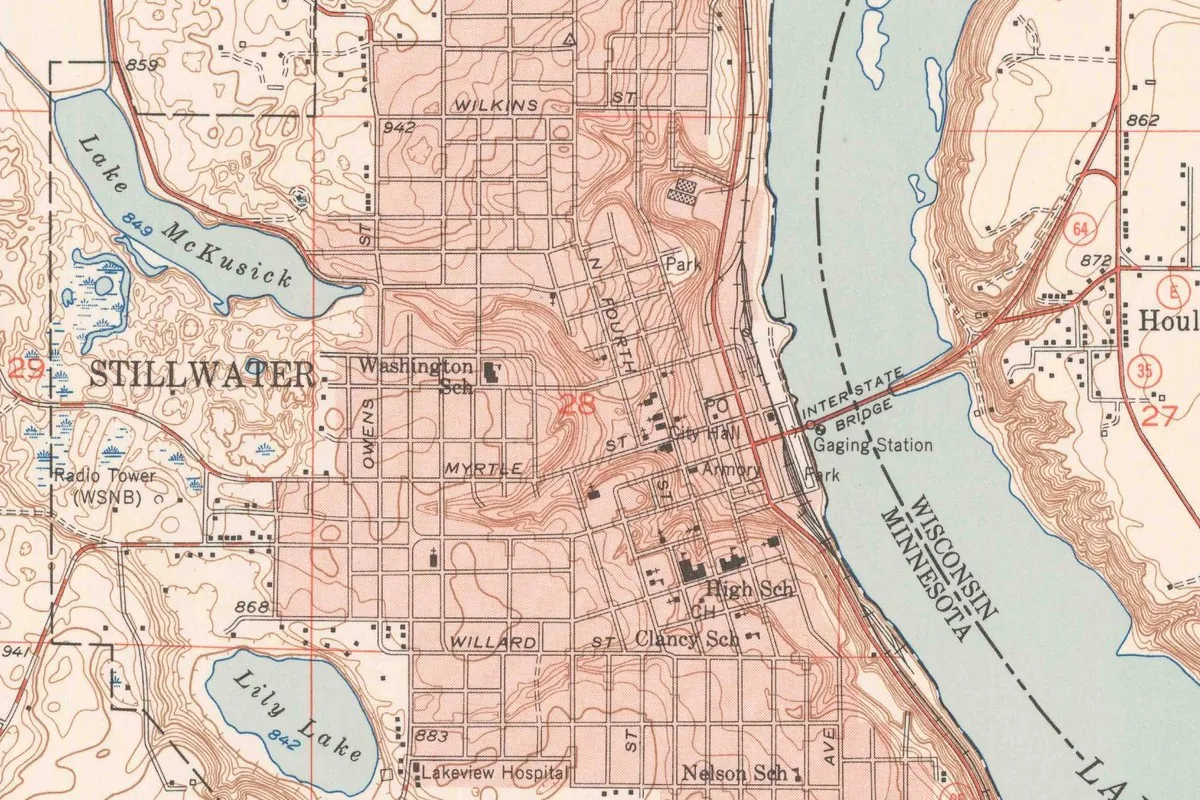
McKusick stayed. Upham says he came to Minnesota in 1840, built the county’s first sawmill, served as a state senator from 1863 to 1866, and died in Stillwater on October 26, 1900, exactly 57 years after the name was adopted. Lake McKusick, which you can spot at the upper left of the 1951 map, is named for him.
He wasn’t the last Maine lumberman to come through. Upham says the Staples family arrived in Stillwater from Topsham, Maine, in 1853-54, and their logging and manufacturing interests later gave their name to Staples in Todd County.
Names before Stillwater
The site wasn’t empty of names before 1843. Upham says that between 1838 and 1841 Joseph R. Brown platted a townsite called Dahkotah on what’s now the north part of the city. And Neill, writing about the river rather than the town, says the St. Croix and Lake St. Croix were “always called by the Sioux, Hogan-wahnkay-kin, (the place where the fish lies.)” That’s his spelling and his translation, and it belongs to the water, not to the settlement.
The mill site grew into a town anyway. Upham says Stillwater was incorporated as a city on March 4, 1854, the same day as St. Paul.
Quick answers
Who named Stillwater, Minnesota?
John McKusick, a lumberman from Maine. Neill’s 1881 county history says that when the partners asked “What shall we call the place?” his proposal, Stillwater, was adopted.
Is Stillwater named after Stillwater, Maine?
Partly. Neill lists “fond recollections of Stillwater, Maine” as one of three reasons, next to the stillness of the lake and the oddity of a mill beside still water.
Was Stillwater named for a lumber company?
In a way. Gannett’s 1905 bulletin says so, and the Stillwater Lumber Company agreement is dated October 26, 1843. Neill and Upham say McKusick proposed the name, and Upham dates its adoption to that same day.
Key dates
- 1843October 11: John McKusick's party lands at the site with the outfit for a sawmill, per Neill's 1881 county history.
- 1843October 26: the Stillwater Lumber Company agreement is signed. Upham dates the adoption of McKusick's name Stillwater to the same day.
- 1854March 4: Stillwater is incorporated as a city, the same date as St. Paul, according to Upham.
- 1900October 26: John McKusick dies in Stillwater, 57 years to the day after the name was adopted.
Getting there
Open Stillwater in Google Maps
Opens in a new tab. The pin is the center of Stillwater in the USGS place-name record.
The closest airports, Amtrak stations and intercity bus stops, measured in a straight line from the center of Stillwater.
Airports
- Minneapolis-St Paul International/Wold-Chamberlain (MSP) 24 mi 38 km
- Chippewa Valley Regional (EAU) Eau Claire 66 mi 106 km
Amtrak trains
- St. Paul-Minneapolis station (MSP) 16 mi 25 km
- Red Wing station (RDW) 36 mi 58 km
Intercity buses
- FlixBus Hudson Wi 8 mi 12 km
- Jefferson Lines St. Paul (Union Depot) 16 mi 25 km
- Land to Air Express St. Paul (Union Depot) 16 mi 25 km
Distances are as the crow flies, not by road. We don't list schedules or fares because they change; check with the airline, Amtrak or the bus company before you go. Official data (FAA commercial service airports (2025), FAA airport locations, Amtrak stations and Intercity Bus Atlas) from the FAA and the U.S. Bureau of Transportation Statistics, checked Nov 13, 2026.
Sponsored
Staying in Stillwater?
Compare hotels in Stillwater, Minnesota, on Expedia.
See hotels in StillwaterWe may earn a commission if you buy through this link. It never changes what we write. Read our affiliate disclosure
Sponsored
Want the spooky side of Stillwater?
The name has its story above. For the ghost stories, US Ghost Adventures runs walking ghost tours in Stillwater.
See ghost tours in StillwaterWe may earn a commission if you book through this link. It never changes what we write. Read our affiliate disclosure
Historical Sources & References
- Edward D. Neill, History of Washington County and the St. Croix Valley (1881), pp. 177 and 498-500. McKusick leaving Cornish, Maine, and Jacob Fisher’s mill site (pp. 498-499); the landing of October 11, 1843, the $300 paid to Fisher, the plan to turn Brown’s creek into the lake above (p. 499), the naming paragraph and the agreement of October 26, 1843, with its first article (p. 500); the Sioux name for the river and lake (p. 177).
- Warren Upham, Minnesota Geographic Names (1920), pp. 546, 571 and 573. Adoption of the name on October 26, 1843, incorporation on March 4, 1854, and Joseph R. Brown’s Dahkotah townsite of 1838-41 (p. 571); McKusick’s birth in Cornish, Maine, his arrival in 1840, first sawmill, senate term and death in 1900, and Lake McKusick (p. 573); the Staples family from Topsham, Maine (p. 546).
- Henry Gannett, The Origin of Certain Place Names in the United States (USGS, 1905), p. 291. Stillwater “named for a lumber company which selected this site for its mill.”
- GNIS feature 652642 (U.S. Geological Survey). How the city’s name is spelled, and Washington County as its home county.
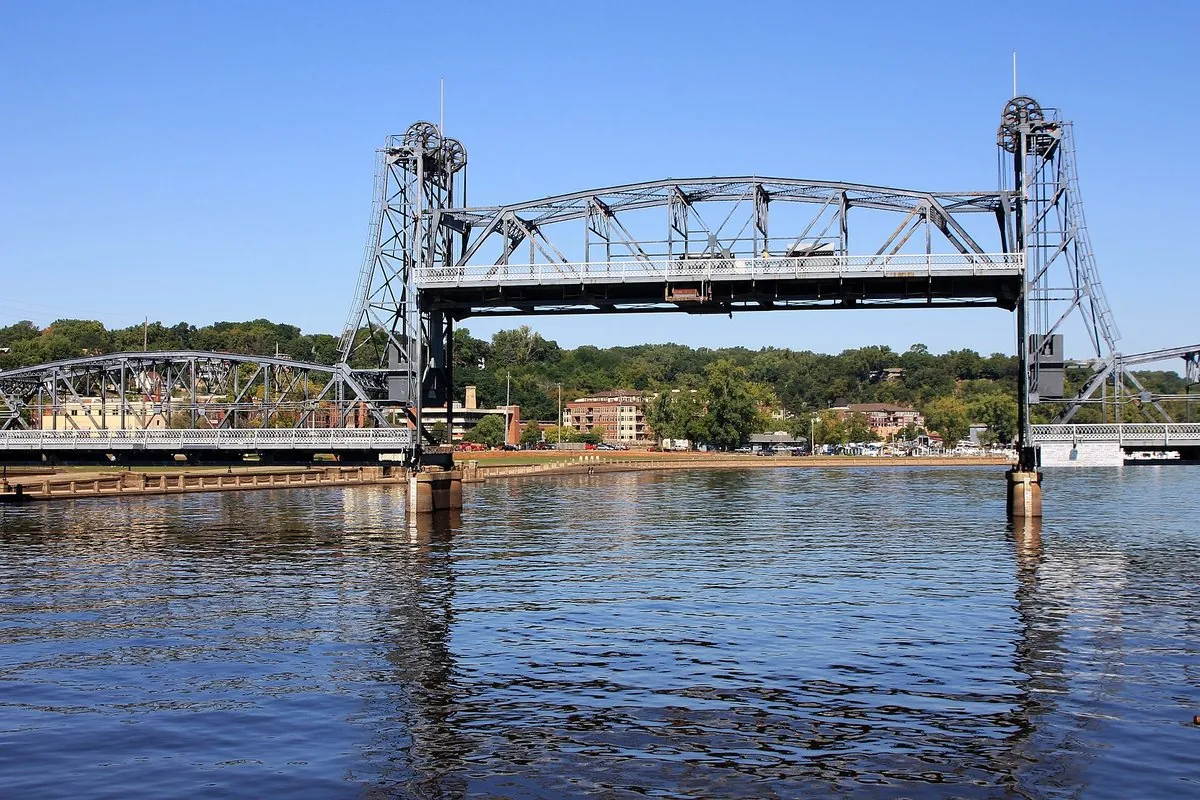
- U.S. Geological Survey, Stillwater sheet (1951). Quadrangle surveyed from 1949 air photos and field-checked in 1951; the crop shows the downtown grid, Lake McKusick and the bridge over to Wisconsin.
Spot something wrong, or know more? Tell us here. You can also email us or use our contact page. Corrections are noted here with their date, never made silently.