Red Wing, Minnesota: A Name Passed Down by Dakota Chiefs
Red Wing is named for the Mdewakanton Dakota chiefs called Red Wing, whose village stood at the foot of He Mni Caŋ, or Barn Bluff. Doane Robinson wrote in 1910 that at least four chiefs in succession bore the name. The best known, Tatanka Mani, or Walking Buffalo, moved his village there during the War of 1812, MNopedia says.
Red Wing, Minnesota, carries a name that wasn’t one man’s: a historian of the Sioux counted at least four Dakota chiefs in a row who bore it. So which Red Wing is the city named for? The sources point to a line of chiefs and to Tatanka Mani’s village, which settlers, MNopedia says, came to know as Red Wing. Two old accounts disagree on where the chief’s name itself came from, and you’ll find both below.
A name handed down
Warren Upham, compiling Minnesota Geographic Names for the Minnesota Historical Society in 1920, quoted Doane Robinson’s entry in the Handbook of American Indians (1910). Robinson called Red Wing “the name of a succession of chiefs of the former Khemnichan band of Mdewakanton Sioux, residing on the west shore of Lake Pepin, Minn., where the city of Red Wing now stands.” At least four of them bore it, he wrote, “each being distinguished by another name.”
The first one Robinson knew of was heard of as early as the time of Pontiac’s war and sided with the English in the Revolution. His son, Walking Buffalo, joined the British in 1812. The name passed down two more generations and, in Robinson’s words, “disappeared during the Sioux outbreak of 1862-65.”
Henry Gannett, putting together his 1905 Geological Survey list of American name origins, kept it short: “Redwing; city in Goodhue County, Minnesota, named for an Indian chief.” He didn’t say which.
Walking Buffalo
The Red Wing most people mean is Tatanka Mani, Walking Buffalo, born around 1755. MNopedia, the Minnesota Historical Society’s encyclopedia, says the immigrants who met him in the early 1800s “came to know him and his village as Red Wing,” and that his father was also known as Red Wing.
Zebulon Pike met him in 1805. According to Pike’s account, the French name for Tatanka Mani, “le Boeuf qui Marche,” was among the Dakota leaders at the treaty signed on September 23 of that year. Upham adds that Pike wrote the name “Talangamane” and also gave his titled name in French, “Aile Rouge,” with its English translation, Red Wing.
During the War of 1812 Tatanka Mani first fought for the British. MNopedia says that by February 1814 his band had come over to the Americans, and on July 19, 1815, he signed a treaty at St. Louis as “Tatangamanee, Walking Buffalo.” In those war years he moved his village south to the foot of He Mni Caŋ, the bluff in what is now downtown Red Wing. After the war, MNopedia says, Americans moving up the Mississippi stopped at Red Wing’s village.
A wing dyed scarlet
Where did the name itself come from? Upham quotes a letter Colonel William Colvill wrote to the geologist N. H. Winchell, printed in 1888. Colvill’s version turns Robinson’s around:
“Red Wing’s titular name was Wacouta—‘the shooter.’ This was always the head chief’s title,—the same as that of the chief who captured Hennepin. He had the name of Red Wing, Koo-poo-hoo-sha … from the swan’s wing, dyed scarlet, which he carried.” (Colvill, quoted in Upham, p. 208)
So the two accounts disagree on which name was the inherited title. For Robinson, Red Wing was the name that passed from chief to chief. For Colvill, the title was Wacouta, and Red Wing came from the scarlet swan’s wing the chief carried. Upham prints both without choosing. MNopedia’s list of readings even includes a 1964 manuscript titled “Who Was Red Wing?”
Other towns have the same trouble with a chief’s name. Decorah, Iowa, honors a family of Ho-Chunk chiefs, and its historians never fully settled which Decorah. Red Cloud, Nebraska, took the name of a Lakota war chief whose own country lay far to the north of the town.
After Red Wing
Tatanka Mani died on March 4, 1829. MNopedia says his surviving son was too ill to lead, so the band chose Wacouta, “Shooter,” his nephew or possibly stepson, by May 18, 1829. Hancock, quoted by Upham, called Wacouta the nephew of “Scarlet Wing” and said his uncle was buried on a bluff near Wabasha.
Upham says two Swiss missionaries, Samuel Denton and Daniel Gavin, opened a mission to the Dakota at Red Wing in 1837. After the treaties of 1851, MNopedia says, Wacouta and his band left Red Wing in 1853 for a reservation on the Minnesota River near present-day Morton. That same year, by Upham’s account, Red Wing was chosen as the county seat, and it was incorporated as a city on March 4, 1857. The Dakota name for the place, Upham adds, was Khemnicha, “the Hill-Water-Wood place,” for the high bluffs and the water and wood that made it a good camp. MNopedia gives the bluff’s Dakota name as He Mni Caŋ, Hill Water Wood, and says French explorers called it “La Grange,” the barn, which Americans turned into Barn Bluff.
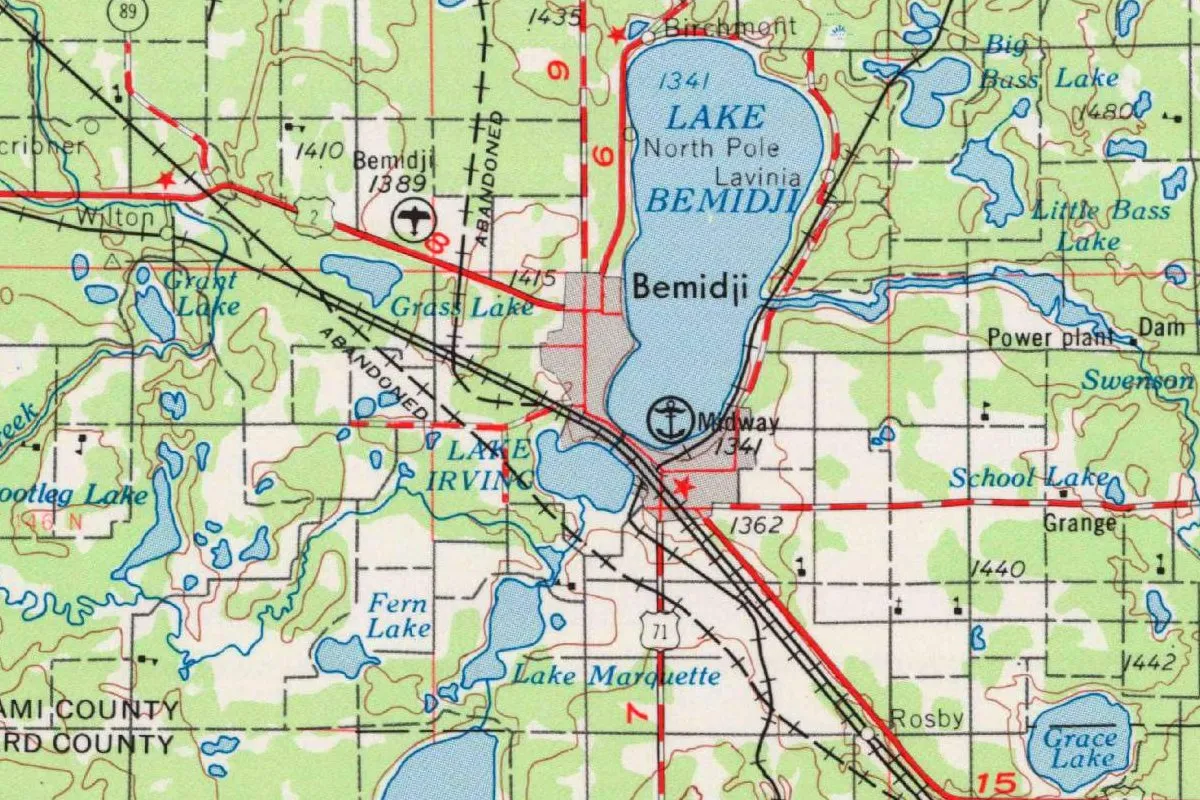
Upham’s 1920 book goes through Minnesota county by county, and for Red Wing it gives more space to the chiefs than to the settlers who came after them. In the same book, he says Bemidji was named for an Ojibwe chief, too, though the city tells that story differently.
Red Wing on the 1952 map
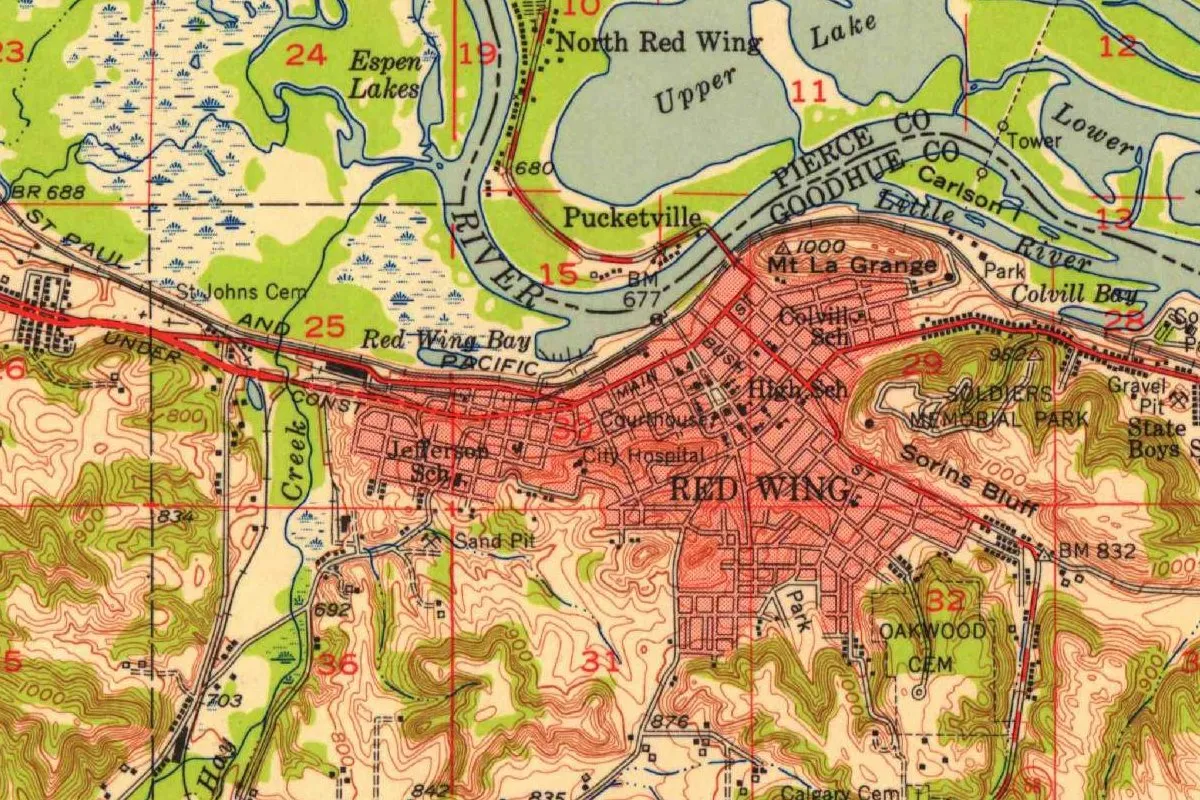
The map at the top comes from the Geological Survey’s Red Wing, Minnesota-Wisconsin sheet, dated 1952. The Minnesota side was mapped from aerial photographs taken in 1949 and field-checked in 1952, and the printer’s line in the margin, “WASHINGTON, D.C.—1954,” shows this copy was printed in 1954. An earlier sheet in the Survey’s collection, from 1944, leaves the Minnesota side of the river blank, so this is the oldest one we found that shows the city. You’ll see “RED WING” across a red-shaded grid along the Mississippi, with the Courthouse, the High School and City Hospital marked, Sorins Bluff and Soldiers Memorial Park to the east, and Red Wing Bay to the west. At the river’s edge stands a hill labeled “Mt La Grange,” with an elevation of 1,000 feet (305 m), a label that echoes the French name MNopedia gives for the bluff.
Quick answers
Who is Red Wing, Minnesota, named after?
The Mdewakanton Dakota chiefs called Red Wing. Doane Robinson wrote in 1910 that at least four chiefs in succession bore the name; the best known is Tatanka Mani, or Walking Buffalo, who died in 1829.
Why was the chief called Red Wing?
The sources differ. William Colvill wrote in 1888 that the name came “from the swan’s wing, dyed scarlet, which he carried,” while Doane Robinson treated Red Wing as a name handed from chief to chief. Pike gave it in French as “Aile Rouge.”
What does Tatanka Mani mean?
Walking Buffalo. Pike wrote it “Talangamane,” which Upham says should be written Tatanka mani, “Buffalo walking.”
What is the Dakota name for Red Wing?
Upham gives Khemnicha, “the Hill-Water-Wood place.” MNopedia gives the bluff’s name as He Mni Caŋ, Hill Water Wood.
Key dates
- 1805Tatanka Mani is present at Zebulon Pike's treaty of September 23, according to Pike's account.
- 1815He signs a treaty at St. Louis as "Tatangamanee, Walking Buffalo"; by then his village stands at the foot of He Mni Caŋ.
- 1829Tatanka Mani dies on March 4; his nephew or stepson Wacouta succeeds him.
- 1837Two Swiss missionaries open a mission to the Dakota at Red Wing, Upham writes.
- 1853Wacouta's band leaves Red Wing for a reservation on the Minnesota River; the town is chosen as county seat.
- 1857Red Wing is incorporated as a city on March 4.
- 1910Doane Robinson writes that at least four chiefs in succession bore the name Red Wing.
- 1952The Geological Survey issues its Red Wing sheet; the copy shown here was printed in 1954.
Things to do in Red Wing, Minnesota
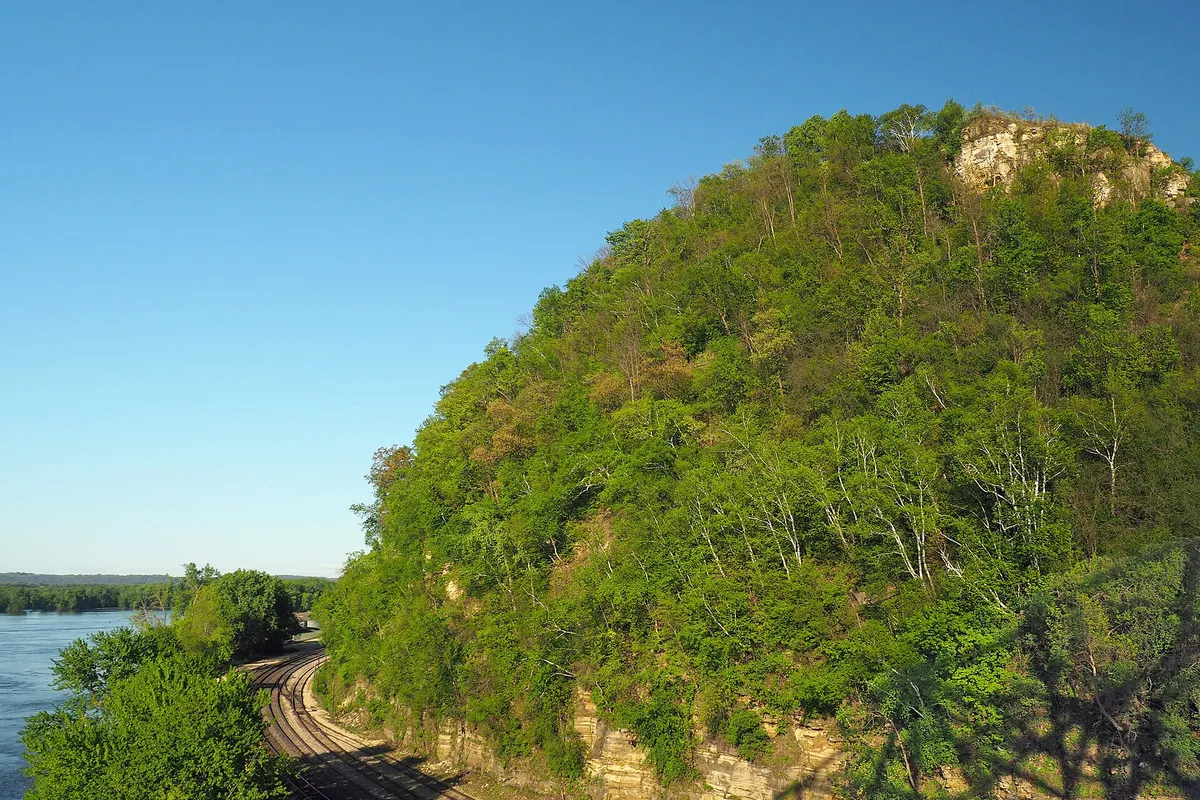
He Mni Caŋ-Barn Bluff
The city's riverside bluff, which it calls one of the best-known natural features on the upper Mississippi and a sacred site of the Bdewakantunwan Dakota Oyate of Prairie Island Indian Community, with a hiking trail open to visitors.
Goodhue County History Center
The county historical society's museum, in a large red brick building on a hill overlooking Red Wing and the Mississippi, with galleries on pioneer life, Native American culture and transportation in the region.
Pottery Museum of Red Wing
A museum on Harrison Street devoted to the town's clay industry, with more than 6,000 pieces of stoneware, art pottery and dinnerware across 13,000 square feet (about 1,200 square meters).
Sheldon Theatre
A theater built in 1904 with money Theodore B. Sheldon left the city, described as the second municipally owned theater in the country and the first west of the Mississippi, restored and reopened for live shows in 1988.
Getting there
Open Red Wing in Google Maps
Opens in a new tab. The pin is the center of Red Wing in the USGS place-name record.
The closest airports, Amtrak stations and intercity bus stops, measured in a straight line from the center of Red Wing.
Airports
- Minneapolis-St Paul International/Wold-Chamberlain (MSP) 40 mi 65 km
- Rochester International (RST) 45 mi 73 km
Amtrak trains
- Red Wing station (RDW) under 1 mi 0.5 km
- St. Paul-Minneapolis station (MSP) 38 mi 61 km
Intercity buses
- Jefferson Lines Cannon Falls 19 mi 31 km
- FlixBus Hudson Wi 29 mi 47 km
- Greyhound Menomonie WI - University of Wisconsin (MNM) 37 mi 59 km
Distances are as the crow flies, not by road. We don't list schedules or fares because they change; check with the airline, Amtrak or the bus company before you go. Official data (FAA commercial service airports (2025), FAA airport locations, Amtrak stations and Intercity Bus Atlas) from the FAA and the U.S. Bureau of Transportation Statistics, checked Nov 18, 2026.
Sponsored
Staying in Red Wing?
Compare hotels in Red Wing, Minnesota, on Expedia.
See hotels in Red WingWe may earn a commission if you buy through this link. It never changes what we write. Read our affiliate disclosure
Historical Sources & References
- Warren Upham, Minnesota Geographic Names (1920), pp. 207-209. The mission of 1837, the county seat of 1853 and the city of 1857; Doane Robinson’s entry on the succession of chiefs; Colvill’s letter on Wacouta and the scarlet swan’s wing; Pike’s “Talangamane” and “Aile Rouge”; Khemnicha; Hancock on Wacouta and “Scarlet Wing.” Checked against the page image.
- MNopedia, “Tatanka Mani (Walking Buffalo), ‘Red Wing’”. His father, Pike’s treaty of 1805, the War of 1812, the treaty of July 19, 1815, the move to He Mni Caŋ, and his death on March 4, 1829.
- MNopedia, “Wacouta I (Shooter)”; “He Mni Caŋ–Barn Bluff”. Wacouta’s election in 1829 and the band’s move in 1853; the bluff’s Dakota, French and English names.
- Henry Gannett, The Origin of Certain Place Names in the United States (1905), p. 260. “Redwing; city in Goodhue County, Minnesota, named for an Indian chief.”
- City of Red Wing, He Mni Caŋ-Barn Bluff; Goodhue County Historical Society; Pottery Museum of Red Wing; Sheldon Theatre. The details in the things-to-do list.
- U.S. Geological Survey, GNIS feature 649885. Red Wing’s listing in the federal names database, in Goodhue County, with its coordinates.
- Red Wing sheet, 1952, printed 1954. The sheet the map at the top was cropped from, mapped, edited and published by the Geological Survey, with the Minnesota side mapped in cooperation with the state’s Department of Conservation.
Spot something wrong, or know more? Tell us here. You can also email us or use our contact page. Corrections are noted here with their date, never made silently.