Winona, Minnesota: The Dakota Name That Replaced Montezuma
Winona comes from a Dakota name for a first-born daughter, which Visit Winona spells Winuŋna. The town was platted in 1852 as Montezuma. Henry D. Huff later said he crossed that name out and wrote Winona on the plat, and a public meeting picked Winona for the post office by a single vote.
Winona, Minnesota, carries a Dakota name for a first-born daughter, and it replaced Montezuma, the name one of its first proprietors gave it in 1852. Two old accounts tell how the switch happened, and the 1883 county history admits nobody was sure who suggested the new name first.
Wabasha’s Prairie
Before it was a town, the place was a prairie on the Mississippi. Visit Winona, the city’s tourism office, says riverboat captains found a sandbar prairie marked only as Island 72, and that in 1851 Capt. Orrin Smith started the first white settlement there and named it Wapasha’s Prairie for the Dakota chief whose band lived there. Warren Upham’s Minnesota Geographic Names (1920) adds that the French called the site La Prairie aux Ailes, “presumably because of its having been occupied by members of Red Wing’s band.” The chiefs of that band are the ones behind the name of Red Wing, Minnesota, up the river.
Montezuma on the plat
The town began with an Aztec name. The History of Winona County, published in 1883, says that when John Ball surveyed the townsite of Smith and E. H. Johnson, “it was given the name of Montezuma, by E. H. Johnson,” and that Johnson stayed “extremely tenacious of the name” and fought the change. Upham dates the plat June 19, 1852, and says Ervin H. Johnson named it for Montezuma, the Aztec ruler.
The post office got the same name. The county history says a lawyer in La Crosse, drawing up the petition with the approval of some members of the settlers’ claim club, “inserted Montezuma as the name of the postoffice,” and put forward a La Crosse man, George G. Barber, for postmaster. The settlers didn’t like a postmaster who lived thirty miles (48 km) away, and the book says they found the name “equally objectionable.”
One vote for Winona
The county history gives two stories of the switch. In one, it quotes a newspaper article in which Henry D. Huff, who bought into the townsite in 1853, remembered it this way: “With the consent of Capt. Smith I erased the name of Montezuma and inserted the name of Winona on the plot.” The register recorded it as Montezuma anyway, Huff said, because Johnson wanted it, “adding a note that the proprietors had changed it to Winona.” Upham sums it up as a change made “through request of Henry D. Huff.”
In the other, a public meeting took up the post office. Winona, Wabasha, Wabasha City, Prairie and Ozelle were all proposed, and “the name of Winona was adopted by a majority of one when the vote was taken.” The book admits it’s “now uncertain who first suggested the name of Winona.” Some said Captain Smith, others Dr. John L. Balcombe, others Dr. Childs, who was known for naming places and his animals. Balcombe, it adds, “was always anxious to have a Dakota name given to the town.” Upham says the name went on the village about a year before Winona County was established on February 23, 1854, and that the city was incorporated on March 6, 1857.
Elsewhere in Minnesota, Mankato took a Dakota name in 1852 too, though a 1909 county history says the man who suggested it was thinking of a water spirit in a German tale.
What Winona means
Upham gives the meaning through Prof. A. W. Williamson, who said that among the Dakota the name went to the “first born, if a daughter, diminutive of wino, woman,” while a first-born son was Chaska. Visit Winona and the Winona County History Center both give the word as Winuŋna, “first-born who is a daughter.” Visit Winona adds the pronunciation, wee-NEW-nuh, and older spellings such as Wenonah, Weenona and Wynona. Henry Gannett, in his 1905 A-to-Z of American names for the Geological Survey, put it as “A Sioux Indian word meaning ‘first-born daughter.’”
Upham also says the county was named for a particular Dakota woman called Winona, a cousin of Wabasha, the last chief of that name. Both of them, he writes, played a prominent role when the Winnebago were moved from Iowa to Wabasha’s Prairie in 1848.
The legend of the maiden
There’s a separate story about the name, and Upham keeps it separate too. He writes that William Keating, who wrote the narrative of Stephen Long’s 1823 expedition, told of “a Dakota maiden named Winona” who leaped to her death from “the Maiden’s Rock,” on Lake Pepin’s east shore, rather than marry a man she didn’t love. Hanford L. Gordon retold it in a poem called “Winona” in 1881 and moved her home elsewhere. The 1883 county history and Upham don’t say the town was named for this maiden. A leap from a cliff is also at the center of the legend in Blowing Rock, North Carolina, where the town’s history tells of a brave who jumped from the gorge’s edge and was blown back to the woman he loved.
A planned name gave way in Waco, Texas, too: a 1912 sketch of that city’s history says it was supposed to be called Lamartine before the name Waco Village was chosen.
You can see the Wenonah statue in Windom Park. Visit Winona says Isabel Kimball sculpted it in 1902.
Winona on the 1934 map
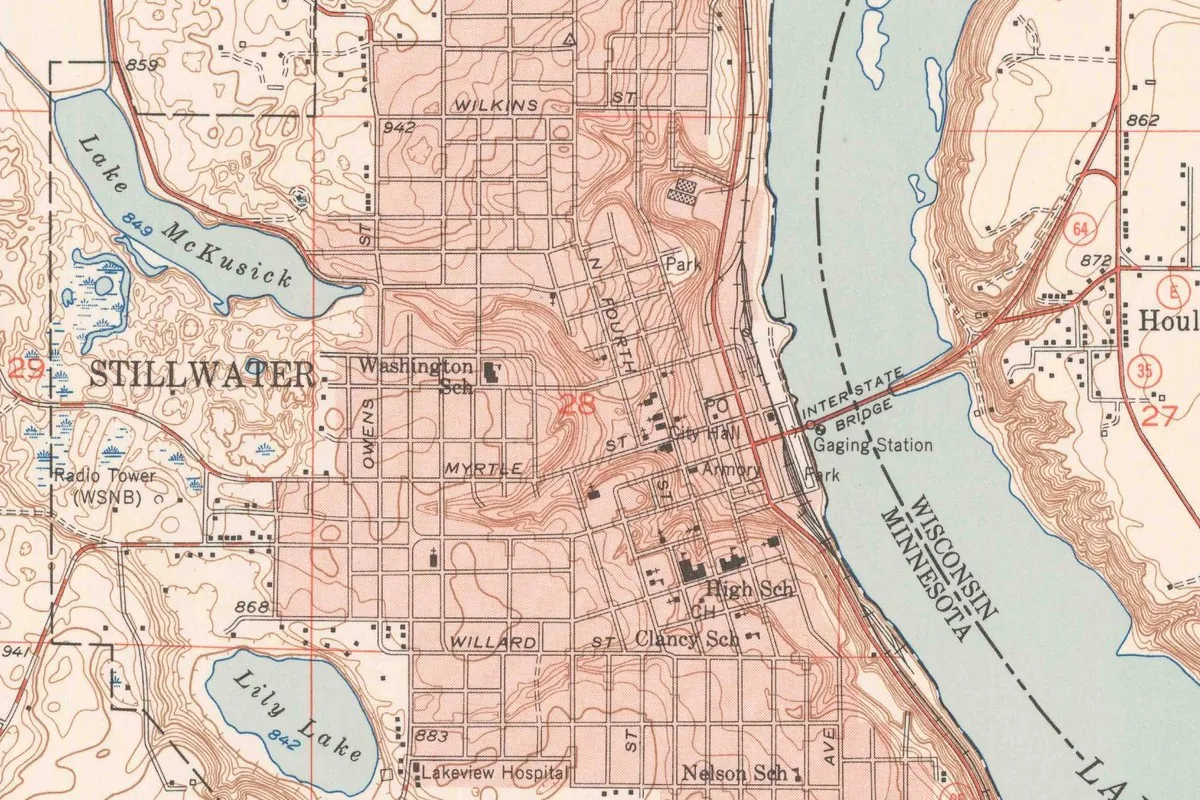
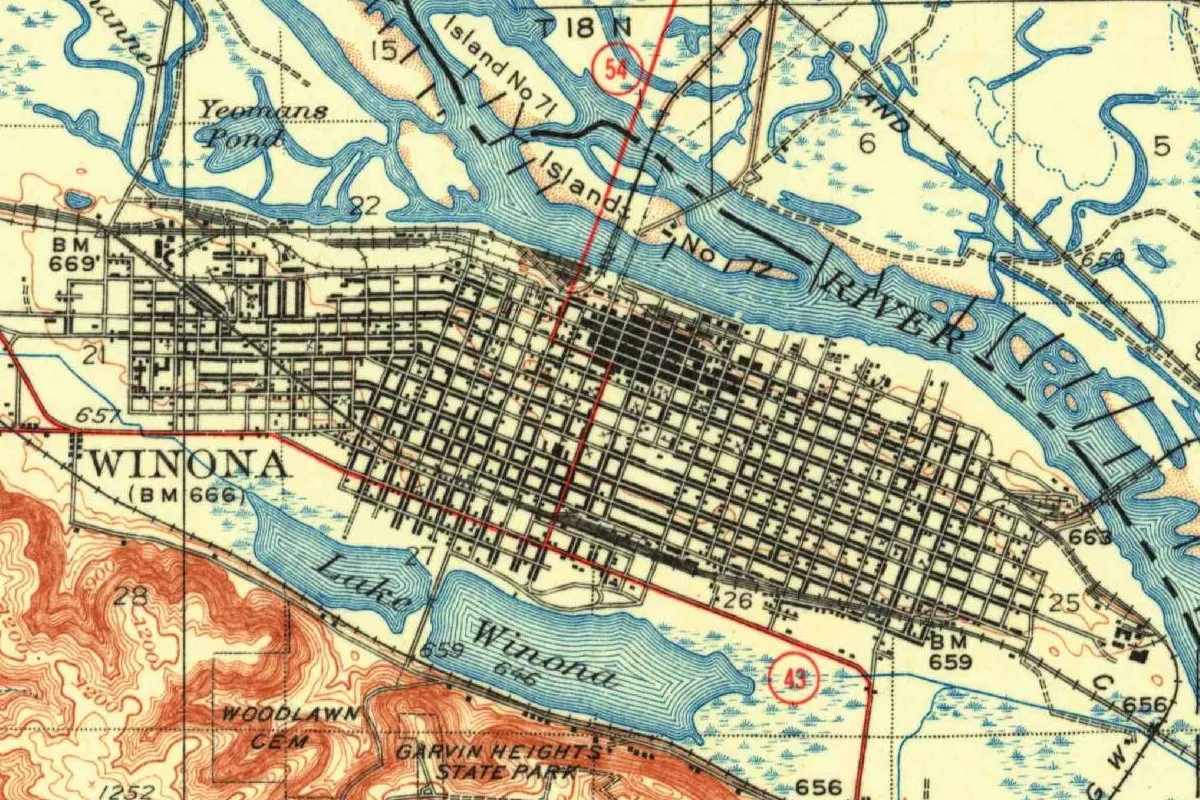
The map at the top of this page is a detail of the U.S. Geological Survey’s Winona sheet, Wisconsin-Minnesota, at 1:62,500, made with the Wisconsin Geological and Natural History Survey. Its margin credits topography to C. P. McKinley, H. E. Simmons and V. E. Barnes, notes that culture and drainage were partly compiled from Army Air Corps aerial photographs, and says the area was “Surveyed in 1926 and 1934.” It’s the 1934 edition, but the printer’s line reads “WASHINGTON, D.C. 1955,” so this copy was printed in 1955.
In the detail, you’ll find Winona’s dense street grid between the river and Lake Winona, with bench mark 666. The river islands are numbered, including Island No 71 and No 72, and Yeomans Pond sits north of town. Routes 54 and 43 cross town, and on the bluffs to the south are Woodlawn Cemetery and Garvin Heights State Park. Contour lines are drawn every 20 feet (6 m).
Quick answers
What does Winona mean?
Upham, citing A. W. Williamson, gives it as a Dakota name for a first-born child if a daughter. Visit Winona spells the word Winuŋna, “first-born who is a daughter.”
What was Winona’s original name?
Montezuma, the name E. H. Johnson gave the townsite in 1852. The site itself was known as Wabasha’s or Wapasha’s Prairie.
Who named Winona?
The 1883 county history says no one was sure. Henry D. Huff said he wrote Winona on the plat, and the post office name was chosen at a public meeting by one vote.
Key dates
- 1823William Keating's narrative of Stephen Long's expedition of this year tells of "a Dakota maiden named Winona" who leaped from Maiden Rock.
- 1851Capt. Orrin Smith starts the first white settlement on the prairie, which he calls Wapasha's Prairie.
- 1852John Ball surveys the townsite, which E. H. Johnson names Montezuma; it is platted on June 19, and the post office also gets the name Montezuma.
- 1853Henry D. Huff buys an interest in the townsite and, by his account, writes Winona on the plat in place of Montezuma.
- 1854Winona County is established on February 23.
- 1857Winona is incorporated as a city on March 6.
- 1902Isabel Kimball sculpts the bronze Wenonah statue for the Landon Fountain in Windom Park.
Things to do in Winona, Minnesota
Winona County History Center
The Winona County Historical Society's museum, with exhibits on the river in its River Gallery, including a display about the Stay Afloat boathouse.
Minnesota Marine Art Museum
An art museum on the river with historic and contemporary works that take water as their subject.
Landon Fountain and the Wenonah statue
A bronze Wenonah sculpted by Isabel Kimball of New York in 1902, set in the Landon Fountain in Windom Park; William Landon commissioned it in memory of his wife, Ida.
Sugar Loaf
The rock pinnacle on the bluff above town that Visit Winona calls the city's best-known landmark, with hiking and climbing nearby.
Getting there
Open Winona in Google Maps
Opens in a new tab. The pin is the center of Winona in the USGS place-name record.
The closest airports, Amtrak stations and intercity bus stops, measured in a straight line from the center of Winona.
Airports
- La Crosse Regional (LSE) 22 mi 36 km
- Rochester International (RST) 44 mi 71 km
- Minneapolis-St Paul International/Wold-Chamberlain (MSP) 97 mi 156 km
Amtrak trains
- Winona station (WIN) under 1 mi 0.6 km
- La Crosse station (LSE) 25 mi 40 km
Intercity buses
- Jefferson Lines Winona St. University under 1 mi 0.6 km
- Land to Air Express Rochester 41 mi 66 km
- FlixBus Eau Claire McDonald's 55 mi 88 km
Distances are as the crow flies, not by road. We don't list schedules or fares because they change; check with the airline, Amtrak or the bus company before you go. Official data (FAA commercial service airports (2025), FAA airport locations, Amtrak stations and Intercity Bus Atlas) from the FAA and the U.S. Bureau of Transportation Statistics, checked Nov 18, 2026.
Sponsored
Staying in Winona?
Compare hotels in Winona, Minnesota, on Expedia.
See hotels in WinonaWe may earn a commission if you buy through this link. It never changes what we write. Read our affiliate disclosure
Historical Sources & References
- Warren Upham, Minnesota Geographic Names (1920), p. 581. The county of 1854, Williamson’s meaning, the pronunciation, Keating’s maiden and Gordon’s poem. Checked against the page image.
- Warren Upham, Minnesota Geographic Names (1920), p. 584. The plat of June 19, 1852, Montezuma, Henry D. Huff, La Prairie aux Ailes and incorporation in 1857.
- History of Winona County (1883), p. 270. John Ball’s survey, Johnson’s Montezuma and Huff’s account of the plat.
- History of Winona County (1883), pp. 327-328. The Montezuma post office, the public meeting, the vote by one, and the doubt over who suggested Winona. Checked against the page images.
- Henry Gannett, The Origin of Certain Place Names in the United States (1905), p. 328. “First-born daughter.”
- Visit Winona, “History & Heritage”. Island 72, Orrin Smith, Winuŋna and its spellings, Sugar Loaf and the Wenonah statue.
- Winona County History Center and Minnesota Marine Art Museum. The museums listed above.
- Winona’s GNIS entry, feature 654269 (U.S. Geological Survey). The city’s listing as a populated place in Winona County, with its coordinates.
- U.S. Geological Survey, Winona sheet (edition of 1934, printed 1955). The 1:62,500 sheet the map at the top was cropped from.
Spot something wrong, or know more? Tell us here. You can also email us or use our contact page. Corrections are noted here with their date, never made silently.