St. Charles, Missouri: Little Hills Became Saint Charles
St. Charles carries a saint's name. The French village of Les Petites Côtes, or Little Hills, became San Carlos under Spanish rule and was anglicized after the 1804 transfer. Why that saint is disputed: the city says it honored King Charles IV's patron saint, Charles Borromeo, while Gannett's 1905 bulletin points to a planned seminary.
The Little Hills
St. Charles began as Les Petites Côtes, the Little Hills, and took the Spanish name San Carlos, for Saint Charles, which became St. Charles in English. Which Saint Charles, and why the Spanish picked him, is where the sources stop agreeing.
The first name is the easy part. Louis Houck’s A History of Missouri, from 1908, says the settlement “was at first known as ‘Les Petite Côtes’ and afterward as ‘Village des Côtes,’” because it sat at the foot of a range of small hills, high enough to keep it out of the Missouri’s floods. Houck adds that the Spanish census of 1787 called it the “Establecimiento de los Pequenas Cuestas,” which he translates as “Village of Little Hills.” So the place had the same name in French and in Spanish before it had a saint’s.
The 1885 History of St. Charles, Montgomery and Warren Counties says Louis Blanchette established a post there in April 1769 and that the village “was called Petite Cotes (Little Hills), and was so called for a long time.” The same book, in an earlier chapter, says it kept that name “till 1784.” That date doesn’t match the other sources, which put the change several years later.
San Carlos
The modern accounts put the new name in 1791. A guide to the St. Charles Borromeo church records, kept by the State Historical Society of Missouri, says the church was dedicated on November 7, 1791, by Manuel Perez, “the Lieutenant Governor of Louisiana,” and that “Perez officially changed the town’s name to San Carlos (St. Charles) the same day he dedicated the church.” The city’s own timeline also dates the change to 1791.
Houck doesn’t give a day, but his evidence points the same way. He says that “shortly before the cession the village was officially known as ‘San Carlos del Misuri,’” and that Perez, in 1792, called Blanchette “fundator y primero habitante de Sn. Carlos del Misury,” the founder and first inhabitant of San Carlos of the Missouri. Houck also found a 1793 order from Baron de Carondelet naming Blanchette to command a “San Fernando,” and he thought that “for a time, at least,” New Orleans may have known Blanchette’s village by that name. What he doubted was whether Blanchette ever acted under that order, which he says “appears to have been issued by mistake.”
Which Saint Charles?
This is the disputed part, and you’ll find two quite different answers.
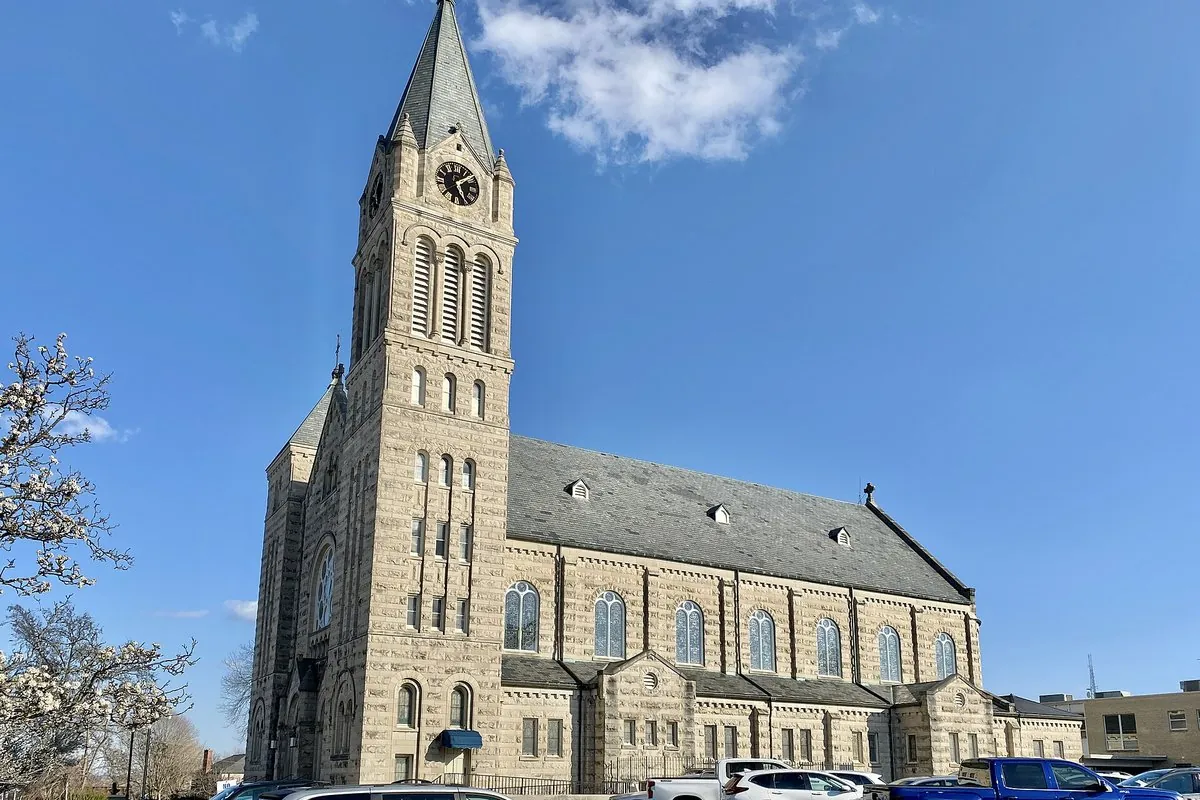
The city’s timeline says Les Petites Côtes became San Carlos “to honor Charles IV of Spain with the name of his patron saint, Bishop Carlos Borromeo.” The church dedicated in 1791 does carry the name of St. Charles Borromeo. But the timeline doesn’t cite a document for the king, and the State Historical Society’s guide, which tells the renaming in detail, doesn’t mention Charles IV at all.
Henry Gannett’s federal bulletin on place names gave a different reason back in 1905. Here is its full entry for the county and city:
“Saint Charles; county, and city in the same county, in Missouri, so named because it was the purpose of the vicar of Pontoise to establish a seminary there in honor of that saint, where the Indians should be educated.”
Gannett doesn’t say who the vicar was, when he planned the school, or where the story came from, and none of the other sources cited here mention a seminary. Houck and the 1885 history don’t explain the choice of saint at all. So the safe version is the one everybody shares: the town got the Spanish name of Saint Charles, and the “why” comes in two flavors.
One more thing to watch for. Gannett lists a Saint Charles Parish in Louisiana right above the Missouri entry, “named for the saint.” That’s a separate place with its own entry, so don’t mix the two up.
From San Carlos to St. Charles
The city’s timeline says that when the land passed to the United States in 1804, “Spanish name of San Carlos is anglicized to Saint Charles.” The federal names database still spells it out as Saint Charles, though the city’s own site uses St. Charles.
The English name soon mattered well beyond the river town. When Missouri chose a permanent capital, the notice ran in the Missourian, which David W. Eaton described in 1916 as “published at St. Charles, Mo., then the temporary capital.” Its issue of January 17, 1822, announced that the new seat of government would be called the City of Jefferson. You can read that story in the article on Jefferson City.
Quick answers
Who is St. Charles, Missouri, named after?
Saint Charles, through the Spanish name San Carlos. Sources disagree on why: the city says Charles Borromeo, patron saint of King Charles IV, while Gannett’s 1905 bulletin says a vicar of Pontoise meant to found a seminary there in that saint’s honor.
What was St. Charles, Missouri, called before?
Les Petites Côtes, the Little Hills. Houck also gives “Village des Côtes,” the 1787 Spanish census form “Pequenas Cuestas,” and “San Carlos del Misuri” for the years just before the 1804 transfer.
When did Little Hills become San Carlos?
The State Historical Society of Missouri and the city both say 1791, and the society gives November 7. The 1885 county history says the old name lasted “till 1784,” so the older books don’t settle it.
Key dates
- 1769April: Louis Blanchette sets up a post on the Missouri, called Petite Cotes (Little Hills), per the 1885 county history.
- 1787A Spanish census lists the village as the Establecimiento de los Pequenas Cuestas, the Village of Little Hills, per Houck.
- 1791November 7: Manuel Perez dedicates the church and changes the town's name to San Carlos, per the State Historical Society of Missouri.
- 1792Perez calls Blanchette the founder and first inhabitant of "Sn. Carlos del Misury," as quoted by Houck.
- 1804The land passes to the United States, and the city's timeline says San Carlos is anglicized to Saint Charles.
- 1822January 17: the Missourian, printed at St. Charles, then the temporary capital, announces the City of Jefferson.
Getting there
Open St. Charles in Google Maps
Opens in a new tab. The pin is the center of St. Charles in the USGS place-name record.
The closest airports, Amtrak stations and intercity bus stops, measured in a straight line from the center of St. Charles.
Airports
- St Louis Lambert International (STL) St. Louis 6 mi 10 km
- Scott AFB/Midamerica St Louis (BLV) Belleville 39 mi 62 km
Amtrak trains
- Kirkwood station (KWD) 15 mi 23 km
- St. Louis station (STL) 19 mi 30 km
Intercity buses
- Greyhound Saint Louis Lambert Field 7 mi 11 km
- OurBus Chesterfield, MO (Chesterfield Mall - Cheesecake Factory - Mall loop) 10 mi 16 km
- FlixBus St Louis Bus Station 19 mi 30 km
Distances are as the crow flies, not by road. We don't list schedules or fares because they change; check with the airline, Amtrak or the bus company before you go. Official data (FAA commercial service airports (2025), FAA airport locations, Amtrak stations and Intercity Bus Atlas) from the FAA and the U.S. Bureau of Transportation Statistics, checked Nov 13, 2026.
Sponsored
Staying in St. Charles?
Compare hotels in St. Charles, Missouri, on Expedia.
See hotels in St. CharlesWe may earn a commission if you buy through this link. It never changes what we write. Read our affiliate disclosure
Sponsored
Want the spooky side of St. Charles?
The name has its story above. For the ghost stories, US Ghost Adventures runs walking ghost tours in St. Charles.
See ghost tours in St. CharlesWe may earn a commission if you book through this link. It never changes what we write. Read our affiliate disclosure
Historical Sources & References
- Henry Gannett, The Origin of Certain Place Names in the United States (USGS, 1905), p. 270. The entry crediting the name to a planned seminary of the vicar of Pontoise in honor of the saint, and the separate Saint Charles Parish in Louisiana.
- Louis Houck, A History of Missouri, vol. 2 (1908), pp. 79-80. “Les Petite Côtes” and “Village des Côtes,” the small hills, the 1787 census name and its translation, “San Carlos del Misuri” before the cession, Perez’s 1792 words on Blanchette, and the 1793 Carondelet order that suggests New Orleans knew the village for a time as “San Fernando.”
- History of St. Charles, Montgomery and Warren Counties, Missouri (1885), pp. 24 and 309. The name Les Petites Cotes, “signifying, Little Hills,” kept “till 1784” (p. 24); Blanchette’s post of April 1769, “called Petite Cotes (Little Hills)” (p. 309).
- State Historical Society of Missouri, St. Charles Borromeo Catholic Church Records (S0138). The church dedication by Manuel Perez on November 7, 1791, and the change of the town’s name to San Carlos the same day.
- City of St. Charles, Timeline. The 1791 name San Carlos tied to Charles IV and Saint Charles Borromeo, and the 1804 anglicizing to Saint Charles.
- David W. Eaton, “How Missouri Counties, Towns and Streams Were Named,” Missouri Historical Review, vol. 10 (1916), p. 279. The Missourian, published at St. Charles, “then the temporary capital,” and its notice of January 17, 1822.
- GNIS feature 756631 (U.S. Geological Survey). The long-form spelling Saint Charles and the county it sits in.
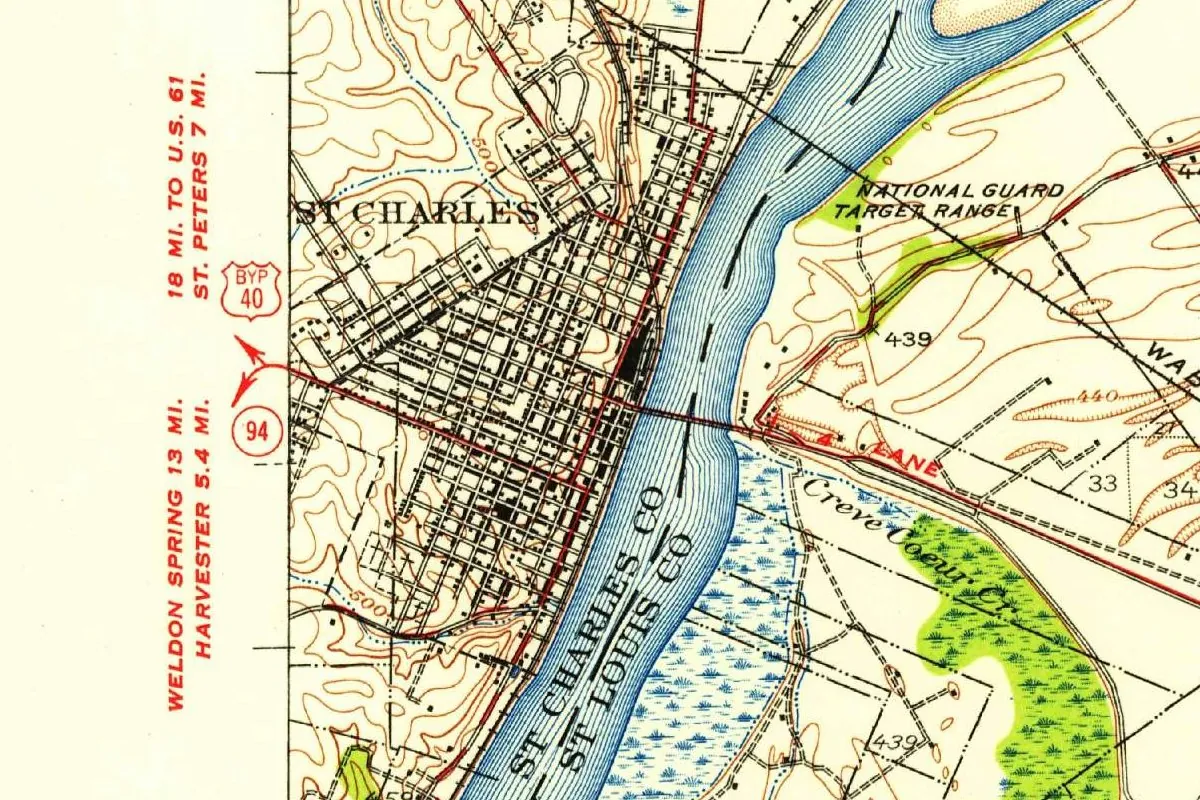
- U.S. Geological Survey, St. Charles sheet (surveyed 1927, printed 1955). A 1955 printing of the sheet first surveyed in 1927, later highway notes and all, cut down to St. Charles and its river crossing.
Spot something wrong, or know more? Tell us here. You can also email us or use our contact page. Corrections are noted here with their date, never made silently.