St. Louis, Missouri: Named for a King's Patron Saint
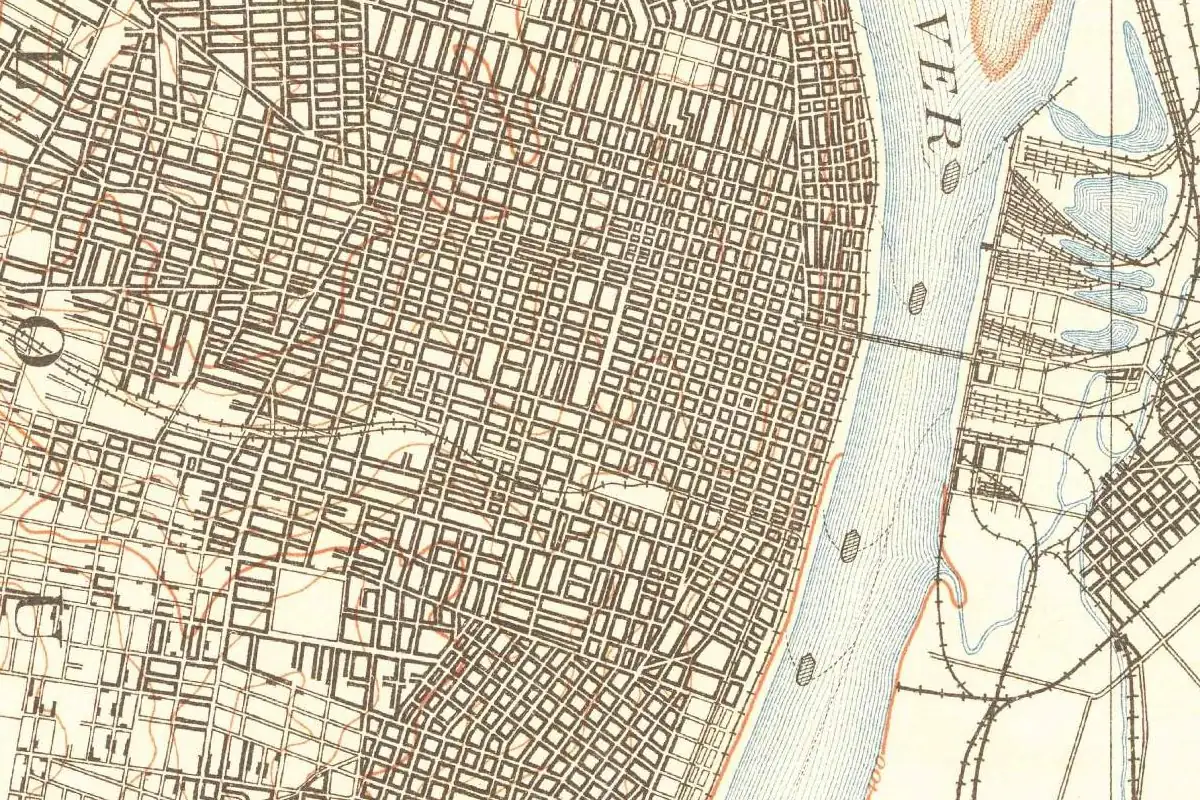
St. Louis, Missouri, was named in the spring of 1764 by Pierre Laclède, a French fur trader, “in honor of Louis XV,” the king of France. That’s how Auguste Chouteau, who was there, remembered it. But the town isn’t called Louisville, and the “Saint” in its name belongs to an earlier king, Louis IX, the patron saint of Louis XV.
Laclède’s village
The story comes almost entirely from one witness. Auguste Chouteau was Laclède’s young stepson. The National Park Service says he was 13 when Laclède took him up the Mississippi in 1763 to find a spot for a trading post, and the two picked a bluff about 18 miles (29 km) below the mouth of the Missouri River.
Years later Chouteau wrote down what happened next. His narrative, in a translation the Missouri Historical Society printed in 1911, says Laclède sent him ahead with a work crew to clear the ground and build a shed. Laclède himself arrived in early April:
“He occupied himself with his settlement, fixed the place where he wished to build his house, laid a plan of the village which he wished to found, (and he named it Saint Louis, in honor of Louis XV, whose subject he expected to remain, for a long time; — he never imagined he was a subject of the King of Spain;)”
That aside about Spain is the twist. By a secret treaty of 1762, France had already handed its land west of the Mississippi to Spain. J. Thomas Scharf’s 1883 History of Saint Louis City and County prints a letter of April 21, 1764, in which the king of France officially told the governor of Louisiana about it. So Laclède was naming his village for a king who no longer owned the ground it stood on.
February 14 or 15?
Chouteau told the story more than once. In a deposition of April 18, 1825, quoted by the 1911 editors, he said the party landed “on the 15th of February, A. D. 1764,” and that “Mr. Laclede on his arrival named the town Saint Louis, in honor of the King of France.” His own narrative, though, puts his arrival on the 14th of March. The editors added a note that it “should be 15 February,” and they explain that some readers had taken Chouteau’s handwritten 5 for a 4. That’s why you’ll still see both February 14 and February 15 given as the city’s birthday.
Louis IX or Louis XV?
So which Louis is it? The two oldest accounts both point to the reigning king, Louis XV. Henry Gannett’s 1905 book on American place names agrees: “named for Louis XV of France.” The National Park Service, on the other hand, says St. Louis was “named for King Louis IX of France.”
Scharf explained how both can be right. He passed along an argument he credited to O. W. Collet of the St. Louis Historical Society, written for readers puzzled that a city would be called “Saint” after a king with a bad reputation:
“Louis XV. was not canonized. If the place had been named directly after the king it would have been termed Louisville, or Louisbourg. According to French custom it requires the addition of ‘ville’ or ‘bourg’ to convert a personal into a local designation. St. Louis was named after the patron saint of Louis XV.”
That saint was Louis IX, the crusader king, whom Pope Boniface VIII canonized in 1297, Scharf notes. So the honor was meant for Louis XV, and the name itself is the saint’s.
Route 66 and the Chain of Rocks
St. Louis later became the gateway to Missouri’s stretch of Route 66. The 1941 WPA guide to Missouri starts its US 66 tour at the Mississippi crossing from East St. Louis and runs through Rolla, Springfield and Joplin to Galena, Kansas.
For a while the road came in over a bridge the Park Service calls one of the more interesting in America. The National Park Service says the Chain of Rocks Bridge opened in July 1929 with a 30-degree bend in the middle, and Route 66 was rerouted over it in 1936. Its name came from the Chain of Rocks, a 17-mile (27 km) stretch of rocky rapids in the river just north of the city. The bridge closed in 1968, and in 1999 it reopened for walkers and cyclists as part of the Route 66 Bikeway. For the rest of the road, see our Route 66 towns collection.
Other places called Saint Louis
The name traveled, and you’ll find it far from Missouri. Gannett lists a town in Sonoma County, California, and a city in Gratiot County, Michigan, both called Saint Louis and “named from the city in Missouri.” The same book says Minnesota’s St. Louis River, and the county named for it, were probably named for a French honor, the cross of Saint Louis, not for this city.
Quick answers
Who is St. Louis named after?
King Louis XV of France, by way of his patron saint, Louis IX. Auguste Chouteau said Pierre Laclède named it “in honor of Louis XV,” and Scharf’s 1883 history explains that the name honors the king through the saint.
Is St. Louis named after Louis IX or Louis XV?
Both, in a sense. The founders meant to honor the reigning king, Louis XV. Because a French town named directly for him would have been a Louisville or Louisbourg, the name “Saint Louis” uses his patron saint, Louis IX.
When was St. Louis founded?
In February 1764. Chouteau’s 1825 testimony gives February 15, though some readers of his handwriting have taken it as February 14. Laclède laid out the village and named it that April.
Who founded St. Louis?
Pierre Laclède, a French fur trader, with his young stepson Auguste Chouteau, who led the first work crew to the site.
Key dates
- 1763Pierre Laclède and his young stepson Auguste Chouteau pick the site for a fur-trading post below the mouth of the Missouri River.
- 1764February 15: Chouteau and about 30 men land and start building. In early April, Laclède lays out the village and names it Saint Louis.
- 1825April 18: Chouteau testifies that Laclède "named the town Saint Louis, in honor of the King of France."
- 1929July: The Chain of Rocks Bridge opens across the Mississippi north of the city.
- 1936Route 66 is rerouted over the Chain of Rocks Bridge.
- 1968The old Chain of Rocks Bridge closes. It reopens in 1999 for walkers and cyclists on the Route 66 Bikeway.
Getting there
Open St. Louis in Google Maps
Opens in a new tab. The pin is the center of St. Louis in the USGS place-name record.
The closest airports, Amtrak stations and intercity bus stops, measured in a straight line from the center of St. Louis.
Airports
- St Louis Lambert International (STL) St. Louis 13 mi 20 km
- Scott AFB/Midamerica St Louis (BLV) Belleville 20 mi 33 km
Amtrak trains
- St. Louis station (STL) under 1 mi 0.6 km
- Kirkwood station (KWD) 12 mi 19 km
Intercity buses
- FlixBus St Louis Bus Station under 1 mi 0.6 km
- Executive Transportation Amtrak Connecting Service · St. Louis under 1 mi 0.6 km
- OurBus Richmond Heights, MO (Richmond Heights Metrolink station bus stop loop) 8 mi 13 km
Distances are as the crow flies, not by road. We don't list schedules or fares because they change; check with the airline, Amtrak or the bus company before you go. Official data (FAA commercial service airports (2025), FAA airport locations, Amtrak stations and Intercity Bus Atlas) from the FAA and the U.S. Bureau of Transportation Statistics, checked Nov 10, 2026.
Sponsored
Staying in St. Louis?
Compare hotels in St. Louis, Missouri, on Expedia.
See hotels in St. LouisWe may earn a commission if you buy through this link. It never changes what we write. Read our affiliate disclosure
Sponsored
Want the spooky side of St. Louis?
The name has its story above. For the ghost stories, US Ghost Adventures runs walking ghost tours in St. Louis.
See ghost tours in St. LouisWe may earn a commission if you book through this link. It never changes what we write. Read our affiliate disclosure
Historical Sources & References
- “Chouteau’s Narrative of the Settlement of St. Louis,” Missouri Historical Society Collections, vol. 3, no. 4 (1911), pp. 338 and 352-353. Laclède “named it Saint Louis, in honor of Louis XV, whose subject he expected to remain, for a long time; — he never imagined he was a subject of the King of Spain”; the editors’ note that the March 14 date “should be 15 February”; and Chouteau’s 1825 deposition: “On the 15th of February, A. D. 1764, they landed […] Mr. Laclede on his arrival named the town Saint Louis, in honor of the King of France.”
- J. Thomas Scharf, History of Saint Louis City and County, vol. 1 (1883), pp. 66-71. The 1825 deposition, the argument credited to O. W. Collet (“St. Louis was named after the patron saint of Louis XV”), the canonization of Louis IX in 1297, and the king’s letter of April 21, 1764, on the secret treaty with Spain.
- Henry Gannett, The Origin of Certain Place Names in the United States (1905), p. 271. “Saint Louis; county, and city in Saint Louis City County, Missouri, named for Louis XV of France,” plus the towns in California and Michigan named for the city.
- National Park Service, “St. Louis: The Early Years (1764-1850)”. Laclède and his 13-year-old stepson, the site 18 miles below the mouth of the Missouri, and the founding in February 1764 of a settlement “named for King Louis IX of France.”
- National Park Service, “Illinois: Chain of Rocks Bridge”. The bridge’s opening in July 1929, its 30-degree turn, the 17-mile shoal, Route 66 over it from 1936, its closing in 1968 and reopening in 1999.
- Writers’ Program, Missouri: A Guide to the “Show Me” State (1941). Tour 5, US 66 from the Illinois line through St. Louis, Rolla, Springfield and Joplin to Galena, Kansas.
- U.S. Geological Survey, St. Louis sheet (1888). The map at the top of this page.
- GNIS feature 765765, Saint Louis (U.S. Geological Survey). The official record, under the spelled-out name Saint Louis.
Sponsored
Gear up for your next road trip
Explore rooftop tents, vehicle awnings and outdoor gear from TOPOAK Overland.
Shop TOPOAK overlanding gearWe may earn a commission if you buy through this link. It never changes what we write. Read our affiliate disclosure
Spot something wrong, or know more? Tell us here. You can also email us or use our contact page. Corrections are noted here with their date, never made silently.