What Does Oconomowoc Mean? Five Answers, No Winner
The name comes from a Potawatomi word, but its meaning is disputed. The city translates Coo-no-mo-wauk as where the waters meet, and the state transportation department adds river of lakes. Henry Gannett wrote in 1902 that it meant home of the beaver, while an 1880 county history leaned toward waterfall and left the question unsettled.
Oconomowoc, Wisconsin, has a Potawatomi name that’s been translated as where the waters meet, river of lakes, home of the beaver and waterfall. Add “beautiful waters” and you’ve got five answers, and that doesn’t count the frontier joke. There’s plenty of water around town. What the word itself means is another matter.
Where the waters meet
The answer you’ll hear first comes from the city. Its history page says the first recorded settlers were members of the Potawatomi and Winnebago tribes, and “it was they who named the area ‘Coo-no-mo-wauk,’ or ‘Where the waters meet.’” The town’s tourism office uses the same words.
The Wisconsin Department of Transportation adds a second option. Its page on the dual-language signs that welcome travelers to Tribal communities around Wisconsin says “Oconomowoc originates from Potawatomi and means ‘where the waters meet,’ or ‘river of lakes.’”
Neither source says who first gave those translations. For that, you have to go back to 1880.
A county history that gave up
In 1880 the Western Historical Company of Chicago published The History of Waukesha County, and its writers took the Indian names seriously. In one chapter they said every translation had been endorsed by a Potawatomi who had lived in the area for sixty years, and “pronounced correct by A. Vieau, who has spoken Pottawatomie a half-century.” Under that seal of approval, the book says, “Coo-no-mo-wauk, from which was derived the name Oconomowoc, was the Pottawatomie term for distinguishing a waterfall in that vicinity.”
Then, in the chapter on the town, the same book lays out the competition. Residents, it says, tell tourists the name “signifies ‘the place of the beaver,’” since signs of beaver work abounded when the whites first came. The first settler, Charles B. Sheldon, had a different story. When he came, he got to know John Dority, who lived with the band of the Winnebago chief Whirling Thunder and spoke the language. Dority told him the name meant “the River of Lakes.” The writer found that “quite reasonable” when “one observes the manner in which the lakes in this vicinity are united by Oconomowoc River.”
A third story said “beautiful waters,” which the book dismissed as more like “a certain poet’s fancy” than an Indian name. And it passed along a joke, “probably the invention of some frontier story-teller,” about an Indian who shot a raccoon, threw up his hands and cried “O, cooney, no mo’ walk”. The earlier chapter had already explained where the raccoon came from: As-sip-uhn, Potawatomi for raccoon, was the name of a small stream in the town.
Here’s where the book ends up:
“What Oconomowoc means, the Indians themselves cannot tell; but Vieau, who has been in Milwaukee and Waukesha Counties about three-score years, says ‘Cou-no-mo-wauk’ means ‘water-fall,’ or place where the river falls. The term seems to have been a Winnebago corruption, wauk meaning river or moving water, e. g., Manitou-wauk (now Manitowoc), Bad Spirit River.”
“The question will be left unsettled,” it concludes, with Vieau apparently the best authority, “although not a full aborigine,” because he was “practically a Pottawatomie.” That comparison with Manitowoc isn’t a stray one. Manitowoc has its own fight over translations, and Jedidiah Morse’s report of 1822 calls it “Ma-nitou-wauk, the river of bad spirits.”
Gannett’s one-line answer
Henry Gannett, in his 1902 compilation for the Geological Survey, didn’t mention any of this. His entry is one line: “Oconomowoc; city in Waukesha County, Wisconsin. An Indian word, meaning ‘home of the beaver.’” That’s the residents’ answer from 1880, more or less, now with a government stamp on it.
Oconomowoc isn’t alone in this. In Yakima, Washington, old books offer three different translations and the city’s history admits nobody really knows. On Mackinac Island, Michigan, some read the long Native name as a great turtle and others tie it to a tribe.
A lake town
The city says the first white settlers, Charles Sheldon and Phil Brewer, built log cabins in 1837. John S. Rockwell built a grist mill and the first store. The 1880 history says the village charter was approved on March 28, 1865, and a city charter followed in 1875, under chapter 59 of that year’s state laws.
After the railroad came, the city says, Oconomowoc became a summer retreat for tourists and wealthy vacationers from Chicago, Milwaukee, St. Louis and other Midwestern cities, and it was known as the “Newport of the West.” The city adds that visits by Presidents Grant, Cleveland, Harrison, McKinley, Theodore Roosevelt, Taft and Coolidge earned Main Street the nickname “Avenue of the presidents.” In 1907 an Oconomowoc resident, Ole Evinrude, invented the outboard boat motor.
Water ties the story together. The state’s Department of Natural Resources says the Oconomowoc River flows southwest “through six major lakes for approximately 49 miles,” about 79 km, before it joins the Rock River.
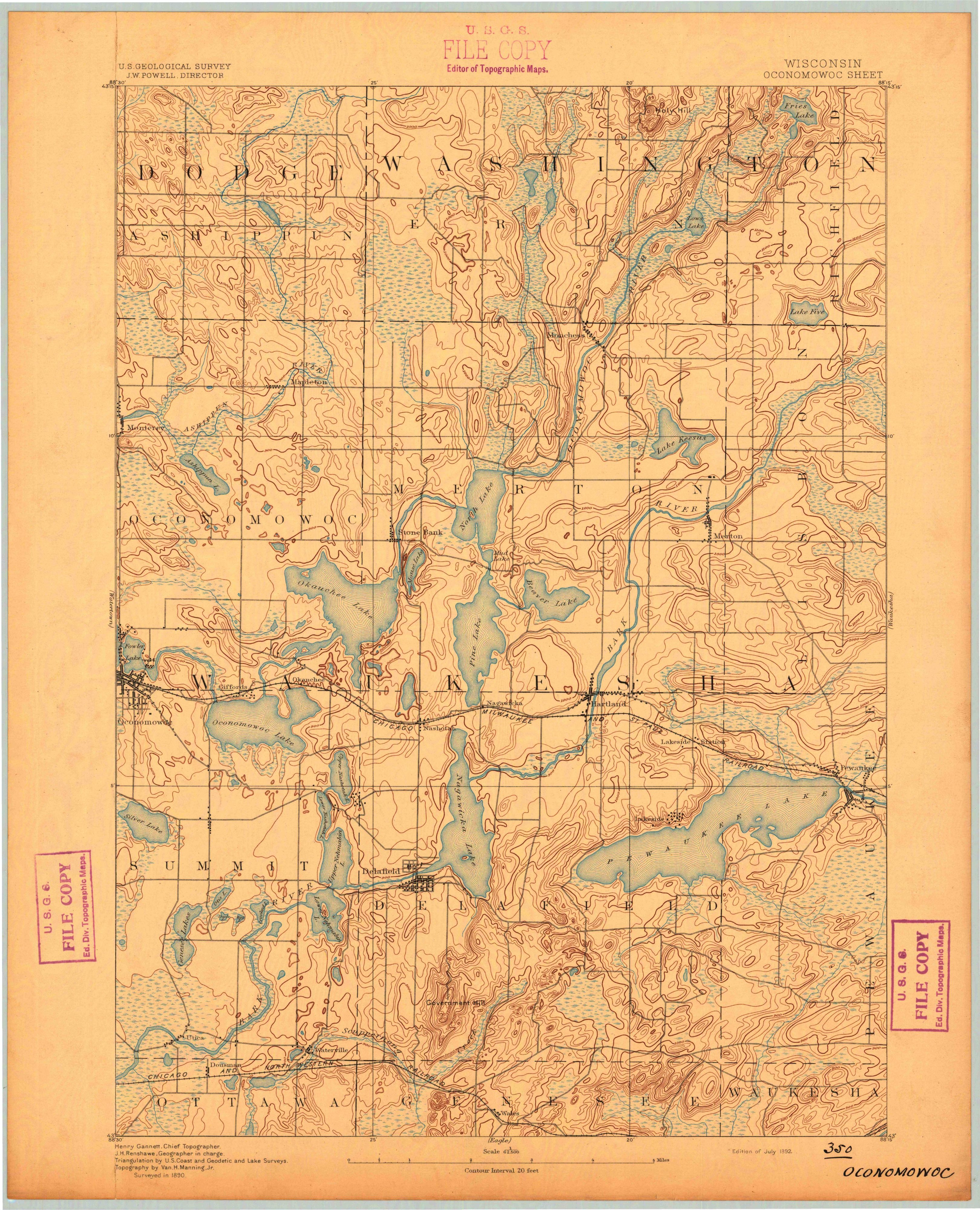
Oconomowoc on the 1892 map
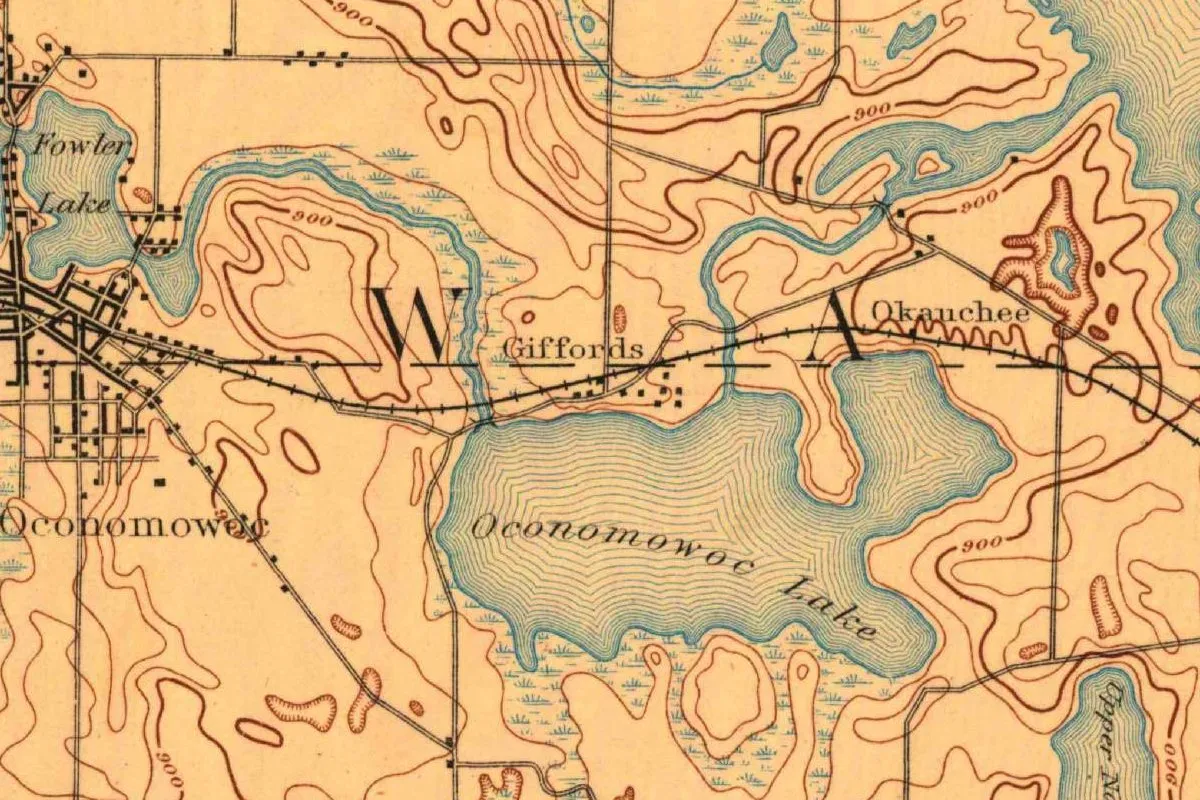
The map at the top comes from the Oconomowoc sheet, surveyed in 1890 under Henry Gannett as chief topographer, and printed in the edition of July 1892, with no later printing marked on it. The town sits at the very west edge of the sheet, so the crop starts right at the border. You can see the street grid, Fowler Lake just above it, the railroad heading east past Giffords and Okauchee, and Oconomowoc Lake in blue. A winding stream links Fowler Lake with Oconomowoc Lake, the same pattern of lakes strung on a river that made the 1880 writer take “the River of Lakes” seriously.
Quick answers
What does Oconomowoc mean?
It’s disputed. The city says Coo-no-mo-wauk means “where the waters meet,” the state transportation department adds “river of lakes,” Henry Gannett said “home of the beaver” in 1902, and an 1880 county history leaned toward “waterfall.”
What language is Oconomowoc?
The city and the state both say Potawatomi. The 1880 county history called Coo-no-mo-wauk a Potawatomi term but also suggested the form was a Winnebago corruption.
Does Oconomowoc mean beaver?
That’s one answer. The 1880 history says residents told tourists it meant “the place of the beaver,” and Gannett printed “home of the beaver” in 1902, but the same history preferred “waterfall.”
Who were the first settlers of Oconomowoc?
The city says Charles Sheldon and Phil Brewer built log cabins in 1837. Sheldon is the settler who heard the “River of Lakes” translation from John Dority.
Key dates
- 1837Charles Sheldon and Phil Brewer build log cabins, the first white settlers on the site.
- 1865March 28: the act incorporating the village of Oconomowoc is approved.
- 1875Oconomowoc is incorporated as a city.
- 1880A history of Waukesha County weighs four translations of the name and leaves the question unsettled.
- 1892The Geological Survey's Oconomowoc sheet, surveyed in 1890, shows the town and its lakes.
- 1902Henry Gannett's Geological Survey bulletin gives the meaning as 'home of the beaver.'
- 1907Oconomowoc resident Ole Evinrude invents the outboard boat motor.
Things to do in Oconomowoc, Wisconsin
Fowler Lake
A 97-acre lake in the heart of town, with fishing, boating and a paved walking loop of about 2 miles (3.2 km) that passes Fowler Park and historic mansions on the isthmus. A downtown boardwalk sits on its shore.
Oconomowoc Area Historical Society and Museum
The town's history museum, whose Streets of Old Gallery re-creates a Victorian home, a dentist's office, a barbershop, a print shop, a bank and John S. Rockwell's general store, with an exhibit on Ole Evinrude.
Augmented Reality History Experience
A walking tour that uses augmented reality to show scenes from the late 1800s and early 1900s, including buildings that no longer stand, the arrival of the railroad and the heyday of Fowler Lake tourism.
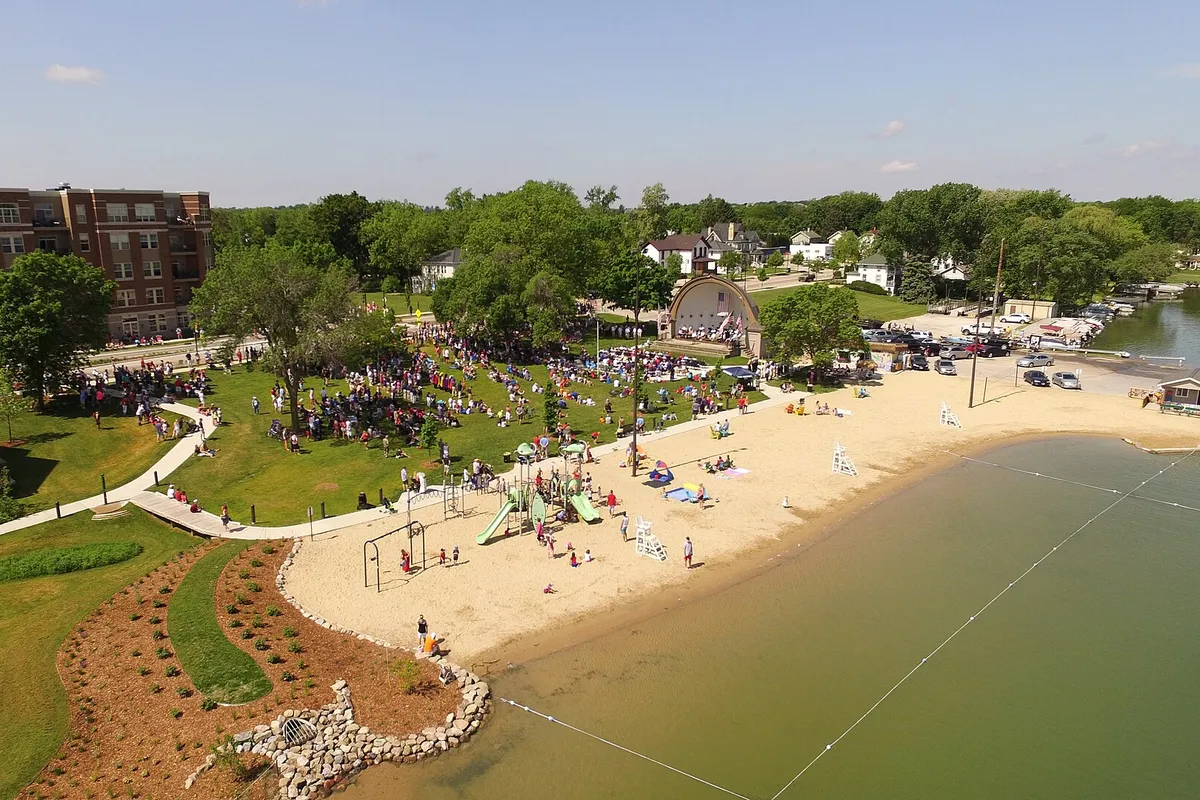
City Beach
One of the town's two public beaches, with sand, a playground on the beach and a bandshell where the local Legion Band plays.
Getting there
Open Oconomowoc in Google Maps
Opens in a new tab. The pin is the center of Oconomowoc in the USGS place-name record.
The closest airports, Amtrak stations and intercity bus stops, measured in a straight line from the center of Oconomowoc.
Airports
- General Mitchell International (MKE) Milwaukee 32 mi 52 km
- Dane County Regional/Truax Field (MSN) Madison 42 mi 68 km
Amtrak trains
- Milwaukee-Downtown station (MKE) 30 mi 48 km
- Columbus station (CBS) 30 mi 49 km
Intercity buses
- Jefferson Lines Johnson Creek 13 mi 22 km
- Wisconsin Coach Lines Barker Rd / Goerkes Corner Park N Ride 18 mi 28 km
- FlixBus Milwaukee Intermodal Station 30 mi 48 km
Distances are as the crow flies, not by road. We don't list schedules or fares because they change; check with the airline, Amtrak or the bus company before you go. Official data (FAA commercial service airports (2025), FAA airport locations, Amtrak stations and Intercity Bus Atlas) from the FAA and the U.S. Bureau of Transportation Statistics, checked Nov 18, 2026.
Sponsored
Staying in Oconomowoc?
Compare hotels in Oconomowoc, Wisconsin, on Expedia.
See hotels in OconomowocWe may earn a commission if you buy through this link. It never changes what we write. Read our affiliate disclosure
Historical Sources & References
- The History of Waukesha County, Wisconsin (1880), pp. 378, 690 and 692. On page 378, the waterfall and the raccoon stream, with translations endorsed by a Potawatomi and by A. Vieau. On page 690, the place of the beaver, Sheldon and Dority’s “River of Lakes,” “beautiful waters,” the raccoon joke, Vieau’s “water-fall” and the comparison with Manitou-wauk. On page 692, the city charter of 1875. All three pages checked against the page images.
- Henry Gannett, The Origin of Certain Place Names in the United States (1902), p. 194. “An Indian word, meaning ‘home of the beaver.’”
- City of Oconomowoc, “History of Oconomowoc”. “Where the waters meet,” Sheldon and Brewer in 1837, Rockwell, the city of 1875, the “Newport of the West,” the museum and Evinrude’s motor of 1907.
- Wisconsin Department of Transportation, dual-language signs. “Where the waters meet,” or “river of lakes.”
- Wisconsin DNR, Oconomowoc River watershed. The river’s course through six major lakes for about 49 miles (79 km) to the Rock River.
- City of Oconomowoc, “Lakes”; Visit Oconomowoc, museums; AR History Experience; “A Day at the Lake”. The details in the things-to-do list.
- GNIS feature 1570737. Oconomowoc’s official entry as a populated place in Waukesha County, with coordinates.
- Oconomowoc sheet, surveyed 1890, edition of July 1892. The sheet the map at the top was cropped from, with topography by Van H. Manning Jr. under J. H. Renshawe.
Sponsored
Put this 1892 map on your wall
The Geological Survey's 1892 Oconomowoc sheet, surveyed in 1890 and showing the town among its lakes, is in the public domain. Download the full-size scan for free, then have it printed on canvas with CanvasOnTheCheap.
Print a map on canvasDownload the full-size mapWe may earn a commission if you buy through this link. It never changes what we write. Read our affiliate disclosure
Spot something wrong, or know more? Tell us here. You can also email us or use our contact page. Corrections are noted here with their date, never made silently.