Golden Gate Bridge: Why It's Called Golden, and History
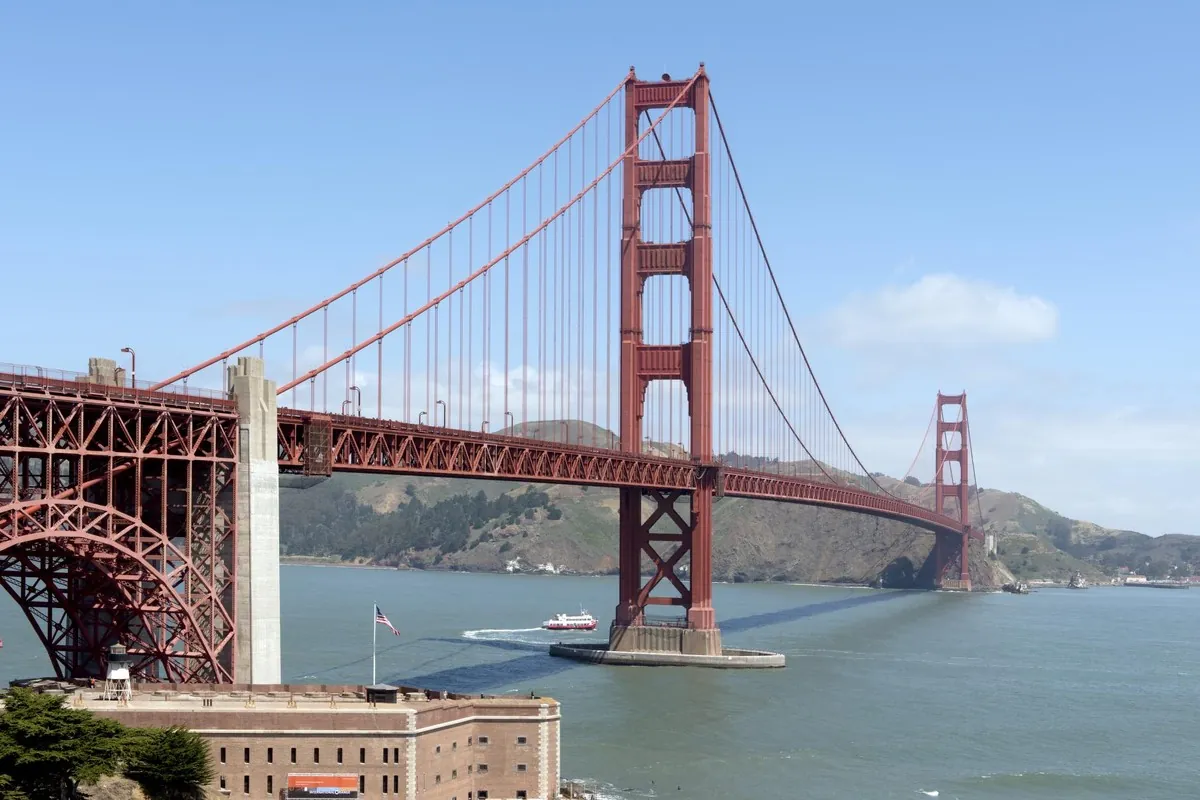
The Golden Gate Bridge takes its name from the strait, which John C. Frémont named for Byzantium’s Golden Horn, not for gold, on his map of 1848. The bridge came almost 90 years later and simply took the name already on the map.
Why Is It Called Golden Gate Bridge?
Start with the water. The SFO Museum puts it plainly: the bridge takes its name from the Golden Gate Strait, the channel from the Pacific into San Francisco Bay. So the question you really want answered is how the strait got its name.
Frémont, the Army explorer, answered that himself. In the Geographical Memoir upon Upper California he wrote for the U.S. Senate in 1848, he described the entrance to the bay as a strait “about one mile broad in the narrowest part, and five miles long from the sea to the bay.” A footnote explains the label he put on his map: “Called Chrysopylae (golden gate) on the map, on the same principle that the harbour of Byzantium (Constantinople afterwards) was called Chrysoceras (golden horn.)” The Greeks, he went on, named their harbor for its shape and its value for trade, and he saw the same promise in this entrance, with its “advantages for commerce, (Asiatic inclusive).”
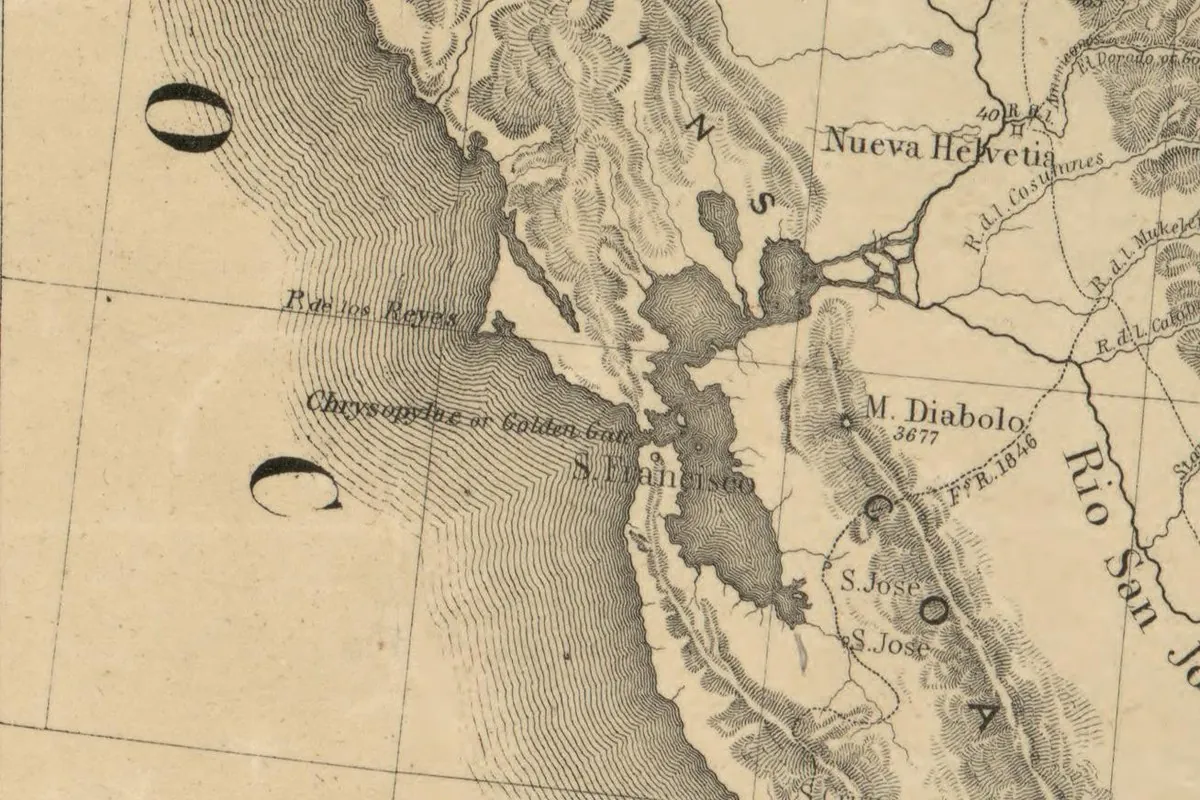
You can see the result on the map at the bottom of this page. Charles Preuss drew it from Frémont’s surveys, and the Senate printed it in 1848. At the mouth of the bay it reads “Chrysopylae or Golden Gate.”
Golden Gate Name Origin: Not Gold, Not Drake, Not the Sunset
People have offered other explanations for a long time. In 1914, Nellie Van de Grift Sanchez, in Spanish and Indian Place Names of California, took on two of them. One credited Sir Francis Drake; she called it “wholly unfounded,” since historians agreed Drake never laid eyes on the inner harbor. Another said Frémont named it for the setting sun shining on the cliffs. Sanchez quoted Frémont’s own later account instead, in which he again pointed to Byzantium and commerce, and concluded that the name was “born in a sordid dream of commerce.”
She also made the point about gold. When Frémont chose the name, she wrote, the metal “still lay buried” out of sight. Sanchez wasn’t starry-eyed about him, either. She admitted some people doubted the story, partly because they didn’t trust Frémont and partly because it sounded far-fetched. To the second doubt, she answered that showing off his Greek was exactly the kind of thing he did; to the first, that the name is there on his 1848 map, as he claimed.
The Golden Gate Bridge district, which runs the bridge today, adds the Spanish side. Its history page says the Spanish name for the strait, used into the 1840s, was the “Boca del Puerto de San Francisco,” or mouth of San Francisco’s port, and that Juan de Ayala’s San Carlos was the first European ship through it, on August 5, 1775. The district also quotes a line it says Frémont spoke in 1846 about “a golden gate to trade with the Orient,” but it doesn’t say where that line was recorded, so we’d treat it with care.
Golden Gate Bridge History
Building a bridge over the strait took decades of arguing. The Federal Highway Administration’s history says the Golden Gate Bridge and Highway District got its name from California’s 1923 law letting voters form tax districts, and that voters backed $35 million in bonds. When Depression markets wouldn’t buy them, chief engineer Joseph Strauss went to A. P. Giannini of the Bank of America, who said, “We will take the bonds.” Work began on January 5, 1933.
Opening day came on May 27, 1937. The day before, the FHWA says, some 200,000 people crossed on foot, running and even on roller skates. On opening day, officials took a ferry to Sausalito, a town whose name, as our Sausalito page explains, means “little willow” in Spanish, and drove a motorcade back across the span, cutting through a redwood log, a set of chains and finally a “living chain” of fiesta queens at the toll plaza on the city side. The SFO Museum notes the bridge’s international orange paint.
The name had spread across the city long before the bridge. Our San Francisco street names guide tells how Golden Gate Avenue first honored President John Tyler, as Tyler Street, and was renamed after Golden Gate Park opened.
Quick answers
Was the Golden Gate Bridge Named for the Gold Rush?
No. It’s named for the Golden Gate Strait, and Frémont’s name for the strait came from the Golden Horn, the harbor of Byzantium, and the trade he expected through the entrance. In 1914 Sanchez wrote that the gold was still buried when he chose it.
Who Named Golden Gate Bridge?
John C. Frémont, who named the strait the bridge crosses. The memoir he addressed to the U.S. Senate in 1848 explains in a footnote that he had labeled the entrance to San Francisco Bay “Chrysopylae (golden gate)” on his map, and the map drawn by Charles Preuss and printed that year carries the label “Chrysopylae or Golden Gate.”
Golden Gate History: What Was the Strait Called Before?
According to the bridge district’s history page, the Spanish called it the “Boca del Puerto de San Francisco,” or mouth of San Francisco’s port, into the 1840s, long after Juan de Ayala’s ship first sailed through in 1775. Frémont’s Greek name, Chrysopylae, didn’t last; its English half, Golden Gate, did.
Why Is the Golden Gate Bridge Orange?
Its paint is a color called international orange, as the SFO Museum’s exhibit notes. The color has nothing to do with the name: Frémont’s map already called the strait the Golden Gate in 1848, almost 90 years before the bridge opened in 1937.
Key dates
- 1775August 5: Juan de Ayala and the crew of the San Carlos sail through the strait into San Francisco Bay.
- 1848Frémont's memoir and Charles Preuss's map, printed for the U.S. Senate, call the strait Chrysopylae, or Golden Gate.
- 1914Nellie Van de Grift Sanchez's book on California place names credits the name to Frémont and rejects the Drake and sunset stories.
- 1933January 5: Construction of the Golden Gate Bridge begins.
- 1937May 27: The bridge opens, a day after some 200,000 people walk across it.
Getting there
Open Golden Gate Bridge in Google Maps
Opens in a new tab. The pin is an approximate point for Golden Gate Bridge.
The closest airports, Amtrak stations and intercity bus stops, measured in a straight line from the center of Golden Gate Bridge.
Airports
- San Francisco International (SFO) San Francisco International Airport 15 mi 24 km
- Oakland San Francisco Bay (OAK) 16 mi 25 km
Amtrak trains
- Berkeley station (BKY) 10 mi 16 km
- Emeryville station (EMY) 10 mi 17 km
Intercity buses
- Amtrak Chartered Vehicle Amtrak Connecting Service · San Francisco 5 mi 8 km
- Greyhound San Francisco (Salesforce Transit Center) 5 mi 8 km
- Gold Runner San Francisco 5 mi 8 km
Distances are as the crow flies, not by road. We don't list schedules or fares because they change; check with the airline, Amtrak or the bus company before you go. Official data (FAA commercial service airports (2025), FAA airport locations, Amtrak stations and Intercity Bus Atlas) from the FAA and the U.S. Bureau of Transportation Statistics, checked Nov 21, 2026.
Sponsored
Planning a visit?
Compare hotels near Golden Gate Bridge on Expedia.
See hotels nearbyWe may earn a commission if you buy through this link. It never changes what we write. Read our affiliate disclosure
Historical Sources & References
- John Charles Frémont, Geographical Memoir upon Upper California (1848; McCarty reprint, 1849), pp. 21-22: the description of the strait and the footnote on “Chrysopylae (golden gate),” Byzantium’s Golden Horn and the “advantages for commerce.”
- Nellie Van de Grift Sanchez, Spanish and Indian Place Names of California (1914), pp. 197-200: the Drake and sunset explanations rejected, Frémont’s later account quoted, “born in a sordid dream of commerce,” the gold “still lay buried” and the doubts about Frémont. Public domain; listed among California’s place-name books.
- Golden Gate Bridge, Highway and Transportation District, “What’s In a Name - The Golden Gate?”: the bridge operator’s history of the strait, the “Boca del Puerto de San Francisco,” Ayala’s passage of August 5, 1775, and the 1846 line it attributes to Frémont without a source.
- Federal Highway Administration, “Two Bay Area Bridges”: the 1923 district law, the $35 million bonds, Giannini, the start of work on January 5, 1933, the walk of May 26, 1937, and opening day on May 27.
- SFO Museum, “The Golden Gate Bridge: Spanning the Strait for Seventy-Five Years”: the strait that gave the bridge its name, the opening on May 27, 1937, and its international orange color.
- Charles Preuss and John Charles Frémont, Map of Oregon and Upper California (U.S. Senate, 1848), Library of Congress: the map at the bottom of this page, with “Chrysopylae or Golden Gate” at the entrance to the bay.
- GNIS feature 252026, Golden Gate Bridge (U.S. Geological Survey): the federal place-name record for the bridge.
Spot something wrong, or know more? Tell us here. You can also email us or use our contact page. Corrections are noted here with their date, never made silently.