Why Is It Called Julian, California? A Cousin's Name
Julian is named for Mike Julian, a Confederate veteran from Georgia. His cousin Drury Bailey laid out a town on his land after gold was found in the hills in 1869-70 and named it for Mike. One historian says Bailey thought his cousin was the handsomest man in camp and that Julian simply sounded better.
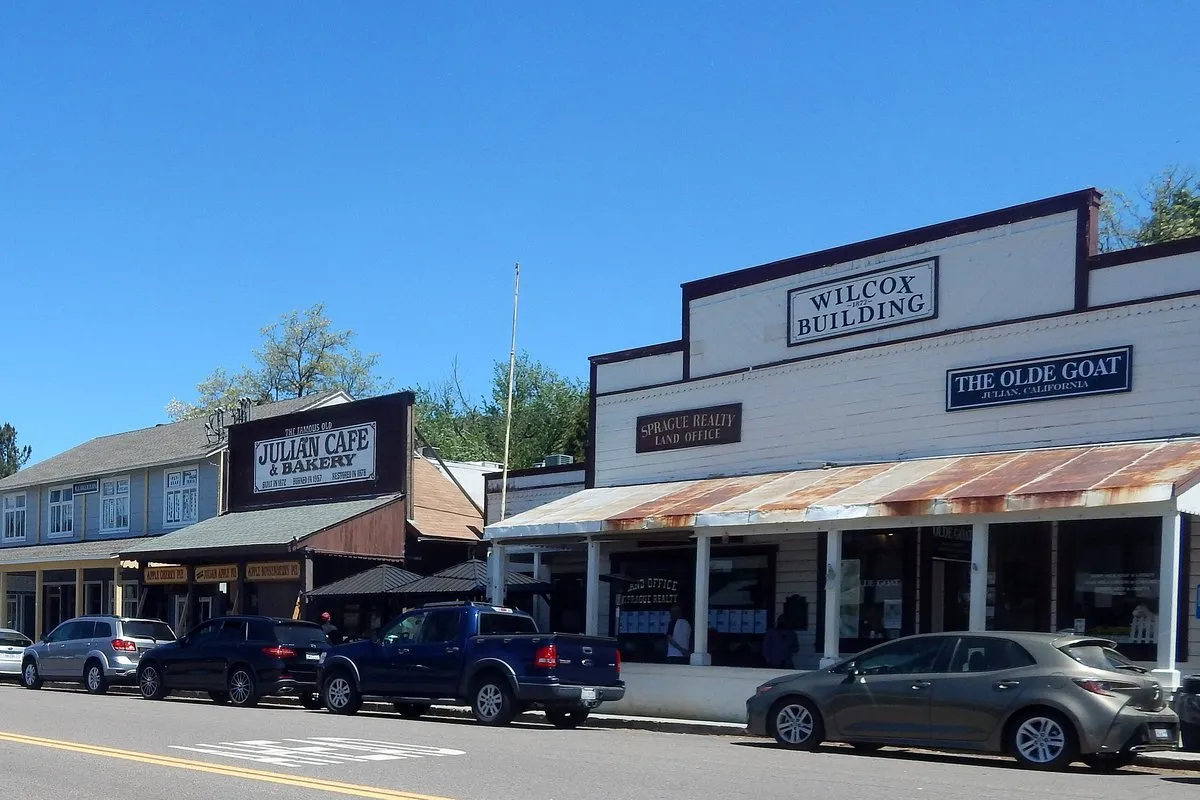
Julian, California, is named for Mike Julian, a cousin of Drury Bailey, who laid out the gold rush town on his own land in 1869-70. The two men had come west from Georgia after fighting for the Confederacy, and the name went to the cousin, not to the landowner.
Why is it called Julian, California?
Because Drury Bailey wanted it that way. In 1869 a small group of Georgia relatives, all Confederate veterans, came into the mountains east of San Diego looking for a new start. When gold turned up in the hills, Bailey staked out a town on his own land. The design guidelines that the County of San Diego wrote for Julian’s historic district in 1989 put it plainly: “Drew Bailey laid out a town on his land and called it Julian City, in honor of his cousin, Mike.”
The state’s landmark listing agrees. California Historical Landmark No. 412, registered in 1948, describes the founder as an “Ex-Confederate soldier” who laid the town out on land he farmed and named the place for “his cousin and fellow native of Georgia, Michael S. Julian.”
Why the cousin and not himself? The historian Kathryn A. Jordan, writing in the Journal of San Diego History in 2008, says Bailey picked Mike because he was the best-looking man in town, and because Julian sounded better than Bailey as the name of a town. The county’s 1989 history, under an old engraving of Mike Julian, calls him “the handsomest man in camp and a favorite with the ladies.” Nobody recorded Bailey saying so himself, so that part is a story, but it’s an old and consistent one.
Julian, CA history: Mike Julian and the Bailey cousins
Michael S. Julian came west with his brother Webb and the Bailey cousins. Jordan lists “four cousins, Drury and James Bailey and Mike and Webb Julian,” who reached Temecula from Georgia in 1869; the county’s history makes Frank and James Bailey brothers of Drury, with Mike and Webb Julian as cousins. Either way, it was a family party.
Mike Julian did more than lend his name. When the miners organized the Julian Mining District on February 15, 1870, Jordan says, they made him its first recorder, the man who kept track of claims. The Julian Chamber of Commerce adds that he was later elected assessor of San Diego County.
There’s one wrinkle in the spelling of the founder’s name. The state landmark listing calls him “Drury D. Batley.” The county guidelines, Jordan and the chamber of commerce all spell it Bailey, and give his first name as Drury, Drew or Drue.
Julian isn’t the only town named inside a family. Bardstown, Kentucky, carries the name of David Bard, whose brother William laid it out for him around 1780. In Sedalia, Missouri, the founder first called his town Sedville after his youngest daughter, Sarah, known at home as “Sed.”
Julian gold rush history
Who found gold first is still argued. Jordan writes that A. E. (Fred) Coleman, a former slave, discovered it near present-day Julian in January 1869. The chamber of commerce describes Coleman as a cattleman who spotted gold in a creek, and puts it in early 1870 on one part of its history page and in June 1869 on another, in the stream now called Coleman Creek. Jordan says Bailey made up his mind to stay that November.
The big finds came in February 1870, when prospectors hit gold-bearing quartz. According to the chamber, the George Washington Mine went on the books on February 22, 1870, Washington’s birthday, filed by H. C. Bickers. A letter in the San Diego Union on March 15 spread the word, and within a month, the county’s history says, the valley held 50 tents, four stores and about a dozen saloons. The first school opened that same year with 65 pupils.
The rush didn’t last. By 1906, the landmark text says, most of the mines had stopped paying, and the town turned to farming. Apples did well: the chamber says Julian’s apples won a Wilder Medal at the Jamestown Exposition in 1907, awarded by the American Pomological Society, and the county’s history dates the first Apple Day to 1909. Telephones had come in 1896; a concrete road arrived in 1926 and electricity in 1931. In 1948 the state named Julian a historical landmark. It’s still a small mountain town in San Diego County, California, about an hour east of San Diego by the chamber’s reckoning. The cousins’ first stop in the state, Jordan says, had been Temecula.
Julian on the 1903 map
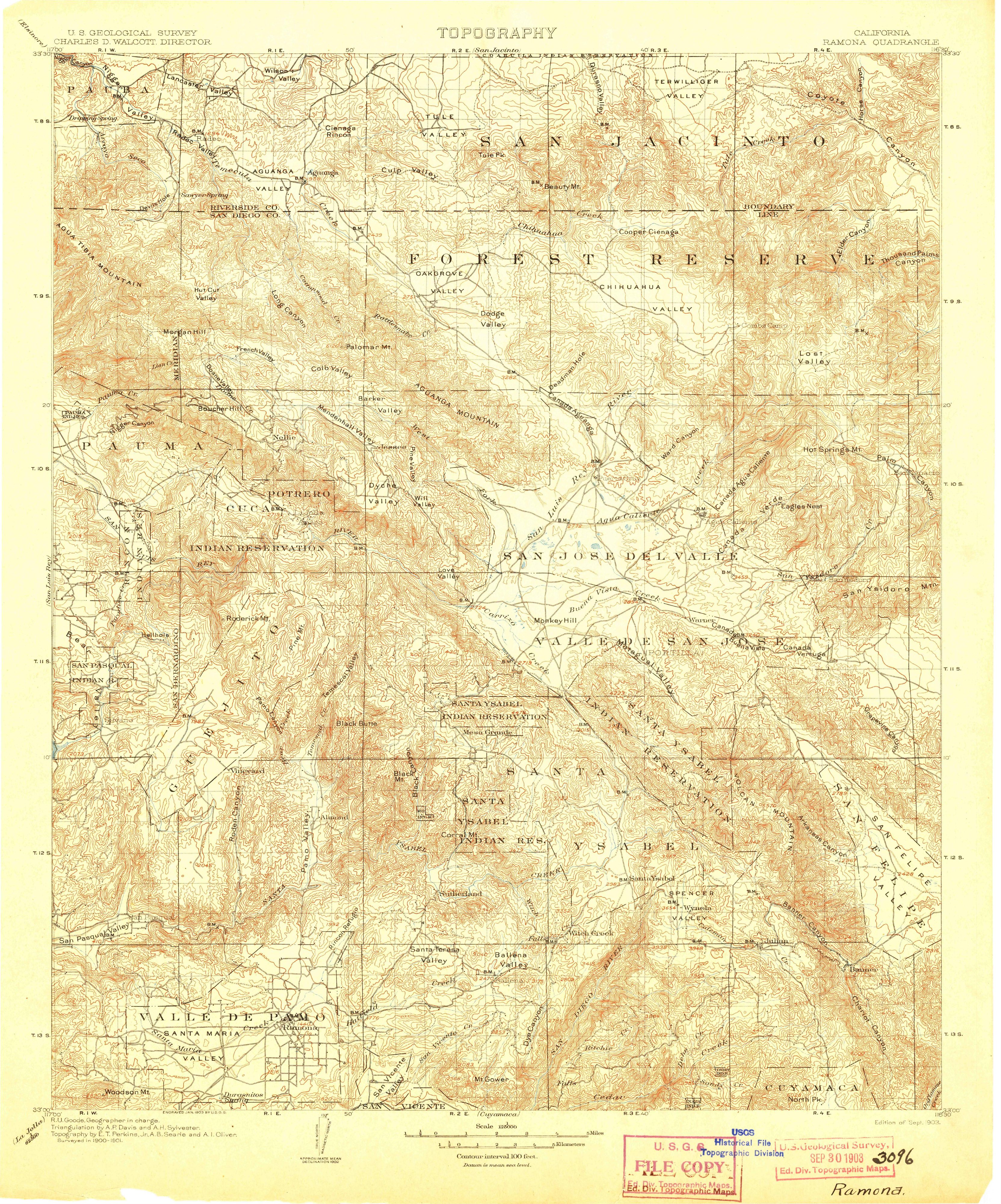
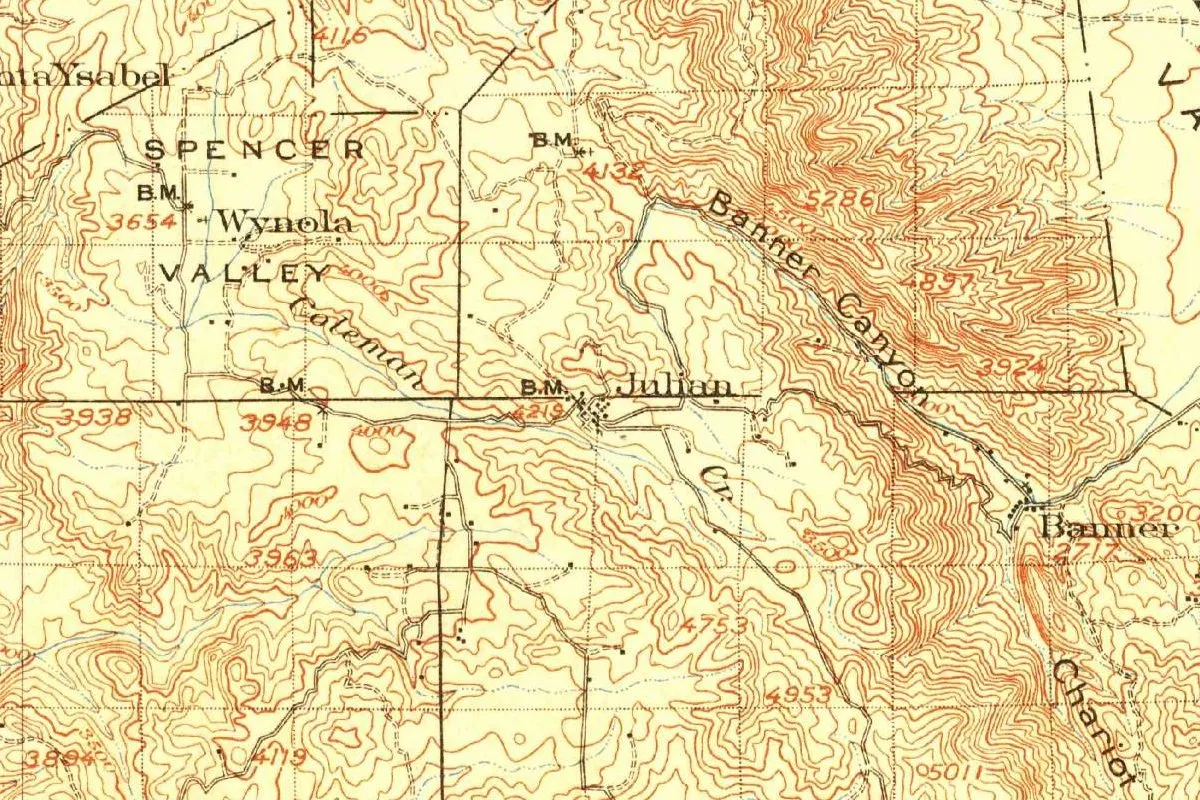
Our map is cut from the Geological Survey’s Ramona sheet, at 1:125,000, surveyed in 1900-1901 and printed in September 1903. By then the boom was over, but the mining country still shows. Julian sits beside a benchmark at 4,219 feet (1,286 m), with the words Coleman and Cr. lettered along the creek on either side of town.
Down Banner Canyon to the east is Banner, another mining camp, and the word Chariot runs down a canyon at the lower right. Wynola and Spencer Valley are off to the northwest, and part of Santa Ysabel shows at the top edge.
Quick answers
Who founded Julian, California?
Drury Bailey, a Confederate veteran from Georgia, platted it on his own property in 1869-70 and gave it his cousin Mike Julian’s surname. The state landmark listing spells his name Batley.
Was the founder of Julian, California, Bailey or Batley?
Most sources, including the county’s 1989 history and Jordan’s 2008 article, spell it Bailey. The text of California Historical Landmark No. 412 is the one that says Batley.
When did the Julian gold rush start?
In February 1870, when the richer quartz veins turned up. Jordan dates Fred Coleman’s first find earlier, to January 1869.
Key dates
- 1869January, by Jordan's account: Fred Coleman, a former slave, finds gold near present-day Julian.
- 1869November: Drury Bailey decides to stay in the valley with his cousins.
- 1870February 15: the miners form the Julian Mining District, with Mike Julian as first recorder.
- 1870February 22: the George Washington Mine is registered.
- 1870March 15: a letter in the San Diego Union spreads word of the strike.
- 1906Most of the mines have stopped paying, says the state landmark text.
- 1907Julian apples win a Wilder Medal from the American Pomological Society at the Jamestown Exposition.
- 1909The town holds its first Apple Day.
- 1948November 15: Julian is registered as California Historical Landmark No. 412.
Things to do in Julian, California
Julian Pioneer Museum
A county museum in an old stone building that a photo from 1887 shows as a brewery. Its collections include lace, clothing from 1896 to 1913, a buggy and a sleigh from early Julian City, and Native American artifacts.
Eagle Mining Co.
Guided tours of one of the old hard rock gold mines, with its tunnels, the tools and machines of early miners, a look at how ore was milled, and gold panning.
Volcan Mountain Wilderness Preserve
A county preserve of about 2,900 acres on Volcan Mountain. The main hike is roughly 5 miles (8 km) round trip from the Hubbell Gate on Farmer Road, and the county says the summit view runs "from the desert to the coast."
Cuyamaca Rancho State Park
A state park of oak woodland, scattered pines and meadows, with more than 100 miles (160 km) of trails. Two popular climbs are Stonewall Peak, 2 miles (3.2 km) up to 5,700 feet (1,737 m), and Cuyamaca Peak, 3.5 miles (5.6 km) up to 6,512 feet (1,985 m).
Getting there
Open Julian in Google Maps
Opens in a new tab. The pin is the center of Julian in the USGS place-name record.
The closest airports, Amtrak stations and intercity bus stops, measured in a straight line from the center of Julian.
Airports
- McClellan-Palomar (CRQ) Carlsbad 39 mi 63 km
- San Diego International (SAN) 42 mi 67 km
Amtrak trains
- Solana Beach station (SOL) 39 mi 63 km
- San Diego station (OLT) 41 mi 66 km
Intercity buses
- Limousine Express Escondido 29 mi 46 km
- Mexicoach Escondido 29 mi 46 km
- Greyhound El Cajon Transit Center 29 mi 47 km
Distances are as the crow flies, not by road. We don't list schedules or fares because they change; check with the airline, Amtrak or the bus company before you go. Official data (FAA commercial service airports (2025), FAA airport locations, Amtrak stations and Intercity Bus Atlas) from the FAA and the U.S. Bureau of Transportation Statistics, checked Nov 21, 2026.
Sponsored
Staying in Julian?
Compare hotels in Julian, California, on Expedia.
See hotels in JulianWe may earn a commission if you buy through this link. It never changes what we write. Read our affiliate disclosure
Historical Sources & References
- California Historical Landmark No. 412, “Julian”. Gold in the winter of 1869-70, Drury D. Batley and his cousin Michael S. Julian, the mines by 1906, and the 1948 registration.
- County of San Diego, Julian Historic District Design Guidelines Manual (1989). “Julian City,” the Bailey and Julian families, the March 1870 letter, the first month of the camp, the school, telephones, Apple Day, the road and electricity, and the 1887 photo of the stone brewery.
- Kathryn A. Jordan, “Life Beyond Gold,” Journal of San Diego History (2008). The four cousins, Fred Coleman in January 1869, the Julian Mining District and why Bailey chose his cousin’s name.
- Julian Chamber of Commerce, “Historic Julian”. Mike Julian as county assessor, Coleman Creek, the George Washington Mine and the 1907 Wilder Medal.
- U.S. Geological Survey, GNIS feature 1652732. Julian in San Diego County.
- Ramona quadrangle, edition of September 1903. The source of the cropped map.
Sponsored
Put this 1903 map on your wall
The Geological Survey's Ramona sheet of 1903, with the gold rush town of Julian between Spencer Valley and Banner, is in the public domain. Download the full-size scan for free, then have it printed on canvas with CanvasOnTheCheap.
Print a map on canvasDownload the full-size mapWe may earn a commission if you buy through this link. It never changes what we write. Read our affiliate disclosure
Spot something wrong, or know more? Tell us here. You can also email us or use our contact page. Corrections are noted here with their date, never made silently.