How to Trace Your Family History Through Old Town Names
The short answer
- Write down every place name exactly as your family's papers spell it.
- Check whether the town had an older name.
- Make sure you have the right one of the towns that share the name.
- If the town seems to have vanished, look for its post office and old maps.
- Then search the records of that place, and add DNA if you want living relatives.
The fastest way to trace your family history is to start with the place, not just the person. Records were kept where people lived, and the town your great-grandmother wrote on a letter may have had another name, may share that name with a dozen other towns, or may not be on today's map at all.
Town names are what this site is about, so this guide sticks to that part of family history research: how to pin down the right town before you go looking for anyone in it. Every example below comes from one of our name stories, and almost every tool below is free to use.
Step 1: Find the town's old name
Plenty of American towns started out under another name, and the records from those years are filed under it. If an ancestor lived somewhere before the change, you'll often find them under the old name only. A few from our stories:
- Hagerstown, Maryland, was laid out in 1762 as Elizabeth Town, named by Jonathan Hager for his wife. It didn't officially take Hager's name until 1814 (the act spelled it Hager's Town), even though people called it after him all along.
- Manchester, New Hampshire, was Derryfield until 1810.
- Saint Paul, Minnesota, was Pig's Eye by 1839, after a one-eyed whiskey seller, and took its saint's name in 1841.
- Jacksonville, Florida, was the Cow Ford, where cattle crossed the St. Johns River, until it was named for Andrew Jackson in 1822.
- Aspen, Colorado, was Ute City when it got started in 1879.
- Truth or Consequences, New Mexico, was Hot Springs until its voters took a radio quiz show's name in 1950.
So if a census or a marriage record lists a town you can't find, try its old name, and the other way around. Our towns that changed their names page gathers more of these switches, each with its source.
The U.S. Geological Survey's place-name database, the Geographic Names Information System (GNIS), can help too. It holds about a million U.S. place names, and the USGS says its records include "known variant names," which is where many old and alternate spellings live. You can search it by name and state.
Step 2: Make sure it's the right town
"Born in Springfield" doesn't tell you much. By our count of federal files, there are 19 cities and towns named Springfield in 19 states, and the USGS list of populated places has 67 Springfields in all. The most common name of all is Franklin, with 29 cities and towns in 28 states.
Settlers carried their old town names west, which is why the same names keep turning up (our Same Name, Different Places page has the stories). To tell them apart, look for anything else the record gives you: a county, a state, a nearby river or the name of a church. The county is the big one, because that's usually where deeds, wills and court records were kept.
Step 3: When the town isn't on the map anymore
Some places your ancestors knew have shrunk to a crossroads or disappeared. Small towns often lived and died with their post office, and the post office left paper behind.
Post office records
The National Archives has microfilmed the appointments of postmasters from 1832 to 1971, and it keeps the Post Office Department's "Records of Site Locations, 1837-1950," which describe where post offices stood. Post office names changed too, and not always with the town. The archives' own example is an office whose later postmasters "changed its name to Norris Falls in 1843, Olmsted in 1845, and Olmsted Falls in 1889."
Old maps
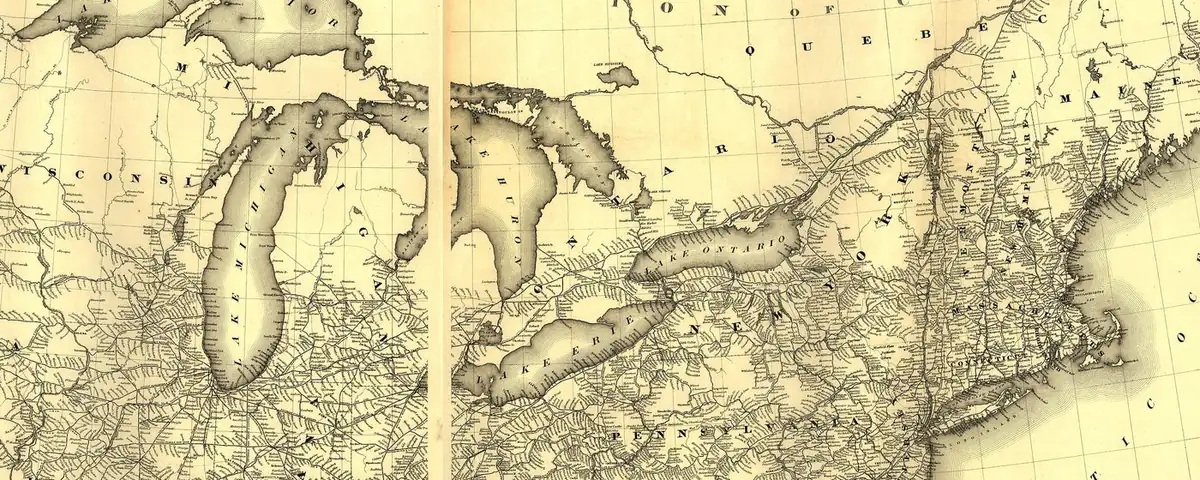
The USGS has put its historical topographic maps, published from 1884 to 2006, online to browse and download "at no cost." In TopoView you can pick an old map of the area and see towns, churches and cemeteries as they were then.
For a town's streets and buildings, the Library of Congress has the Sanborn fire insurance maps. Sanborn made "more than fifty thousand editions of fire insurance maps of more than ten thousand communities," and the library's collection is arranged by state and city.
Old newspapers and gazetteers
The Library of Congress's Chronicling America lets you search millions of newspaper pages "from nearly every state and territory," published through 1963. Small-town papers often printed births, weddings, deaths and who came to visit whom. For a quick list of old place-name books, FamilySearch's research wiki keeps a guide to United States gazetteers.
Is a town named after your family?
People search for their ancestry by last name all the time, and it's tempting when your surname is on a town sign. Lots of towns do carry a family name: Hagerstown for Jonathan Hager, Dolton, Illinois, for the Dolton family, whose toll bridge on the Little Calumet River was known as the Dolton bridge, and Harrisburg for John Harris, whose family ran a ferry on the Susquehanna.
Sharing the name doesn't make you kin, though. The way to find out is the slow one: work back one generation at a time with records, and see whether your line ever meets the founder's family in that county.
Towns founded by immigrant groups
If your family came over with a group, the town they built can be a shortcut to where they started. Pella, Iowa, was named in 1848 by a Dutch minister who'd broken with his country's national church and brought his colony there; the name is that of an ancient city of refuge. Anaheim, California, was started by German settlers from San Francisco, who joined the Santa Ana River's "Ana" to heim, the German word for home, in January 1858. For Dutch or German genealogy, a colony like these can point you to the church and the community the settlers came from.
Where a DNA test fits in
Paper records tell you where people lived. A DNA test does a different job: it can match you with living relatives who share your DNA and give an estimate of where your ancestors came from. It won't tell you the name of the town. Used together, a cousin match can point you to a family line, and the town records can confirm it.
FamilyTreeDNA's Family Finder is one of these autosomal tests. The company says it's "designed to find matches in our massive DNA database on all of your ancestral lines within the last five generations." If you want to try it, there's a link in the sponsored box at the end of this page; we earn a commission if you buy through it.
Quick answers
How do I trace my family history for free?
Start with the place your family lived and its records. The USGS old maps, the GNIS name search and the Library of Congress's newspapers and Sanborn maps are free to search online, and the National Archives has its post office records on microfilm.
How do I find the old name of a town?
Look up the town in the USGS GNIS database, which lists known variant names, and read a history of the town or county. Our towns that changed their names page has examples like Elizabeth Town (Hagerstown) and Derryfield (Manchester).
How do I find a town that no longer exists?
Check old USGS topographic maps of the area, from as early as 1884, and the National Archives' records of post office locations, which go back to 1837.
Am I related to the person my town is named for?
Not just because you share the name. You'd need records that connect your family line to theirs, generation by generation.
Can a DNA test tell me where my ancestors came from?
It can estimate regions and match you with relatives, but it can't name the town. That part still comes from the records.
Sponsored
Tracing your family's roots?
FamilyTreeDNA's Family Finder test matches you with relatives who share your DNA and estimates where your ancestors came from.
See the Family Finder testWe may earn a commission if you buy through this link. It never changes what we write. Read our affiliate disclosure
Historical Sources & References
- National Archives, "Post Office Records". Postmaster appointments, 1832-1971; Records of Site Locations, 1837-1950; and the Norris Falls, Olmsted and Olmsted Falls example. Accessed November 11, 2026.
- U.S. Geological Survey, "What is the Geographic Names Information System (GNIS)?" About a million names, with known variant names. Accessed November 11, 2026.
- U.S. Geological Survey, "Historical Topographic Maps: Preserving the Past". Maps published from 1884 to 2006, free to download; browse them in TopoView. Accessed November 11, 2026.
- Library of Congress, Sanborn Maps, "About this Collection". More than 50,000 editions for more than 10,000 communities. Accessed November 11, 2026.
- Library of Congress, Chronicling America, "About this Collection". Newspaper pages from nearly every state and territory, through 1963. Accessed November 11, 2026.
- FamilySearch Research Wiki, "United States Gazetteers". A guide to place-name books. Accessed November 11, 2026.
- FamilyTreeDNA, "Family Finder". The company's description of its autosomal test and matches within five generations. Accessed November 11, 2026.
- Our stories on Hagerstown, Manchester, Saint Paul, Jacksonville, Aspen, Truth or Consequences, Dolton, Harrisburg, Pella and Anaheim, and our pages on Springfield and the most common town names, each with its own sources.
Image credit. Sharing image: U.S. Geological Survey, Hagerstown sheet (1:48,000), 1909. Public domain.