Wallace, Idaho: Named for a Colonel Who Lost His Claim
Wallace is named for Col. William R. Wallace, who came to the South Fork of the Coeur d'Alene River in 1884, built a cabin and laid out a town known as Placer Center. A National Register nomination says it was officially named Wallace in 1887. By 1889 he had lost his claim to the townsite.
Wallace, Idaho, is named for Col. William R. Wallace, who built a cabin there in 1884 and laid out a camp first called Placer Center. The town kept his name. The land under it didn’t stay his: by 1889 his title had failed and the lots were up for grabs.
Placer Center
The camp’s first notice in print came from a mining-camp paper. An Illustrated History of North Idaho, published in 1903, quotes the Eagle of May 10, 1884, under the headline “Placer Center”: “This is the name of a new town started on the south fork of the Coeur d’Alene, at a point about seven miles up the road from Evolution.” The Eagle liked its chances because it sat “on the Mullan road, which is the main emigrant road on the Bitter Root divide.” The 1903 history adds simply: “‘Placer Center’ is the Wallace of today.”
The Mullan name turns up in the naming story of Missoula, Montana, too, where an early writer credited Lt. John Mullan as the first to use the word Missoula. In Placerville, California, the same mining word, placer, ended up in the town’s permanent name.
The National Register of Historic Places nomination for the Wallace post office, written in 1988, tells how the camp began: in 1884, the colonel “and several other men packed to the site of what is now Wallace and built a cabin.” They platted the ground and drew up the town’s general layout. Lead ore turned up that same year, the nomination says, and placer mining gave way to prospecting.
From Placer Center to Wallace
The Wallaces ran the mail. The nomination says a post office opened on August 17, 1886, “with Mrs. Lucie Wallace as postmistress.” The Historic Wallace Chamber of Commerce spells her name Lucy, says she joined her husband in 1885, and calls her the town’s first postmistress.
Then came the name. “In 1887 a city government was set up,” the nomination says, with Col. Wallace elected mayor, “and the town was officially named Wallace in honor of Col. Wallace.” It doesn’t say who proposed it. Incorporation followed in 1888. The 1903 history says the petition, presented to the Shoshone County commissioners on May 2, 1888, covered eighty acres (32 ha) “originally held by Colonel W. R. Wallace, by virtue of Sioux half-breed scrip,” and that Wallace was one of the five trustees named.
The colonel loses his claim
That scrip was the problem. The 1903 history prints a ruling from the General Land Office’s commissioner: the scrip had been issued to Walter Bourke, and a duplicate, issued after the original was reported lost, had already been used for land in Dakota in 1880. Wallace’s filing with the original was declared “fraudulent and void in its inception.” The chamber puts it more gently, saying he was rumored to have bought the land with Sioux scrip that was later found not to be valid.
The book quotes the Wallace Miner’s account of what happened next. After dark on February 19, 1889, the townsite “suddenly reverted from patented ground to the public domain,” and people who’d paid for their lots were left with “nothing but squatters’ rights.” Lot jumpers grabbed corners at Cedar and Sixth and at Bank and Sixth. In a letter to the Murray Sun dated March 1, 1889, Wallace protested: “I have lived here through dark and gloomy days, when none would take part in the present townsite as a gift, and I have been called a fool and crank.” The 1903 history’s own judgment: “His claim was successfully contested, and he lost the fruits of his labor.” A townsite patent for the eighty acres (32 ha) went to the town’s trustees on June 11, 1892.
The book’s next page adds that Wallace died in Whittier, California, in November 1901, and that his son Oscar later served as the town’s mayor.
Fire and silver
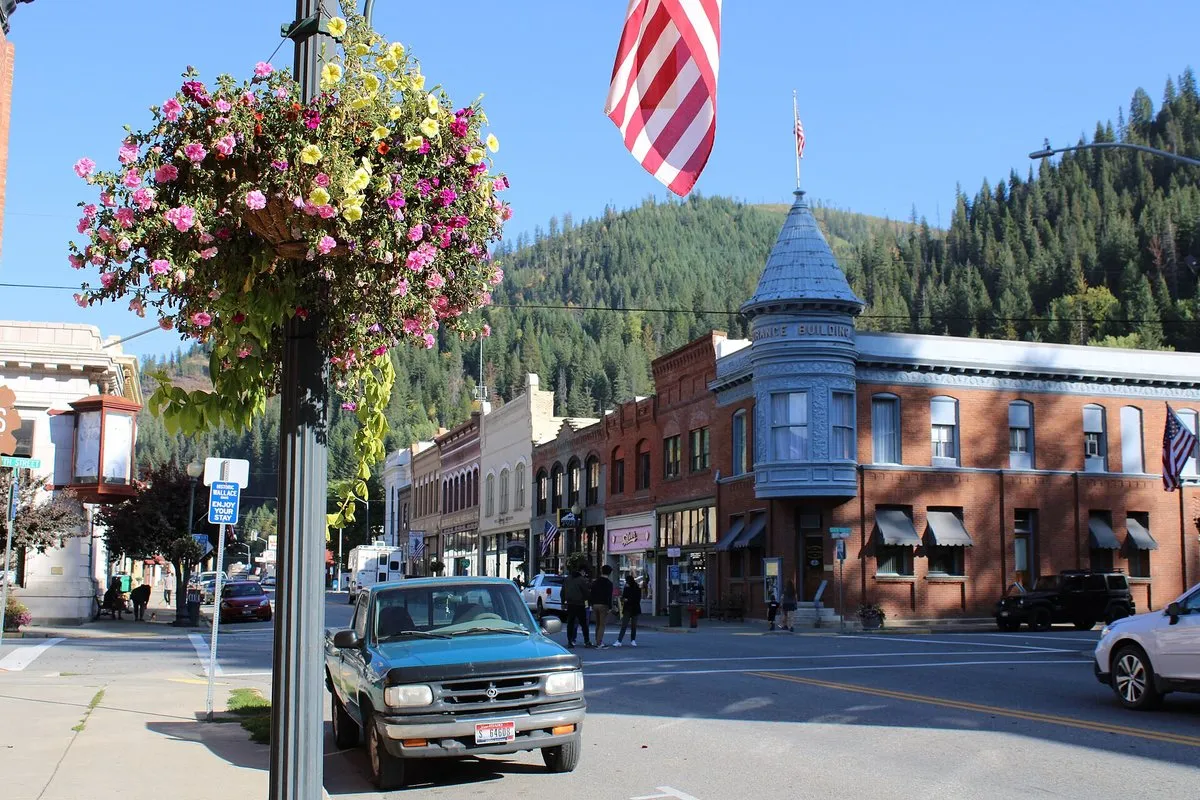
The town Wallace laid out had a rough few decades. The nomination says the whole business district burned on July 27, 1890, and that the town came back mostly in brick. It became the county seat in 1898. The chamber’s history adds the Big Burn of 1910, when forest ranger Ed Pulaski took his crew underground in a mine south of Wallace. If you walk through downtown today, you’re among buildings that, the chamber says, are all listed on the National Register of Historic Places.
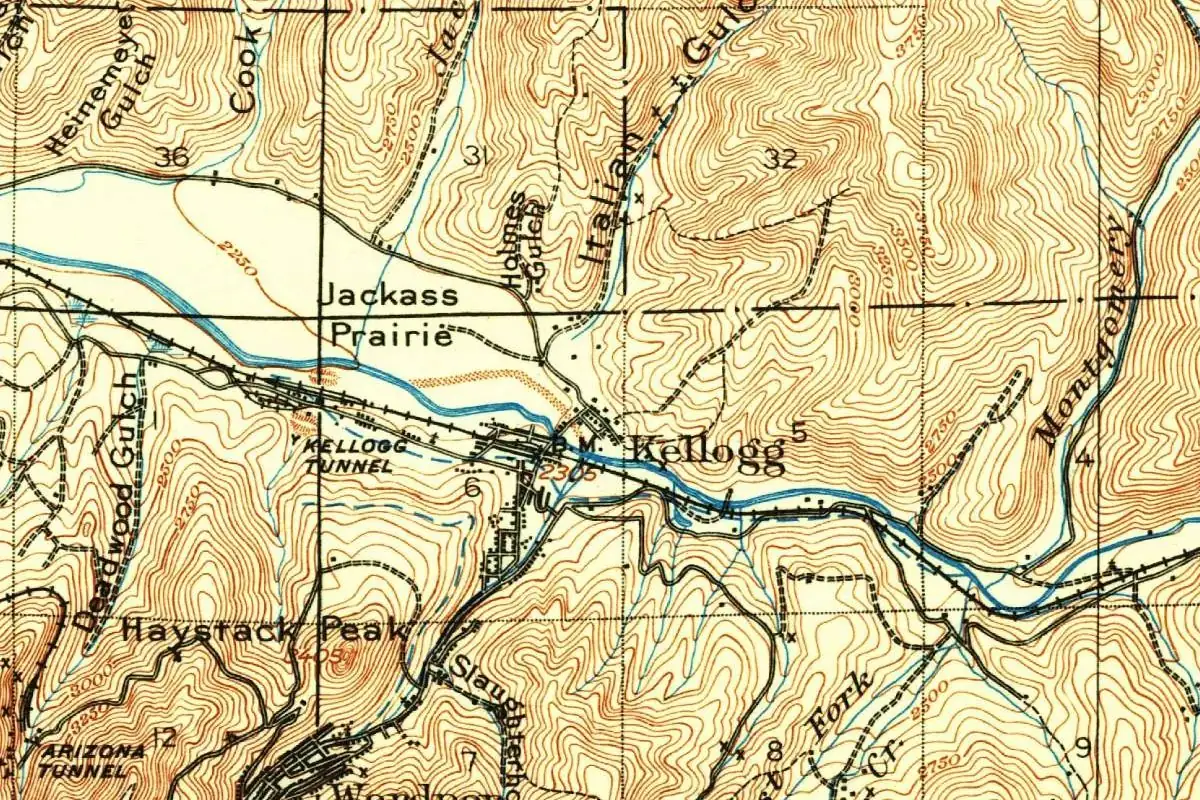
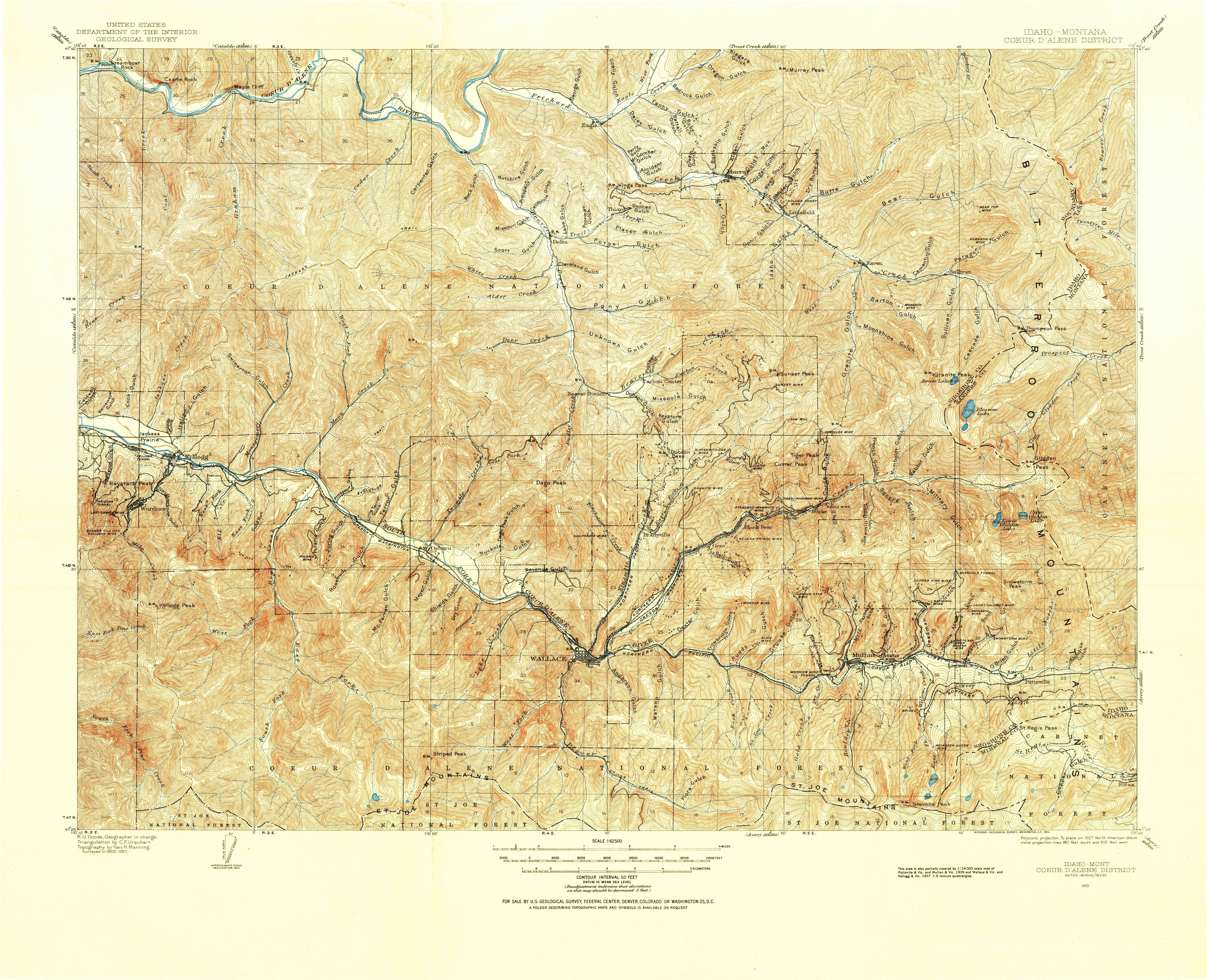
Down the same river in Idaho, Kellogg got its name from a prospector rather than a townsite founder, and it shows up on the same 1901 map sheet as Wallace.
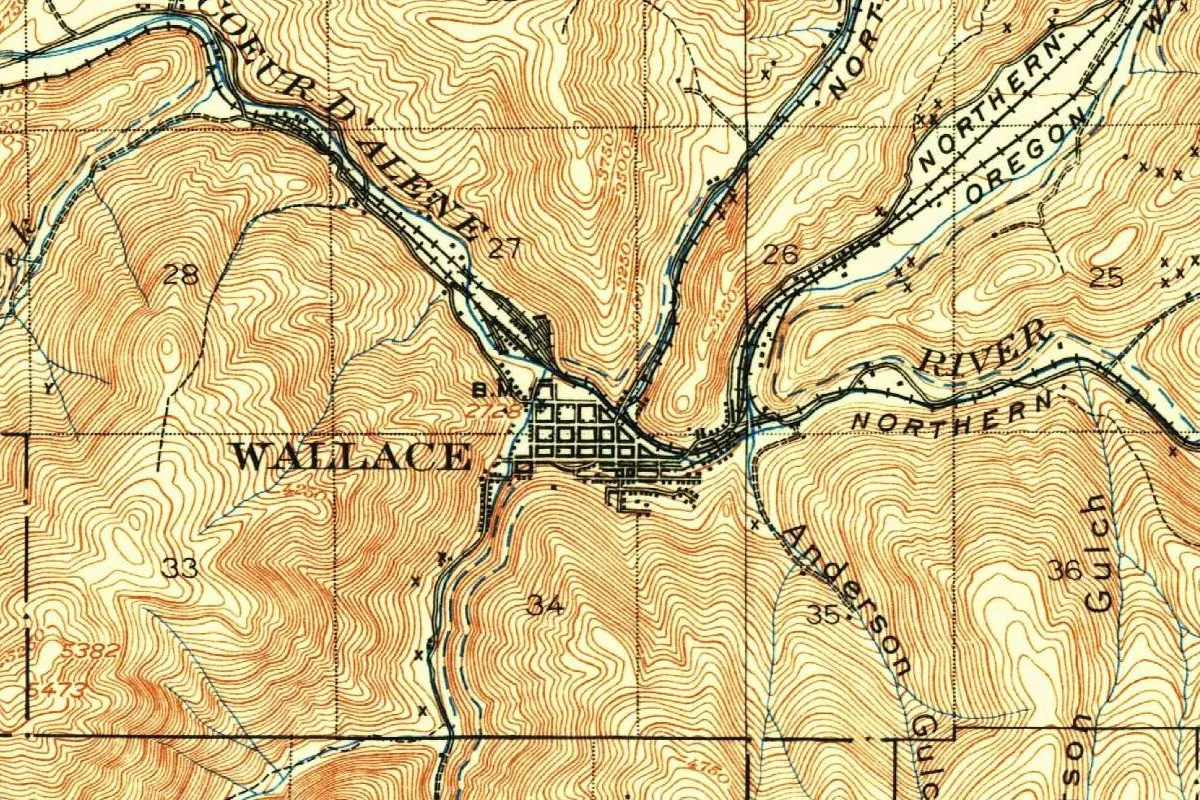
Wallace on the 1901 map
The map at the top of this page is a detail of the U.S. Geological Survey’s Coeur d’Alene District sheet, Idaho-Montana, at 1:62,500. Its margin names R. U. Goode as geographer in charge, with triangulation by C. F. Urquhart and topography by Van. H. Manning, and says the district was “Surveyed in 1900-1901.” The sheet is the 1901 edition, but the printer’s line at the bottom reads “WASHINGTON, D.C. 1954,” so this copy came off the press in 1954.
In the detail, you can see Wallace’s street grid where the valleys come together, the words COEUR D’ALENE and RIVER along the stream, and rail lines labeled NORTHERN and OREGON. Anderson Gulch cuts into the hills to the southeast, and the contour lines are drawn every 50 feet (15 m).
Quick answers
Who was Wallace, Idaho, named after?
Col. William R. Wallace, who came to the site in 1884, built a cabin and helped lay out the town. The National Register nomination says he was elected mayor when the first city government was set up in 1887, though the 1903 history names W. S. Haskins as the first mayor elected, under the city charter of 1893.
What was Wallace, Idaho, called before?
Placer Center, the name the Eagle used in May 1884.
What happened to Colonel Wallace’s townsite?
The General Land Office ruled that the scrip behind his claim was void, and in February 1889 the land went back to the public domain. The town’s trustees received a patent for it in 1892.
Key dates
- 1884Col. Wallace and a small party put up a cabin and plat a camp called Placer Center, which the Eagle reports on May 10.
- 1886A post office opens on August 17, with Mrs. Wallace as postmistress.
- 1887Wallace's first city government takes office with the colonel as mayor, and his name becomes the town's official one.
- 1888Wallace is incorporated after a petition to the Shoshone County commissioners on May 2.
- 1889On February 19, word that Wallace's claim had failed sets off a scramble for town lots; on March 1 he defends himself in a letter to the Murray Sun.
- 1890Fire destroys the business section on July 27, and the town is rebuilt mostly in brick.
- 1892A townsite patent for the eighty acres (32 ha) is issued to the town's trustees on June 11.
Things to do in Wallace, Idaho
Northern Pacific Depot Museum
A railroad museum in the old depot, laid out like a working station, on the trains that served the mining district from 1887 until the last one ran in July 1992.
Wallace District Mining Museum
A museum on the Coeur d'Alene Mining District and the Silver Valley, started in 1956, with artifacts, documents and a walk-through mock mine.
Center of the Universe
A manhole cover at Bank and Sixth streets, marked with the initials of four mining companies, where the mayor proclaimed Wallace the Center of the Universe in 2004.
Pulaski Tunnel Trail
A trail near town that follows part of the escape route of Ed Pulaski's firefighters in 1910, about 4 miles (6.4 km) round trip to an overlook facing the old mine tunnel where he sheltered his crew.
Getting there
Open Wallace in Google Maps
Opens in a new tab. The pin is the center of Wallace in the USGS place-name record.
The closest airports, Amtrak stations and intercity bus stops, measured in a straight line from the center of Wallace.
Airports
- Pullman/Moscow Regional (PUW) 75 mi 121 km
- Spokane International (GEG) 76 mi 122 km
Amtrak trains
- Sandpoint station (SPT) 62 mi 100 km
- Libby station (LIB) 66 mi 106 km
Intercity buses
- Jefferson Lines Kellogg 11 mi 17 km
Distances are as the crow flies, not by road. We don't list schedules or fares because they change; check with the airline, Amtrak or the bus company before you go. Official data (FAA commercial service airports (2025), FAA airport locations, Amtrak stations and Intercity Bus Atlas) from the FAA and the U.S. Bureau of Transportation Statistics, checked Nov 18, 2026.
Sponsored
Staying in Wallace?
Compare hotels in Wallace, Idaho, on Expedia.
See hotels in WallaceWe may earn a commission if you buy through this link. It never changes what we write. Read our affiliate disclosure
Historical Sources & References
- H. J. “Jim” Kolva and Steve Franks, National Register nomination, “Wallace Main Post Office” (1988), section 8. The cabin of 1884, Placer Center, the post office of 1886 and Mrs. Lucie Wallace, the city government and the official name of 1887, incorporation in 1888, the fire of 1890 and the county seat in 1898.
- An Illustrated History of North Idaho (1903), pp. 1026-1028. The Eagle’s report of May 10, 1884, the petition of 1888, the scrip, Wallace’s letter of March 1, 1889, the Land Office ruling, the patent of 1892 and Wallace’s death in 1901. Checked against the page images.
- Visit Wallace, “History & Heritage”. The 80 acres, the rumored Sioux scrip, Lucy Wallace, and the Big Burn of 1910.
- Northern Pacific Depot Museum, Wallace District Mining Museum, Center of the Universe and Pulaski Tunnel Trail. The places listed above, from the Historic Wallace Chamber of Commerce site.
- Wallace’s GNIS entry, feature 392796 (U.S. Geological Survey). The city’s listing as a populated place in Shoshone County, with its coordinates.
- U.S. Geological Survey, Coeur d’Alene District sheet (edition of 1901, printed 1954). The 1:62,500 sheet the map at the top was cropped from.
Sponsored
Put this 1901 map on your wall
The Geological Survey's 1901 Coeur d'Alene District sheet, surveyed in 1900-1901 and shown here in a 1954 printing, is in the public domain. Download the full-size scan for free, then have it printed on canvas with CanvasOnTheCheap.
Print a map on canvasDownload the full-size mapWe may earn a commission if you buy through this link. It never changes what we write. Read our affiliate disclosure
Spot something wrong, or know more? Tell us here. You can also email us or use our contact page. Corrections are noted here with their date, never made silently.