Marquette, Michigan, Started Out as Worcester
Marquette is named for Father Jacques Marquette, the French Jesuit missionary, but it didn't start out that way. The crew that began clearing the site on Lake Superior on July 10, 1849, called it Worcester, after the Massachusetts hometown of their boss, A. R. Harlow. Soon afterward the name was changed to honor Marquette.
A crew, a lake shore and the name Worcester
The men who cleared the first lots of Marquette, Michigan, in July 1849 called the place Worcester, after a Massachusetts city, and the name didn’t last. It was soon swapped for the name of Father Jacques Marquette, the Jesuit missionary who’d traveled the Great Lakes almost two centuries earlier.
We know about Worcester because one of the men holding an axe that day lived long enough to tell it. Peter White came to the iron hills west of the lake in May 1849 as part of a small party that Robert Graveraet brought in to hold the mineral lands of the Marquette Iron Company. By White’s account they spent the next weeks fighting mosquitoes at night and black flies by day, and on July 10 they came down to “the lake shore, as we then termed it.” There they met A. R. Harlow, who had just arrived with mechanics, goods and money to build a forge.
“Though we called it Worcester”
White told the story in an address at Marquette in April 1870, and it was printed in the 1883 History of the Upper Peninsula of Michigan:
“At 1 o’clock of that day, we commenced clearing the site of the present city of Marquette, though we called it Worcester in honor of Mr. Harlow’s native city.”
So the first name was a compliment to the boss. White doesn’t say who suggested it, only that “we” called it that, and he was telling it 21 years after the fact. But it’s a firsthand account, and it lines up with what others said about the company.
In a Fourth of July address in 1876, also reprinted in that 1883 history, S. P. Ely explained who was behind the venture. The Marquette Iron Company, he said, had been organized in 1848 by Harlow, by Edward Clark, “then of Worcester, Mass.,” and by Graveraet. Ely treated the arrival of Harlow’s party on July 10, 1849, as the date of the city’s first settlement, and he quoted White’s own account of the Worcester name. Two of the company’s founders, in other words, had Worcester connections, so it’s not hard to see why the name came to mind.
The dock that floated away
White’s memory of that first week is worth a detour, because it’s funny. Right after clearing the brush, the crew built a dock out of whole trees piled crosswise in the water and topped with sand and gravel. It took them about three days, and they were proud of it. The next morning a gentle sea had carried it off. “Not a trace of it remained,” White said. He wrote a little memorial in the sand with a stick, the captain stepped on it, and nobody tried to build another dock for a long time.
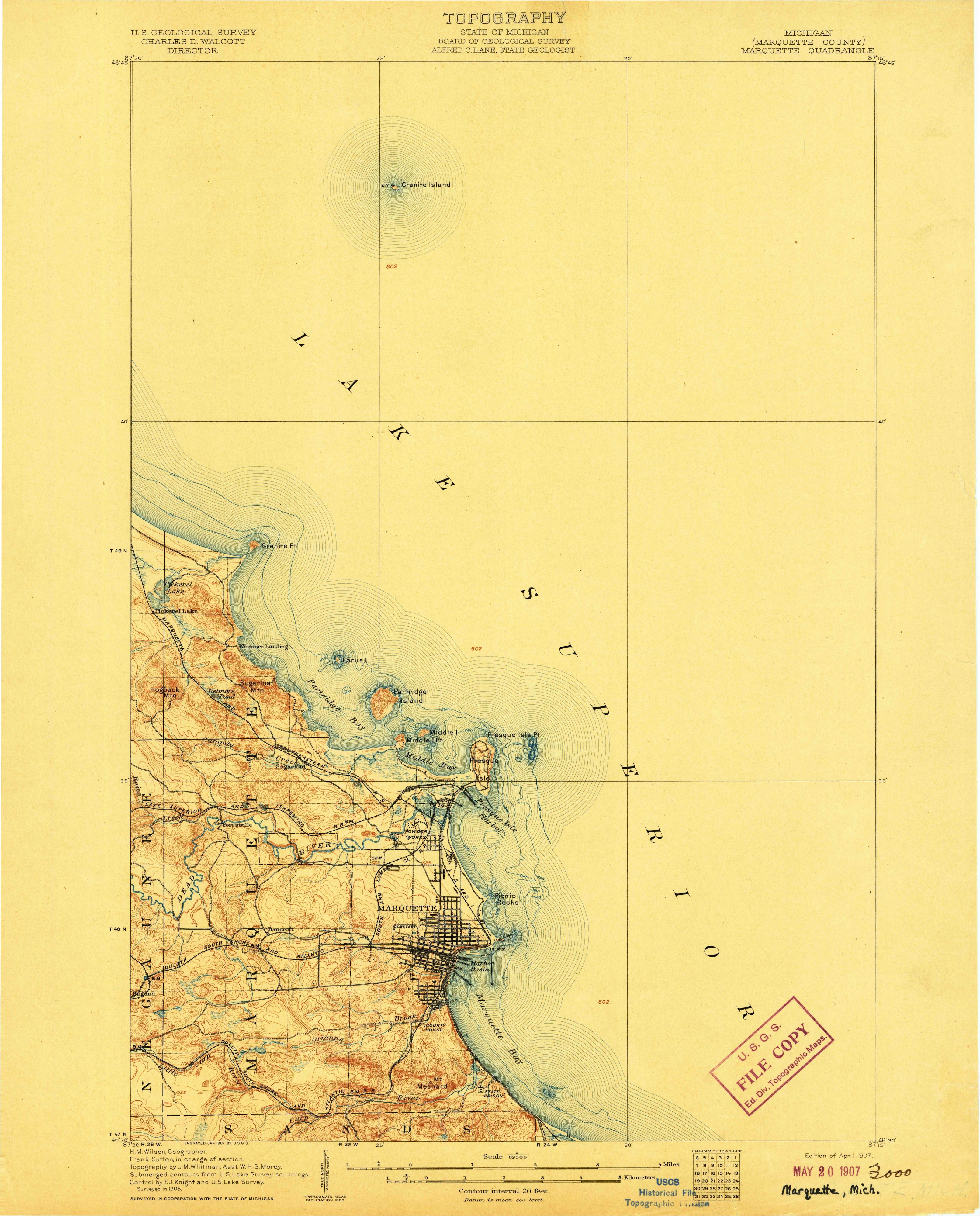
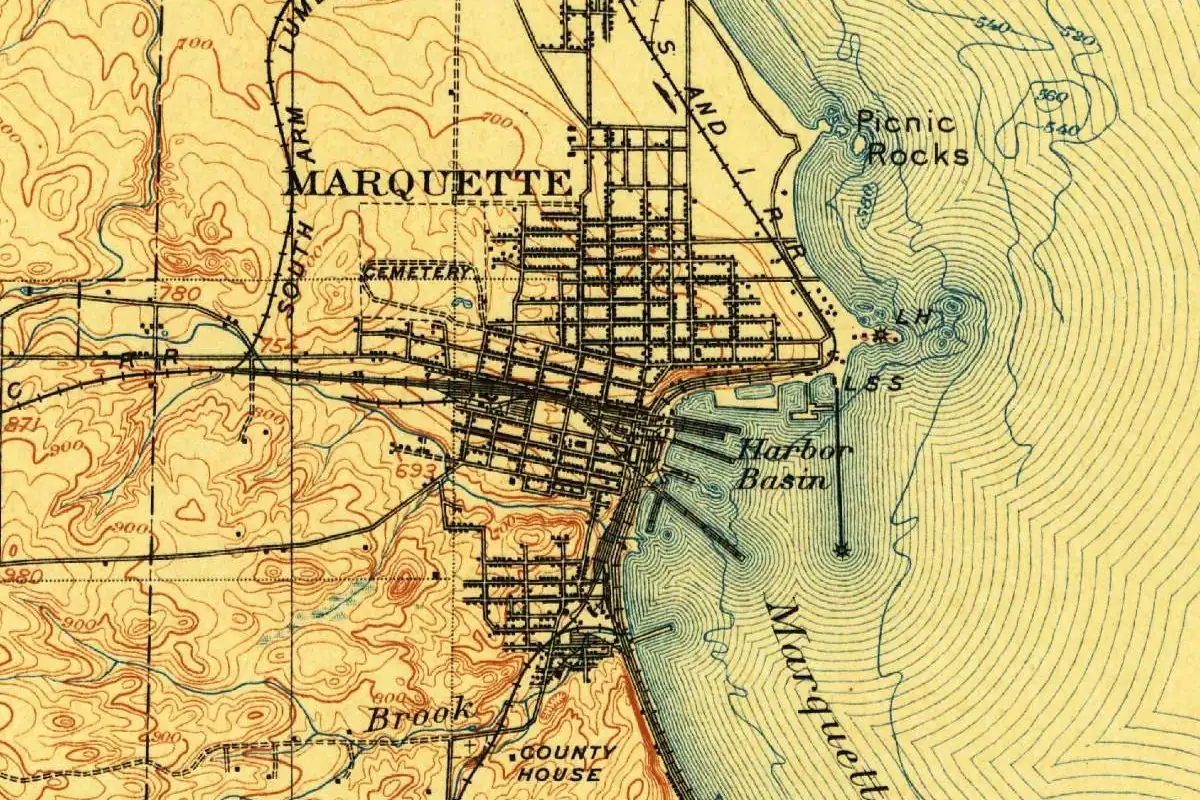
That’s the town you see at the top of this page in its grown-up form. On the 1907 map, long ore docks reach into the Harbor Basin, a lighthouse stands on the point, and the word MARQUETTE sits over a grid of streets. Peter White’s Worcester was a few cleared lots near “the point of rocks” at the shore.
From Worcester to Pere Marquette
So when did Worcester become Marquette? The sources here are vaguer than you might like. Ralph D. Williams, who wrote a biography of Peter White in 1907, retold the clearing of the site and said the crew “decided to call the future city Worcester, in honor of Mr. Harlow’s native home.” Two pages later he added:
“It should be noted that the name of Worcester did not long continue. It was changed to that of the most illustrious of the Jesuit missionaries, Pere Marquette, who now sleeps peacefully at St. Ignace.”
That’s the clearest statement of the switch, but Williams didn’t give a date or say who made the call, and none of the other sources on this page does either. You’ll find an exact year in some modern summaries. We couldn’t trace it back to a source we could open, so we’ve left it out.
What’s certain is that the missionary’s name was already attached to this part of the Upper Peninsula. The Library of Michigan says the Marquette County area was set off in 1843 and organized in its own right in 1851, and that it was named for Father Jacque Marquette, “a Jesuit missionary who was an early visitor to the area.” The city became its county seat.
A name shared across the Midwest
Father Marquette’s name shows up on maps all over the region, and Henry Gannett didn’t try to tell them apart. In the Geological Survey bulletin he revised in 1905, a single Marquette heading covers them all: a city in Kansas, a county, a city and a river in Michigan, and a county and a town in Wisconsin, all “named for the Jesuit Missionary Jacques Marquette.” He didn’t say anything about Worcester.
It’s the same Marquette whose 1673 trip with Louis Joliet runs through our stories of Joliet, Illinois and the Mississippi River, and whose unflattering name for a certain bay turns up in the story of Green Bay. Michigan’s share of him is just one of many stops on our Michigan page.
Two hometowns in one name story
There’s a nice symmetry in all this. The first name looked east, to a Massachusetts city the company men knew. The second looked back in time, to a missionary who, as Williams put it, sleeps at St. Ignace.
Ely, speaking in 1876, made a point worth keeping in mind. Marquette and the other missionaries, he said, had tried to plant their religion on Lake Superior in the seventeenth century, “but all traces of their residence and their work, had passed away.” The iron that brought Harlow’s party, Ely added, doesn’t seem to have been known to the Jesuits at all. The town took the priest’s name anyway, and it’s kept it ever since.
Quick answers
What was Marquette, Michigan, originally called?
Worcester. Peter White, who helped clear the site on July 10, 1849, said the crew called it Worcester “in honor of Mr. Harlow’s native city.”
Who is Marquette, Michigan, named after?
Father Jacques Marquette, the Jesuit missionary. Ralph D. Williams wrote in 1907 that Worcester “did not long continue” and was changed to the name of “Pere Marquette.”
Why was it first named after Worcester, Massachusetts?
Because A. R. Harlow, who led the party that started the town, came from there, according to Peter White. Another founder of the Marquette Iron Company, Edward Clark, was “then of Worcester, Mass.,” according to S. P. Ely.
When did Worcester become Marquette?
No date appears in the sources on this page. Williams says only that the Worcester name “did not long continue.”
Key dates
- 1848A. R. Harlow, Edward Clark of Worcester, Massachusetts, and Robert J. Graveraet organize the Marquette Iron Company.
- 1849On July 10, Harlow's party arrives and starts clearing the town site, which the crew calls Worcester.
- 1870Peter White, one of that crew, tells the story of the first day in an address at Marquette.
Things to do in Marquette, Michigan
Marquette Regional History Center
A nonprofit history center founded in 1918 that keeps exhibits, artifacts and a research library on the Marquette area, and describes itself as a forum linking the community with its past.
Peter White Public Library
The library formed in 1891 from Peter White's private collection and the school library. Its 1904 building, on land given by John Munro and Mary Beecher Longyear, used Indiana limestone, a red tile roof and stained glass.
Presque Isle Park
A 323-acre wooded headland jutting into Lake Superior, with pebble beaches, rocky cliffs, bogs and trails, Peter White Drive around its edge, and the graves of Charlie Kawbawgam, last chief of the local Chippewas, and his wife, Charlotte.
Marquette Maritime Museum and Lighthouse
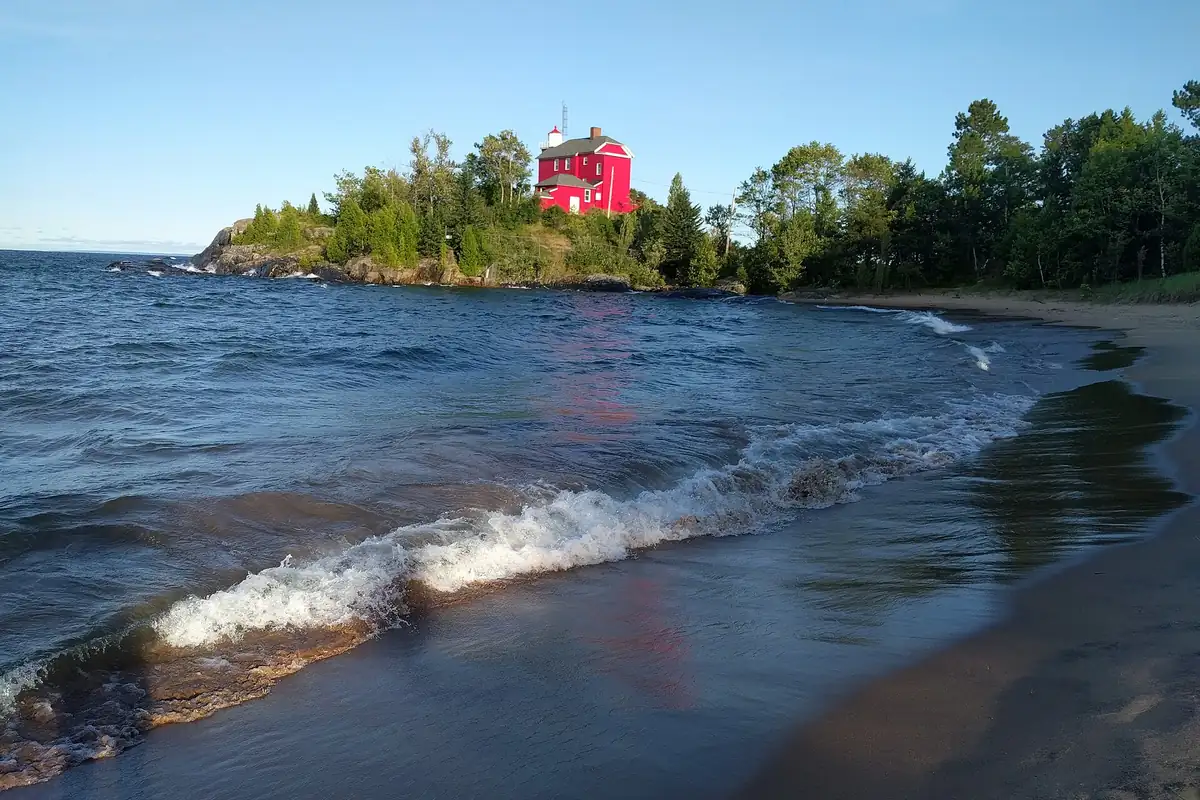
A nonprofit maritime museum that also offers tours of the Marquette Lighthouse, with a mission of preserving the maritime history of Marquette, Lake Superior and the Great Lakes and remembering submarine veterans.
Getting there
Open Marquette in Google Maps
Opens in a new tab. The pin is the center of Marquette in the USGS place-name record.
The closest airports, Amtrak stations and intercity bus stops, measured in a straight line from the center of Marquette.
Airports
- Marquette Sawyer Regional (SAW) Gwinn 13 mi 22 km
- Delta County (ESC) Escanaba 59 mi 94 km
Intercity buses
- Indian Trails Marquette (MarqTran) 3 mi 5 km
Distances are as the crow flies, not by road. We don't list schedules or fares because they change; check with the airline, Amtrak or the bus company before you go. Official data (FAA commercial service airports (2025), FAA airport locations, Amtrak stations and Intercity Bus Atlas) from the FAA and the U.S. Bureau of Transportation Statistics, checked Nov 14, 2026.
Sponsored
Staying in Marquette?
Compare hotels in Marquette, Michigan, on Expedia.
See hotels in MarquetteWe may earn a commission if you buy through this link. It never changes what we write. Read our affiliate disclosure
Historical Sources & References
- Peter White, address of April 1870, in History of the Upper Peninsula of Michigan (1883), p. 383. The arrival at the lake shore on July 10, 1849; the quoted line about clearing the site and calling it Worcester “in honor of Mr. Harlow’s native city”; the dock built of whole trees that the sea carried off. The introduction to the address (p. 382) dates it to April 1870 at Marquette.
- S. P. Ely, address of July 4, 1876, in History of the Upper Peninsula of Michigan (1883), p. 415. Graveraet’s small party of May 1849, with Peter White, sent to hold the company’s iron locations; the Marquette Iron Company organized in 1848 by A. R. Harlow, Edward Clark “then of Worcester, Mass.,” and Robert J. Graveraet; July 10, 1849, as the date of first settlement; White’s account of the Worcester name quoted again; the missionaries Allouez, Mesnard and Marquette and the iron unknown to the Jesuits.
- Ralph D. Williams, The Honorable Peter White (1907), p. 38. The crew “decided to call the future city Worcester, in honor of Mr. Harlow’s native home.”
- Ralph D. Williams, The Honorable Peter White (1907), p. 40. The quoted passage: Worcester “did not long continue” and was changed to the name of Pere Marquette, buried at St. Ignace.
- Henry Gannett, The Origin of Certain Place Names in the United States, 2nd ed. (1905), p. 200. The Marquette entry covering places in Kansas, Michigan and Wisconsin “named for the Jesuit Missionary Jacques Marquette.”
- Library of Michigan, County Guides: Marquette. The county area set off in 1843 and organized in 1851, named for Father Jacque Marquette; the city as county seat.
- GNIS feature 631600 (U.S. Geological Survey). The gazetteer record for Marquette, in Marquette County.
- U.S. Geological Survey, Marquette sheet (1907). The 1:62,500 quadrangle the map at the top of this page was cropped from.
Sponsored
Put this 1907 map on your wall
The 1907 USGS Marquette sheet is in the public domain. Download the full-size scan for free, then have it printed on canvas with CanvasOnTheCheap.
Print a map on canvasDownload the full-size mapWe may earn a commission if you buy through this link. It never changes what we write. Read our affiliate disclosure
Spot something wrong, or know more? Tell us here. You can also email us or use our contact page. Corrections are noted here with their date, never made silently.